INDUSTRY 4.0
Industry 4.0 and Smart Manufacturing: A Practical Guide for Engineers
What Industry 4.0 actually means on a plant floor, the building blocks in the order you meet them, and a one-machine project that teaches most of them.

Industry 4.0 smart manufacturing means connecting machines, plant systems and business systems so that production data flows and drives decisions. For an engineer it is less about new buzzwords than about getting reliable, well-named data out of PLCs, storing it, acting on it and keeping it secure. PLC and SCADA skills remain the foundation.
Where the idea came from
The term comes from Germany's Industrie 4.0 initiative, presented at the Hannover Messe in 2011. The numbering counts industrial revolutions: mechanisation with steam, mass production with electricity, automation with electronics and PLCs, and now the connection of those automated systems to each other and to software.
That last point matters. Industry 4.0 does not replace the third revolution; it builds on it. A plant without working automation has nothing to connect.
The building blocks of Industry 4.0 smart manufacturing

Connectivity
Machines have to share data before anything else is possible. On the plant floor that means industrial protocols: Modbus for simple devices, PROFINET or EtherNet/IP between controllers and I/O, and OPC UA for structured, secure data between PLCs, SCADA and software. MQTT, an OASIS-standard lightweight publish and subscribe protocol, is common for sending data onward to servers and the cloud.
Context
A value called DB12.DBD40 means nothing to anyone outside the PLC team. Context is naming and structuring data so others can use it: which site, which line, which machine, what unit. The ISA-95 standard, which separates the enterprise into levels from field devices up to business systems, is the usual reference for deciding where data belongs; our guide to manufacturing execution systems explains the level 3 layer that sits between them. Many plants now keep one agreed structure, sometimes called a unified namespace, that every system publishes to and reads from.
Storage and visibility
Historians and time-series databases keep the record. Dashboards turn it into something a shift can act on, and OEE (overall equipment effectiveness: availability times performance times quality) is usually the first number people want. It is simple to calculate and hard to argue with.
Analytics and AI
Once data is clean and has history, you can predict: bearing wear from vibration, a filter blocking from differential pressure, a batch drifting out of specification. This is where machine learning earns its place. Our post on predictive maintenance with AI covers it in depth.
Digital twins
A digital twin is a model that behaves like the real system. The version most automation engineers will use first is virtual commissioning: running the real PLC program against a simulated machine, so logic errors surface on a laptop instead of on site. See digital twin technology in manufacturing.
Edge and cloud
Some processing has to happen close to the machine, fast and without depending on a network link. That is edge computing. Other work, such as comparing ten sites or training a model on a year of data, suits the cloud. Most real architectures use both.
Security
Every connection is also a way in. The ISA/IEC 62443 series is the reference for industrial cybersecurity: it divides a plant into zones joined by controlled conduits and sets security levels for each. NIST's free Guide to Operational Technology Security (SP 800-82 Rev. 3) is a readable companion. Connecting a PLC directly to the internet is still the most common mistake, and still an easy one to avoid. Our OT cybersecurity primer covers the Purdue model and where to start.
What changes for automation engineers
The PLC does not go away. It still runs the machine, deterministically, every scan, and it still owns interlocks and safety. What changes is that the PLC program becomes a data source that other people depend on. That brings new habits:
- Structure your tags. Use user-defined types and consistent names so a machine's data can be read as a whole, not tag by tag.
- Expose data read-only. Give other systems what they need through OPC UA or a gateway, and keep write access narrow and deliberate.
- Think about quality and time. A value without a timestamp and a quality flag cannot be trusted by anyone downstream.
- Learn a little data work. Python, SQL or Node-RED let you check what your machine is really sending, instead of waiting for someone else to complain.
A first project you can actually build
The best way to understand Industry 4.0 is to do all of it on one machine, small.
In this lesson by Réverti Ivanov, OEE is explained in the context of Industry 4.0. It is a good primer for the project below, because OEE is the number most first projects set out to measure.

Pick a machine with a PLC and a clear count, such as a filler or a packer. Read three things, read-only: whether it is running, how many good parts it has made and which fault is active. Publish them with timestamps through Node-RED or an OPC UA client, store a week of history in a simple database, and calculate OEE. Put it on a screen the shift can see. Then do the part that makes it worth doing: sit down with the operators, find the biggest loss and fix it.
That one project touches connectivity, context, storage, visibility and, if you are careful, security. It is also something you can explain in an interview in two minutes, which a list of buzzwords is not.
Skills to build, in order
If you are an automation engineer planning your own Industry 4.0 learning, this order avoids the usual trap of starting with the most fashionable topic. Our post on the manufacturing skills gap in 2026 sets out the published numbers and the skills worth learning.
- One PLC platform, properly. Structured programs, user-defined types, clean tag names. Everything later depends on the data being right at source.
- Industrial networks. IP addressing, subnets, Modbus, PROFINET or EtherNet/IP, then OPC UA. Most connection problems are network problems.
- One integration tool. Node-RED is a forgiving place to start: it reads Modbus and OPC UA, publishes MQTT and writes to databases with very little code.
- Data basics. Enough SQL to query a table and enough Python or a reporting tool to chart a week of data and calculate OEE.
- Security. Zones, conduits and the ISA/IEC 62443 vocabulary, so the systems you connect stay safe.
- Analytics and AI. Only now, when you have clean data with history to work on.
Each step is useful on its own, so the plan pays back even if you stop halfway.
What to be sceptical about
- Dashboards nobody acts on. Data only has value when someone changes something because of it.
- Platforms before problems. Choose the problem first; most first projects need less software than vendors suggest. Our IMTS 2026 highlights show the AI and robot products on offer this year; judge each one against a problem you actually have.
- AI on bad data. If the count is wrong in the PLC, no model will fix it.
Learn the pieces free
Node-RED for Industrial IoT covers dashboards, Modbus, OPC UA with an S7-1500, MQTT, databases and OEE. Industrial Communication covers the protocols underneath, Power BI OEE Dashboards for Manufacturing the reporting, and AI for Industrial Automation where AI fits. The IIoT and OT security path puts three of them in order. Learning is free in full. If you pass a course's final assessment, the optional EDWartens Certificate of Completion is a small one-off fee, US$8.99 for a beginner course. Anyone can check it at edwartens.com/verification; it is not a vendor certification or an accredited qualification.
Take the free course
 Free
FreeIIoT · Beginner · Free
Node-RED for Industrial IoT
 Free
FreeIndustrial networks · Intermediate · Free
Industrial Communication: Serial, Fieldbus, Ethernet, Modbus, PROFINET and OPC UA
 Free
FreeData and analytics · Beginner · Free
Power BI for Manufacturing: OEE and Production Dashboards
 Free
FreeAI and machine learning · Intermediate · Free
AI for Industrial Automation
Questions
What is Industry 4.0 in simple words?
It is the idea of connecting machines, plant systems and business systems so that data flows between them and decisions are made from it. The automation underneath, PLCs, drives and SCADA, stays the foundation.
Where did the term Industry 4.0 come from?
It comes from a German government-backed initiative, Industrie 4.0, which was presented publicly at the Hannover Messe trade fair in 2011. The four refers to a fourth industrial revolution after mechanisation, electrification and automation.
Do I need to learn AI to work in Industry 4.0?
Not first. Most projects fail on getting clean, well-named data out of machines, which is PLC, network and SCADA work. AI and analytics come later and depend on that data being right.
What is a digital twin?
A virtual model of a machine or process that behaves like the real one closely enough to test changes on. In automation the most common form is virtual commissioning: running the real PLC program against a simulated machine before site.
Is Industry 4.0 the same as IIoT?
IIoT, the Industrial Internet of Things, is one part of it: connected devices sending data. Industry 4.0 is broader and also covers how that data is modelled, secured and used across the business.
Sources
- ISA: ISA-95 standard
- ISA: ISA/IEC 62443 series of standards
- MQTT.org: MQTT, the standard for IoT messaging
- NIST SP 800-82 Rev. 3: Guide to Operational Technology (OT) Security
Written by the EDWartens engineering team for general education. Product names are trademarks of their owners; mentioning them does not imply endorsement. Prices and terms of other providers were checked on the date shown and can change.
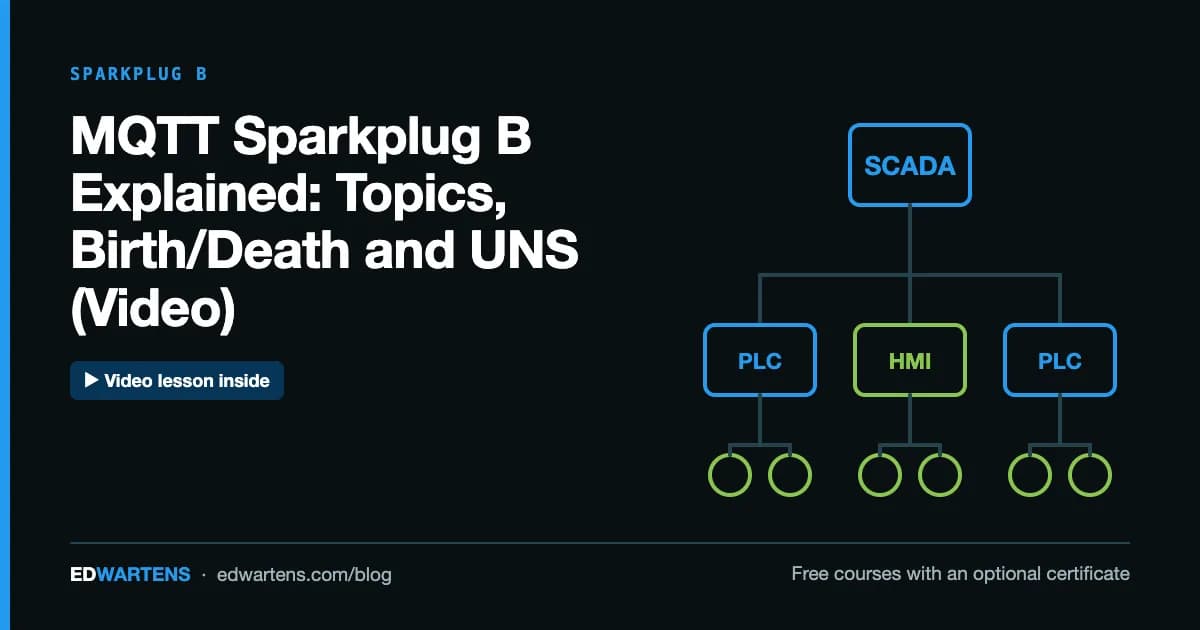
MQTT Sparkplug B Explained: Topics, Birth/Death and UNS (Video)

Node-RED PLC Dashboard: Read Live Data and Build an Operator Page (Video)

IIoT Training: How Plant Data Gets From a PLC to a Dashboard, and How to Learn It Free

Data Engineering for Industrial AI: Getting Plant Data Ready for a Model
SCADA Training: A Complete Guide to Architecture, Protocols and Skills
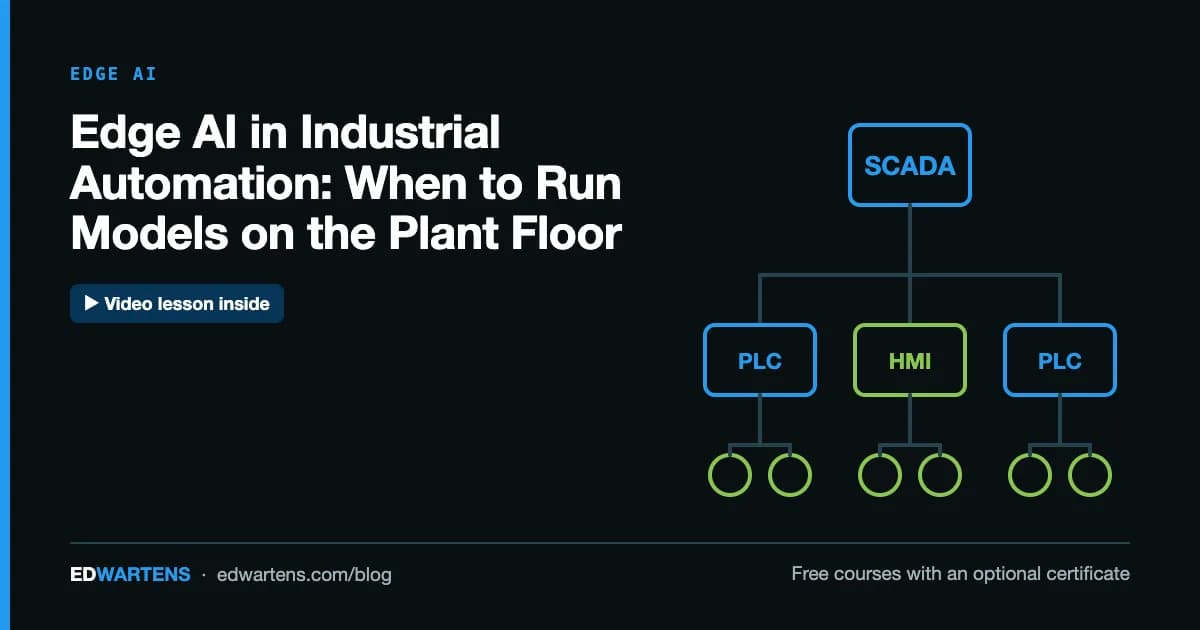
Edge AI in Industrial Automation: When to Run Models on the Plant Floor