DIGITAL TWINS
Digital Twins in Manufacturing: What They Are and How Engineers Use Them
What separates a digital twin from a simulation, the four uses that pay back in manufacturing, virtual commissioning with a PLC, and how to keep a twin honest.
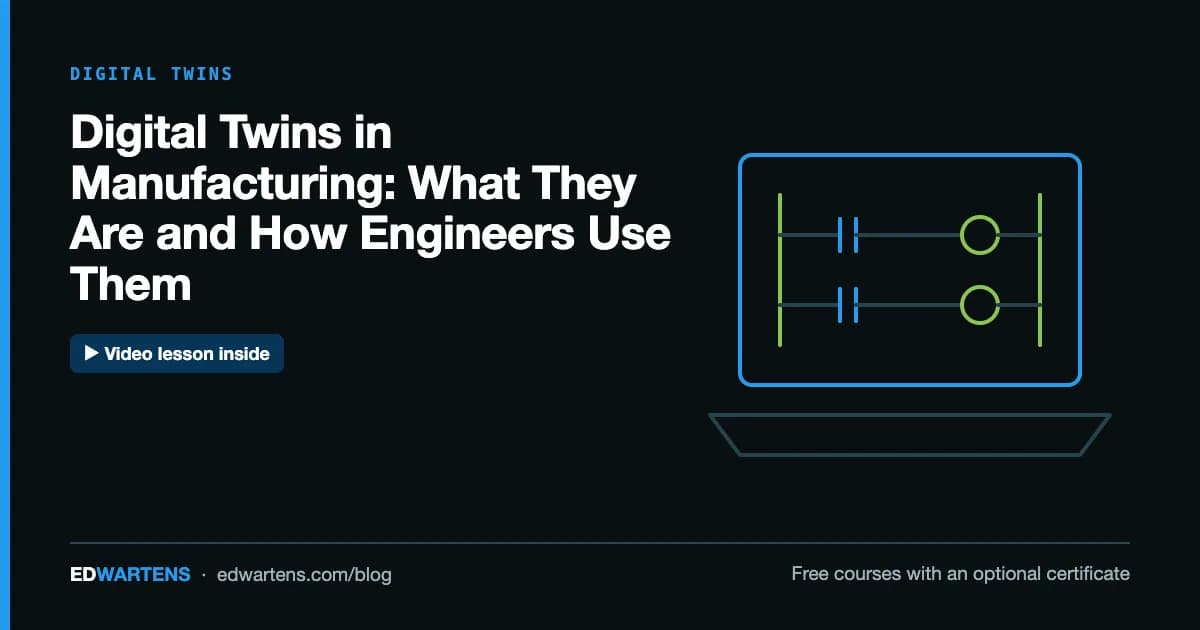
A digital twin in manufacturing is a model of one specific machine, line or process that is kept in step with it by live data. Engineers use digital twins to test PLC code before a machine exists, try changes without stopping production, train operators, and spot faults when the real asset stops behaving the way the model predicts.
In this lesson by IBM Technology, the idea of a digital twin is explained in general terms. It sits in the "Digital twins and simulation" module of our free AI for Industrial Automation course, whose objectives are to tell a simulation from a twin, name four uses that pay, and use a twin as an anomaly detector. This article covers those three from a controls engineer's point of view.
A twin is not just a simulation
The word "twin" is used loosely, and vendors stretch it. A useful test is which way the data flows, a classification widely used in the research literature.

- A digital model is updated by hand in both directions. Most 3D layouts and offline simulations are this.
- A digital shadow updates itself from the real asset, but a person decides what to do with what it shows.
- A digital twin closes the loop: the asset updates the model, and the model's output feeds back to the asset, directly or through an approved setpoint change.
The other test is identity. A simulation of "a pump" is a design tool. A twin is of this pump, with its own wear, its own calibration and its own history.
Four digital twin uses in manufacturing that pay
1. Virtual commissioning. The real PLC program runs against a simulated machine before the machine is built. Sequencing errors, missing interlocks and wrong I/O addresses are found at a desk. This is the most common entry point, and strictly it uses a digital model or shadow; it becomes a twin later if the model is kept in step with the finished machine.
2. Operator training. A model of the line lets operators practise start-ups, shutdowns and upset conditions that would be unsafe or expensive to create on the real plant. Our look at VR and AR in industrial training compares immersive training with plain simulators.
3. What-if and optimisation. Try a new recipe, a faster conveyor speed or a different buffer size on the model first, and see where the bottleneck moves.
4. Anomaly detection. A twin predicts what the asset should be doing given its inputs: the expected motor current for this load, or the expected tank level for these valve positions. The gap between prediction and measurement, called the residual, is a sensitive fault signal. When it grows and stays large, something has changed in the real asset. This links twins directly to predictive maintenance.
A fifth use is growing: generating synthetic data, such as rendered images of rare defects, to train machine learning models where real examples are scarce.
Virtual commissioning in practice

The simplest version is one you can build on a laptop: a PLC program running on a simulated CPU, such as Siemens S7-PLCSIM, connected to a 3D scene in Factory I/O. The scene's sensors become PLC inputs and its motors and valves become outputs, so your ladder logic moves boxes you can see. Industrial projects use heavier tools that import the mechanical CAD and model kinematics, but the principle is the same. For a full walkthrough of the laptop version, see Factory I/O for PLC Training, and for the simulated CPUs themselves, free PLC simulators compared. At IMTS 2026, FANUC showed robots trained partly in photorealistic simulations of the factory, the same idea at a larger scale.
Two things decide whether virtual commissioning pays:
- Fidelity to the question. To test sequence logic, a model that moves parts at roughly the right speed is enough. To test a servo tuning, you need dynamics. Building more detail than the question needs is the most common way to overspend.
- Fault testing. The value is in testing what happens when a sensor fails, a part jams or an operator presses the wrong button. A model that only runs the happy path finds only the easy bugs.
Keeping a twin honest
A twin drifts. Bearings wear, heat exchangers foul, a valve is replaced with a different model. If nobody recalibrates, the twin starts reporting differences that are not faults, and people stop trusting it. The practice task in the course asks you to describe a twin for one unit of your plant: its inputs, what it predicts, and how you would check it against reality every week. That weekly check, and a named owner who does it, matters more than the software. Start small: one pump, one heat exchanger, one filler. Prove that the twin's predictions stay close to measurements for a few months, and only then connect its output to anything that changes the process.
The data plumbing
A twin needs data in a structured form. OPC UA (IEC 62541) carries values with an information model that says what they mean. MQTT and a unified namespace give many consumers one place to subscribe. The ISA-95 hierarchy of enterprise, site, area, line and cell gives a naming structure so the twin of "line 3, filler" finds the right tags. The ISO 23247 series describes a digital twin framework for manufacturing, and is worth reading before you design your own architecture.
The vendors are consolidating this layer too: Schneider Electric's planned acquisition of PTC would put PTC's engineering and product-lifecycle software, which many twin projects draw their models from, alongside an automation supplier's control portfolio.
Where twins go wrong
- No question. "Build a twin of the plant" is not a project. "Cut commissioning time on the next filler" is. Industry 4.0 for engineers makes the same point about every smart-factory project.
- Fidelity creep. Every added detail costs build time and maintenance.
- No owner. A twin with nobody responsible for recalibrating it becomes a stale model within months.
- Cost above value. For a simple machine, a well-tested PLC program and a good manual may be enough.
Learn digital twins and virtual commissioning free
AI for Industrial Automation covers twins alongside predictive maintenance, vision and data architecture. Siemens TIA Portal with Factory I/O is hands-on virtual commissioning across nine scenes, from a two-sensor conveyor to an analog tank level loop. MATLAB and Simulink for Control Systems teaches the dynamic modelling that higher-fidelity twins are built on. A free account saves your progress.
The courses are free in full. The optional EDWartens Certificate of Completion is a small one-off fee, US$8.99 for a beginner course. Anyone can check it at edwartens.com/verification. It is not a vendor certification or an accredited qualification.
Take the free course


Questions
What is a digital twin in manufacturing?
A digital twin is a model of one specific machine, line or process that is kept in step with it by live data. It is used to predict behaviour, test changes, detect faults and train people without touching the real asset.
What is the difference between a simulation and a digital twin?
A simulation models a design and answers what-if questions. A digital twin is tied to one real asset and updated continuously with its data, so it reflects that asset's current state rather than the design.
What is virtual commissioning?
Virtual commissioning tests the real PLC program against a simulated machine before the machine is built. Logic errors are found at a desk instead of on site, where they cost more to fix.
Is there a standard for digital twins in manufacturing?
Yes. The ISO 23247 series sets out a digital twin framework for manufacturing, covering the reference architecture and how a twin represents manufacturing elements.
Can I practise virtual commissioning for free?
Yes. The free Siemens TIA Portal with Factory I/O course runs PLC code in PLCSIM against 3D scenes, using the software makers' trial licences, with no hardware needed.
Sources
- Factory I/O: home page and free trial
- OPC Foundation: Unified Architecture
- ISA: ISA-95 standard
- IBM Technology on YouTube
Written by the EDWartens engineering team for general education. Product names are trademarks of their owners; mentioning them does not imply endorsement. Prices and terms of other providers were checked on the date shown and can change.
Remote PLC Programming Jobs: Where They Exist and How to Land One

The Manufacturing Skills Gap in 2026: The Numbers and the Skills to Learn

OPC UA Explained: Address Space, Subscriptions and Security for Engineers

The Wartens Ecosystem Explained: Where EDWartens Fits
How to Become a Commissioning Engineer in Automation: Skills, Site Work and a First-Year Plan
MQTT Sparkplug B Explained: Topics, Birth/Death and UNS (Video)