Commissioning engineer job simulation
A commissioning engineer job simulation lets you practise bringing a plant into service. You turn raw test results into pass, fail or invalid, run loop checks, test a safety stop that fails, sort a punch list and assemble the handover dossier for a simulated dairy skid. It runs in a virtual plant, so no hardware or site visit is needed. It is practice, not employment.
Days 1 to 5 are free, about 3 to 4 hours. No card to start.
You join Marlhurst Commissioning Ltd (simulated company), a commissioning contractor in Meravon. Your project is Milk balance tank skid U-1 commissioning. Days 1 to 5 are free, about 3 to 4 hours at 30 to 45 minutes a day. Premium continues to day 20, about 12 to 15 hours in all. It is practice, not employment.

- Days 1 to 5 free
- 30 to 45 minutes a day, about 3 to 4 hours free
- At a simulated company
- Electrical lab, PLC lab, Process lab
The project
You join Marlhurst Commissioning Ltd (simulated company)
Milk balance tank skid U-1 commissioning
Project MRS300 · for Fellmoor Dairy Products LtdFellmoor Dairy is adding a balance tank skid with a transfer pump, a control valve and three instruments to milk reception, and the electrical contractor says it is nearly finished. This project proves it: tests before energising, loop checks, I/O checkout, acceptance tests and a punch list, with every hold point signed before work goes on.
- Turn insulation and loop test results into pass, fail or invalid
- Stop unsafe work and refuse to start with category A items open
- Check every I/O point and commission the pump starter and control valve
- Raise a management of change request for the low-low interlock
- Assemble the commissioning handover dossier
You are the junior commissioning engineer on a new milk balance tank skid. The electrical contractor says it is nearly finished. Your job is to prove it: insulation tests before anything is switched on, loop checks of every instrument, an I/O checkout, functional and site acceptance tests, and a punch list, with a hold point at each step where somebody must sign before the work goes on. Along the way somebody is working on a live panel without a permit, the client wants the pump started early, and an emergency stop test fails. The skill is to be calm, exact and impossible to hurry past a hold point.
- Commissioning Leadcompany
- Project Managercompany
- Instrument Techniciancompany
- Client Operations Managerclient
- Client Safety Officerclient
- Electrical Contractor Supervisorclient
- Contractor Electricianclient
- Control System Vendor Engineervendor
A working day
A working day in the Commissioning Engineer job simulation
- 30 to 45 minutesa working day
- 3 to 4 hoursFree: 5 working days
- 12 to 15 hoursPremium: 20 working days
- Clock inBadge in at the workplace. Your day starts.
- Morning briefingA short meeting: one safety moment, today's top jobs and your own plan.
- WorkTasks, documents, emails and colleagues, with lab machines for the hands-on jobs. "How to do this" help shows only where you need it.
- Report and planWrite the end-of-day report, then put tomorrow's jobs in order.
- Clock outDay done. Clock in for the next day now, or stop for today.
Here the morning briefing is the commissioning stand-up in the team area, you take your lunch at 12:30 on the simulated clock, and the end-of-day report is the daily progress report.
Day 1: your manager checks what you know
- You rate yourself on the main skills of the role, from never done it to could teach it.
- Two quick "show me" questions test the skills you rated highest.
- Your manager then makes a learning plan from your answers. Any AI-written text is labelled.
- "How to do this" help opens on the tasks where you are weaker, and stays folded away where you are strong.
- Your levels move as you work: good results raise a skill, weak results lower it. Fixed rules decide the levels.
Want a taste first? The 3-minute demo needs no sign-in and saves nothing.Try the 3-minute demo (opens the simulator, nothing is saved)
Look inside
What the simulator looks like
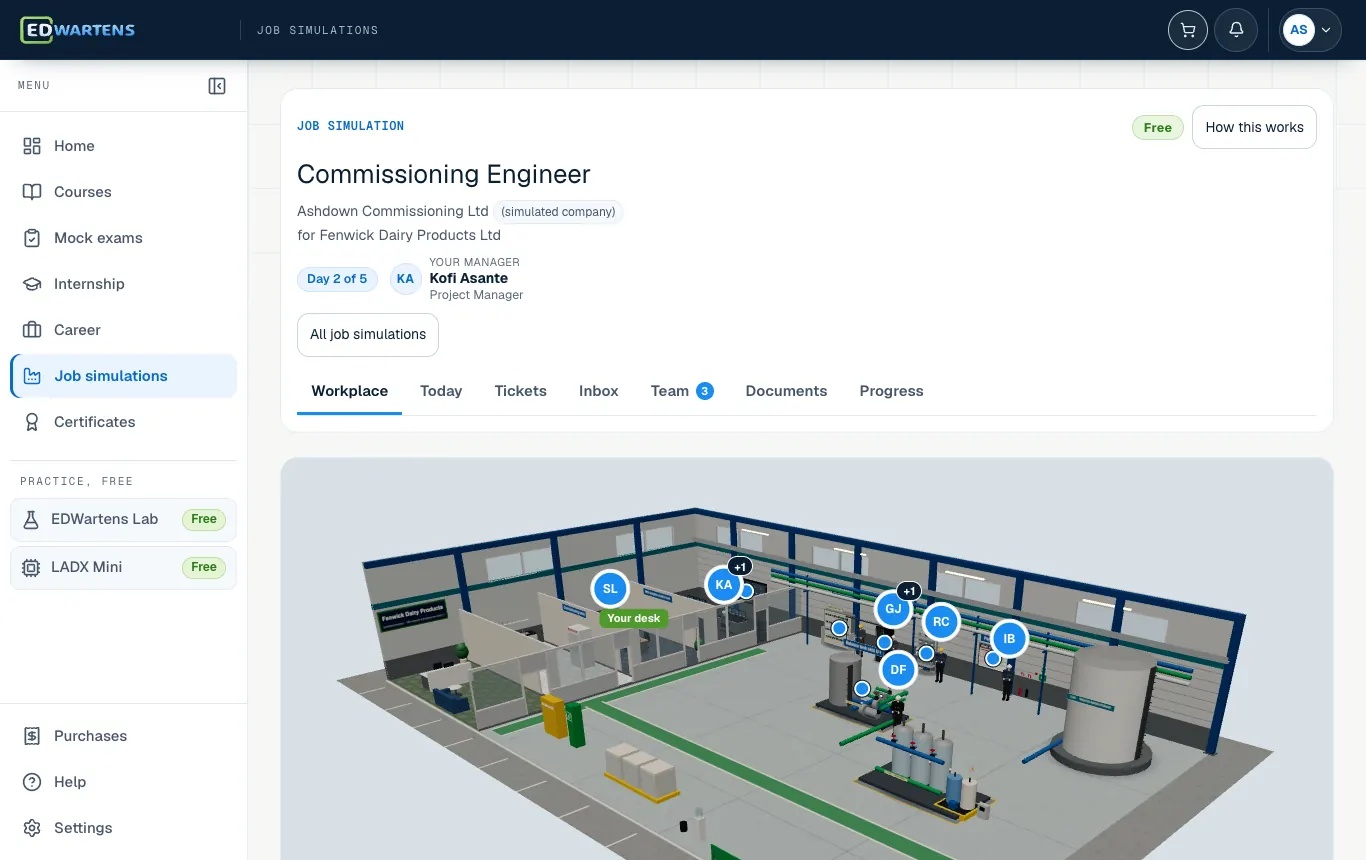
Start in the workplace, with the team around you. 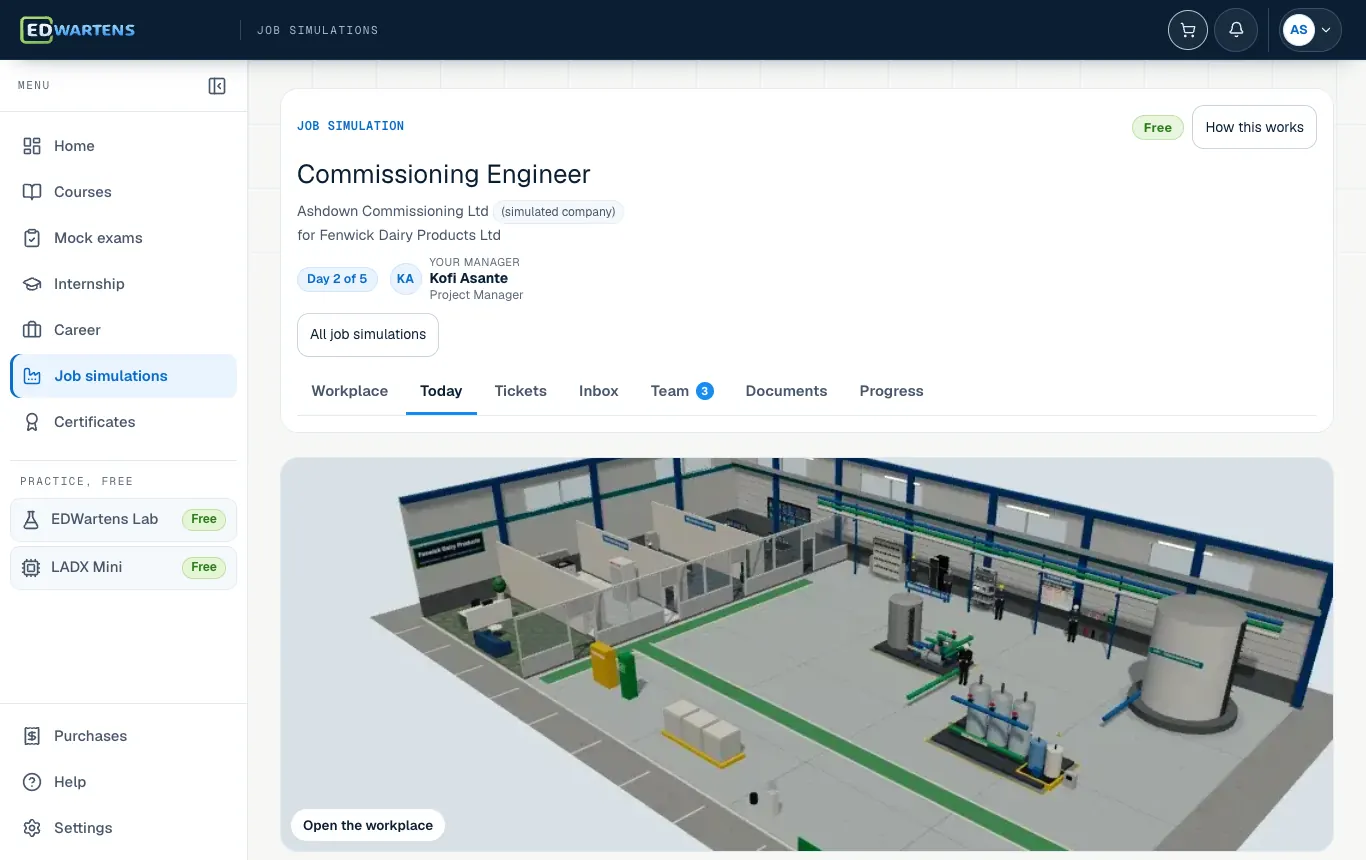
Today: the morning email and your tickets for the day. 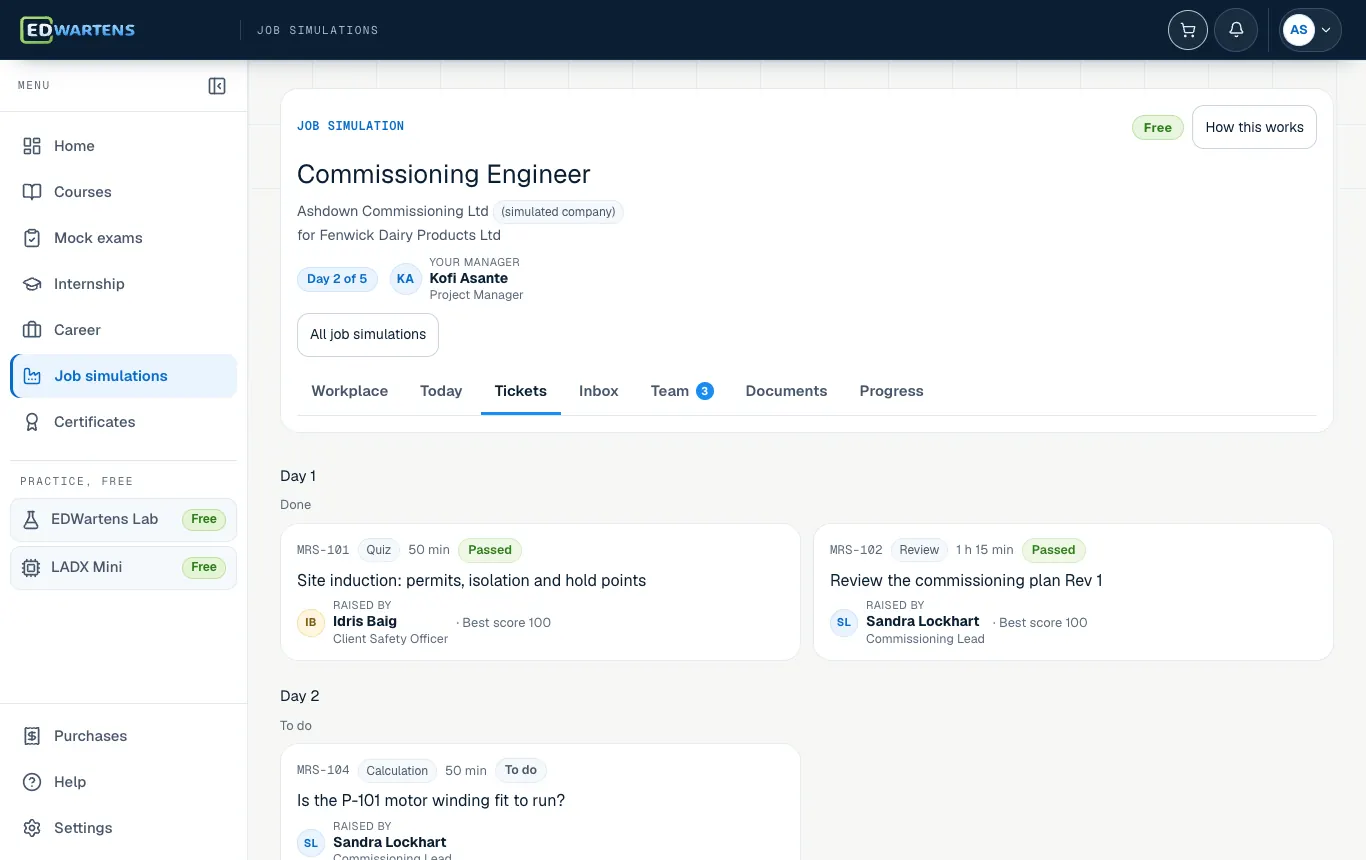
Work: every ticket, by day, with its status. 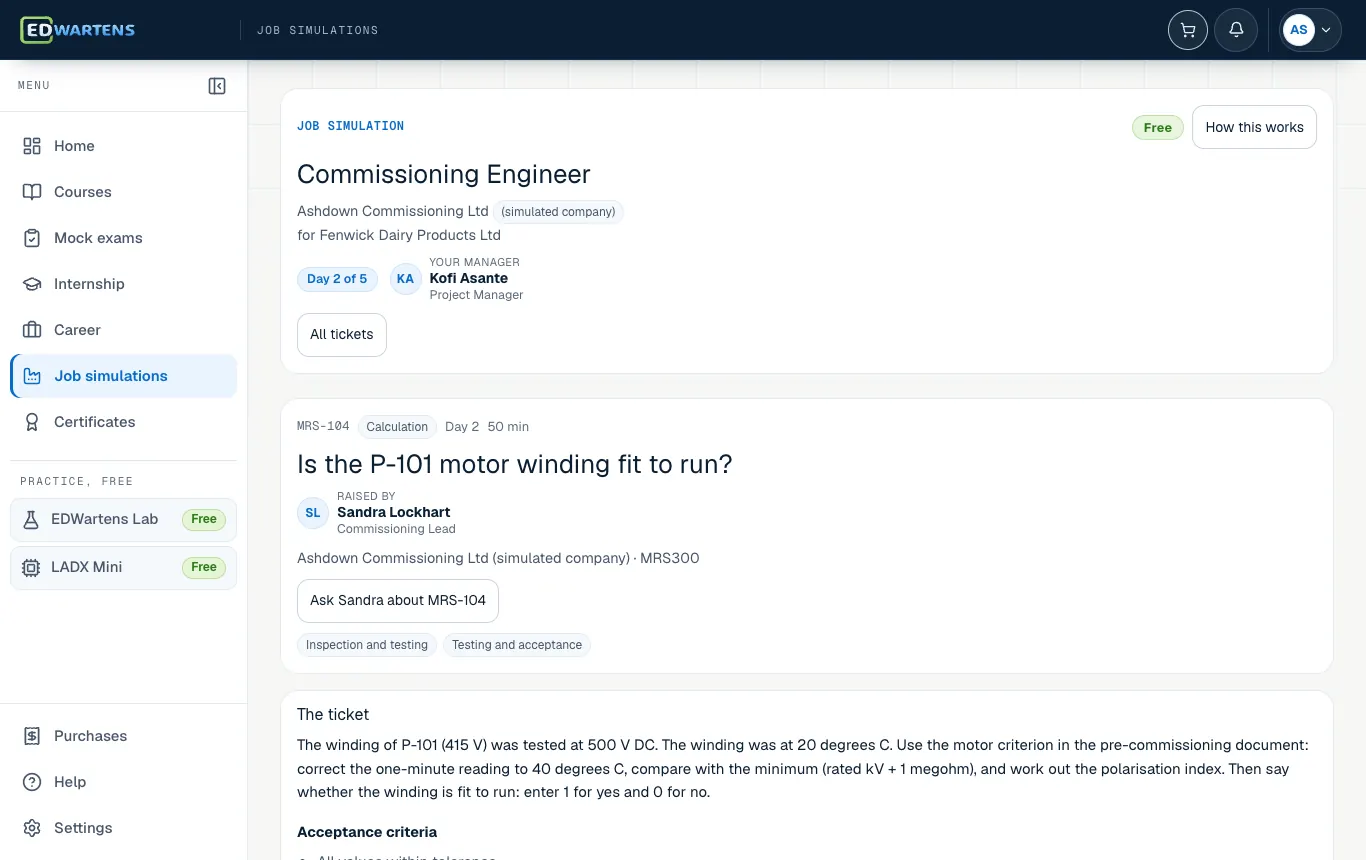
A ticket, written the way a colleague would write it. 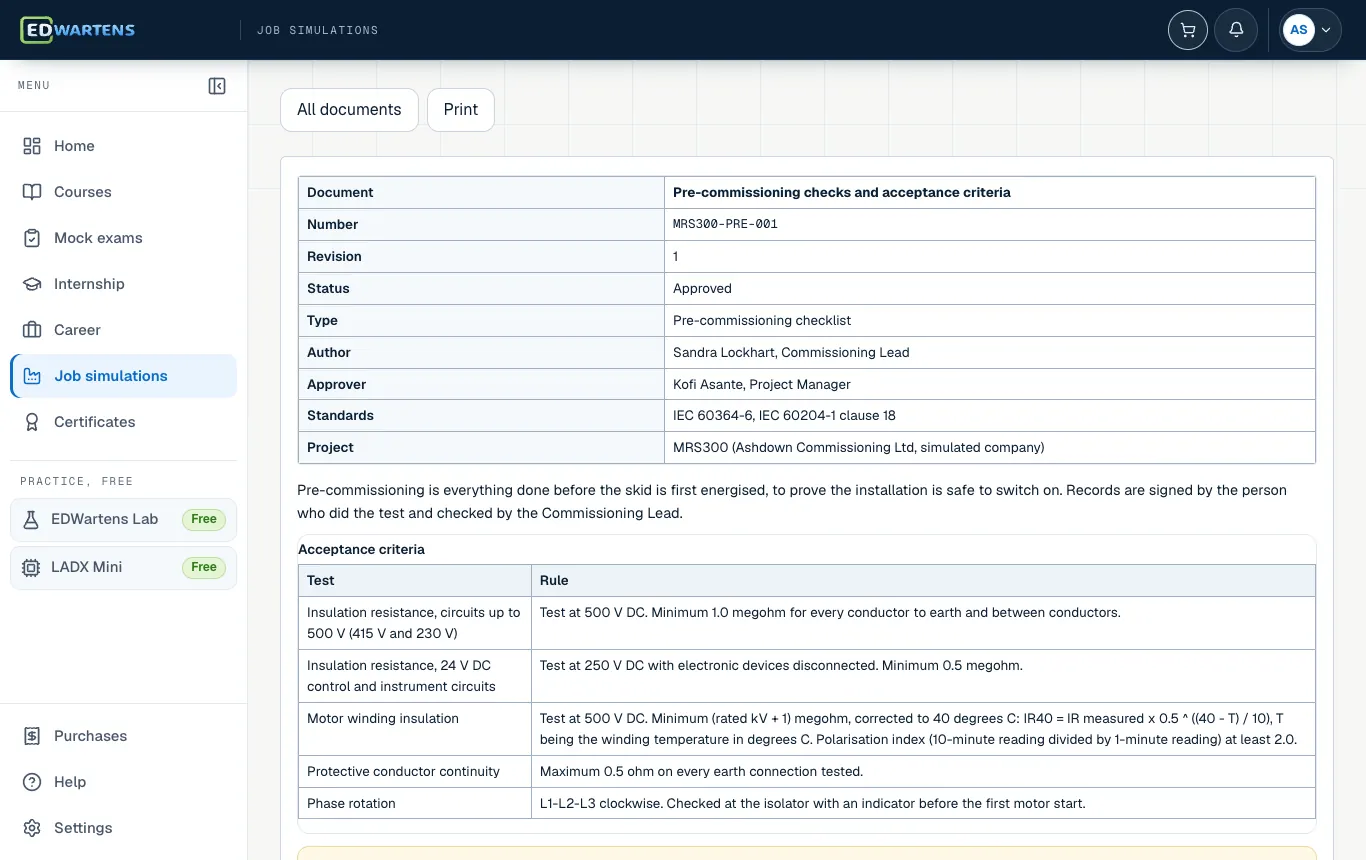
A project document with its number, revision and status. 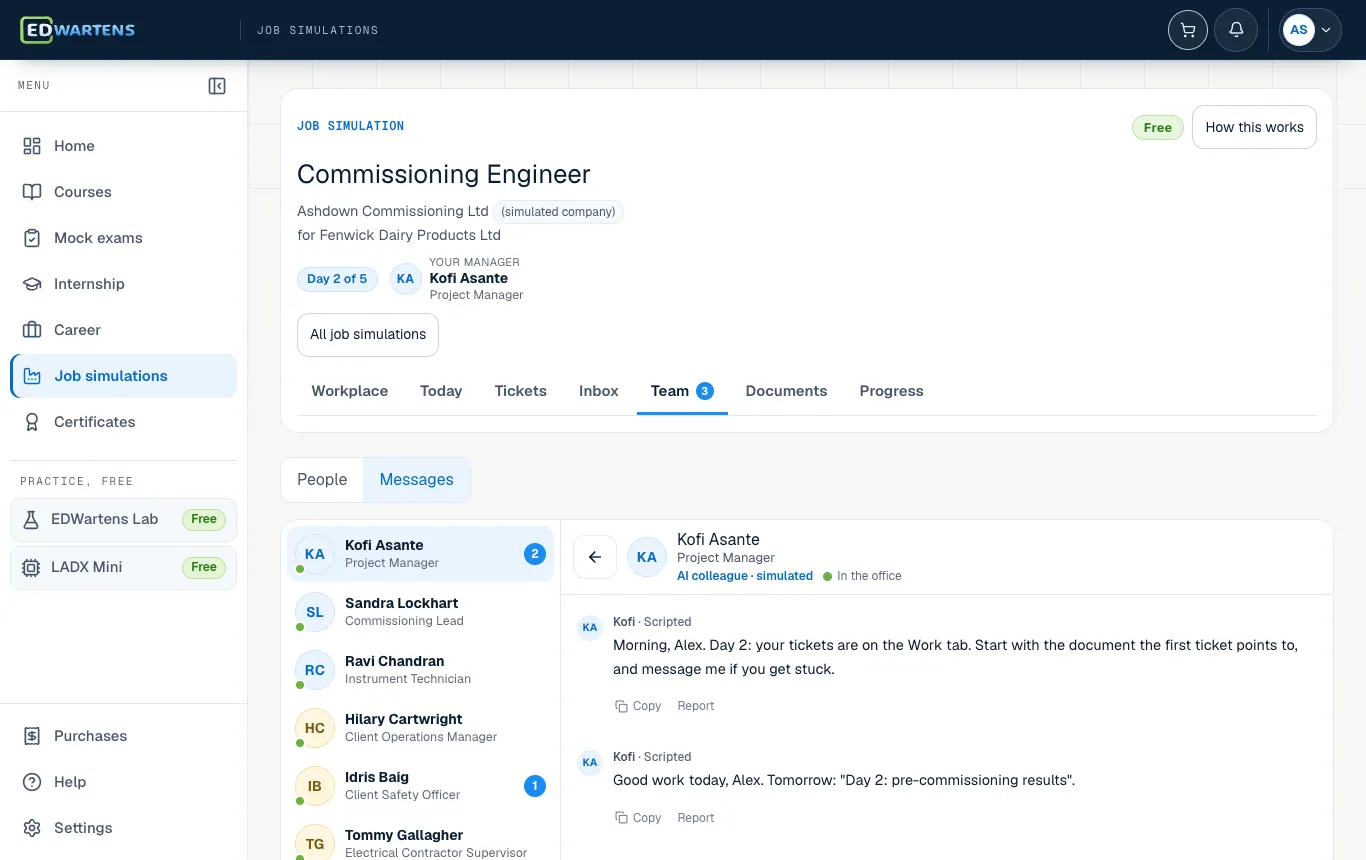
Ask a colleague. They are AI colleagues: they help you think, they do not hand out answers.


Screenshots from the simulator. Company, people and data are fictional and always labelled as simulated.
Meet the team
The colleagues you work with
 AIFacundo OrtegaProject ManagerSimulated colleague, company side
 AIThuli NcubeCommissioning LeadSimulated colleague, company side
 AIArnab BasuInstrument TechnicianSimulated colleague, company side
 AINaveed FarooquiClient Safety OfficerSimulated colleague, client side
 AITrang DangClient Operations ManagerSimulated colleague, client side
 AIBryce GagnonElectrical Contractor SupervisorSimulated colleague, client side
 AILuca FontaineContractor ElectricianSimulated colleague, client side
 AIHala AzizControl System Vendor EngineerSimulated colleague, vendor
Fictional people, with simulated faces.
What you walk away with
What you walk away with from the Commissioning Engineer job simulation
Commission a dairy skid: pre-commissioning tests, loop checks, functional tests and a handover dossier.
What you produce
- Insulation resistance results with pass or failTest record
- Loop check sheet for three analogue loopsLoop check sheet
- Daily commissioning reportDaily report
- I/O point-to-point checkout findingsI/O checkoutPremium
- Management of change requestChange controlPremium
- Categorised punch listPunch listPremium
- Commissioning handover dossierCapstonePremium
- Handover note to the operations managerHandover notePremium
Skills you practise
- Commissioning
- Written communication
- Safety and safe systems of work
- Testing and acceptance
- Handover and documentation
- Loop checks and I/O checkout
- Fault finding
- Document and revision control
Roles to look for
- Commissioning Engineer
- Commissioning Technician
- C&I Commissioning Engineer
- Field Service Engineer
304 live openings on the UK jobs board, checked 10 Nov 2026. See the jobs
Your proof
- A certificate anyone can verify. Optional, and included in Premium.
- An entry on your EDWartens profile under Work experience, marked as a job simulation.
- A work record with your skill scores, with Premium.
Free courses that go with it
What you can talk about at interview
- You can explain what a pre-commissioning check proves and how you record a pass, a fail or an invalid result.
- You can describe how you loop check an analogue loop and what you write on the sheet.
- In Premium, you can talk through a functional test, a management of change request and how you push back when the client wants to start early.
The workplace
Where you work and what is in it
- You work at Fellmoor Dairy Products (simulated company). The site is the Milk reception and balance tank skid U-1.
- Inside you will find tanks, a control valve with a positioner, transmitters, a pump set and SCADA screens. They are machines from our 3D lab, placed in the workplace and driven by what you do.
- The simulated working day runs from 08:00 to 16:30. The clock moves on while you work, so a day takes you 30 to 45 minutes.
- Milk reception control room
- Commissioning cabin
- Balance tank skid U-1
- Instrument rack
- Marshalling panel
- Permit board
Day by day
Days 1 to 5: where the project stands
- By day 2Commissioning plan reviewed and insulation results judged
- By day 5Loop checks done, daily report written, pump starter commissioned
Every task in the free daysday by day
Day 1
2 tasks- Site induction: permits, isolation and hold pointsQuiz
- Review the commissioning plan Rev 1Document review
Day 2
2 tasks- Insulation resistance results: pass, fail or invalidTable
- Is the P-101 motor winding fit to run?Calculation
Day 3
2 tasks- Loop check a level loop in the process labLab machine
- Loop check sheet for the three analogue loopsTable
Day 4
2 tasks- Live work without a permitDecision
- Write today's daily commissioning reportWriting
Day 5
1 task- Commission the transfer pump starterLab machine
Premium: days 6 to 20about 12 to 15 hours in all
After day 5 the project goes on with a change request, site work, faults, a handover and a capstone reviewed by an engineer. Your manager checks in on days 5, 10 and 15 and gives a final review on day 20.
- By day 10Transmitter calibrated, I/O checked out, change request raised
- By day 15Emergency stop failure handled, site acceptance run, punch list categorised
- By day 20Dossier checked and the handover note given to the Operations Manager
Day 6
1 task- Calibrate a pressure transmitterLab machine
Day 7
1 task- I/O checkout: what is wrong at each point?Table
Day 8
1 task- Start the plant before the category A items are closed?Decision
Day 9
1 task- Raise a management of change request for the low-low interlockWriting
Day 10
1 task- Stroke the control valve and set the controller actionLab machine
Day 11
1 task- Hand, Off, Auto and floats without bypassing the E-stopLab machine
Day 12
1 task- The emergency stop runs on for four secondsDecision
Day 13
1 task- Site acceptance test and two hidden faultsLab machine
Day 14
1 task- Categorise the punch listTable
Day 15
1 task- Re-plan after the crane delay and the vendor leaveWriting
Day 16
1 task- Check the draft handover dossier indexDocument review
Day 17
1 task- Check the first pump run readingsCalculation
Day 18
1 task- Capstone: the commissioning handover dossierHand-in
Day 19
1 task- Handover note to the Operations ManagerWriting
Day 20
1 task- A conversation about your own workViva
What you produce
What you hand in during the Milk balance tank skid U-1 commissioning project
- Insulation resistance results with pass or failInsulation resistance test record · Free days
- Loop check sheet for three analogue loopsLoop check sheet · Free days
- Daily commissioning reportDaily report · Free days
- I/O point-to-point checkout findingsI/O checkout record · Premium
- Management of change requestMOC form · Premium
- Categorised punch listPunch list · Premium
- Commissioning handover dossierHandover dossier · Premium
Real documents
The documents you will work with
- MRS300-PTW-001Site rules, permit to work and hold points
- MRS300-INS-001Instrument index and equipment list, skid U-1
- MRS300-PRE-001Pre-commissioning checks and acceptance criteria
- MRS300-COM-PLN-001Commissioning plan and procedure
- MRS300-LCS-001Loop check sheet template and acceptance rule
- MRS300-LOG-004Raw site notes, day 4
- MRS300-PID-001Process and instrument diagram, balance tank skid U-1
- MRS300-LPD-001Loop diagram, tank level LT-101
Documents that arrive in Premiumchange requests, records, handover
- MRS300-IOC-001I/O point-to-point test record, day 7
- MRS300-FTS-001Functional test procedure and record
- MRS300-MOC-001Management of change form and rules
- MRS300-FTS-001Functional test procedure and record, after MOC-01
- MRS300-SCH-001Remaining activities and resources
- MRS300-PCH-001Punch list, raw findings
- MRS300-HOV-002Handover dossier index, draft
- MRS300-HOV-001Handover requirements (taking over)
- MRS300-RAMS-001Risk assessment and method statement, first run of P-101
Skills checked
The skills this simulation checks
- Commissioning
- Written communication
- Safety and safe systems of work
- Testing and acceptance
- Handover and documentation
- Loop checks and I/O checkout
- Fault finding
- Document and revision control
Tools
In the industry, and here
| In the industry | Here |
|---|---|
| Insulation tester, multimeter, loop calibrator | The process lab and panel lab, with injected signals, meters and a calibrator |
| Loop check sheets, punch list, daily report in spreadsheets | Tables and documents you fill in and have checked |
| Permit to work and lock-out records | Site rules, hold points and permit register as documents |
| Completion dossier in a document system | A pack you assemble and upload for review |
Standards
The standards the work follows
- IEC 60364-6
- IEC 60204-1
- ISA-5.1
- NFPA 70E (safe work practice)
Real lab machines
The lab machines you use
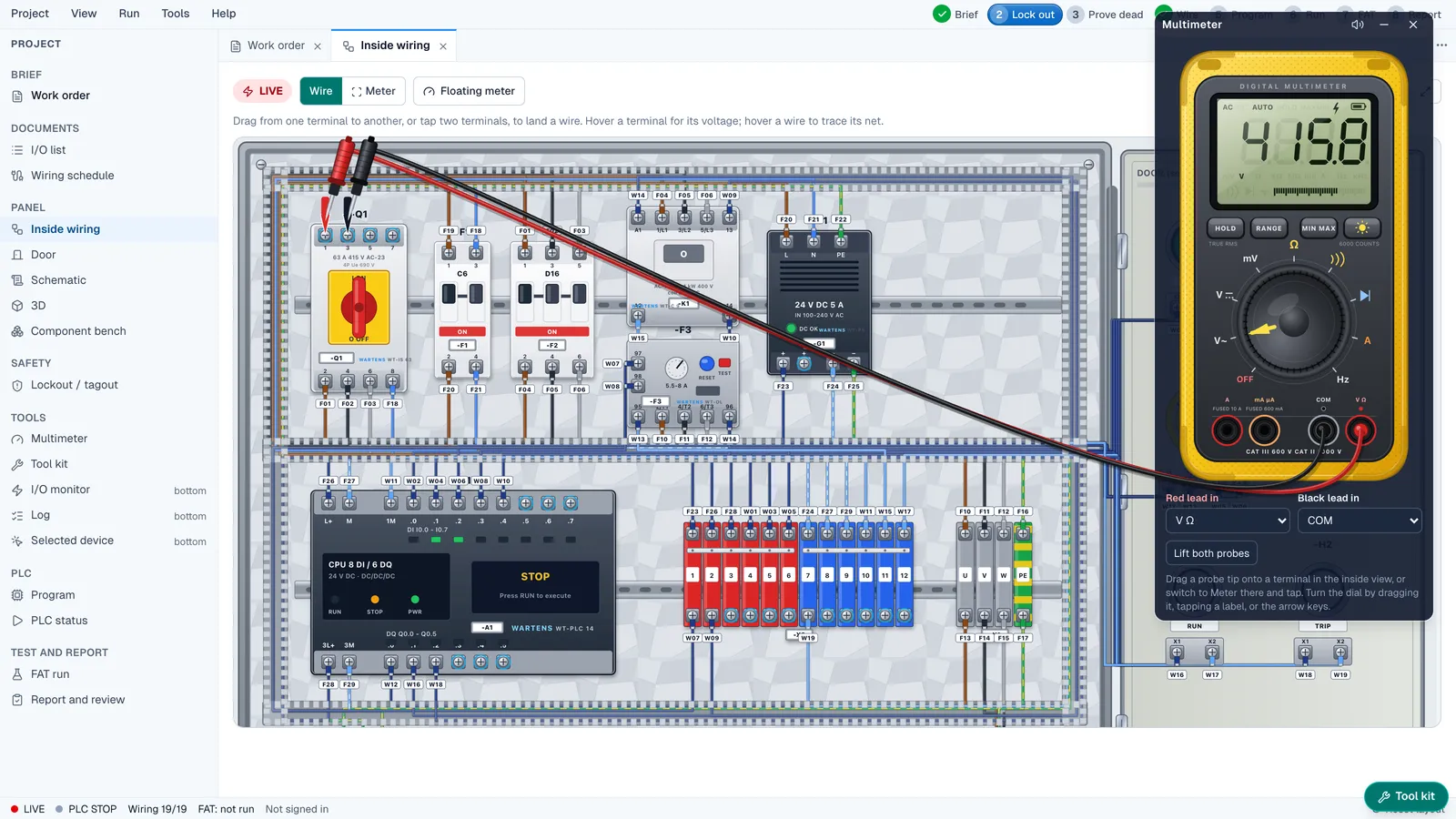 Electrical labWire, lock out and fault-find a control panel, then prove it with a factory acceptance test.Read the lab guide (opens in a new tab)
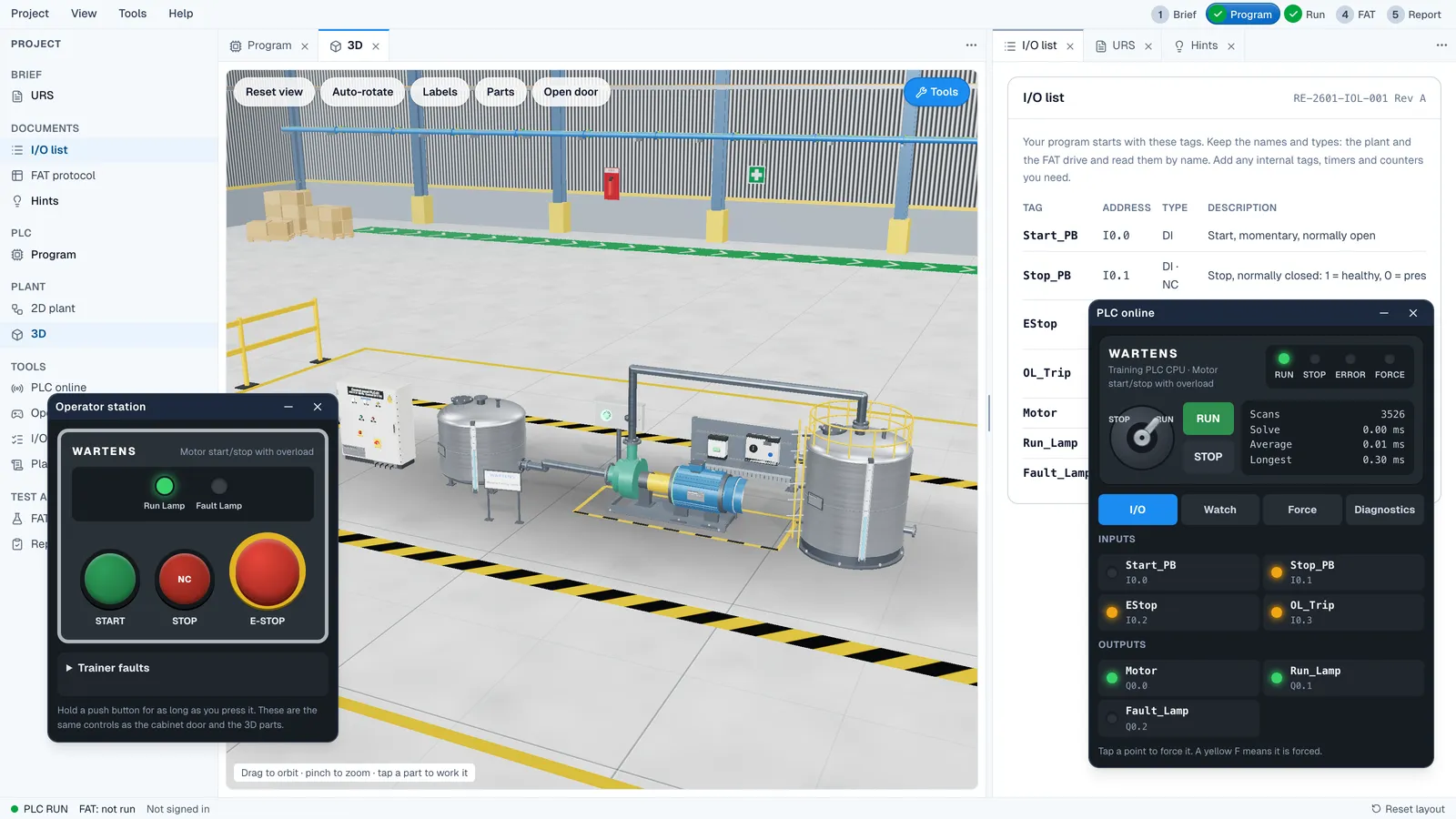 PLC labProgram a working machine in ladder logic, press Simulate and watch it run.Read the lab guide (opens in a new tab)
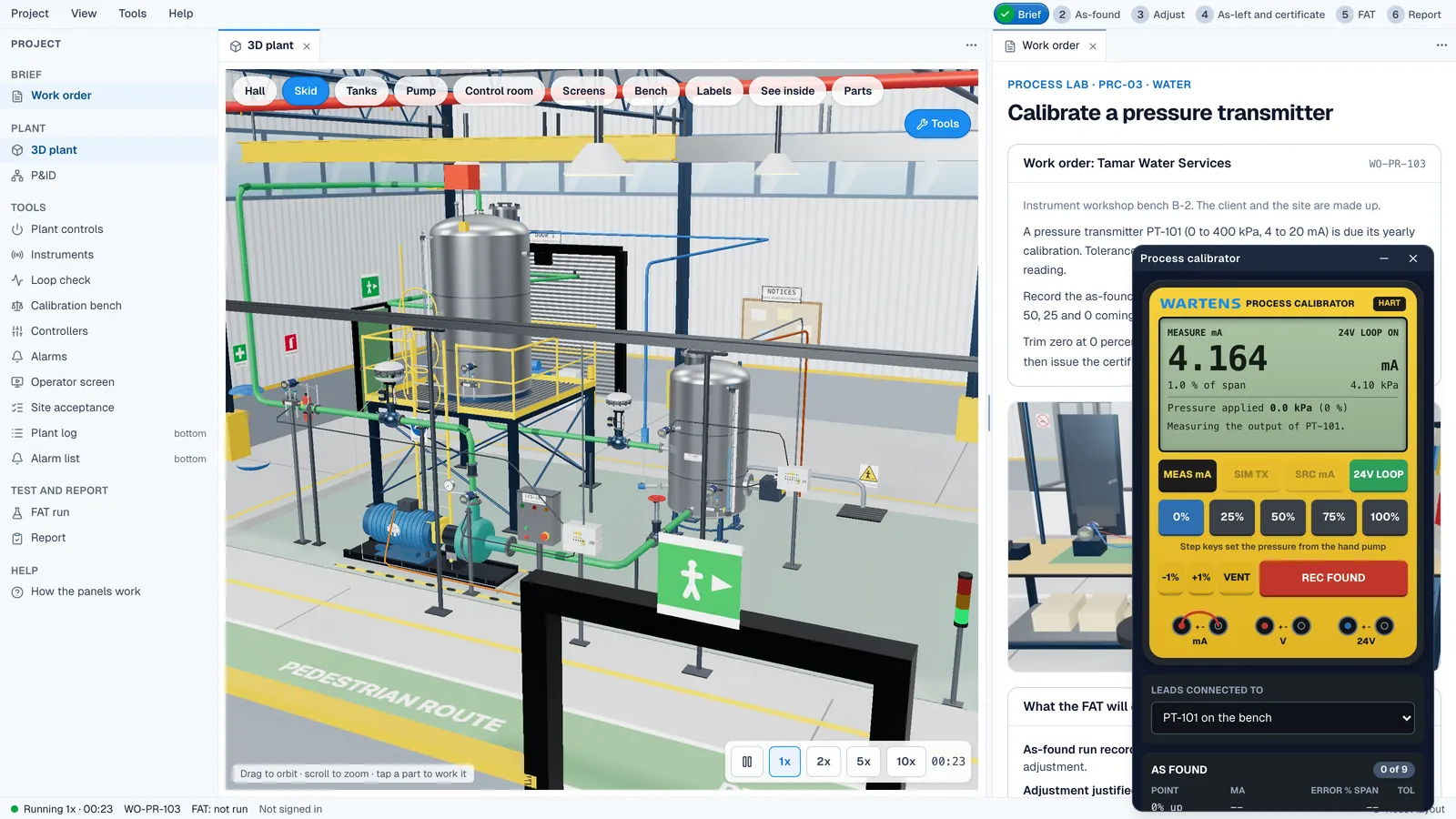 Process labTune loops, calibrate instruments and run a plant from a SCADA room.Read the lab guide (opens in a new tab)
Practise it in the lab
A look at the Electrical lab
Prepare
Free courses that get you ready
- electrical safety and lock-out
- wiring regulations in practice
- P&ID and instrument documents
- loop checks and commissioning
- QA and QC inspection
- industrial motor control
- process lab (opens in a new tab)
- 4 to 20 mA loops
- panel lab (opens in a new tab)
- PLC and electrical troubleshooting
- EHS and permit to work
- control valves and flow
- machine safety and safety functions
- project coordination and planning
A clear finish
How the simulation ends and what you keep
- Your own documents, written to industry standard with a title block: company, project, document number, revision, status, and who prepared, checked and approved it.
- A work pack you keep, as a PDF and a zip: your project file, your documents, your timesheet and your skills before and after.
- A final review after your last day: your skills before and after, the projects you delivered, three strengths and two next steps.
- A letter from your manager, written by AI from your results and labelled as such.
- An entry on your EDWartens profile under Work experience, marked as a job simulation, with your logged hours.
Your proof, optional
A certificate you can verify
Job Simulation Certificate
Your name
completed the Commissioning Engineer job simulation at Marlhurst Commissioning Ltd (simulated company). Graded score band shown on the real certificate.
- Number
- EDW-JS-0000
- Verify
- edwartens.com/verification
- A graded, verifiable certificate with your score and band
- A public verification page and QR code
- The details to list it on LinkedIn under Licences & certifications, ready to copy
- It is a training certificate. It is not employment, and the company is simulated
Optional: ₹499 in your currency
On your profile
How it shows on your profile
Work experience
Commissioning Engineer (job simulation)
Marlhurst Commissioning Ltd (simulated company)
3 to 4 hours active hours logged · Your dates
Verified, with the certificateA job simulation is a realistic training project at a simulated company. It is not employment, an internship or a work placement. Hours are active hours the learner logged on EDWartens.
Plain facts
What this is and what it is not
What it is
- A practice simulation of a junior role at a simulated company.
- A project with real-style documents, colleagues to ask and lab machines to work on.
- Checked work with feedback, and something specific to talk about at an interview.
What it is not
- Not employment, an internship or a work placement.
- Not a job offer, and we do not promise a job.
- Not a qualification. It does not replace time on a real site.
- Not real people: the colleagues are AI characters.
Your colleagues are AI characters, not real people. They have names, roles and faces, always labelled as simulated. Your manager's closing letter is written by AI from your results and says so.
About the Commissioning Engineer role
FAT, SAT and the loop check: three tests in one table
These tests are often confused, and a commissioning engineer is expected to keep them apart.
- Factory acceptance test (FAT): done at the supplier's works against the agreed specification, before the equipment ships.
- Site acceptance test (SAT): done after installation, on the customer's site, to show the installed system meets the specification.
- Loop check: proves that one instrument, its wiring, the I/O channel and the control system tag all agree, for example a transmitter range reading correctly on the operator screen.
A commissioning day, ticket by ticket
The free days follow the order a real job does. You start with site induction, permits and hold points, review the commissioning plan, judge insulation resistance results, loop check three analogue loops and commission a transfer pump starter in the lab.
Along the way you write the daily commissioning report, which is the document a client reads first. Premium days continue with transmitter calibration, an I/O checkout where every point has a different fault, a site acceptance test with hidden faults and the categorised punch list.
Sign-off sheets, punch lists and the dossier
Commissioning produces evidence. The simulation gives you a loop check sheet template with its acceptance rule, a raw site notes page that you have to turn into a report, and a punch list of raw findings that you must categorise.
You also review a draft handover dossier index against the project records. The point of each task is the same: records that a client's quality manager would accept, with failures shown honestly rather than tidied away.
Each document is a small lesson in tone: plain, dated and signed off, so that a stranger can trust it.
Reading the pack: P&ID, loop diagram and I/O list
Before any test you need to read the documents that define it. The pack includes an instrument index, pre-commissioning checks with acceptance criteria and a management of change form.
ISA-5.1 gives the instrument tag names you will see on drawings, and IEC 60364-6 and IEC 60204-1 sit behind the electrical checks. The simulation also asks you to refuse to start a plant while category A items are open, and to raise a change request instead of patching a live plant.
Where commissioning leads
Commissioning engineers move towards project engineering, controls leadership, or specialist work such as safety systems and instrumentation. Learn next whatever your first project exposes: loop calibration, motor control and permit systems are the common gaps.
The related roles on this page, instrumentation and SCADA, are the two disciplines you will test most often.
Keep your own record of the faults you met and how each was found. Interviewers for commissioning roles often ask for a story about a test that failed, and the daily reports in this simulation give you several to tell.
Keep going
Related job simulations, internships and jobs
Instrumentation Engineer
Instrument index, datasheets, loop diagrams and calibration on a process plant.
See the Instrumentation Engineer job simulationSCADA and HMI Engineer
Build the tag list, alarm list and screens for a live process.
See the SCADA and HMI Engineer job simulationPLC Programmer
Write the I/O list, program the line, run the FAT and handle a change request.
See the PLC Programmer job simulation
- Free Commissioning and Maintenance internship
- Browse jobs
- Engineering job simulations
- Job simulation questions
Last reviewed 24 Oct 2026. Practice, not employment.
Questions
Quick answers
What does a commissioning engineer do?
Job advertisements describe leading or witnessing pre-FAT, FAT and SAT, functional testing, loop checks, I/O checkout, communications checks and sequence validation, and closing a punch list. The simulation turns each of those duties into a task.
What is the difference between FAT and SAT?
A factory acceptance test is done at the supplier's site before shipment. A site acceptance test is done after installation on the customer's site, against the agreed specification.
What is a loop check?
A test that confirms a field instrument or device, its wiring, the I/O channel and the control system tag all agree. For example, a transmitter's range shows correctly on the operator screen.
What is a punch list?
A list of outstanding defects and missing items that must be fixed before handover, usually ranked by importance. In the simulation you categorise the raw findings and decide which items stop the start-up.
How do I become a commissioning engineer with no experience?
Advertisements typically ask for an electrical, instrumentation or related degree or diploma. Show that you can read P&IDs and schematics and run test records. A practice plant with loop checks and a punch list is a practical start.
What documents does a commissioning engineer use?
P&IDs, electrical schematics, a control philosophy, I/O lists, loop diagrams, test procedures and sign-off sheets. The simulation supplies a pack of these for the dairy skid.
Can commissioning be done remotely?
Parts can, such as virtual factory tests and remote I/O checks. Site safety checks and final witness tests normally need people on site, so a simulation shows method and records, not site experience.
Is commissioning travel-heavy?
It is often site-based and project-driven, but patterns vary by employer, so check each advertisement. The simulation does not assume any travel.
What is a working day like in the Commissioning Engineer job simulation?
You clock in, join the commissioning stand-up in the team area, work through the day's tasks, write the daily progress report and clock out. A day takes 30 to 45 minutes, and the free days are about 3 to 4 hours in all.
What will I produce in the Commissioning Engineer job simulation?
You work on the Milk balance tank skid U-1 commissioning project for Fellmoor Dairy Products Ltd. In the free days you produce insulation resistance results with pass or fail, loop check sheet for three analogue loops, daily commissioning report. Premium, about 12 to 15 hours over 20 days, takes the project through to its handover. Each document has a title block and you keep them in your work pack.
Do I need site experience first?
No. The simulation teaches the order of work, the paperwork and the safety rules as you go. Some electrical knowledge helps.
Is the dairy or the contractor real?
No. Marlhurst Commissioning and Fellmoor Dairy are made-up companies and the project is simulated. The tests, forms and situations follow what a junior commissioning engineer meets.
How long does it take?
The free week is about ten hours over five days. The full Premium edition runs over twenty working days and about thirty to forty hours, at your own pace.
Which equipment brands does it use?
None. The content is vendor-neutral, so it applies to any plant that follows the same standards.
What do I get at the end?
A work record with scores by task and skill, which shows on your EDWartens profile under Work experience, marked as a job simulation.
Is the Commissioning Engineer job simulation free?
Yes, to start. Days 1 to 5 are free, about 3 to 4 hours. The certificate and the Premium edition are optional and are priced on this page in your currency.
Does it count as work experience?
It shows on your EDWartens profile under Work experience, marked as a job simulation. It is not employment and not a job offer. A job simulation is a realistic training project at a simulated company. It is not employment, an internship or a work placement. Hours are active hours the learner logged on EDWartens.
Start the Commissioning Engineer job simulation today.
Days 1 to 5 are free, about 3 to 4 hours. No card to start.