REMOTE CONTROLS WORK
Remote PLC Programming Jobs: Where They Exist and How to Land One
Most remote controls work is hybrid: design, code and virtual commissioning from home, start-up on site. Which tasks travel, which employers hire remotely, what to show them, and how to filter the job board.
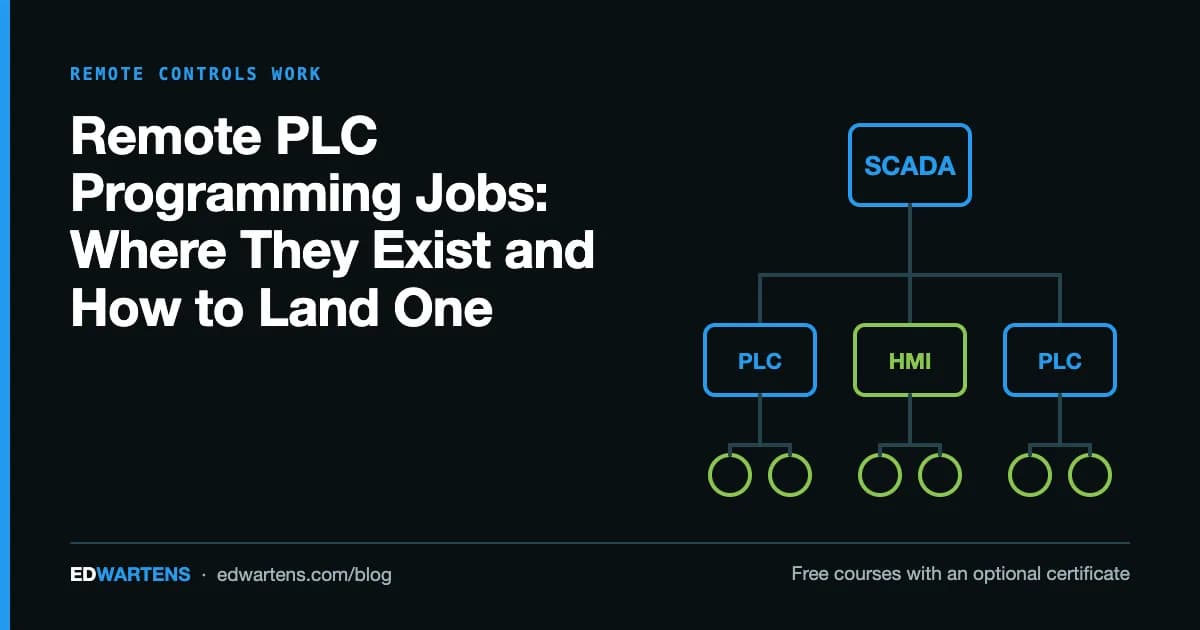
Remote PLC programming jobs do exist, but most are hybrid rather than fully remote. Writing the specification, programming the PLC and HMI, and testing against a simulated machine can all be done from home. Loop checks, site commissioning and panel work cannot. So the typical remote controls role is home-based with a stated share of travel, and the fully remote jobs sit at the software end: SCADA, MES, data and OT security.
Written 5 October 2026. Job-board details describe how the EDWartens board works today.
That is not the answer people hope for, but it is the useful one. Knowing which tasks travel well tells you which employers can hire you remotely, and what you have to prove before they will.
Can PLC programmers work remotely?
Yes, for a large part of the job. A controls project runs from paperwork to plant, and the early stages are done at a desk:
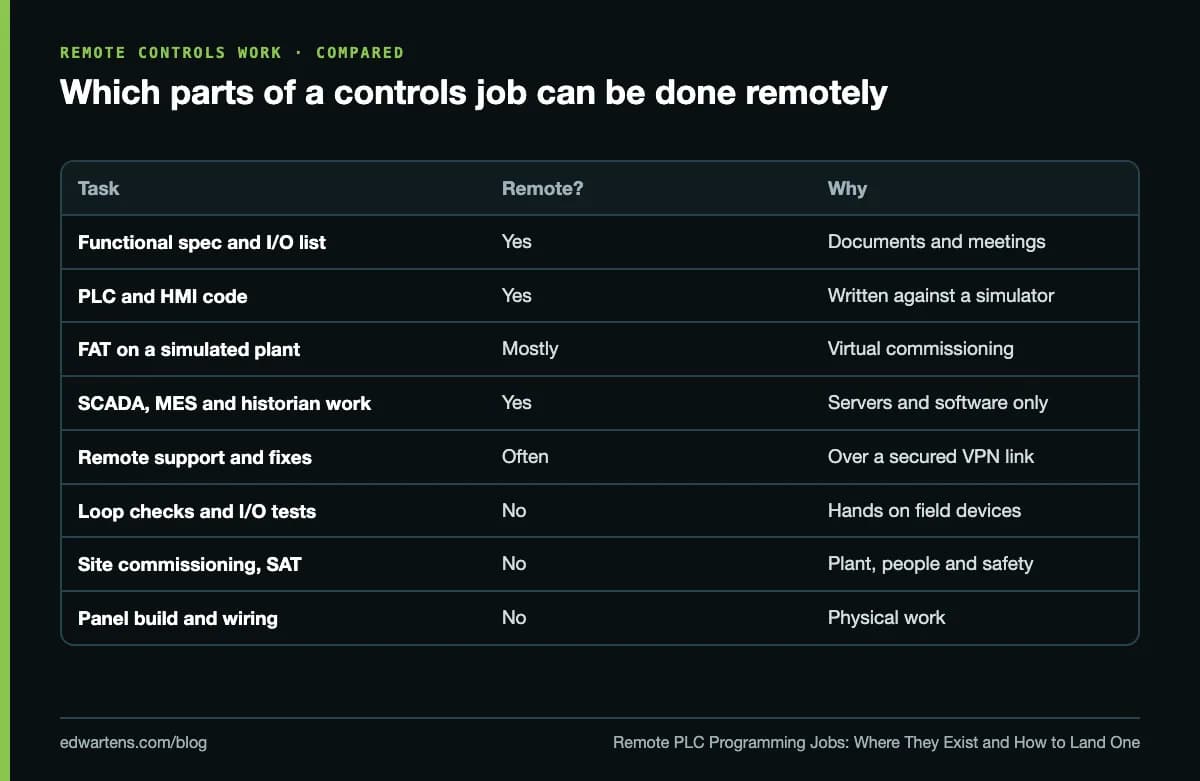
The shift that made this possible is simulation. Siemens describes S7-PLCSIM Advanced as a way to test, debug and optimise control programs against digital twins, cutting commissioning time and cost. Tools such as Factory I/O do the same for training and smaller machines. A programmer can now write and test most of the logic against a simulated conveyor, filling line or warehouse before the real one is built. That work, often called virtual commissioning, is what a remote engineer does all day.
What simulation does not replace is the plant. Field wiring is wrong, instruments are ranged differently from the datasheet, a valve sticks. Someone has to be there. Our guide to becoming a commissioning engineer describes that site work in detail.
Which automation employers hire remotely?
- System integrators. The largest group. Programmers develop and test at home or in the office, then travel to site for start-up. Adverts often state a travel percentage.
- Machine builders (OEMs). Software for standard machines is written centrally. Remote support of installed machines is a common home-based role, sometimes on a rota.
- SCADA, MES and historian specialists. Work on servers and software, often in virtual machines or the cloud. Ignition, AVEVA and WinCC developers are among the most likely to be fully remote.
- IIoT and data teams. Connecting PLCs to dashboards and analytics with MQTT, Node-RED, containers and databases. This is close to software engineering and hires like it.
- OT security. Asset inventories, network reviews and monitoring can be done remotely, though assessments still need site visits.
Plant-side employers (a brewery, a water company, a refinery) mostly want their controls engineers on site, because the job is keeping that plant running.
Is remote access to a plant safe?
It can be, and an employer will ask how you would do it. Remote access is one of the main routes attackers use. CISA's advisory AA26-097A, first published on 7 April 2026 and updated on 22 July 2026, described attackers changing project logic on internet-exposed Rockwell, Schneider and Siemens PLCs. Its advice includes taking PLCs off the internet, using the physical run-mode switch to stop remote changes, and multi-factor authentication for external access. CISA's guide to securing remote access software (June 2023) warns that attackers increasingly misuse legitimate remote tools.
So a good remote engineer works through the customer's approved VPN or remote access gateway, never an open port or a personal remote desktop tool, and agrees changes with someone on site. NIST's SP 800-82 Rev. 3 is the standard reference for OT security practice. Our free course Cybersecurity for PLC Programmers covers access levels and protection in TIA Portal and Studio 5000.
How to prove you can work unsupervised
Remote hiring managers worry about one thing: will this person deliver without someone checking every hour? A degree does not answer that. A portfolio does.
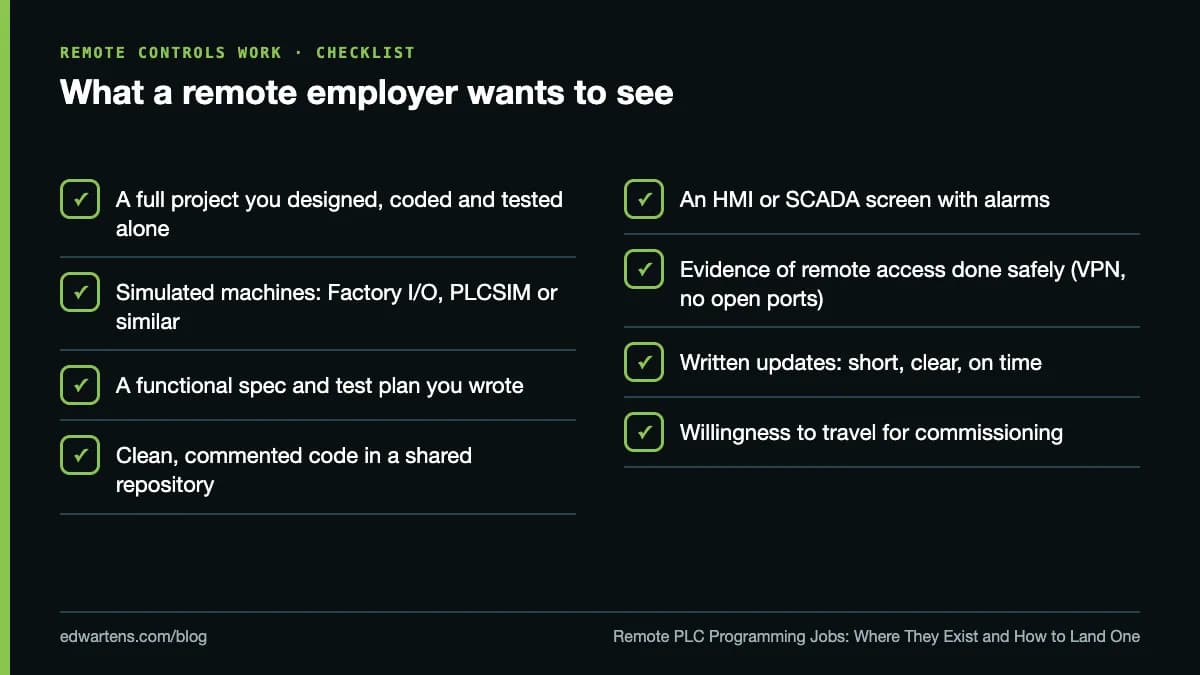
The strongest single piece is a complete project done alone: a written functional specification, a PLC program tested against a simulated machine, an HMI with alarms, and a test record. Our free TIA Portal with Factory I/O virtual commissioning course has nine machines to build exactly this. For background on the simulator, read Factory I/O for PLC training. Then present it the way our guide to an engineering portfolio from course projects suggests: problem, approach, result, with screenshots and a short video.
For software-heavy remote roles, add one data project: read live values from a PLC into a dashboard with Node-RED for Industrial IoT, or build a SCADA project in Ignition. Running it in containers, as taught in Docker and Containers for Automation Engineers, shows you can deploy it too.
How to find remote PLC programming jobs on our job board
The free EDWartens job board lists PLC, SCADA, controls, instrumentation, robotics and commissioning openings by country. They are read from employers' own career sites (ABB, Emerson, GE Vernova, Hitachi Energy, Honeywell, Johnson Controls and Rockwell Automation) and from the Adzuna job search, and refreshed twice a day. Apply goes straight to the employer's site.
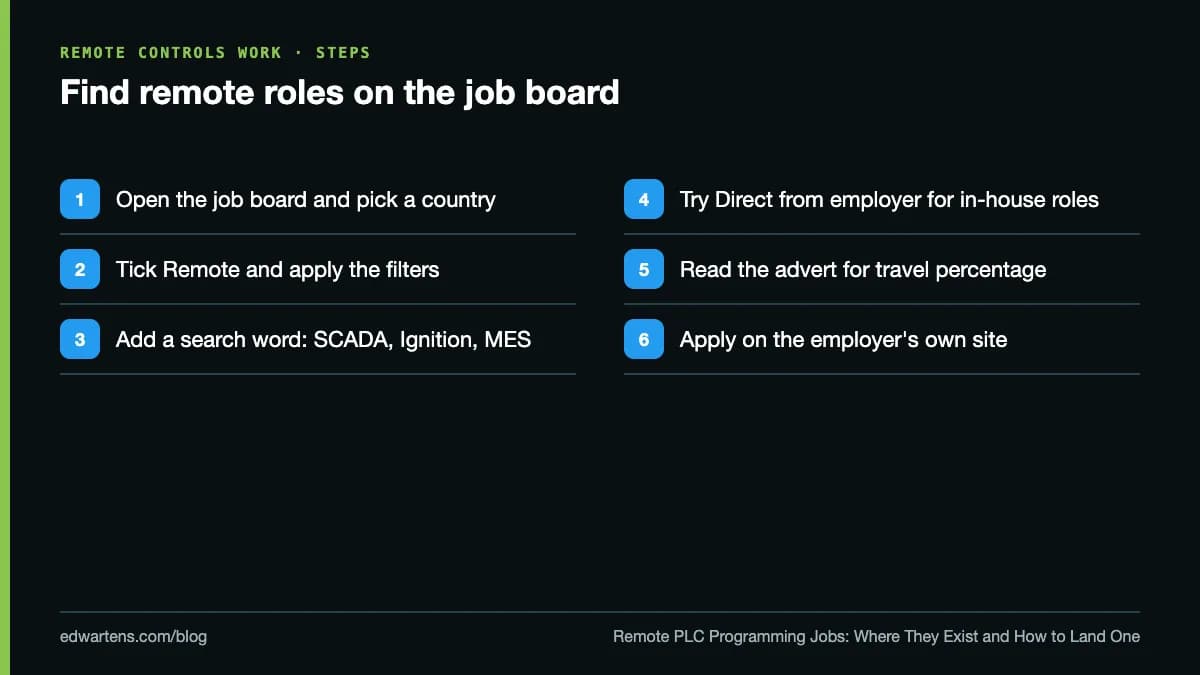
Each country page, such as jobs in the United States, the United Kingdom or Germany, has a search box and three filters: Entry-level friendly, Direct from employer and Remote. Two details are worth knowing:
- What counts as remote. A job is marked remote when the advert's title or location says remote, work from home, home-based, remote-first or similar. Phrases such as remote monitoring, remote support, remote operations or remote commissioning are deliberately not counted, because they describe the work, not where you sit. That keeps a field service role that "supports remote sites" out of the remote filter.
- Thin countries. When a country has fewer than five live jobs, its page also shows remote roles hiring elsewhere, plus the employers' own career sites to watch.
Keep your search words specific: Ignition, MES, SCADA developer, controls software, OT security. A remote role still sits in a country for tax and employment law, so most employers want you resident there. Our guide to automation jobs by country explains how to search across borders.
What a hybrid controls week can look like
A typical pattern at an integrator, during the build phase of a project:
- Monday and Tuesday at home: write the sequence for a palletiser from the functional specification, test it against a simulated machine, and update the I/O list.
- Wednesday at home: a video call with the customer's process engineer to agree alarm limits; record the decisions in the specification.
- Thursday: review a colleague's code through the team's version control, then fix the review comments on your own.
- Friday: a factory acceptance test, run with the customer watching remotely, against the simulation.
Then, a month later, two or three weeks on site for installation checks, start-up and the site acceptance test. Remote work in controls is real, but it is usually measured in weeks per year away rather than never.
Questions to ask before you accept a remote role
- What is the expected travel? Ask for a percentage and how much notice you get.
- Who is on site when I change code? The answer should be a named person, every time.
- How do I connect? Look for a managed VPN or remote access gateway with multi-factor authentication.
- What equipment is provided? A laptop able to run TIA Portal, Studio 5000 or a SCADA designer, licences and, ideally, a test rack.
- Is there an on-call rota? Remote support roles often include one, sometimes across time zones.
- Where must I live? Most employers need you resident in a country where they can employ you.
Remote contracts and freelancing
Some experienced engineers get remote work as contractors: writing code for an integrator's project, reviewing someone else's logic, or supporting a machine fleet. It usually comes through people who have already seen your work on site. Our freelance automation engineer guide covers finding clients, rates and insurance. The r/PLC community is also a useful place to see how working engineers talk about remote and hybrid arrangements.
Before you apply
Remote adverts draw many applicants, so the CV has to match the advert's words. Our guide to an ATS-friendly automation CV and the free Job Description Analyzer help you do that. If you plan to compare remote offers across countries, our post on PLC programmer salaries by country gives sourced ranges. Remote monitoring and support is common in SCADA work; see how to become a SCADA engineer.
All the courses named here are free in full. An optional EDWartens Certificate of Completion, from US$2.99, can be checked by code at edwartens.com/verification. It is not a vendor certification and is not accredited.
Take the free course


Questions
Can PLC programmers work remotely?
Partly. Design, code, simulation testing and much SCADA work can be done from home, and many integrators and machine builders allow it. Loop checks, site commissioning and panel work cannot, so most roles are hybrid with some travel.
Which automation jobs are fully remote?
The closest to fully remote are software-heavy roles: SCADA and MES development, historian and data work, IIoT platforms, OT security analysis and some remote support desks at equipment makers. Even these usually ask for occasional site visits.
Do remote controls engineers still travel for commissioning?
Usually, yes. Start-up and site acceptance testing need someone at the plant, so adverts for remote or hybrid controls roles commonly state a travel percentage. Read that figure before you apply.
How do I find remote SCADA or MES jobs?
On the free EDWartens job board, choose a country, tick Remote and search for SCADA, Ignition or MES. The board marks a job remote only when the advert says the work itself is remote, not when it merely mentions remote monitoring or remote support.
What should a remote PLC programmer's portfolio show?
A complete project you specified, coded and tested on your own against a simulated machine, with the spec, the test plan, clean code and an HMI screen. That proves you can deliver without someone looking over your shoulder.
Sources
- Siemens: SIMATIC S7-PLCSIM Advanced (virtual commissioning and digital twins)
- Factory I/O: 3D factory simulation for PLC training
- CISA: Guide to Securing Remote Access Software (6 June 2023)
- CISA advisory AA26-097A: Iranian-affiliated cyber actors exploit PLCs (7 April 2026, updated 22 July 2026)
- NIST SP 800-82 Rev. 3: Guide to Operational Technology (OT) Security (September 2023)
- r/PLC: the PLC programmers' community on Reddit
Written by the EDWartens engineering team for general education. Product names are trademarks of their owners; mentioning them does not imply endorsement. Prices and terms of other providers were checked on the date shown and can change.
Digital Twins in Manufacturing: What They Are and How Engineers Use Them
VR and AR in Industrial Training: Where They Help and Where a Simulator Does More
MQTT Sparkplug B Explained: Topics, Birth/Death and UNS (Video)
Automation Engineer Career Guide 2026: Roles, Skills and a Free Learning Route

The Manufacturing Skills Gap in 2026: The Numbers and the Skills to Learn
RS-485 Wiring Explained: Termination, Biasing and Daisy Chains (Video)