CONTROLS ENGINEER ROADMAP
How to Become a Controls Engineer: A 2026 Roadmap
The degree, apprenticeship and technician routes into controls engineering, the skills employers test, how to land the first job and how long each route takes, with US, UK and Canadian data.

To become a controls engineer, most people take a bachelor's degree in electrical, mechatronics or control engineering, learn PLC programming, electrical drawings and HMI or SCADA work, then join a system integrator, machine builder or plant as a junior engineer. You can also get there without a degree, by starting as a technician through an apprenticeship, an associate degree or an electrician's trade and moving up through commissioning work. Either way, real time on equipment is what turns study into a controls engineering career.
Checked on 11 October 2026 against the sources listed under this post.
This roadmap covers each route, the skills employers test, how to land the first job and how long it takes, with figures from US, UK and Canadian government and careers sources.
What does a controls engineer do?
A controls engineer is an engineer who designs, programs, tests and commissions the systems that run machines and processes automatically: PLCs, HMIs, drives, instruments and the networks between them. On a typical project you read or draw the electrical schematics, write the PLC and HMI programs, test them in the office, then commission them on site.
The job description varies by employer. At a system integrator you might program a packaging line one month and a water pumping station the next. At a plant you keep existing systems running and improve them. The NCEES specification for the US PE Control Systems exam is a good map of the profession: it tests measurement, control systems (drawings, PID, PLC and DCS programming, HMI, commissioning and security), final control elements such as valves and motor controls, signals and networking, and safety systems.
What degree do you need to become a controls engineer?
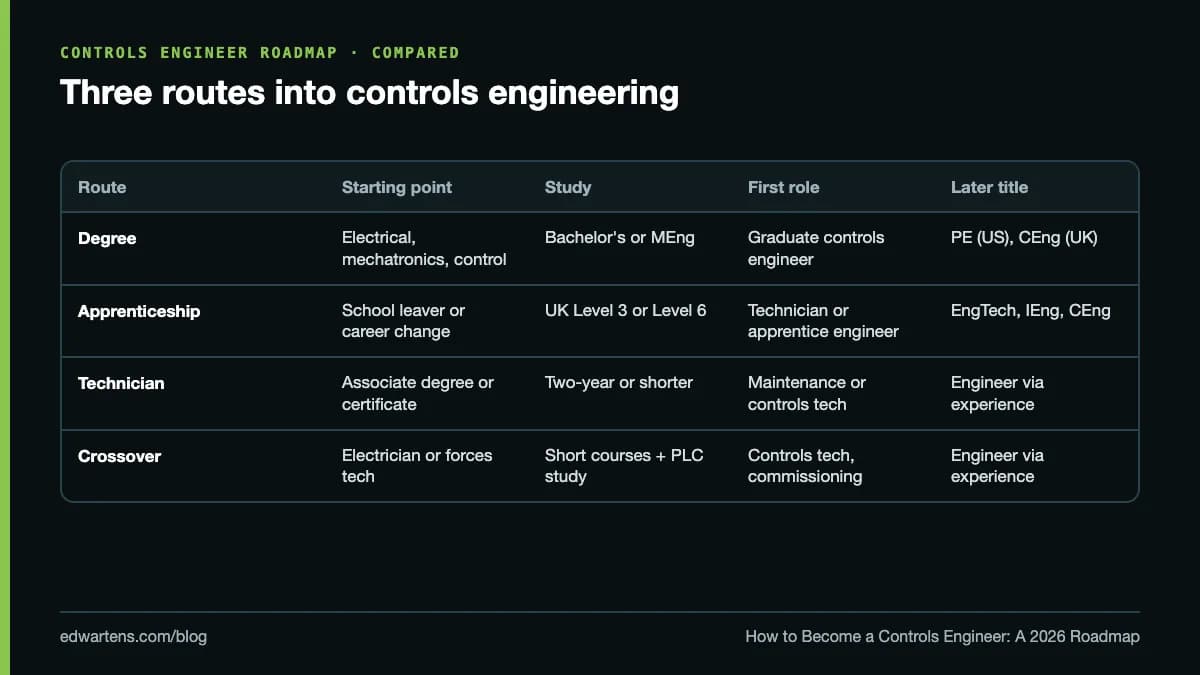
Most controls engineers have a degree in electrical or electronic engineering, mechatronics or control engineering. The US Bureau of Labor Statistics lists a bachelor's degree as the typical entry-level education for electrical and electronics engineers, and notes that employers value internships and co-operative (co-op) programmes. In the UK, the Prospects job profile for control and instrumentation engineers lists control and instrumentation engineering (typically a four-year MEng), electrical and electronic engineering, chemical, mechanical, computer and systems engineering, and physics. If your degree had little control content, some employers ask for an MSc in control systems.
A degree also matters later. In the US, the BLS explains that a Professional Engineer (PE) licence typically needs an engineering degree, the Fundamentals of Engineering exam, several years of experience and the PE exam. In the UK, an accredited degree makes Chartered Engineer (CEng) registration smoother, though the Engineering Council states that it is not required for any of its titles.
Can you become a controls engineer without a degree?
Yes. The technician route is slower to reach the "engineer" title on paper, but it builds the hands-on skill that many graduates lack.
Technician and associate degree route (US and elsewhere)
The BLS profile for electro-mechanical and mechatronics technologists and technicians says workers typically need an associate's degree or a postsecondary certificate. Technicians who learn PLCs, drives and instruments often move into controls technician and then controls engineer roles as they take on design and programming work.
UK apprenticeships
- Level 3: the Engineering technician apprenticeship (ST0457) typically takes 42 to 48 months and is designed to be recognised at Engineering Technician (EngTech) level. Its mechatronics maintenance option was replaced on 10 October 2025 by a separate Mechatronics maintenance technician standard (ST1326).
- Level 6: the Control systems engineer (degree) apprenticeship (ST0023) combines paid work with a degree. Prospects lists it as a route into control and instrumentation engineering.
Prospects also notes that HND holders may need to start at technician level and progress from there.
Electrician and armed forces crossover
Electricians and forces technicians already read drawings, wire panels and fault-find safely, which a classroom cannot fully teach. What they usually need to add is PLC programming, HMI work and the documentation side of a project. A first role as a controls technician or commissioning technician is the usual bridge.
What skills does a controls engineer need?
| Skill | What you should be able to do | Free course to start |
|---|---|---|
| Electrical fundamentals | Read schematics, size and test circuits, work safely | Electrical Fundamentals for Technicians |
| Motor control | Wire and troubleshoot starters, interlocks and drives | Industrial Motor Control |
| PLC programming | Write ladder and structured text, use timers, counters, function blocks | Siemens TIA Portal or Allen-Bradley Studio 5000 |
| HMI and SCADA | Build screens, alarms and trends operators can use | Covered in the PLC courses |
| Networks | Configure PROFINET or EtherNet/IP devices and diagnose faults | Covered in the PLC courses |
| Safety and security | Understand interlocks, safety functions and OT security basics | Learn on the job, then certify |
PLC languages are standardised. IEC 61131-3 is the international standard for PLC programming languages; its current edition, IEC 61131-3:2025, defines structured text, ladder diagram and function block diagram, plus sequential function chart elements for structuring programs. Learn them properly on one platform and the second platform takes far less time. Our guide on how long it takes to learn PLC programming gives realistic study times.
How to become a controls engineer: step by step
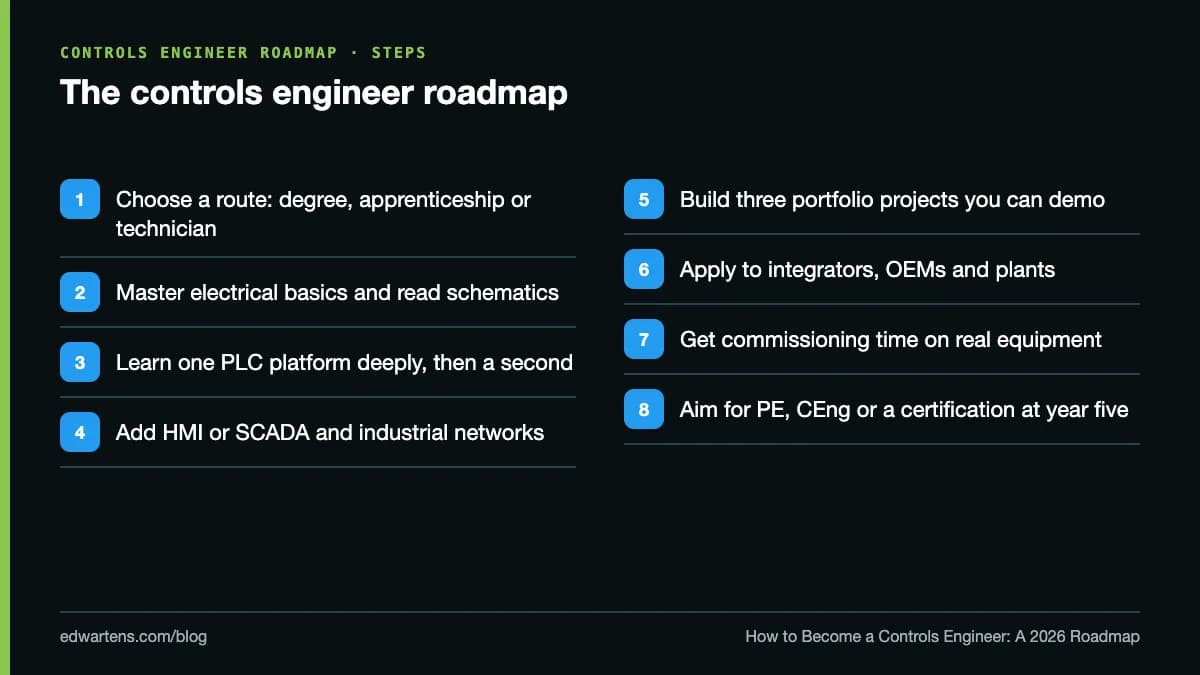
- Choose your route. A degree if you can study full time, an apprenticeship if you want to earn while you learn, a technician role if you are already in industry.
- Learn electrical basics first. Volts, current, relays, contactors and how to read a wiring diagram. You cannot fault-find a PLC system whose wiring you cannot read.
- Learn one PLC platform deeply. Pick the one named most often in the adverts where you want to work, then check which one local integrators use.
- Add HMI, SCADA and networking. Build screens with alarms and trends, and connect devices over an industrial network.
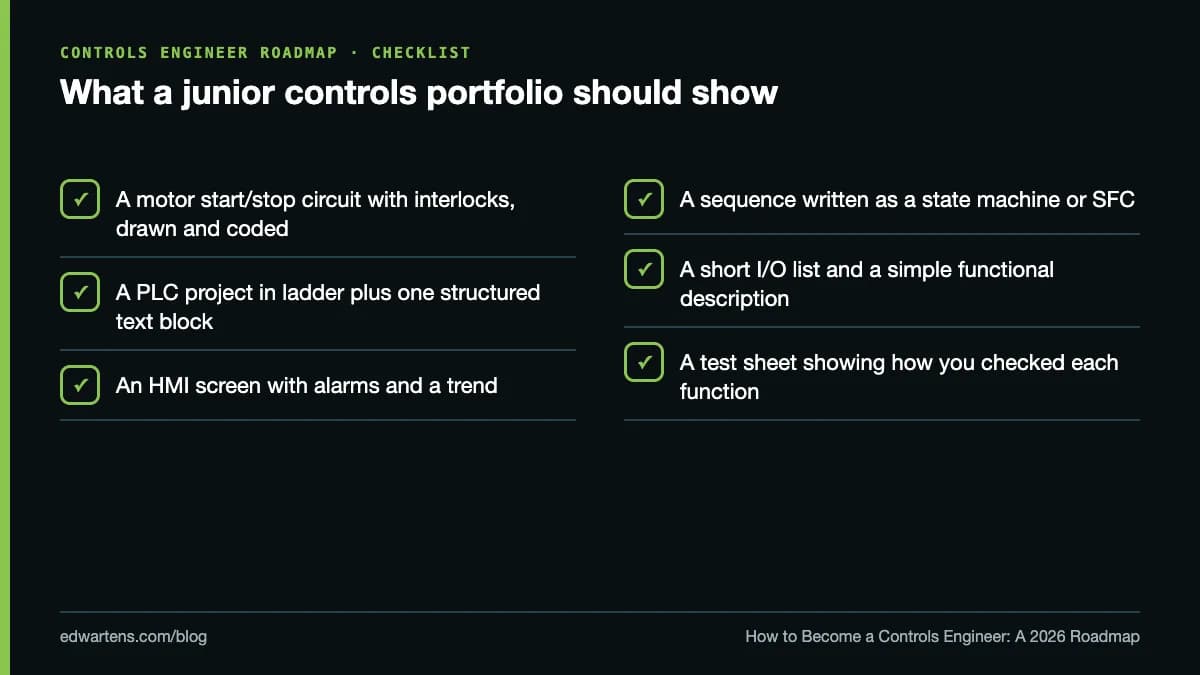
- Build a portfolio. Three small, finished projects beat ten half-done ones. See the checklist below.
- Apply widely and prepare. Practise with our PLC interview questions and answers, then search the free job board.
- Get site time. Commissioning is where you learn fastest. Our guide on how to become a commissioning engineer explains that route.
- Plan a professional title. After a few years, consider a PE (US), CEng or IEng (UK), or an ISA certification. Our controls engineer certifications guide compares them.
How to get your first controls engineer job
Three kinds of employer hire junior controls engineers:
- System integrators build control systems for other companies. You see many platforms and industries and do a lot of commissioning, often with travel.
- Machine builders (OEMs) make packaging, process or assembly machines. Projects repeat on one platform, which is a good place to learn standards and good structure.
- End-user plants in sectors that Prospects lists, such as oil and gas, power generation, pharmaceuticals, utilities, FMCG and chemicals, employ controls engineers to keep systems running and improve them.
Bring your portfolio to the interview and be ready to explain one fault you found and fixed. Prospects lists problem-solving, troubleshooting, numeracy and communication among the skills employers look for, and a typical week of 37 to 40 hours, with some roles on call for plant faults.
How long does it take to become a controls engineer?
There is no single figure, because the routes differ. These are the building blocks from the sources we checked:
| Stage | Typical length | Source |
|---|---|---|
| UK MEng in control and instrumentation | Typically four years | Prospects |
| UK Level 3 engineering technician apprenticeship | 42 to 48 months | Skills England |
| US PE Control Systems exam | Designed for at least four years of post-college experience | NCEES |
| UK registration processing, once your institution approves | Normally within 10 working days | Engineering Council |
In practice, plan for your degree or apprenticeship, then a few years of supervised project and commissioning work before you lead projects on your own. The Engineering Council also notes that engineers do not need a licence to practise in the UK, so you can work as a controls engineer before you are chartered.
How much does a controls engineer earn?
All figures read 11 October 2026:
- United States: the BLS put the median electrical engineer at 120,630 US dollars in May 2025, with the lowest 10% under 76,550 and the highest 10% over 184,300 US dollars. Employment of electrical and electronics engineers is projected to grow 8% from 2025 to 2035, with about 16,300 openings a year. On the technician route, the median electro-mechanical and mechatronics technician earned 73,900 US dollars in May 2025.
- Canada: the Job Bank puts control systems engineers (NOC 21310) at a median 50.67 Canadian dollars an hour, from 33.65 at the low end to 79.23 at the high end (2023 to 2024 data, updated 19 November 2025).
- United Kingdom: Prospects gives graduate control and instrumentation salaries of 25,000 to 30,000 pounds, 35,000 to 50,000 pounds with several years' experience and up to 75,000 pounds at senior, chartered level (November 2024).
For more countries, see our PLC programmer salary by country guide or try the free salary estimator. For the wider picture of automation careers, read the automation engineer career guide.
Start learning today, free
You can build most of the core skills before your first interview. Start with Electrical Fundamentals for Technicians and Industrial Motor Control, then pick Siemens TIA Portal or Allen-Bradley Studio 5000. Every course is free in full. An optional EDWartens Certificate of Completion is proof that you finished a course, not a vendor certification or an accredited qualification, and anyone can check one at edwartens.com/verification.
Take the free course



Questions
What degree do you need to become a controls engineer?
Most controls engineers hold a bachelor's degree in electrical, electronic, mechatronics or control engineering; the US Bureau of Labor Statistics lists a bachelor's degree as the typical entry level for electrical engineers. In the UK, Prospects also lists chemical, mechanical, systems and computer engineering and physics as relevant degrees. A degree is common but not the only route.
Can I become a controls engineer without a degree?
Yes, usually by starting as a technician. In the US, electro-mechanical and mechatronics technicians typically need an associate's degree or a postsecondary certificate, and in England a Level 3 engineering technician apprenticeship typically takes 42 to 48 months. Technicians move into controls engineering by building PLC, drawing and commissioning experience on the job.
How long does it take to become a controls engineer?
On the degree route, expect the length of the degree plus a few years of supervised work before you lead projects alone. For a US PE licence, NCEES designs the Control Systems exam for engineers with at least four years of post-college experience. A UK degree apprenticeship in control systems engineering combines the degree and the work experience in one programme.
How much does a controls engineer earn?
The US Bureau of Labor Statistics put the median electrical engineer at 120,630 US dollars in May 2025. Canada's Job Bank puts the median control systems engineer at 50.67 Canadian dollars an hour (2023 to 2024 data). In the UK, Prospects gives graduate control and instrumentation salaries of 25,000 to 30,000 pounds, rising to 35,000 to 50,000 pounds with experience.
Where do controls engineers get their first job?
Most start at a system integrator, a machine builder (OEM) or an end-user plant. Integrators give the widest exposure to platforms and commissioning, machine builders give repeatable projects on one platform, and plants give maintenance and improvement work. Prospects also lists oil and gas, pharmaceuticals, utilities, FMCG and power generation as typical employers.
Which PLC should I learn first to become a controls engineer?
Learn the platform that appears most often in the job adverts where you want to work; Siemens TIA Portal and Rockwell Studio 5000 are two of the names you will see most. The languages are standardised in IEC 61131-3, so the second platform is much quicker to learn than the first.
Sources
- US Bureau of Labor Statistics: Electrical and Electronics Engineers, Occupational Outlook Handbook (May 2025 pay, 2025 to 2035 outlook, modified 27 August 2026)
- US Bureau of Labor Statistics: Electro-mechanical and Mechatronics Technologists and Technicians (May 2025 pay, modified 27 August 2026)
- Prospects: Control and instrumentation engineer job profile (November 2024, read 11 October 2026)
- Government of Canada Job Bank: Control systems engineer wages, NOC 21310 (2023 to 2024 data, updated 19 November 2025)
- Skills England: Engineering technician apprenticeship, ST0457 v1.6, Level 3 (updated 10 October 2025)
- Skills England: Control systems engineer (degree) apprenticeship, ST0023 (read 11 October 2026)
- Engineering Council: Becoming professionally registered (read 11 October 2026)
- Engineering Council: FAQs, professional registration (read 11 October 2026)
- IEC Webstore: IEC 61131-3:2025, Programmable controllers, Part 3: Programming languages (published 22 May 2025)
- NCEES: PE Control Systems exam (read 11 October 2026)
- NCEES: PE Control Systems CBT Exam Specifications, effective 1 October 2022
Written by the EDWartens engineering team for general education. Product names are trademarks of their owners; mentioning them does not imply endorsement. Prices and terms of other providers were checked on the date shown and can change.

ATS-Friendly CV for Automation, PLC and Controls Engineers: Keywords, Bullets and Mistakes

Are Free PLC Certificates Worth It? What Employers Actually Check

PLC Training in the UK: Apprenticeships, Vendor Courses and What 'Accredited' Means
Automation Training for Fresh Engineering Graduates: From Degree to First Job

How to Build an Engineering Portfolio From Course Projects (Automation and Controls)

PLC vs DCS: Differences and When to Use Each