CONTROLS CERTIFICATIONS
Controls Engineer Certifications: CAP, CCST and More
Which certifications a controls engineer can actually earn, who issues them, the experience each one demands, how the exams work and what they cost, all checked on the issuers' own pages.

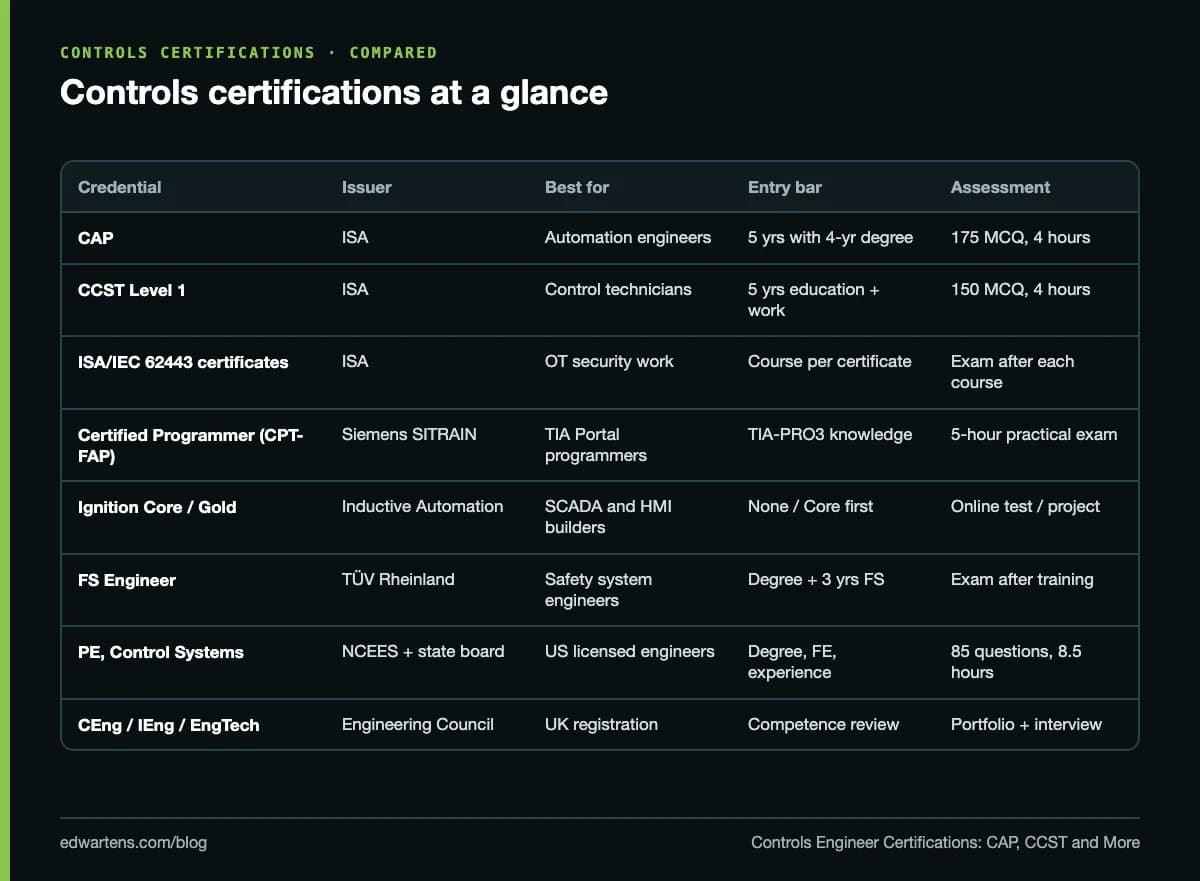
The main controls engineer certifications are ISA's Certified Automation Professional (CAP) for experienced automation engineers, ISA's Certified Control Systems Technician (CCST, three levels) for instrument and control technicians, the ISA/IEC 62443 cybersecurity certificates, vendor credentials from Siemens, Rockwell Automation and Inductive Automation, and functional safety certificates such as TÜV Rheinland's FS Engineer. A licence is a separate thing: in the US it is the Professional Engineer (PE) licence, with its own Control Systems exam, and in the UK it is voluntary registration as a Chartered Engineer, Incorporated Engineer or Engineering Technician.
Checked on 11 October 2026 against the sources listed under this post.
Lists of "best certifications" often mix these up. This guide separates them, gives the eligibility rules and exam format from each issuer's own page, and is honest about what a free course certificate is worth.
What counts as a controls engineer certification?
Four kinds of credential get called a "certification", and employers weigh them differently.
- A professional certification is an independent assessment of your competence against a published body of knowledge, usually with an experience requirement, an exam and a renewal cycle. CAP and CCST are examples.
- A certificate programme is a course followed by an exam on what the course taught, usually with no experience requirement. The ISA/IEC 62443 certificates and Rockwell's certificate programmes work this way.
- A vendor certification is proof that you can use one company's platform to that company's standard, such as Siemens TIA Portal or Ignition.
- A licence or registration is a legal or professional status granted by a regulator or a licensed institution: the PE in the US, CEng in the UK.
What is the ISA Certified Automation Professional (CAP)?
The Certified Automation Professional (CAP) is ISA's vendor-neutral certification for automation engineers who design, build and run control systems. It is the closest thing to a general "automation controls engineer certification".
CAP eligibility
According to ISA's CAP requirements page:
- With a four-year technical degree (engineering, chemistry, physics, maths or another technical field), you need at least 5 years in automation, documented as 7,500 hours within the 5 years before you apply. ISA counts a year as 1,500 hours.
- With a two-year degree or no degree, you need at least 10 years (15,000 hours). An associate degree in automation or a related technology counts as two years of experience.
- Without a four-year degree, at least two years must be in "responsible charge", backed by two signed references, one from a current or former supervisor. Management, administration and marketing roles do not count.
- Passing the CAP Associate certificate exam counts as one year towards the total.
CAP exam format and cost
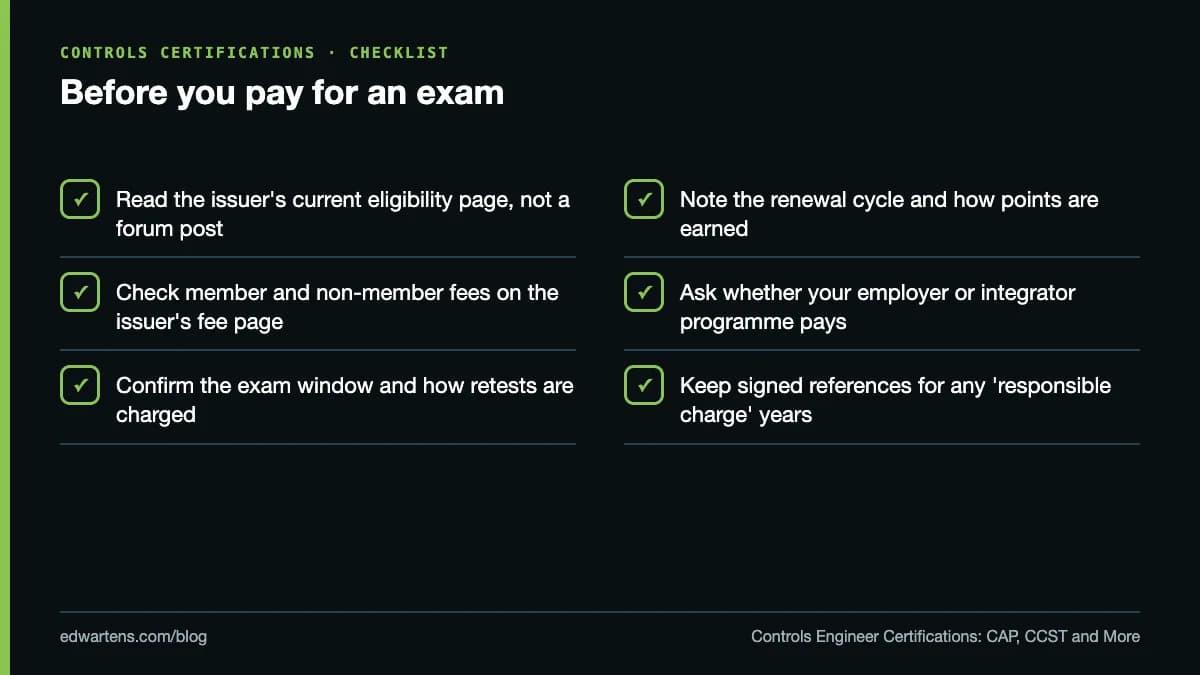
The CAP exam has 175 multiple-choice questions in four hours, closed book, taken online at home or at a Meazure Learning test centre. ISA does not give you a score: you see pass or fail, and a domain report only if you fail. ISA runs CAP review courses, but the exam fee is not included in them. ISA's certification FAQ (read 11 October 2026) lists the CAP exam at 373 US dollars for members and 467 US dollars for non-members, with a retest at 164 or 205 US dollars. You renew by earning professional development points over three years.
People also search for a "certified automation professional salary". We could not find any government data that separates CAP holders from other engineers, so we do not quote one. For market pay, see our PLC programmer salary by country guide.
What is the ISA CCST, and which level should you take?
The Certified Control Systems Technician (CCST) is ISA's certification for technicians who calibrate, maintain, repair and troubleshoot measurement and control systems. It has three levels, and the years below are combined education, training and work experience, which may not overlap (ISA CCST requirements).
| Level | Minimum years | Of which in work | Exam | Fee, member / non-member |
|---|---|---|---|---|
| Level 1, CCST | 5 | 1 year related work | 150 questions, 4 hours | 331 / 415 USD |
| Level 2, CCST Specialist | 7 | 2 years in I&C | 125 questions, 3 hours | 315 / 397 USD |
| Level 3, CCST Master | 13 | 5 years in I&C | 150 questions, 4 hours | 331 / 415 USD |
Fees are from ISA's certification FAQ, read 11 October 2026. A registered apprenticeship in instrumentation, electrical, electronics or mechanical programmes, or a related degree counted for up to four years, can make up the education part. Completing ISA's CST Associate programme counts as one year. Level 2 and Level 3 add supervision and management knowledge to the technical content.
For a study guide, start with the topics the exam actually tests: instrument calibration, loop checking, troubleshooting and documentation. Our free Instrument Calibration, Loop Checks and Commissioning course and Industrial Instrumentation and Process Control course cover that ground, though they are not ISA review courses.
Which certifications cover OT security and functional safety?
ISA/IEC 62443 cybersecurity certificates
The ISA/IEC 62443 Cybersecurity Certificate Program has four certificates, each earned by taking a course and passing its exam: Fundamentals Specialist (course IC32, no prerequisite), then Risk Assessment Specialist (IC33), Design Specialist (IC34) and Maintenance Specialist (IC37). Holding all four earns the Cybersecurity Expert title automatically. ISA states that the certificates do not need renewing. If you want the background first, our free IEC 62443 training guide and the free OT and ICS Cybersecurity with ISA/IEC 62443 course explain the standard.
TÜV Rheinland FS Engineer
TÜV Rheinland's FS Engineer certificate requires an engineering degree, at least three years of practical functional safety experience, the complete training and a passed exam. Passing the exam alone does not earn it; if you lack the three years, the certificate is issued once you reach them. Areas include safety instrumented systems, IEC 61508 design and machinery safety. It is valid for five years, and the first five-year extension costs 400 euros.
Do Siemens, Rockwell and Inductive Automation certify programmers?
Yes, and for a first or second job these often matter more than CAP, because an advert names a platform.
- Siemens. SITRAIN's Siemens Certified Programmer in TIA Portal (CPT-FAP) is a three-day face-to-face course: two days of theory, then a 5-hour practical exam in which you write and commission a PLC program on an S7-1500, ET 200SP, TP700 panel and SINAMICS G120 plant model. Knowledge to the level of the TIA-PRO3 course is required. Our free Siemens TIA Portal course is a starting point before SITRAIN.
- Rockwell Automation. The certificate programmes (Logix Programmer, Logix Maintainer, Kinetix 5700 motion and PowerFlex 750 drives) combine required and elective courses with an online final assessment. On the traditional path, all courses and the test must be completed within 18 months.
- Inductive Automation. The Ignition Core test is an online, auto-graded exam at 350 US dollars, completed within 30 days of purchase. Gold needs Core first, costs 500 US dollars and is a manually graded practical submitted within six months. Inductive University's video courses are free, but Inductive Automation states that certification is "only earned through a certification test". Certifications last three years.
Is there a controls engineer licence?
United States: the PE in Control Systems
US engineering licences are issued by each state. The BLS notes that a licence is not required for entry-level jobs, and that a PE typically needs an engineering degree, a passed Fundamentals of Engineering (FE) exam, several years of experience and a passed PE exam. The NCEES PE Control Systems exam is computer-based, with 85 questions in an 8.5-hour exam within a 9.5-hour appointment, offered once a year (next date 14 April 2027) at Pearson test centres. The NCEES fee is 400 US dollars, and your state board may add its own. It is designed for engineers with at least four years of post-college experience.
| PE Control Systems knowledge area | Questions |
|---|---|
| Measurement | 17 to 27 |
| Control systems (drawings, PID, PLC and DCS, HMI, commissioning, security) | 17 to 27 |
| Final control elements (valves, relief devices, motor controls) | 14 to 23 |
| Signals, transmission and networking | 11 to 18 |
| Safety systems (SIL selection and verification) | 11 to 19 |
Source: NCEES exam specifications, effective 1 October 2022, topics unchanged since October 2019.
United Kingdom: Chartered, Incorporated or Technician
The Engineering Council's FAQ is plain: "Engineers do not require a licence to practise in the UK." Registration is a professional title instead. You join a licensed institution, which assesses your competence against UK-SPEC through a portfolio and a professional review. An accredited degree helps but is not required. For controls work, the Institute of Measurement and Control is licensed by the Engineering Council to award CEng, IEng and EngTech.
How to choose the right certification
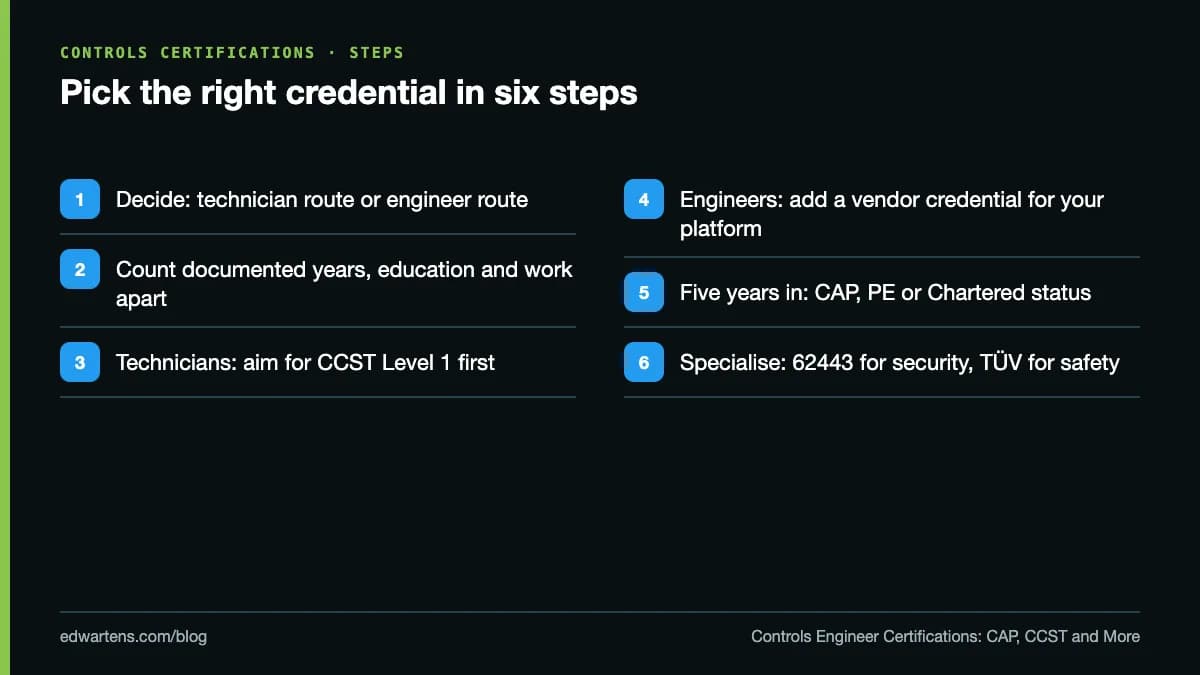
- Pick your route. Technicians who calibrate and maintain loops point towards CCST; engineers who design and program systems point towards a vendor credential, then CAP or a PE.
- Count your documented years. Both ISA certifications count education and work separately, and neither lets them overlap.
- Match the platform in the adverts you want. If they say TIA Portal, Studio 5000 or Ignition, that vendor's credential is the stronger signal.
- Plan the long credential. At about five years, decide between CAP, a PE (US) or Chartered status (UK). They suit different markets, not different abilities.
- Specialise if your sector demands it. OT security roles ask for ISA/IEC 62443; process safety roles ask for SIS and TÜV-style certificates.
Where do free course certificates fit?
A free course certificate is proof of completion, not a professional certification. It tells an employer you finished a course; it does not test you against an industry body's standard or verify your experience. Our guide to whether free PLC certificates are worth it explains when they help on a CV.
The same applies to ours. Every EDWartens course is free in full, and the optional EDWartens Certificate of Completion, from US$8.99, is not a vendor credential (not a Siemens, Rockwell or ISA certification) and is not accredited. Anyone can check one at edwartens.com/verification; our post on how to verify an engineering training certificate shows how employers do that for any provider. For where certifications sit in a whole career, read our automation engineer career guide, and use how to become a controls engineer for the step-by-step route.
Take the free course
 Free
FreeInstrumentation · Beginner · Free
Industrial Instrumentation and Process Control
 Free
FreeInstrumentation · Beginner · Free
Instrument Calibration, Loop Checks and Commissioning
 Free
FreeCybersecurity · Intermediate · Free
OT and ICS Cybersecurity with ISA/IEC 62443
 Free
FreePLC programming · Beginner · Free
Siemens TIA Portal
Questions
What is the best certification for a controls engineer?
For an experienced automation engineer, the ISA Certified Automation Professional (CAP) is the broadest vendor-neutral certification; it needs five years of automation work with a four-year technical degree, or ten years without one. Early in a career, a vendor credential for the platform you use, such as Siemens Certified Programmer or Ignition Core, is usually more useful to an employer. In the US the PE licence, and in the UK Chartered Engineer registration, carry more weight than any single certification.
What is the difference between ISA CAP and CCST?
CAP is for automation engineers and tests the whole project lifecycle in a 175-question, four-hour exam. CCST is for control systems technicians who calibrate, maintain and troubleshoot instruments and loops, and has three levels with 125 to 150 questions each. Both are issued by ISA and renewed by professional development points over three years.
How much does the ISA CCST exam cost?
ISA's certification FAQ, read on 11 October 2026, lists the CCST Level 1 exam at 331 US dollars for ISA members and 415 US dollars for non-members. A retest is 164 or 205 US dollars. Fees change, so check ISA's fee page before you apply.
Is there a licence for controls engineers?
In the United States, yes: state boards license Professional Engineers, and NCEES sets a PE Control Systems exam, offered once a year, with the next sitting on 14 April 2027. In the UK, the Engineering Council states that engineers do not need a licence to practise; Chartered, Incorporated and Engineering Technician registration are voluntary professional titles awarded through institutions such as InstMC.
Can I get the ISA CCST Level 1 without a degree?
Yes. CCST Level 1 needs at least five years of combined education, training and related work experience, including at least one year of work. An apprenticeship in instrumentation, electrical or electronics, or a related degree counted for up to four years, can make up the education part, but education and work periods may not overlap.
Is a free course certificate a professional certification?
No. A certificate from a free online course proves you completed that course; it does not assess you against an industry body's standard or check your work experience. It is useful evidence of learning on a CV, but it is not a CAP, CCST, vendor certification or licence.
Sources
- ISA: Certified Automation Professional (CAP), exam format (read 11 October 2026)
- ISA: CAP Requirements, eligibility and responsible charge (read 11 October 2026)
- ISA: Certified Control Systems Technician (CCST), levels and exams (read 11 October 2026)
- ISA: CCST Requirements, eligibility by level (read 11 October 2026)
- ISA: Certification FAQs, fee table and recertification (read 11 October 2026)
- ISA: ISA/IEC 62443 Cybersecurity Certificate Program (read 11 October 2026)
- NCEES: PE Control Systems exam (read 11 October 2026)
- NCEES: PE Control Systems CBT Exam Specifications, effective 1 October 2022
- Engineering Council: Becoming professionally registered (read 11 October 2026)
- Engineering Council: FAQs, professional registration (read 11 October 2026)
- Institute of Measurement and Control: Professional registration (read 11 October 2026)
- Siemens SITRAIN: Siemens Certified Programmer in TIA Portal (CPT-FAP) (read 11 October 2026)
- Rockwell Automation: Certificate Programs (read 11 October 2026)
- Inductive Automation: Ignition Certification Tests (read 11 October 2026)
- Inductive Automation: Training Classes and Certification (read 11 October 2026)
- TÜV Rheinland: FS Engineer certificate requirements (read 11 October 2026)
- US Bureau of Labor Statistics: Electrical and Electronics Engineers, How to Become One (modified 27 August 2026)
Written by the EDWartens engineering team for general education. Product names are trademarks of their owners; mentioning them does not imply endorsement. Prices and terms of other providers were checked on the date shown and can change.

How to Build an Engineering Portfolio From Course Projects (Automation and Controls)

ATS-Friendly CV for Automation, PLC and Controls Engineers: Keywords, Bullets and Mistakes

PLC Interview Questions and Answers: 30 Questions With Model Answers

PLC and Automation Jobs by Country: How to Search Internationally
4-20 mA Current Loop Explained: Wiring, Loop Power and Faults (Video)

How to Become a SCADA Engineer: Skills, Tools and a Free Path