SCADA CAREER
How to Become a SCADA Engineer: Skills, Tools and a Free Path
What SCADA engineers do in water, power, oil and gas and pharma, the five skill blocks employers ask for, a free 16-week route, portfolio projects and the usual ways in.

How to become a SCADA engineer, in one paragraph: learn the basics of one PLC, then one SCADA platform in depth (Ignition, WinCC or similar), the industrial protocols that connect them, enough SQL to work with historians and reports, and the basics of OT security. Then prove it with one complete project. Most people get in through a system integrator, a utility or a machine builder, usually from a PLC, instrumentation or IT background.
Written 5 October 2026.
This guide starts with the job, because the skills only make sense once you know what a SCADA engineer spends the day doing.
What does a SCADA engineer do?
SCADA (supervisory control and data acquisition) is the layer above the PLCs. The PLCs run the machines. The SCADA system collects their data, shows it to operators on screens, raises alarms, stores history and lets operators send commands: start a pump, change a set point, acknowledge an alarm. On a water network or a pipeline it does this across hundreds of remote sites; in a factory it may cover one building.
A SCADA engineer's work typically includes:
- configuring device connections and tags (the named data points from each PLC)
- designing operator screens and navigation
- setting up alarms, priorities and alarm notifications
- logging history and building reports and trends
- connecting the system to databases, MES or business systems
- managing users, redundancy, backups and security
- commissioning, then supporting the system for years
The work looks different in each sector:

SCADA, HMI and DCS: what is the difference?
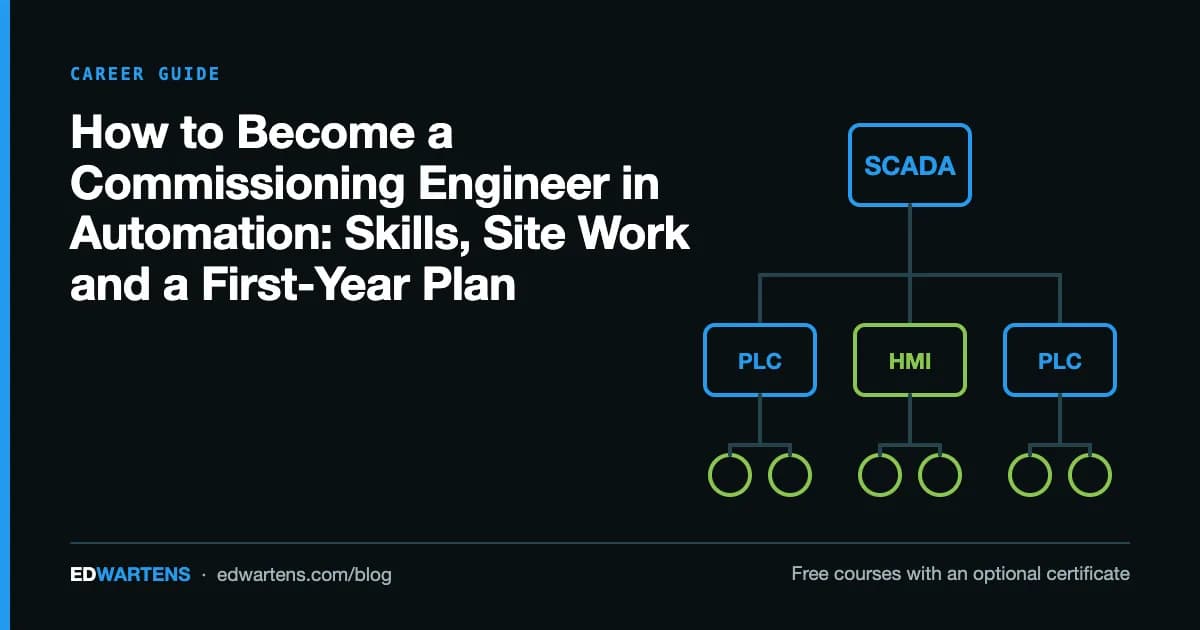
An HMI is usually one operator panel or screen for one machine, talking to one PLC. SCADA supervises many controllers, often across many sites, with central alarms, history and users. A DCS (distributed control system) is a single vendor's integrated system of controllers and operator stations, built for continuous process plants such as refineries and chemical works. The skills overlap, and many engineers move between them, but SCADA work is the one that most often spans long distances and mixed equipment from different vendors.
For a closer look at one sector, read our guides to water treatment automation and renewable energy automation. For the architecture itself, our SCADA training guide explains servers, clients, historians and redundancy.
SCADA engineer skills: what employers ask for
SCADA adverts across the US, UK, Europe, the Gulf, Australia and South Africa list much the same things. They fall into five blocks:

1. PLC basics
You do not have to be a PLC expert, but you must read PLC code, understand inputs and outputs, and know how a 4-20 mA signal becomes an engineering value. Example: a level transmitter ranged 0 to 5 m sends 12 mA. That is (12 - 4) / 16 = 50% of span, so the SCADA screen should show 2.5 m. If it shows something else, the scaling is wrong in the PLC or the tag, and finding which is a SCADA engineer's job. Our free 4-20 mA Scaling Calculator does the arithmetic. Our post on PLC and SCADA training together explains why the two skills go hand in hand.
2. One SCADA platform, in depth
Pick one platform and learn it from tags to alarms to history. Employers care more that you know one well than that you have touched five. Inductive Automation's own Inductive University teaches Ignition free, and the software runs in a free trial mode. If you later want a vendor credential, Inductive Automation sells certification tests: US$350 for Core and US$500 for Gold, with Core required before Gold. Siemens, AVEVA and Rockwell Automation also sell instructor-led training on their own platforms through their training centres. None of these is needed for a first job: a junior engineer who can show a working project is usually hired on that, and the employer often pays for vendor training later.
3. Networks and protocols
SCADA is mostly communication. Learn Ethernet and IP addressing, Modbus RTU and TCP, and OPC UA, the OPC Foundation's platform-independent standard for exchanging industrial data. Then add what your sector uses: DNP3 in water and power in North America and Australia, IEC 61850 and IEC 60870-5-104 in substations, PROFINET or EtherNet/IP in factories. Our Modbus tutorial and OPC UA explainer are good starting points, and MQTT Sparkplug B explained covers how data leaves the plant.
4. SQL and historians
Alarms, trends, batch records and reports all end up in databases. You should be able to write a SELECT with a WHERE clause, join two tables and group results. For example: one query that returns each pump's total run hours per day, from a table of start and stop events, is a realistic first task on a water project.
5. OT security
SCADA servers are the bridge between plant and office, so they are a target. CISA's advisory AA26-097A (7 April 2026, updated 22 July 2026) described attackers manipulating data on HMI and SCADA displays after getting into internet-exposed PLCs. Understand zones and conduits, secure remote access and backups. NIST's SP 800-82 Rev. 3 is the standard reference, and our post on free IEC 62443 training lists free ways to learn it.
How to become a SCADA engineer in 16 weeks, free
With a technical background and about eight to ten hours a week, sixteen weeks gets you to a junior level:

Mapped to free courses:
- PLC basics: Siemens TIA Portal or Allen-Bradley Studio 5000, with a simulator.
- Protocols: Industrial Communication, which covers RS-485, Modbus, PROFINET, EtherNet/IP and OPC UA.
- First platform: Ignition SCADA (gateway, tags, Designer, alarms, SQL history, Perspective) or Siemens WinCC SCADA.
- SQL: SQL for PLC and SCADA Engineers, with MySQL or SQL Server Express, both free.
- Breadth: the SCADA specialist learning path groups four of the most widely installed platforms: InTouch, Ignition, WinCC and Citect. Spend a week on a second one so you can talk about the differences.
- Security: ICS Security Foundations.
Every SCADA course is listed under free SCADA courses. For a first hands-on session, our walkthrough of an Ignition first project takes you from install to a first screen, and Inductive Automation's own Getting Started with Ignition video is a good companion.
Portfolio projects that get interviews
One finished project beats five half-done ones. Good choices:
- Water pump station. Two duty and standby pumps, a level transmitter, a simulated PLC, an Ignition or WinCC screen with alarms, and a daily run-hours report from SQL.
- Tank farm with history. Three tanks, level and temperature trends, high and low alarms with priorities, and an alarm summary.
- Line OEE dashboard. Count good and rejected parts from a simulated machine and display availability, performance and quality.
- Remote telemetry outstation. A small PLC reporting over Modbus TCP to a central server, with a communications-failure alarm and a last-good-value display. It shows you understand the problem that defines SCADA: data from far away that sometimes stops arriving.
Write a short functional description, record a two-minute video, and put the screenshots in your CV. Our guide to a portfolio from course projects shows how to present it.
What interviewers ask junior SCADA engineers
Expect practical questions rather than theory. Common ones:
- A value on the screen is frozen. Where do you look first? (Communication status, the tag quality, then the PLC.)
- How would you design alarm priorities so operators are not flooded?
- What is the difference between polling a device and subscribing to changes?
- How would you store a year of one-second data without filling the disk? (Deadbands, compression and a historian.)
- How should an engineer connect to a remote site for support?
Our PLC interview questions and answers cover the controller side of the same interview.
Ways into a SCADA job
- System integrators hire the most junior SCADA engineers and give the widest exposure, at the cost of travel.
- Utilities (water, power) hire SCADA and telemetry engineers and value stability and security knowledge.
- Equipment makers need engineers to configure and support their own monitoring systems.
- From PLC or instrumentation roles: many SCADA engineers start as PLC programmers or technicians and move up a layer.
- From IT: network and database skills transfer well; add PLC basics and plant knowledge.
Look for "SCADA engineer", "SCADA developer", "telemetry engineer" and "control systems engineer" on our free job board, and read our automation engineer career guide for how roles progress. For pay, our post on PLC programmer salaries by country gives sourced ranges; SCADA roles sit close to them. Some SCADA support roles are hybrid; see remote PLC programming jobs.
All these courses are free in full. If you want proof of completion, an optional EDWartens Certificate of Completion, from US$2.99, can be checked at edwartens.com/verification. It is not a vendor certification and is not accredited. Our comparison of free SCADA courses with certificate covers the other options.
Take the free course

SCADA · Beginner · Free
Ignition SCADA by Inductive Automation

SCADA · Intermediate · Free
Siemens WinCC SCADA: V7, Unified and Advanced

Data and analytics · Beginner · Free
SQL for PLC and SCADA Engineers

Industrial networks · Intermediate · Free
Industrial Communication: Serial, Fieldbus, Ethernet, Modbus, PROFINET and OPC UA
Questions
What does a SCADA engineer do?
A SCADA engineer builds and looks after the supervisory system that lets operators see and control a plant or a spread-out network of sites. That means configuring tags and device connections, drawing screens, setting up alarms and history, connecting databases and keeping the system secure and running.
Do I need to know PLC programming to work in SCADA?
You need to read PLC programs and understand tags, I/O and scaling, because SCADA sits on top of the controllers. You do not need to be an expert PLC programmer, but engineers who can do both are the easiest to hire.
Which SCADA software should I learn first?
Learn one platform properly before sampling others. Ignition is a good first choice because its training at Inductive University is free and the software has a free trial mode. If the jobs near you use Siemens, AVEVA or Citect, pick that instead.
How long does it take to become a SCADA engineer?
With a technical background, about four months of steady part-time study is enough to reach a junior level: PLC basics, one platform, protocols, SQL and a portfolio project. Becoming a confident engineer takes a year or two of real projects.
Is SCADA a good career?
Yes, for people who like both plant and software. Water, power, renewables, oil and gas and manufacturing all run SCADA, and OT security has made the work more important. Pay is close to PLC and controls roles, and rises with process and security experience.
Is SQL needed for SCADA?
Increasingly, yes. Historians, reports, batch records and many dashboards read from relational databases, and adverts often list SQL. Basic SELECT queries, joins and grouping cover most of what a junior SCADA engineer needs.
Sources
- Inductive University: free Ignition training from Inductive Automation
- Inductive Automation: Ignition certification tests (Core US$350, Gold US$500)
- OPC Foundation: What is OPC UA?
- CISA advisory AA26-097A: Iranian-affiliated cyber actors exploit PLCs (7 April 2026, updated 22 July 2026)
- NIST SP 800-82 Rev. 3: Guide to Operational Technology (OT) Security (September 2023)
- Inductive Automation: Getting Started with Ignition (YouTube)
Written by the EDWartens engineering team for general education. Product names are trademarks of their owners; mentioning them does not imply endorsement. Prices and terms of other providers were checked on the date shown and can change.

Free Learning Paths to a Controls, Automation or Industrial AI Role: Plan a Self-Taught Route

A Free Industrial Automation Course With Certificate: A 12-Week Curriculum
How to Become a Commissioning Engineer in Automation: Skills, Site Work and a First-Year Plan

ATS-Friendly CV for Automation, PLC and Controls Engineers: Keywords, Bullets and Mistakes

Node-RED PLC Dashboard: Read Live Data and Build an Operator Page (Video)

Are Free PLC Certificates Worth It? What Employers Actually Check