CAREER GUIDE
How to Become a Commissioning Engineer in Automation: Skills, Site Work and a First-Year Plan
What commissioning engineers actually do on site, how FAT, SAT and loop checks fit together, the skills and tickets employers ask for, and a realistic 12-month plan to get there.
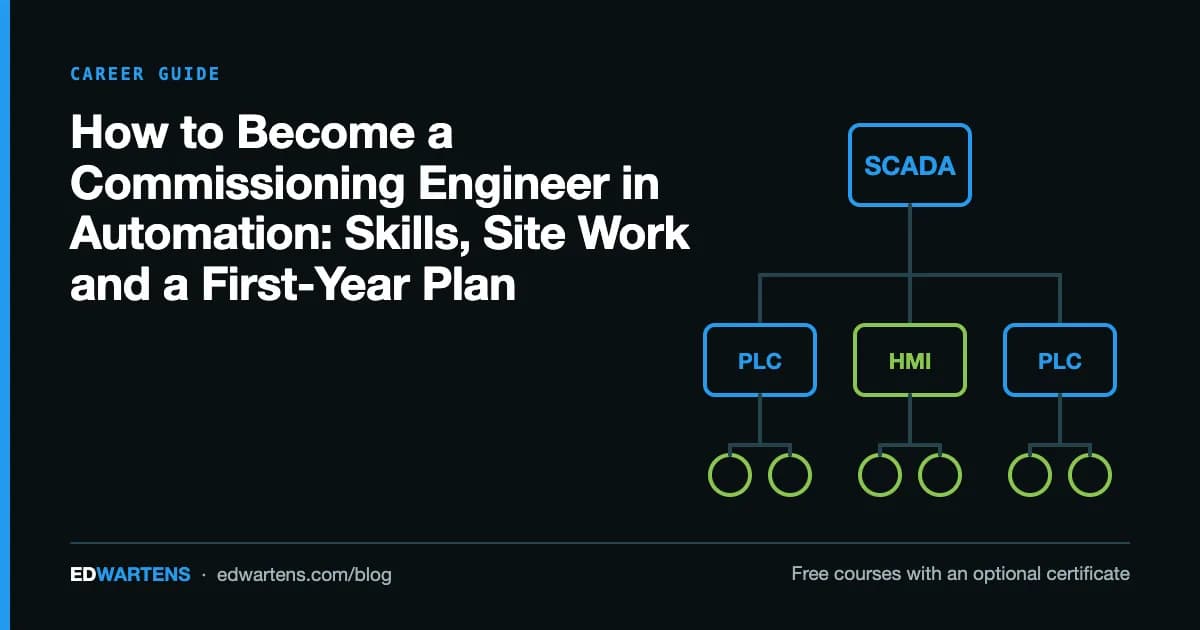
To become a commissioning engineer in controls and automation, build a base in electrical safety and PLC programming, learn to test systematically (I/O and loop checks, FAT and SAT), and get onto a site as a junior or assistant commissioning engineer, usually from an electrical, instrument or PLC role. Most employers ask for an engineering degree or a time-served electrical or instrument apprenticeship, plus a willingness to travel.
Checked 5 October 2026.
This guide covers what the job involves, the skills employers look for, and a 12-month plan to get there. It does not cover pay, which varies too much by country and sector to be useful here.
What does a commissioning engineer actually do?
A commissioning engineer tests equipment on site and makes sure everything the client needs is installed correctly and safely and works as designed, then hands it over. The TARGETjobs job description adds the parts people forget: investigating problems, liaising with clients and installers, and supervising technical staff.
In automation, a typical week might include:
- Checking that every field device is wired to the right PLC terminal.
- Loop-checking transmitters and valves from the field to the HMI.
- Testing interlocks and alarms against the cause-and-effect chart.
- Setting up drives and tuning PID loops on the real process.
- Fixing the things that do not work, and recording what you changed.
- Running acceptance tests with the client and signing off test sheets.
Commissioning engineers work for machine builders, system integrators, engineering contractors, building services firms, utilities and power companies. TARGETjobs is honest about the conditions: travel to sites that can be remote, time away from home, and unsociable hours around deadlines or on plants that never stop.
How commissioning fits together
Commissioning is a sequence, and each stage proves something before the next one depends on it.
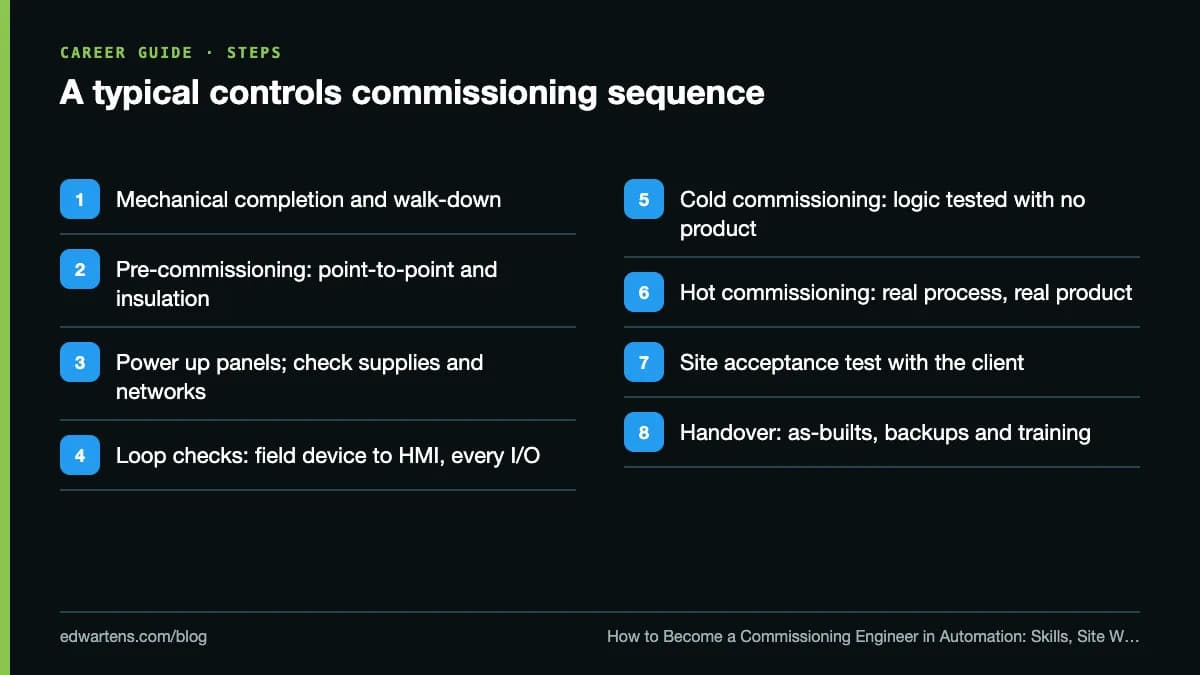
The order is the point. A loop check assumes the wiring is right; cold commissioning assumes the loops are right; hot commissioning assumes the logic is right. Skipping a stage moves its problems to a stage where they are slower and more dangerous to find.
FAT, SAT and SIT
The formal tests have an international standard behind them. IEC 62381:2024 sets out requirements and checklists for the factory acceptance test, an optional factory integration test, the site acceptance test and the site integration test of automation systems in the process industry. Its purpose is to let the owner, the buyer and the vendor agree in advance what will be tested and who is responsible.
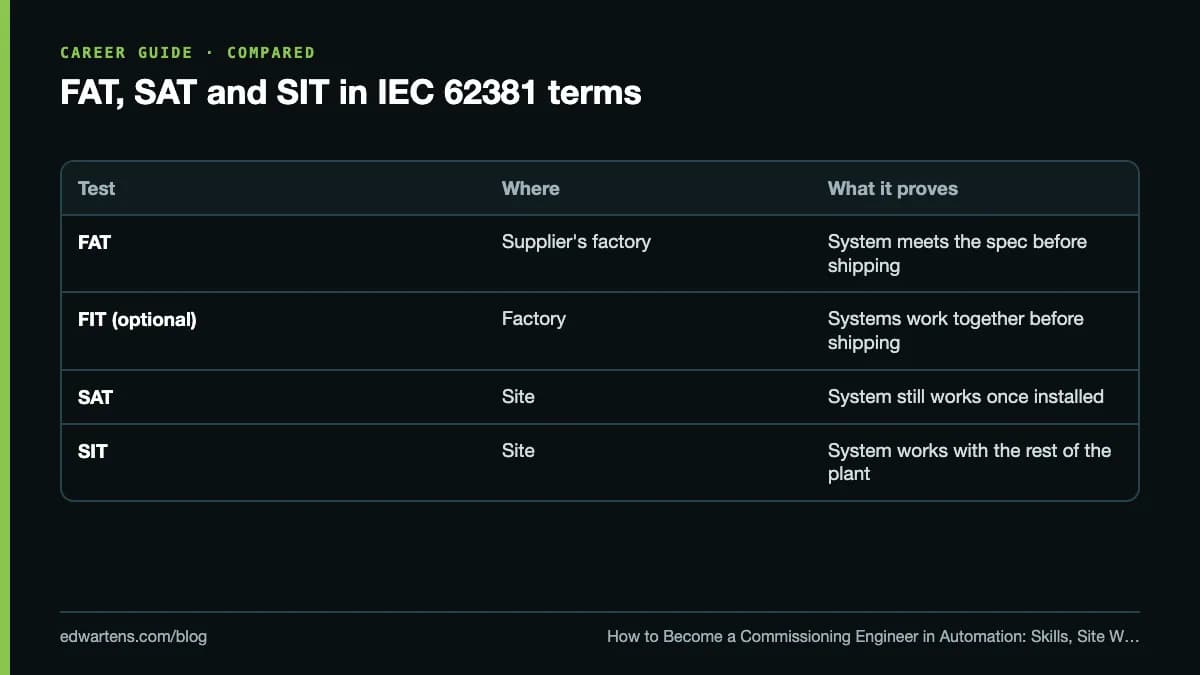
Even outside the process industry, most machine builders follow the same shape: a FAT at their works, a SAT at the customer's site, and a punch list of items to close before handover.
The skills employers look for
1. Electrical safety, before anything else
On site you will isolate equipment before you work on it, often many times a day. In the US, OSHA's lockout/tagout standard (29 CFR 1910.147) sets out how hazardous energy must be controlled during servicing and maintenance. In the UK, the HSE's guidance is that it is never absolutely safe to work live, and that safe isolation means isolating every energy source (electrical, pneumatic, hydraulic, mechanical), locking it, keeping the key and posting warning notices. Whatever country you work in, learn your site's permit system and never test or force anything you have not confirmed is safe.
2. Reading drawings
You must read schematics, terminal plans, P&IDs, loop drawings and cause-and-effect charts fluently. Our guide to reading a P&ID is a good start on the process side.
3. PLC and HMI programming, especially online work
Commissioning is mostly online work on a running controller: monitoring, forcing with care, editing logic without stopping the machine, taking backups and comparing versions. You need to know the platform the site runs, which is usually Siemens or Rockwell, with others by region and industry. Our PLC programming guide covers the basics.
4. Instruments, drives and networks
Expect to scale a 4-20 mA signal, set up a VFD from its nameplate, and find out why a PROFINET or EtherNet/IP device will not come online. These three cause a large share of commissioning delays.
5. Documentation
Every loop you check, every parameter you change and every red-line on a drawing has to be recorded. Clients accept systems on evidence, not on your word.
Site tickets and certificates
Requirements depend on the country, the industry and the site. Almost every site needs a safety induction and evidence that you are competent for electrical work. On oil, gas, chemical and other hazardous-area sites, competence to the IEC 60079 series for explosive atmospheres is usually checked. CompEx is a widely recognised scheme for this: it certifies electrical and mechanical workers against the competence requirements of IEC 60079 parts 10, 14 and 17, and is accredited by UKAS to ISO/IEC 17024. Vendor courses on the site's PLC, DCS or drives also count.
Routes into commissioning
- From an electrical or instrument technician role. You already isolate, test and fault-find. Add PLC programming and documentation and move into controls commissioning.
- From a PLC programmer at a system integrator or machine builder. Ask to go to site for FATs and installations. Most integrators need people willing to travel.
- As a graduate. Join an integrator, contractor or OEM graduate scheme and ask for site rotations early. Our guide to automation training for fresh graduates covers the first steps.
A 12-month plan
Months 1 to 3: the electrical base. Take Electrical Fundamentals for Technicians: multimeter use, three-phase basics and reading drawings. Learn your country's isolation rules.
Months 4 to 6: one PLC platform, properly. Take a free PLC course on the platform the jobs near you ask for. Then take Siemens TIA Portal Commissioning: Hardware, PLCSIM, Backups and Troubleshooting, which is about getting a program into a real machine and keeping it there.
Months 7 to 9: virtual commissioning. In TIA Portal with Factory I/O you test your logic against a simulated machine. Write a functional specification, an I/O list and a FAT checklist, then run your own FAT and record the results. That pack is something to show an employer; see our guide to building an engineering portfolio.
Months 10 to 12: networks and the job hunt. Take Industrial Communication to cover Modbus, PROFINET and OPC UA. Then search for junior or assistant commissioning roles on the job board or by country, for example the United Kingdom, United States or UAE. Check your CV with the ATS Resume Checker and practise with Interview Question Prep.
Mistakes new commissioning engineers make
- Forcing outputs without a second check. Confirm what the output drives and that the area is clear first.
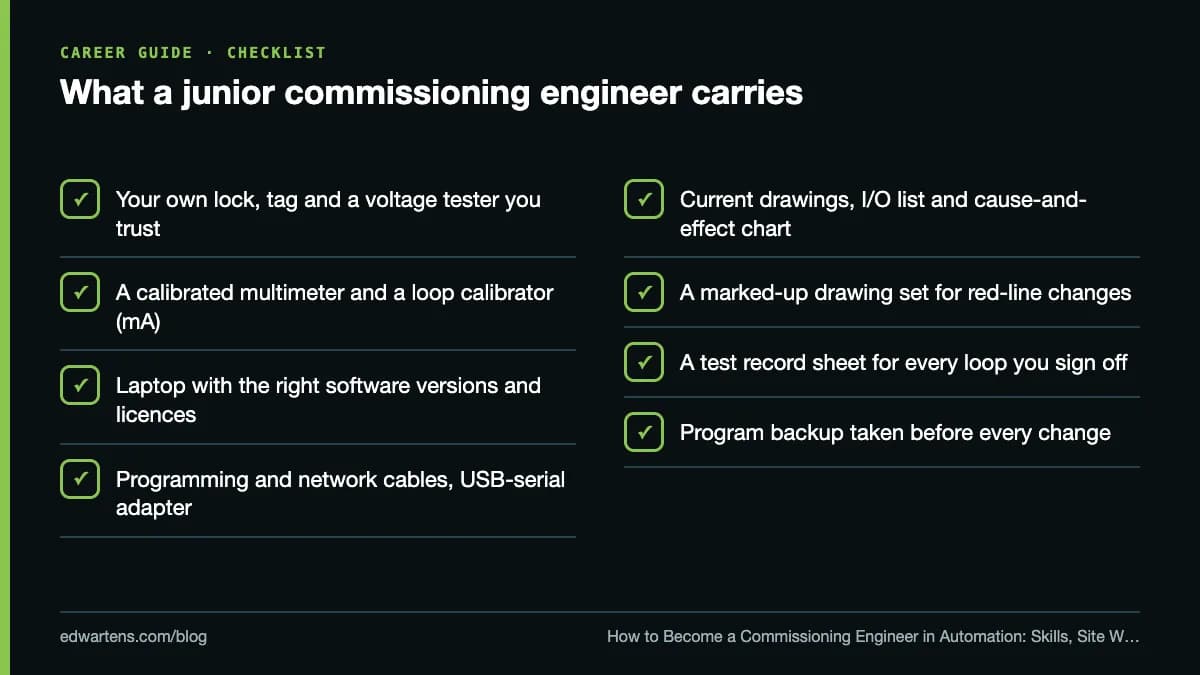
- Changing logic without a backup. Take one before every change, and name it with the date.
- Not writing things down. If it is not on a test sheet, it did not happen.
- Fixing the symptom and moving on. A loop that reads wrong because of a scaling error will read wrong on every similar loop.
- Arguing with the client on site. Record the issue, agree who owns it, and escalate through the project manager.
Where the free courses help, and where they do not
The courses above teach the methods and let you practise them on simulators. They do not replace supervised site experience, a safety induction or any legally required electrical qualification. If you want proof of study, each course has an optional EDWartens Certificate of Completion, from US$2.99, issued after you pass the final assessment and verifiable at edwartens.com/verification. It is not a vendor certification and is not accredited. For the wider picture of automation roles, read our automation engineer career guide.
Take the free course

PLC programming · Intermediate · Free
Siemens TIA Portal Commissioning: Hardware, PLCSIM, Backups and Troubleshooting

PLC programming · Beginner · Free
Siemens TIA Portal with Factory I/O: Virtual Commissioning Projects

Electrical · Beginner · Free
Electrical Fundamentals for Technicians: Volts to Multimeter to Drawings

Industrial networks · Intermediate · Free
Industrial Communication: Serial, Fieldbus, Ethernet, Modbus, PROFINET and OPC UA
Questions
What does a commissioning engineer do?
They test equipment and systems on site to prove they were installed correctly and safely and work as designed, then hand them over to the client. In controls and automation that means checking wiring and I/O, loop-checking instruments, testing PLC and SCADA logic, tuning loops and drives, fixing faults and writing up the results.
Do you need a degree to be a commissioning engineer?
Many employers ask for an engineering degree in electrical, mechanical or a related discipline. A time-served electrical or instrument apprenticeship plus several years of site experience is the other common route, especially for electrical and instrument commissioning technicians who later move up.
What is the difference between FAT and SAT?
A factory acceptance test (FAT) happens at the supplier's works before shipping and proves the system meets the specification. A site acceptance test (SAT) repeats the key tests after installation, on site, with real wiring and field devices. IEC 62381 defines both, plus an optional factory integration test and a site integration test.
Is commissioning a good job for a PLC programmer?
Yes, it is one of the fastest ways to get better. On site you see your code meet real devices, real faults and real operators. Expect travel, time away from home and long hours near deadlines, which is why some engineers do a few years of commissioning and then move into design or project roles.
What certificates help a commissioning engineer get on site?
It depends on the country and the site. Most sites require site safety induction and evidence of electrical competence. For hazardous areas, competence to IEC 60079 is usually checked, and CompEx is a widely recognised scheme for that. Vendor training on the plant's PLC, drives or DCS also helps.
How do I get commissioning experience with no site access?
Practise the method on a simulator. Write a program, connect it to a virtual machine in Factory I/O or PLCSIM, write a loop-check sheet for every I/O point, run a mock FAT against your own functional specification and record the results. It is not site experience, but it is evidence you know the process.
Sources
- TARGETjobs: Commissioning engineer job description
- IEC 62381:2024 Automation systems in the process industry: FAT, SAT and SIT
- OSHA: Control of Hazardous Energy (Lockout/Tagout), 29 CFR 1910.147
- HSE: Electricity at work FAQs (safe isolation, live working, competence)
- Wikipedia: CompEx (competency in explosive atmospheres)
Written by the EDWartens engineering team for general education. Product names are trademarks of their owners; mentioning them does not imply endorsement. Prices and terms of other providers were checked on the date shown and can change.


