INDUSTRIAL ETHERNET
PROFINET vs EtherNet/IP: Differences, Speed and Which to Learn
A fair comparison of PROFINET and EtherNet/IP: how each moves I/O data, real-time and motion options, ring redundancy, device files and addressing, 2026 market share, and which one to learn first for the jobs near you.
PROFINET vs EtherNet/IP comes down to ecosystem more than speed. Both are industrial Ethernet protocols that move real-time I/O data between PLCs and field devices over standard Ethernet. PROFINET is managed by PI (PROFIBUS & PROFINET International) and is the native network of Siemens controllers; EtherNet/IP is managed by ODVA, carries the Common Industrial Protocol (CIP), and is the native network of Rockwell Automation's controllers. Learn the one your plant or target employer uses.
Checked 5 October 2026 against ODVA, PI and HMS Networks publications.
What are PROFINET and EtherNet/IP?
EtherNet/IP puts CIP, the protocol also used by DeviceNet and ControlNet, on top of standard Ethernet and TCP/IP. ODVA's own technology overview, PUB00138R8, states that EtherNet/IP was introduced in 2001. The "IP" stands for Industrial Protocol, not Internet Protocol, although it does run over the Internet Protocol suite.
PROFINET is the Ethernet successor to PROFIBUS, developed under PI. Its I/O model, PROFINET IO, will feel familiar to anyone who has used PROFIBUS DP: a controller exchanges cyclic data with distributed devices, with standard alarms and diagnostics.
Both run on ordinary Ethernet physical layers, use the same RJ45 and M12 connectors and the same cable categories, and can share infrastructure with IT traffic. The differences are in how they move time-critical data and how you configure them.
How each one moves I/O data
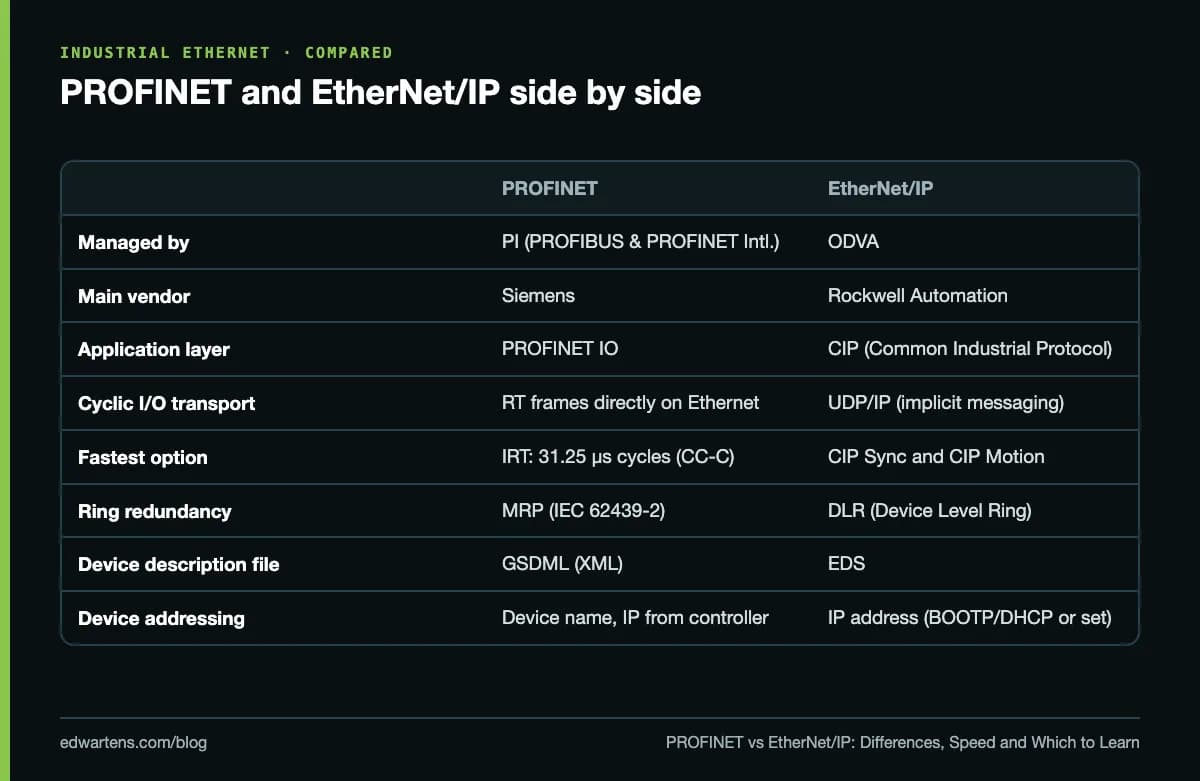
EtherNet/IP uses two kinds of messages, as ODVA describes them. Explicit messages are request-and-response transactions (read this parameter, write that value) and travel over TCP/IP. Implicit messages carry real-time I/O data at regular intervals over UDP/IP, which has low overhead and allows multicast, so one device can produce data that several controllers consume. You set the update rate per connection as the RPI, the requested packet interval. Because the I/O travels in normal UDP/IP packets, it can be routed with standard IP equipment.
PROFINET sends standard (RT) cyclic I/O in frames placed directly on Ethernet with their own EtherType, skipping the TCP/IP stack for speed, while configuration, parameters and diagnostics use normal TCP/IP or UDP/IP. The penalty is that PROFINET RT frames do not cross IP routers; they stay in one Ethernet subnet.
Is PROFINET faster than EtherNet/IP?
For everyday I/O, both are fast enough, and the configured update rate and the network design matter more than the protocol. The real differences appear at the top end.
PROFINET splits capability into three conformance classes. CC-A covers real-time I/O, alarms and diagnostics on standard Ethernet hardware. CC-B adds network diagnostics over SNMP. CC-C adds IRT (Isochronous Real Time), which, according to PI's page on conformance classes, can reach cycle times of 31.25 µs with 1 µs of jitter. IRT reserves a time slot in every cycle and needs switches with IRT hardware, so it is used for tightly synchronised motion such as printing presses and packaging machines.
EtherNet/IP takes a different route for motion. CIP Sync synchronises device clocks across the network, and CIP Motion runs drives over it, so devices can act on time-stamped commands. ODVA lists both, along with CIP Safety for functional safety and CIP Security for device-level security, as services of the CIP family.
For the very fastest machine control, many builders choose neither and use EtherCAT, which HMS ranks third by new nodes.
Topology and ring redundancy
Both networks support star, line and ring topologies, using switches built into the devices so you can daisy-chain I/O through a machine.
- PROFINET uses the Media Redundancy Protocol (MRP), standardised as IEC 62439-2. A ring manager blocks one port in normal operation and opens it if the ring breaks. IEC 62439-2 defines recovery-time classes; 200 ms with up to 50 switches is a common configuration. PROFINET also has MRPD for seamless redundancy with IRT; PI's media redundancy guideline covers both.
- EtherNet/IP uses Device Level Ring (DLR), which ODVA describes as a single-fault-tolerant ring built from embedded-switch devices. DLR is designed for device-level rings with fast recovery; check each device's documentation for its supported role.
Configuration: GSDML vs EDS, names vs IP addresses
Commissioning feels different on each, and this is where newcomers lose time.
On PROFINET, each device type has a GSDML file, an XML description you import into the engineering tool (TIA Portal, for example). Each device is identified by a device name, which you assign once; the controller then gives it its IP address at start-up. Replace a failed device, give the new one the same name (or let topology detection do it), and it takes over.
On EtherNet/IP, each device type has an EDS (electronic data sheet). Each device needs an IP address, set by BOOTP/DHCP, rotary switches or software, and the controller connects to that address. ODVA also defines QuickConnect for devices, such as robot tool changers, that must connect with minimal delay at power-up.
Either way, you need solid IP addressing and subnet skills. Our subnetting walkthrough for PLC and OT networks covers them.
Diagnostics: what you see when something breaks
Both networks report faults in detail, and knowing where to look is half of commissioning.
- PROFINET devices send standardised diagnostic alarms to the controller: a wire break on a channel, a missing module, a lost connection. All PROFINET devices support neighbour detection, and Conformance Class B adds SNMP, so the engineering tool can draw the real topology and compare it with the planned one. In TIA Portal, a failed device shows as a red icon in the network view with the alarm text beside it.
- EtherNet/IP devices report connection status per I/O connection, and each device exposes its own diagnostics through CIP objects. In Studio 5000, a faulted module shows a warning triangle in the I/O tree, with a fault code such as a connection timeout. Network-level faults are usually found in the managed switches' port statistics.
On both, the most common faults are the same: a duplicated IP address, a device name or IP that does not match the project, the wrong device description file version, or a damaged cable or connector. Get the addressing right and keep a labelled network drawing, and most problems disappear.
A worked example: one machine, two versions
Imagine a packaging machine builder in Italy that sells the same machine to a food plant in Germany and a bottler in Ohio. The German customer's standard is Siemens S7-1500 with PROFINET; the US customer runs ControlLogix on EtherNet/IP.
The builder keeps the same drives, remote I/O and robot, but orders each in a PROFINET or an EtherNet/IP version. On the German machine, the engineer imports the GSDML files, assigns device names and sets up an MRP ring through the machine. On the US machine, the engineer adds the EDS files, gives each device an IP address and builds a DLR ring. The control logic is rewritten in each vendor's tool, but the network design, the I/O list and the ring layout are almost identical. An engineer who understands one network can do the second in days, not months.
PROFINET vs EtherNet/IP market share in 2026
HMS Networks, which makes connectivity products for all the major networks, publishes an annual estimate of newly installed nodes in factory automation. Its 2026 study, published on 16 June 2026, found industrial Ethernet at 79% of new nodes, up from 76%.
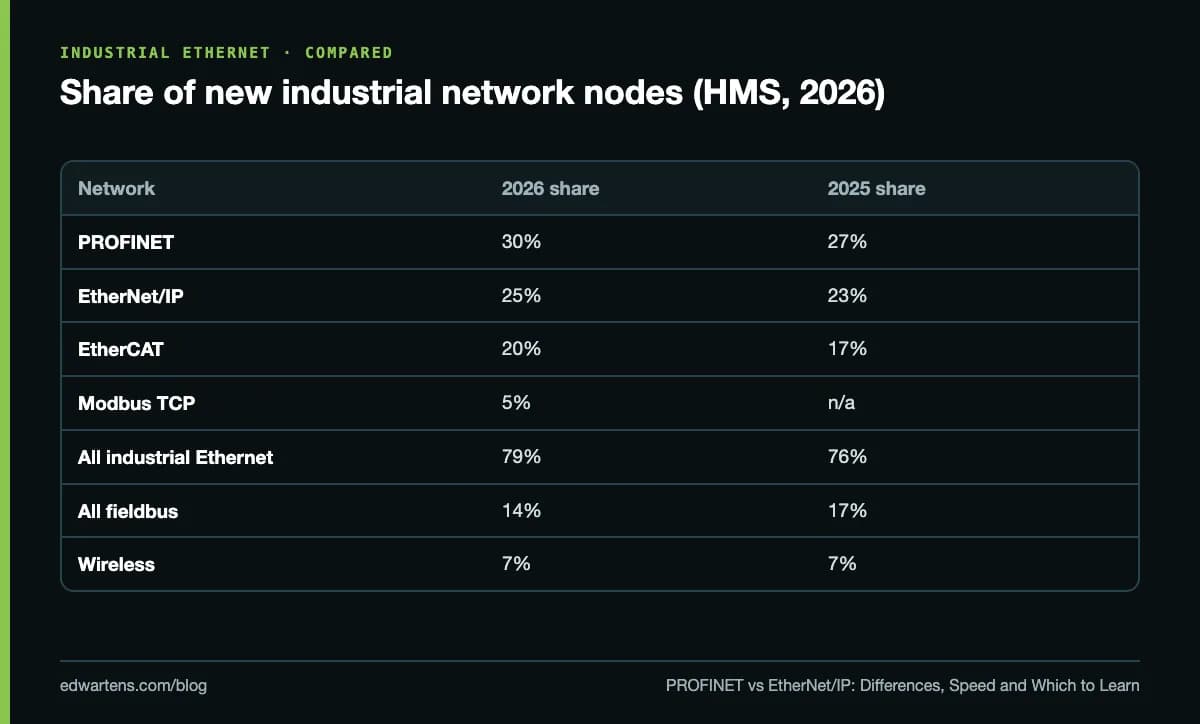
PROFINET led with 30%, EtherNet/IP had 25% and EtherCAT 20%. HMS expects new node installations to grow by about 7.7% a year on average over the next five years. These are global figures, and the local picture follows the PLC supplier: PROFINET goes wherever Siemens controllers are the plant standard, which is common across Europe, while EtherNet/IP goes with Rockwell controllers, which are most common in the United States and Canada. In automotive, both appear, depending on each carmaker's standard.
Can they work together?
Yes, with a gateway or a dual-protocol device. Both protocols can share the same switches and cabling because both are standard Ethernet, but a PROFINET controller and an EtherNet/IP device do not speak the same application protocol. Machine builders who sell worldwide often offer both, and many drives, robots and remote I/O come in PROFINET and EtherNet/IP versions. For plant-wide data rather than control, OPC UA is the usual bridge; see our guide to OPC UA. For serial devices underneath, see RS-485 wiring and our Modbus tutorial.
Both networks also need protecting: they were designed for trusted plant floors. Our guide to OT cybersecurity and IEC 62443 explains zones and conduits.
Should you learn PROFINET or EtherNet/IP first?
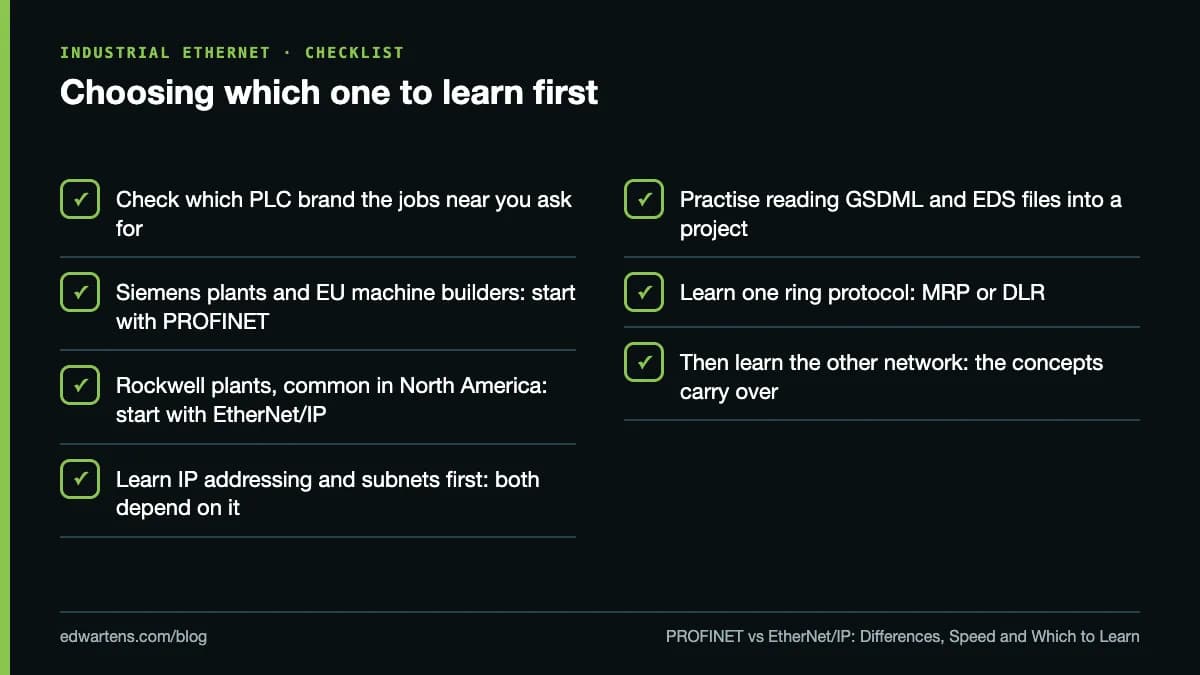
Look at job listings where you want to work. Searching the job board by country, for example Germany, the United States or Canada, shows which platform employers ask for. If listings mention TIA Portal and S7-1500, learn PROFINET, starting with our Siemens PLC training guide. If they mention Studio 5000 and ControlLogix, learn EtherNet/IP, starting with our Allen-Bradley PLC training guide. Whichever you choose, data leaving the cell increasingly travels over MQTT with Sparkplug B, and controllers on either network must never be reachable from the internet, as the 2026 Iran-linked PLC attacks showed.
Free routes: PROFINET and Industrial Ethernet covers PROFINET setup and diagnostics; Industrial Communication covers Modbus, PROFINET, EtherNet/IP and OPC UA side by side; Siemens TIA Portal and Allen-Bradley Studio 5000 teach the controllers on each side. See all networks courses. The courses are free; an optional EDWartens Certificate of Completion, from US$2.99, is issued after the final assessment and can be checked at edwartens.com/verification. It is not a vendor certification and is not accredited.
Take the free course

Industrial networks · Beginner · Free
PROFINET and Industrial Ethernet

Industrial networks · Intermediate · Free
Industrial Communication: Serial, Fieldbus, Ethernet, Modbus, PROFINET and OPC UA

PLC programming · Beginner · Free
Siemens TIA Portal

PLC programming · Beginner · Free
Allen-Bradley Studio 5000
Questions
Is PROFINET faster than EtherNet/IP?
For standard I/O, both are fast enough for most machines and the device update rate you configure matters more than the protocol. At the top end, PROFINET IRT (Conformance Class C) offers cycle times down to 31.25 µs with 1 µs jitter on suitable hardware. EtherNet/IP handles demanding motion with CIP Sync clock synchronisation and CIP Motion.
Can PROFINET and EtherNet/IP run on the same network?
They can share standard Ethernet cabling and switches, because both use standard Ethernet, but a PROFINET controller cannot talk to an EtherNet/IP device directly. To connect the two worlds you use a gateway or a device that supports both protocols. In practice, most plants keep each machine on one protocol.
Which is more popular, PROFINET or EtherNet/IP?
In HMS Networks' 2026 study of newly installed nodes in factory automation, PROFINET had 30% of the market and EtherNet/IP 25%, with EtherCAT third at 20%. Locally, the choice follows the PLC supplier, Siemens or Rockwell, so the regional picture can differ from the global one.
Do I need special switches for PROFINET?
Not for basic PROFINET RT (Conformance Class A), which runs on standard Ethernet hardware, though managed industrial switches with PROFINET diagnostics are strongly recommended. PROFINET IRT needs switches with IRT hardware support, and MRP rings need switches that support MRP.
Should I learn PROFINET or EtherNet/IP first?
Learn the one used by the PLC brand in the jobs you want: PROFINET for Siemens, EtherNet/IP for Rockwell. Before either, learn IP addressing and subnets, because both depend on them. The second network is much quicker to learn once you know the first.
How does EtherCAT compare?
EtherCAT, from the EtherCAT Technology Group and Beckhoff, processes frames on the fly as they pass through each device, which makes it popular for fast motion and machine building. It took 20% of new nodes in HMS's 2026 figures, behind PROFINET and EtherNet/IP.
Sources
- HMS Networks: Industrial network market shares 2026 (16 June 2026)
- ODVA: EtherNet/IP, CIP on Ethernet Technology (PUB00138R8, February 2024)
- ODVA: EtherNet/IP technology overview
- PROFINET North America (PI): PROFINET conformance classes
- PI: PROFINET media redundancy guideline
- Wikipedia: Media Redundancy Protocol (IEC 62439-2)
Written by the EDWartens engineering team for general education. Product names are trademarks of their owners; mentioning them does not imply endorsement. Prices and terms of other providers were checked on the date shown and can change.

Are Free PLC Certificates Worth It? What Employers Actually Check

Free Learning Paths to a Controls, Automation or Industrial AI Role: Plan a Self-Taught Route

ATS-Friendly CV for Automation, PLC and Controls Engineers: Keywords, Bullets and Mistakes

Best Free PLC Courses With Certificate in 2026 (Verified)

TIA Portal Free Trial and Licences Explained (and What PLCSIM Needs)

How to Choose a PLC Training Provider: A Checklist for Any Country