Software and DevOps · Free
Docker and Containers for Automation Engineers
The prerequisite under every modern edge and IIoT job: what a container actually is and why it is not a virtual machine, installing Docker, the commands you use every day, reading logs and getting a shell inside a running container, developing against containers instead of installing software by hand, writing a Dockerfile, private registries, Docker Compose for a full edge stack, volumes so plant data survives a restart, and the production practices that decide whether an image belongs on a plant machine.

Inside the course
From the lessons

What a container is, and why it is not a virtual machine
TechWorld with Nana
Images, registries and the workflow you will follow
TechWorld with Nana
Installing Docker and running your first container
TechWorld with Nana

Everyday commands, and looking inside a running container
TechWorld with Nana

Developing against containers instead of installing software
TechWorld with Nana

Writing a Dockerfile and building your own image
TechWorld with Nana
Lesson frames belong to the creators named in the Credits below and are shown from YouTube.
What you will learn
Run, stop, inspect and remove containers from the command line; find why a container failed using its logs and a shell inside it; replace hand-installed software with images pulled from a registry at a pinned version; write a Dockerfile that builds your own application into a versioned image; push that image to a private registry and pull it on a plant machine; bring up a multi-service stack such as an MQTT broker, a time-series database and a dashboard from one Compose file; keep data across restarts and upgrades with named volumes; and say plainly whether a site needs an orchestrator or whether Compose on one box is the better answer.
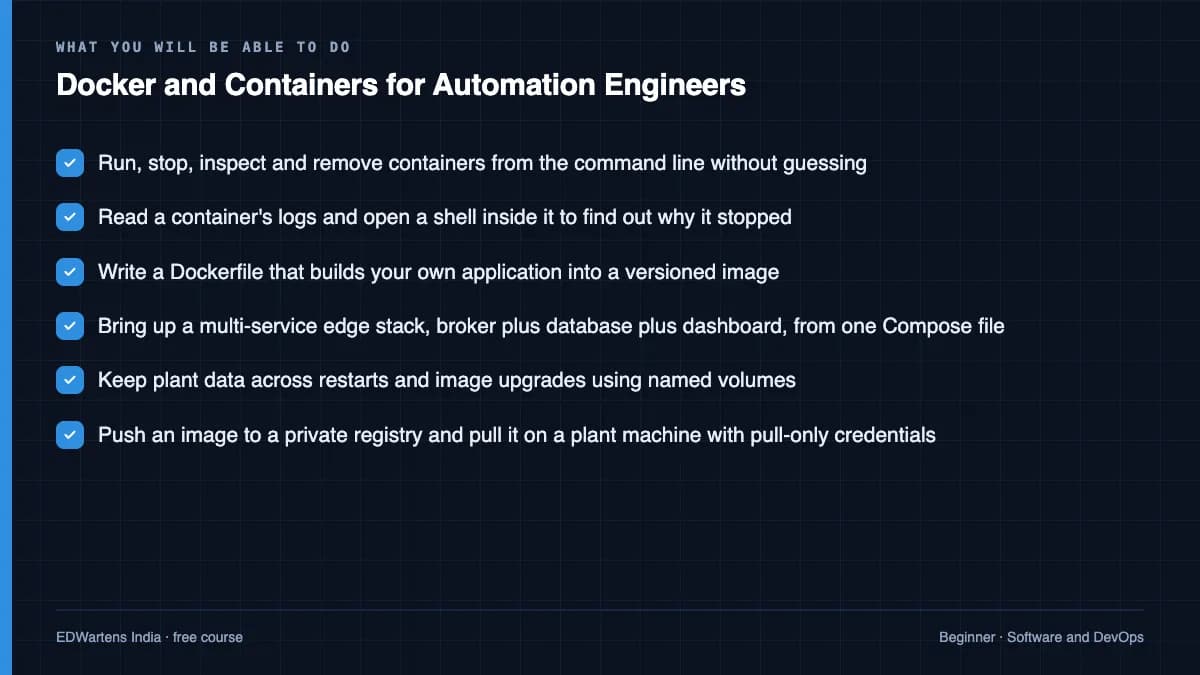
- Run, stop, inspect and remove containers from the command line without guessing
- Read a container's logs and open a shell inside it to find out why it stopped
- Write a Dockerfile that builds your own application into a versioned image
- Bring up a multi-service edge stack, broker plus database plus dashboard, from one Compose file
- Keep plant data across restarts and image upgrades using named volumes
- Push an image to a private registry and pull it on a plant machine with pull-only credentials
For you
Taking Docker and Containers for Automation Engineers from the United States
- Free in the United States, as everywhere, and self-paced: lessons, notes and the final assessment are open at any hour, so your time zone and shift pattern do not matter.
- The optional certificate for learners in the United States is a one-off US$23.99. What you get for it
- Plants across the Americas most often run Allen-Bradley, Siemens and Inductive Automation; each has its own free course to take next.
- See automation and engineering jobs in the United States, and what the industry looks like in Houston, Detroit and Chicago.
- EDWartens also has a regional site for the United States, for classroom training and local support: edwartens.com/us.
The course project · about 14 hours
Containerised plant data stack on an edge PC: Node-RED, Mosquitto, InfluxDB and Grafana with Compose, volumes and a runbook
Design, build, test and document the containerised data stack for a foundry's melt shop on a fanless industrial edge PC: four services from pinned images in one Compose file, named volumes that survive a recreate, a private registry so the plant machine never touches the internet, resource and log limits, one image of your own from a Dockerfile, and a runbook for deploy, upgrade, backup and rollback that you perform rather than describe. The sample pack shows what an edge-software delivery hands over.
Sample document pack, 7 documents, filled in for the scenario
- URSUser Requirements: Melt-Shop Data Stack on Edge PC EDGE-01
- SDSSoftware Design Specification: Edge Stack gfp-edge on EDGE-01
- IP planIP Plan, Networks and Port List: Edge PC EDGE-01 and the Plant Registry
- ProcedureRunbook: Deploy, Upgrade, Backup, Restore and Rollback of the gfp-edge Stack
- Test reportValidation Report: Restart, Persistence, Limits, Security and Restore of the gfp-edge Stack
- Risk registerRisk Register: Edge Data Stack gfp-edge
- O&M manualOperation and Maintenance Manual: gfp-edge Stack (Operation section, the electrical-room note)
Read inside the course and download as a workbook. The project is optional practice, marked when you submit it; the certificate needs only the modules and the final assessment.
Course content
11 modules · 17 lessons · 3h 25m
In order, at whatever pace suits you. Each module ends with a practice task that builds on the last.
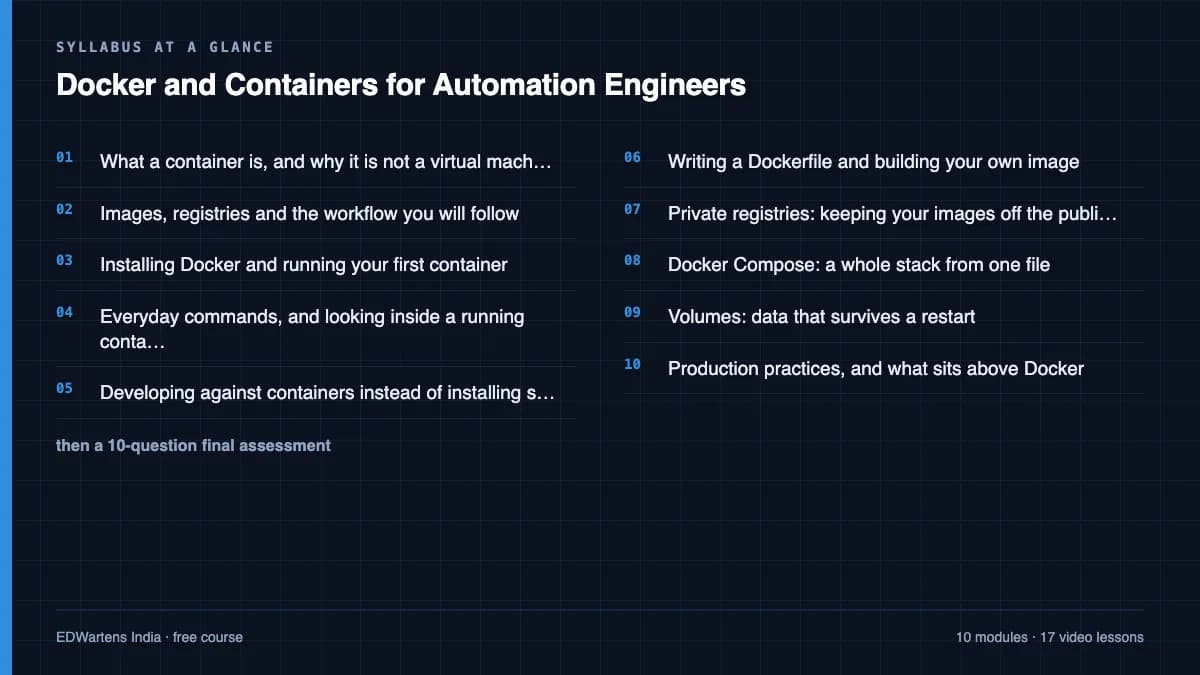
- 01What a container is, and why it is not a virtual machine2 lessons15m
- 02Images, registries and the workflow you will follow2 lessons14m
- 03Installing Docker and running your first container1 lesson20m
- 04Everyday commands, and looking inside a running container2 lessons26m
- 05Developing against containers instead of installing software1 lesson21m
- 06Writing a Dockerfile and building your own image1 lesson24m
- 07Private registries: keeping your images off the public internet1 lesson16m
- 08Docker Compose: a whole stack from one file3 lessons26m
Requirements
- Who it is for
- Beginner. You need to be comfortable typing commands at a terminal. No prior container, cloud or Linux administration experience is assumed, and no PLC knowledge is needed to follow the lessons.
- Software
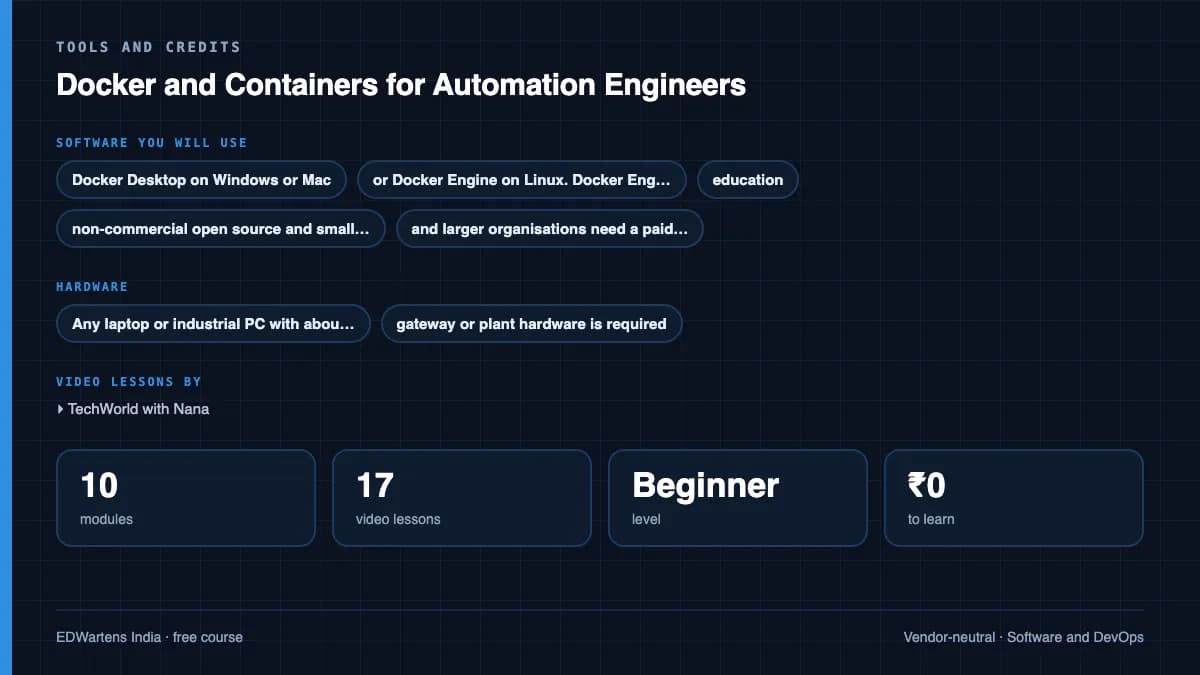
- Docker Desktop on Windows or Mac, or Docker Engine on Linux. Docker Engine is free for any use. Docker Desktop is free for personal use, education, non-commercial open source and small businesses, and larger organisations need a paid subscription. A text editor and a free Docker Hub account. What to download, and how
- Hardware
- Any laptop or industrial PC with about 8 GB of RAM and hardware virtualisation enabled. No PLC, gateway or plant hardware is required.
Software you need
What to download, where from, what it costs and how to install it. Every link goes to the maker's own site, never a mirror.
Required
- 01Free for personal use, education and small businesses
Docker Desktop
Docker, Inc.
- Runs on
- Windows 10 64-bit version 22H2 (build 19045) or Windows 11 64-bit version 23H2 (build 22631) or later, with WSL 2 and hardware virtualisation on, 8 GB RAM. Also macOS and Linux.
- Account
- None needed
Free for personal use, education, non-commercial open source projects, and businesses with fewer than 250 employees and less than 10 million US dollars in annual revenue. Larger businesses need a paid subscription. Docker Engine on Linux is open source and is not covered by these terms.
Steps
- 1.Open docker.com/products/docker-desktop and download the installer for your system.
- 2.On Windows, install WSL first (wsl --install) if you do not have it.
- 3.Run the installer and keep the WSL 2 option selected.
- 4.Restart if asked, then start Docker Desktop and accept the subscription terms.
- 5.Open a terminal and run: docker run hello-world
- Turn on virtualisation in BIOS or UEFI if Docker says it is not available.
- On Linux servers, install Docker Engine instead of Docker Desktop.
Official download pagedocker.comAlternatives
- Docker Engine (Linux): Free, open source engine for Linux. Not covered by the Docker Desktop subscription terms.
- 02Free plan with limits
Docker Hub
Docker, Inc., in the browser
- Runs on
- Any modern web browser
- Account
- A free Docker account (Docker Personal plan)
The free Docker Personal plan includes one private repository and 100 Docker Hub pulls per hour when signed in, subject to reasonable use. Each image on Docker Hub has its own licence.
Steps
- 1.Open hub.docker.com and click Sign up.
- 2.Create your account with email, or with Google or GitHub, and verify your email.
- 3.In a terminal, run: docker login and enter your Docker username.
- 4.Pull an image, for example: docker pull hello-world
- Prefer images marked Docker Official Image or Verified Publisher.
- Signing in raises your pull limit compared with anonymous pulls.
Open Docker Hubhub.docker.com
Optional
Useful, not needed to finish the course.
- 03Free
Visual Studio Code
Microsoft
- Runs on
- Windows 64-bit (supported Windows client versions), macOS (latest and two previous releases), Linux (Ubuntu 20.04, Debian 10, RHEL 8, Fedora 36 or later)
- Account
- None needed
- Size
- Less than 200 MB download, under 500 MB installed
Free to download and use. Extensions from the Marketplace each have their own licence.
Steps
- 1.Open code.visualstudio.com/download.
- 2.Pick the installer for your system (on Windows, the User Installer is fine).
- 3.Run the installer. On Windows, tick "Add to PATH" if it is offered.
- 4.Open VS Code and install the extensions your course uses, for example the Python extension.
- Hardware needs are small: a 1.6 GHz processor and 1 GB of RAM.
- On Windows, the "Open with Code" options in the installer let you open folders from File Explorer.
Official download pagecode.visualstudio.com
Checked against each maker's own page on 27 September 2026. Trial lengths and editions change; the maker's page is the final word.
Docker and Containers for Automation Engineers at a glance
Docker and Containers for Automation Engineers is a free, self-paced online course from EDWartens for automation engineers and developers. It has 11 modules and 3h 25m of video lessons by TechWorld with Nana, with written notes and worked problems, a practical project with a document pack and a 15-question final assessment (pass mark 60%). Learning is free with an account; an optional certificate with a public verification code is issued when you pass. Last updated 27 September 2026.
All course factsHide course facts
- Price
- Free, for good. No trial, no card. The only paid item is the optional certificate, a small one-off fee.
- Who it is for
- Automation engineers and developers
- Format
- 11 self-paced modules, 3h 25m of video, written notes, a practice task per module and one final assessment.
- Level
- Beginner. Beginner. You need to be comfortable typing commands at a terminal. No prior container, cloud or Linux administration experience is assumed, and no PLC knowledge is needed to follow the lessons.
- Brand
- Vendor-neutral
- Software
- Docker Desktop on Windows or Mac, or Docker Engine on Linux. Docker Engine is free for any use. Docker Desktop is free for personal use, education, non-commercial open source and small businesses, and larger organisations need a paid subscription. A text editor and a free Docker Hub account.
- Hardware
- Any laptop or industrial PC with about 8 GB of RAM and hardware virtualisation enabled. No PLC, gateway or plant hardware is required.
- Certificate
- Optional EDWartens Certificate of Completion, verifiable by code. Not a vendor credential.
- Video lessons by
- TechWorld with Nana (independent creators, credited below)
- Language
- English
- Last updated
- 27 September 2026
A shareable EDWartens certificate
Finish every module and pass the final assessment, and the optional EDWartens certificate is yours. It carries a unique verification code on a public page anyone can check, so it stands up when a recruiter looks it up. See it below.
The course itself stays free whether or not you ever buy one.
Stuck? Ask a practising engineer
A free course usually means a comment section and hope. This one does not. Every module has an Ask-your-trainer panel that reaches the same engineers who teach our paid programme: people who commission panels for a living, not moderators.
Pairs well with
 PLC programming · FreeSiemens TIA PortalFrom zero electrical knowledge to a working, simulated S7-1200 program, for nothing.
 PLC programming · FreeSiemens TIA Portal in Three HoursThe first three hours of the Siemens TIA Portal course, cut to end on a win: what a PLC is, how it is wired, a project configured in TIA Portal, and your first ladder program running in simulation. Finish it in an evening or two, earn a certificate, and carry straight on into the full course.
 PLC programming · FreeTIA Portal: Build a MachineOne machine, start to finish. Take a bottle filling line from a written specification and an I/O list to a structured S7-1200 program with a fill station, a capper, a reject sorter and an operator screen with alarms, then test it against a written record and archive it for hand-over. The lessons are the reference; the machine is yours, and it is what you submit.
 Instrumentation · FreeInstrumentation for PLC EngineersThe half of the loop that is not code. Follow one measurement from the transmitter in the field, down the 4-20 mA loop, into the analog card, through NORM_X and SCALE_X into engineering units, out again to a valve, and back to the control room when the reading is wrong.
More free courses: Free Industry 4.0 and IIoT courses
Learner reviews
No reviews yet
Reviews here are written only by learners who have finished every module of Docker and Containers for Automation Engineers, and they are published exactly as written. Finish the course and yours will be the first.
Common questions
Is the Docker and Containers for Automation Engineers course really free?
Yes. All ten modules, the practice tasks, the practice questions and the final assessment are free. You create an account so your progress is saved and the assessments can be marked. The certificate is the only paid item, and only if you want it.
What certificate does the Docker and Containers for Automation Engineers course give?
An EDWartens Certificate of Completion, issued when you have finished every module and passed the final assessment at 60%, with a verification code anyone can check. It is not a vendor credential and is never described as one.
Who made the video lessons in the Docker and Containers for Automation Engineers course?
TechWorld with Nana, on her own YouTube channel, credited at the foot of this page. EDWartens did not make the videos and the creator is not affiliated with EDWartens. What EDWartens wrote is the study plan, the notes, the practice tasks and the assessments.
Is this the same as a Docker or Kubernetes certification?
No. There are paid, vendor-run container and Kubernetes examinations, and this course is neither of them, is not accredited by anyone, and does not follow their exam objectives. It is preparation and practice. What you get here is an EDWartens Certificate of Completion.
Do I need to know Linux or programming?
No. You need to be able to type commands at a terminal and read the output. The course explains what each command does. If you have never used a command line, plan a little extra time on DK3 and DK4.
What do I need installed, and does it cost anything?
Docker Desktop on Windows or Mac, or Docker Engine on Linux. Both are free for personal use, education and small businesses, and larger companies need a paid Docker Desktop subscription. You need a laptop with about 8 GB of RAM and hardware virtualisation enabled in firmware, which is worth checking before you start.
Will this help with Node-RED, Ignition or an edge gateway?
That is why it exists. Node-RED, Grafana, InfluxDB, MQTT brokers and most edge software now ship as container images, and the EDWartens Node-RED and Ignition courses assume you can run one. This course fills that gap: by DK8 you can bring the whole stack up from a single Compose file.
Does the course cover Kubernetes?
Not as a subject you learn to operate. The last module explains what Kubernetes and Docker Swarm add over Docker on a single host, and when a site genuinely needs them, so you can make that call honestly rather than adopting an orchestrator for one edge PC.
What you walk away with
Your certificate for Docker and Containers for Automation Engineers
Finish the course, pass the final, and this is the document with your name on it.
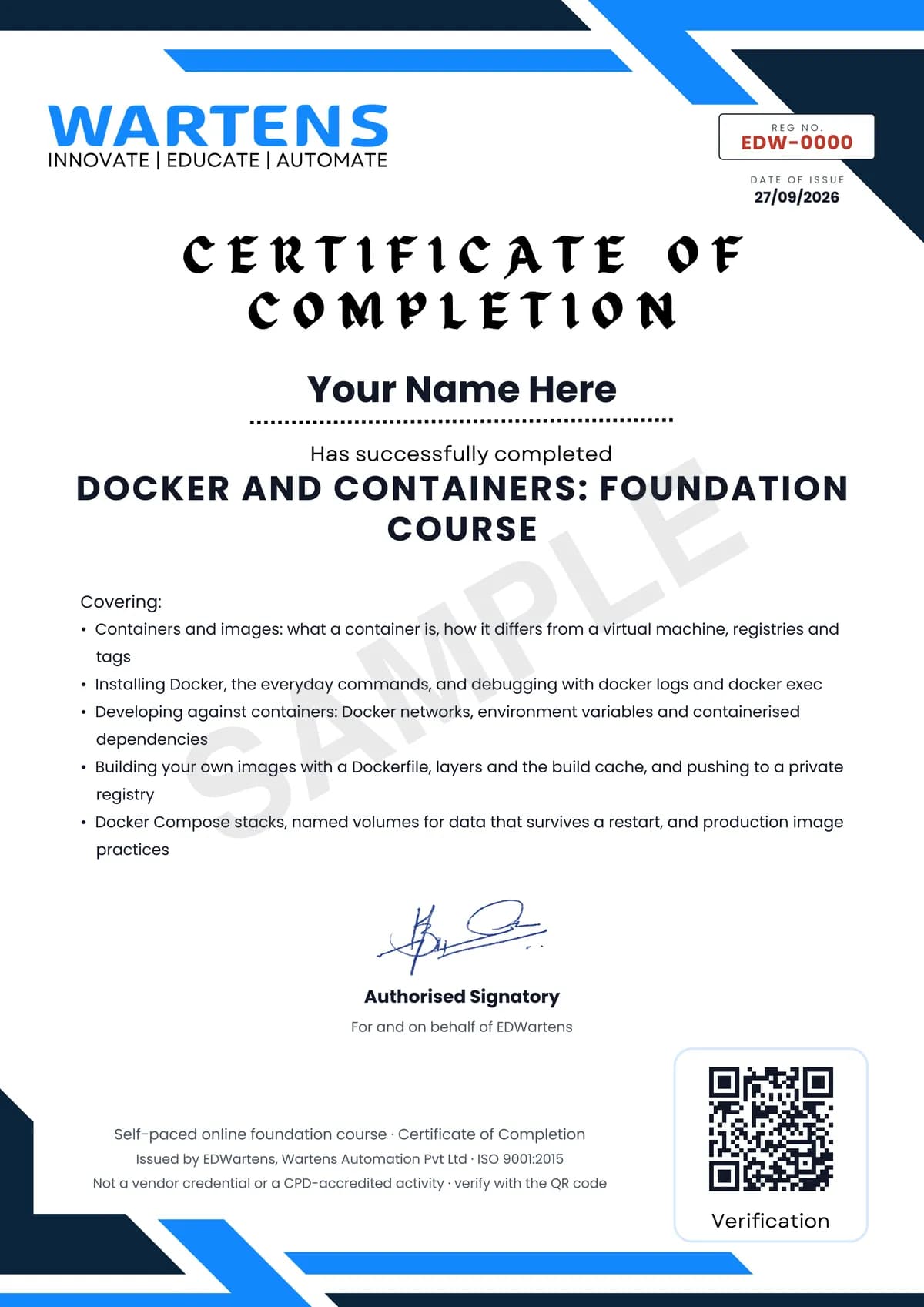
Verifiable by anyone
Adds to LinkedIn in one click
QR code on the certificate
Names what you can do
A permanent link
Earned, not attended
Learning is free. The certificate is optional.
Add it now and pay only when you have finished the course, or come back for it later. One-off, US$23.99, with a receipt.
Issued by EDWartens, the training division of Wartens, as a Certificate of Completion for this self-paced course. Sold by Wartens Ltd (England and Wales). It is not a vendor certification, a university award or a CPD-accredited activity, and it does not certify competence on live equipment. Delivered electronically; see the refund policy.
Credits
Who made the video lessons
The video lessons in this course were created by the people below, not by EDWartens. Every lesson streams from its creator's own YouTube channel; EDWartens neither hosts nor sells that footage, and the creators are not affiliated with EDWartens and do not endorse this course. What EDWartens wrote is the study plan, the notes, the practice tasks and the assessments.
- TechWorld with Nanaevery video lesson in this course, from the Docker tutorial series and the channel's Compose, volumes and production videos: what a container is, Docker against a virtual machine, installing Docker, the eight basic commands, debugging with docker logs and docker exec, developing with containers, the Dockerfile, private registries, Docker Compose and deployment, volumes, the production best practices, and where Kubernetes and Swarm fit
If you are one of these creators and would like a lesson removed or credited differently, write to info@wartens.com.