IMMERSIVE TRAINING
VR and AR in Industrial Training: Where They Help and Where a Simulator Does More
Headsets earn their place for hazards, spaces and procedures. For programming skills, laptop simulators already do most of the work. How to tell the difference.
VR/AR industrial training helps where space, hazard or rarity matter: walking a plant before you visit it, rehearsing an emergency or a lockout, or following instructions overlaid on the machine. For PLC, SCADA and robot programming, a laptop simulator teaches most of the skill today, free or on vendor trials, with no headset.
What VR is good at
Virtual reality replaces what you see with a simulated scene. That is valuable when the real thing is dangerous, rare, far away or expensive to stop.
- Spatial familiarisation. Walking a model of a plant, a substation or an offshore module before your first visit, so you know where the escape routes, isolation points and control rooms are.
- Hazardous and rare events. Practising the response to a gas release, a fire alarm or a trapped person, which cannot be rehearsed for real and happens too seldom to learn on the job.
- Procedures with a strict order. Valve line-ups, lockout and tagout, confined-space entry checks. The trainee practises the sequence and the system records each step.
- Scale and reach. Standing inside a robot cell to see what the arm can reach, or checking that a maintenance technician can get to a component.
What AR is good at
Augmented reality overlays information on the real world through a headset, glasses or a tablet. Its strength is guidance during real work rather than rehearsal away from it.
- Step-by-step work instructions shown on the equipment being maintained.
- Remote expert support, where a specialist elsewhere sees what the technician sees and marks up the view.
- Live data on the asset: pointing at a pump and seeing its current values, alarms and maintenance history.
In this short tutorial by ABB Robotics, from our free RobotStudio course, the RobotStudio AR Viewer application is introduced. It shows one way AR is already used alongside an offline robot programming tool.
AR depends on things a demo room hides: reliable tracking in a cluttered plant, a network where the work happens, and content kept in step with the real equipment. In a hazardous area, only devices certified for that zone under schemes such as IECEx or ATEX can be used.
Where headsets struggle
Honest limits matter when you are deciding where to spend a training budget.
- Content costs money to build and to keep current. When the plant is modified, the virtual plant must be modified too, or trainees learn a layout that no longer exists.
- Fine manual skills transfer poorly. Hand controllers are a weak substitute for terminating a wire, tightening a gland or feeling a valve seat.
- Comfort. Some people experience motion sickness, and long sessions are tiring.
- Assessment. Completing a scenario in a headset is not the same as showing competence on the job. Programmes still need practical sign-off.
- One headset per learner. Classroom scale needs hardware, charging, hygiene and support.
What already works on a laptop
For the core programming skills of automation, simulation is already mature and needs no headset.
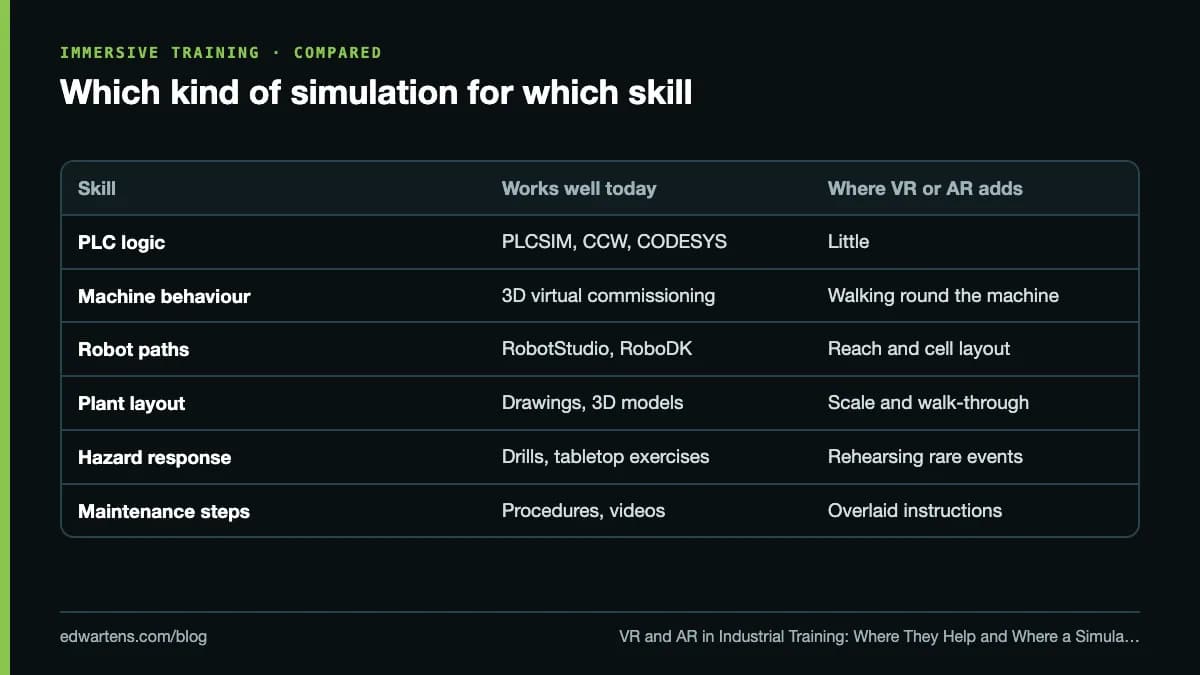
PLC logic is learnt in simulators such as PLCSIM, Connected Components Workbench's Micro800 simulator and CODESYS. The options are compared in free PLC simulators compared.
Machine behaviour is learnt through virtual commissioning: a 3D model of a conveyor, sorter or palletiser, connected to a simulated PLC, so your program drives moving parts, sensors and faults on screen. It is the same technique engineering teams use to test code before a real machine is built, and it is the closest thing to immersive training that most learners need. Factory I/O is a common tool for it; our Factory I/O guide covers set-up and a first project.
A typical first exercise shows why this works. You map the scene's photo-eyes and motor outputs to PLC tags, write the start, stop and jam-detection logic, and run it. Boxes pile up when a timer is wrong, and a sensor you forgot to debounce counts twice. Those are the faults you would meet on a real conveyor, found at a desk rather than on a commissioning floor, and they teach fault-finding in a way a scripted headset scenario rarely does.
Robot programming is learnt in offline programming tools such as ABB RobotStudio and RoboDK, where you teach targets, write paths and check reach and collisions in a 3D cell. See free robot programming simulators.
[Digital twins](/blog/digital-twin-technology-manufacturing) extend the idea to whole lines and plants: a simulation kept in step with the real process, used for training operators as well as for engineering. That is where VR is most likely to add real value, as a way of looking into a twin that already exists for engineering reasons.
How to judge a VR/AR industrial training offer
Before buying or recommending one, ask:
- Which task does it train, and how is competence measured afterwards?
- Does the skill transfer to the real equipment, and has anyone checked?
- Who updates the content when the plant changes, and how quickly?
- What does it add over a desktop simulator, a video or a supervised walk-down?
- How many learners can use it at once, and what hardware does each need?
If the answers are specific, the programme is probably worth it. If the answer to question 4 is only that it is more engaging, a simulator and a good instructor may do more.
A free route through simulation-based training
- Siemens TIA Portal with Factory I/O: virtual commissioning projects on 3D machine scenes, from a two-sensor conveyor to a palletising assembler and an analogue level loop.
- Siemens TIA Portal Commissioning: PLCSIM, downloads, backups and troubleshooting, the step between a simulated and a real machine.
- ABB RobotStudio and RAPID: robot programming in a virtual cell, for beginners.
- RoboDK Offline Programming: brand-independent cell layout, reach studies and path programming.
For the physical side, with a real robot in the room, look to your own workplace, a college robot cell or the robot maker's instructor-led courses, and arrive having finished the simulation work above.
Start the courses
The courses are free in full, with lessons from independent creators credited on each course page, EDWartens notes, practice tasks and one final assessment of 15 questions. Create a free account so your progress is saved.
The optional EDWartens Certificate of Completion is a small one-off fee, US$8.99 for a beginner course such as RobotStudio. It can be checked at edwartens.com/verification. It is not a Siemens, ABB or RoboDK certification, and not an accredited qualification.
Take the free course
 Free
FreePLC programming · Beginner · Free
Siemens TIA Portal with Factory I/O: Virtual Commissioning Projects
 Free
FreeRobotics · Beginner · Free
ABB Robot Programming with RobotStudio and RAPID
 Free
FreeRobotics · Beginner · Free
RoboDK Offline Programming and Simulation
 Free
FreePLC programming · Intermediate · Free
Siemens TIA Portal Commissioning: Hardware, PLCSIM, Backups and Troubleshooting
Questions
Is VR useful for industrial training?
Yes, for tasks where space, hazard or rarity matter: learning a plant's layout before visiting, rehearsing an emergency response, or practising a procedure in the right order. It adds less for programming skills, which are learnt well on a laptop simulator.
What is the difference between VR and AR training?
Virtual reality replaces your surroundings with a simulated scene, so it suits rehearsal away from the plant. Augmented reality overlays information on the real equipment, so it suits guidance during real work, such as step-by-step maintenance instructions.
Can I learn PLC programming in VR?
You can, but a headset adds little to the core skill, which is writing and debugging logic. Free and trial simulators on a laptop, including 3D virtual machines connected to a simulated PLC, teach it well without special hardware.
What is virtual commissioning?
Testing a PLC program against a simulated model of the machine before the real machine exists or is available. It finds logic faults early and is one of the most practical forms of industrial simulation.
Can AR devices be used in hazardous areas?
Only devices certified for the hazardous area zone, under schemes such as IECEx or ATEX. A standard consumer headset or tablet is not suitable for a zoned area.
Sources
- IECEx: IEC system for certification to standards for equipment in explosive atmospheres
- Factory I/O
- ABB: RobotStudio Suite
- RoboDK
Written by the EDWartens engineering team for general education. Product names are trademarks of their owners; mentioning them does not imply endorsement. Prices and terms of other providers were checked on the date shown and can change.
Remote PLC Programming Jobs: Where They Exist and How to Land One

IFR World Robotics 2026: 5 Million Robots and What It Means for Engineers
How to Become a Commissioning Engineer in Automation: Skills, Site Work and a First-Year Plan

Your First FANUC Teach Pendant Program, Step by Step (Video)

ABB RobotStudio: Your First Pick-and-Place in RAPID (Video)

Industrial Robotics Training: A Robot Programming Guide for Beginners