AI and machine learning · Free
AI for Industrial Automation
The hub of the industrial track: where AI actually sits beside PLC, SCADA, MES and the historian; which of the seven use cases pay and what data each needs; OPC UA, MQTT and the unified namespace; edge against cloud; predictive maintenance as a business case; vision, digital twins, copilots and agents; the vendor landscape; safety, security and governance — ending with a readiness audit of a real process.

Inside the course
From the lessons

Where AI sits in a plant
NVIDIA

The data a plant already has
4.0 Solutions

Edge or cloud
RealPars
Machine vision and AI inspection
Breen Machine Automation Services LLC

Copilots and agents for the engineering office
Charbax
Safety, security and governance
International Society of Automation - ISA
Lesson frames belong to the creators named in the Credits below and are shown from YouTube.
What you will learn
Place any AI proposal on the control hierarchy and the use-case map; inventory a plant's data and its quality problems; choose OPC UA, MQTT or a unified namespace for getting data to a model; decide edge or cloud; build the predictive-maintenance business case; specify a vision, twin or copilot project with the PLC in charge; read a vendor demo critically; apply functional safety, 62443 and change control to a model; and write the eight-section readiness audit a plant manager can fund.
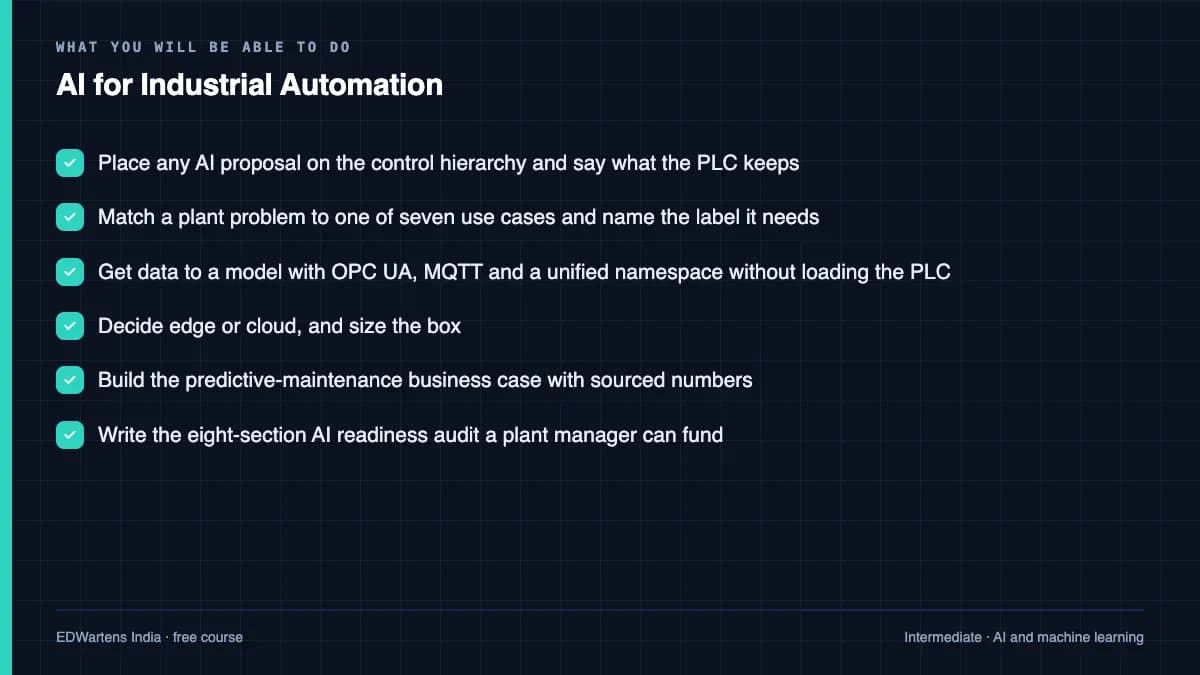
- Place any AI proposal on the control hierarchy and say what the PLC keeps
- Match a plant problem to one of seven use cases and name the label it needs
- Get data to a model with OPC UA, MQTT and a unified namespace without loading the PLC
- Decide edge or cloud, and size the box
- Build the predictive-maintenance business case with sourced numbers
- Write the eight-section AI readiness audit a plant manager can fund
For you
Taking AI for Industrial Automation from the United States
- Free in the United States, as everywhere, and self-paced: lessons, notes and the final assessment are open at any hour, so your time zone and shift pattern do not matter.
- The optional certificate for learners in the United States is a one-off US$28.99. What you get for it
- Plants across the Americas most often run Allen-Bradley, Siemens and Inductive Automation; each has its own free course to take next.
- See automation and engineering jobs in the United States, and what the industry looks like in Houston, Detroit and Chicago.
- EDWartens also has a regional site for the United States, for classroom training and local support: edwartens.com/us.
The course project · about 6 hours
An AI readiness audit of one real process, written for the plant manager
Pick one process you know — your plant's, your college lab's, or a plant you have visited — and write the eight-section readiness audit: cost of the problem, data inventory, use-case shortlist, a six-week first project, architecture, governance, budget. A document, not code; the hardest deliverable in the track.
The course project · about 4 hours
A quantified business case for predictive maintenance on the stand-in plant
Using the maintenance history and motor-fleet datasets, build the business case for a predictive-maintenance pilot on the three worst assets: downtime cost, catch rate, sensor and integration cost, payback, and the success metric — a spreadsheet and a two-page proposal.
Course content
13 modules · 39 lessons · 6h 38m
In order, at whatever pace suits you. Each module ends with a practice task that builds on the last.
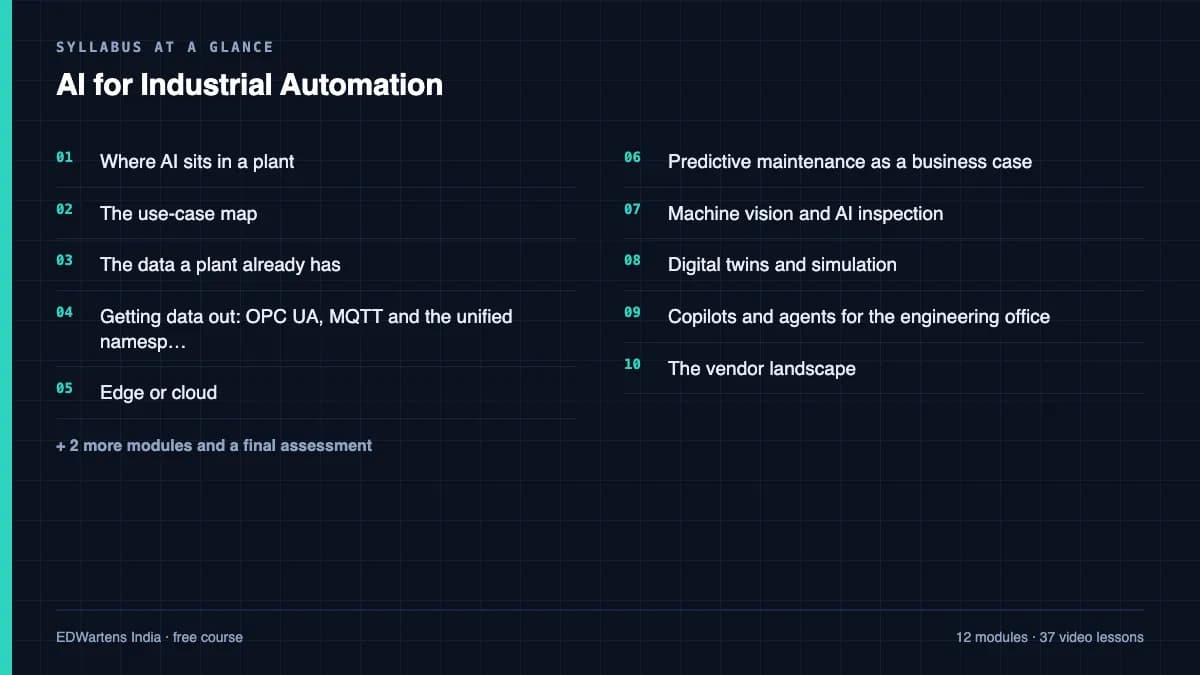
- 01Where AI sits in a plant3 lessons25m
- 02The use-case map2 lessons17m
- 03The data a plant already has1 lesson22m
- 04Getting data out: OPC UA, MQTT and the unified namespace5 lessons1h 2m
- 05Edge or cloud4 lessons52m
- 06Predictive maintenance as a business case4 lessons27m
- 07Machine vision and AI inspection6 lessons21m
- 08Digital twins and simulation4 lessons27m
Requirements
- Who it is for
- Intermediate. Best after any PLC or SCADA course in the automation track and the Generative AI foundations; no coding required for most modules.
- Software
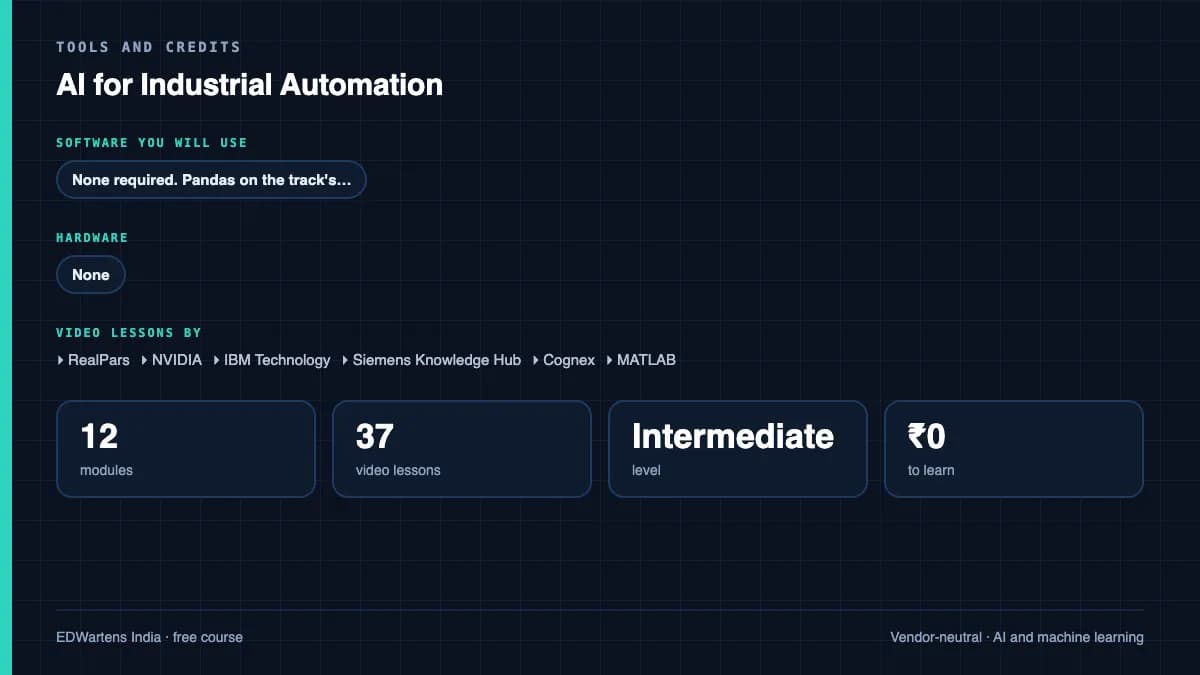
- None required. Pandas on the track's datasets for the optional business-case project. What to download, and how
- Hardware
- None.
Software you need
What to download, where from, what it costs and how to install it. Every link goes to the maker's own site, never a mirror.
Nothing is required
Colab is only for the optional business-case project.
Optional
Useful, not needed to finish the course.
- 01Free, GPU time not guaranteed
Google Colab
Google, in the browser
- Runs on
- Any modern web browser
- Account
- A free Google account
Colab is free to use. In the free version GPUs and TPUs are heavily restricted and not guaranteed, sessions can run for at most 12 hours, and idle sessions are stopped. Paid plans give more reliable access.
Steps
- 1.Open colab.research.google.com and sign in with your Google account.
- 2.Click New notebook (or open the notebook your course links to).
- 3.For a GPU, choose Runtime, then Change runtime type, then pick a GPU if one is offered.
- 4.Type code in a cell and press Shift and Enter to run it.
- Save a copy to your Google Drive so your changes are kept.
- Files on the runtime are deleted when the session ends. Save outputs to Drive.
Open Google Colabcolab.research.google.com
Checked against each maker's own page on 27 September 2026. Trial lengths and editions change; the maker's page is the final word.
AI for Industrial Automation at a glance
AI for Industrial Automation is a free, self-paced online course from EDWartens for engineers, developers and students applying AI to real work. It has 13 modules and 6h 38m of video lessons by RealPars, NVIDIA, IBM Technology and others, with written notes and worked problems, a practical project with a document pack and a 15-question final assessment (pass mark 60%). Learning is free with an account; an optional certificate with a public verification code is issued when you pass. Last updated 27 September 2026.
All course factsHide course facts
- Price
- Free, for good. No trial, no card. The only paid item is the optional certificate, a small one-off fee.
- Who it is for
- Engineers, developers and students applying AI to real work
- Format
- 13 self-paced modules, 6h 38m of video, written notes, a practice task per module and one final assessment.
- Level
- Intermediate. Intermediate. Best after any PLC or SCADA course in the automation track and the Generative AI foundations; no coding required for most modules.
- Brand
- Vendor-neutral
- Software
- None required. Pandas on the track's datasets for the optional business-case project.
- Hardware
- None.
- Certificate
- Optional EDWartens Certificate of Completion, verifiable by code. Not a vendor credential.
- Video lessons by
- RealPars, NVIDIA, IBM Technology, Siemens Knowledge Hub, Cognex, MATLAB, ADASH, 4.0 Solutions, Opto Video, Inductive Automation, Enuda, edureka!, Future in the Making, Automatedo, Charbax, Retrocausal AI, Microsoft Developer, IT and Automation Academy, Breen Machine Automation Services LLC, International Society of Automation - ISA, Patrick Byrne - AI & Manufacturing (independent creators, credited below)
- Language
- English
- Last updated
- 27 September 2026
A shareable EDWartens certificate
Finish every module and pass the final assessment, and the optional EDWartens certificate is yours. It carries a unique verification code on a public page anyone can check, so it stands up when a recruiter looks it up. See it below.
The course itself stays free whether or not you ever buy one.
Stuck? Ask a practising engineer
A free course usually means a comment section and hope. This one does not. Every module has an Ask-your-trainer panel that reaches the same engineers who teach our paid programme: people who commission panels for a living, not moderators.
Pairs well with
 PLC programming · FreeSiemens TIA PortalFrom zero electrical knowledge to a working, simulated S7-1200 program, for nothing.
 PLC programming · FreeSiemens TIA Portal in Three HoursThe first three hours of the Siemens TIA Portal course, cut to end on a win: what a PLC is, how it is wired, a project configured in TIA Portal, and your first ladder program running in simulation. Finish it in an evening or two, earn a certificate, and carry straight on into the full course.
 PLC programming · FreeTIA Portal: Build a MachineOne machine, start to finish. Take a bottle filling line from a written specification and an I/O list to a structured S7-1200 program with a fill station, a capper, a reject sorter and an operator screen with alarms, then test it against a written record and archive it for hand-over. The lessons are the reference; the machine is yours, and it is what you submit.
 Instrumentation · FreeInstrumentation for PLC EngineersThe half of the loop that is not code. Follow one measurement from the transmitter in the field, down the 4-20 mA loop, into the analog card, through NORM_X and SCALE_X into engineering units, out again to a valve, and back to the control room when the reading is wrong.
More free courses: Free AI courses for engineers
Learning paths with this course
- Industrial AI engineer · 4 coursesAI where the machines are: where it sits beside PLC and SCADA, predictive maintenance on real run-to-failure data, machine vision quality inspection with YOLO, and plant data over Modbus and OPC UA in Python.
Learner reviews
No reviews yet
Reviews here are written only by learners who have finished every module of AI for Industrial Automation, and they are published exactly as written. Finish the course and yours will be the first.
Common questions
Is this a coding course?
No. It is the decision course: what to do first, with what data, on which box, under which rules. The Predictive Maintenance, Machine Vision and Industrial Data courses are where you then build it.
Who is the AI for Industrial Automation course for?
Automation, electrical and instrumentation engineers who are being asked about AI by their managers or their customers, and want to answer with a plan rather than a vendor's brochure.
What are the projects in the AI for Industrial Automation course?
A readiness audit of one real process — cost of the problem, data inventory, use-case shortlist, a six-week first project, architecture, governance and the ask — or a quantified predictive-maintenance business case on the track's datasets for learners without a plant of their own.
Is the AI for Industrial Automation course really free?
Yes. Every module, practice task, project and assessment. You create an account so your progress is saved and the assessments can be marked. The certificate is the only paid item, and only if you want it.
What certificate does the AI for Industrial Automation course give?
An EDWartens Certificate of Completion, issued when you have finished the modules and passed the final assessment (the project is optional practice), with a verification code anyone can check. It is not a vendor credential and is never described as one.
Who made the video lessons in the AI for Industrial Automation course?
The creators named in the Credits block at the foot of this page, on their own YouTube channels. EDWartens did not make the videos and the creators are not affiliated with EDWartens. What EDWartens wrote is the study plan, the notes, the practice tasks, the projects and the assessments.
How long does the AI for Industrial Automation course take?
Plan on about 12 hours in all, including the video lessons, notes and practice tasks. It is self-paced, so you work through the thirteen modules at your own speed.
What you walk away with
Your certificate for AI for Industrial Automation
Finish the course, pass the final, and this is the document with your name on it.
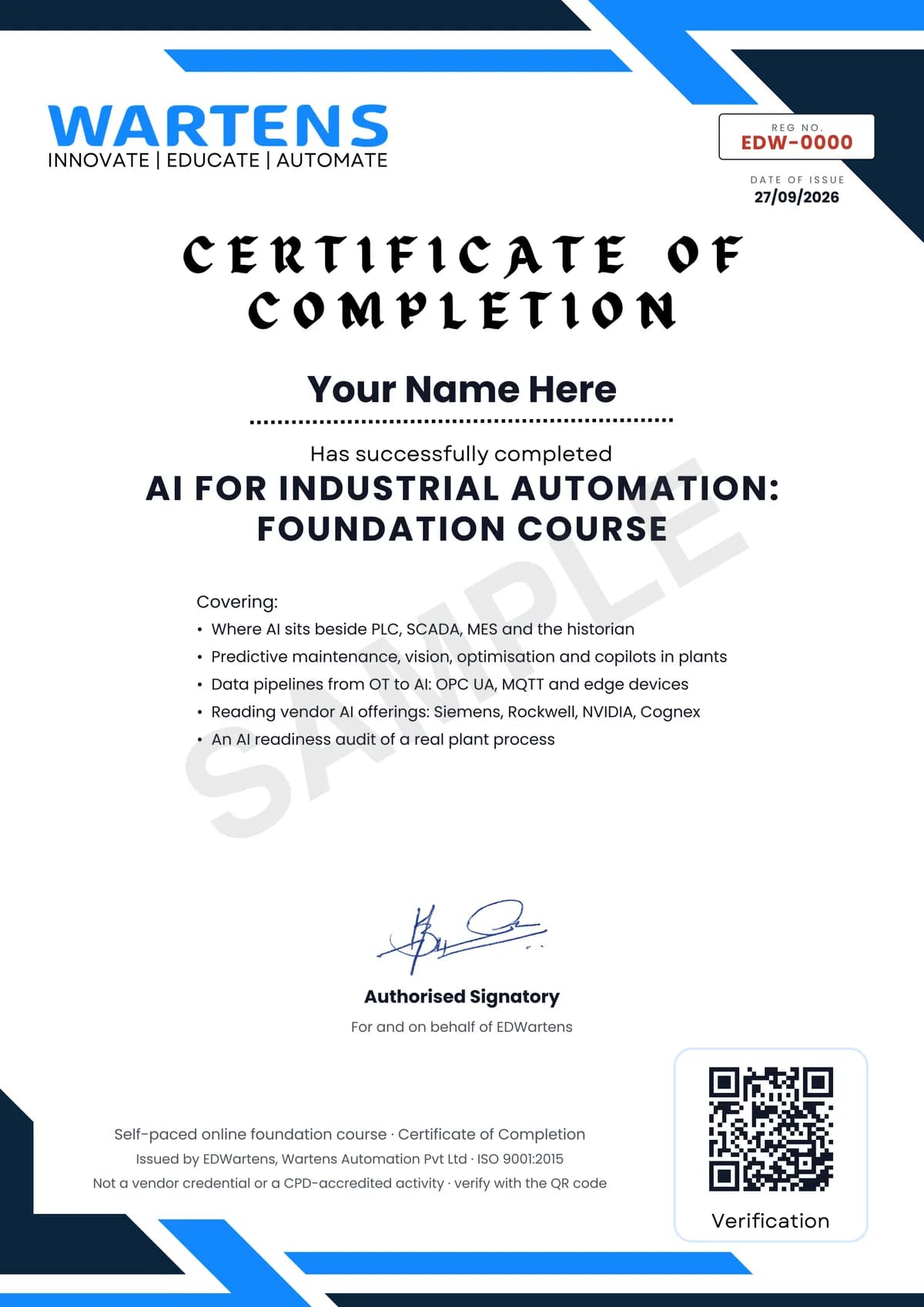
Verifiable by anyone
Adds to LinkedIn in one click
QR code on the certificate
Names what you can do
A permanent link
Earned, not attended
Learning is free. The certificate is optional.
Add it now and pay only when you have finished the course, or come back for it later. One-off, US$28.99, with a receipt.
Issued by EDWartens, the training division of Wartens, as a Certificate of Completion for this self-paced course. Sold by Wartens Ltd (England and Wales). It is not a vendor certification, a university award or a CPD-accredited activity, and it does not certify competence on live equipment. Delivered electronically; see the refund policy.
Credits
Who made the video lessons
The video lessons in this course were created by the people below, not by EDWartens. Every lesson streams from its creator's own YouTube channel; EDWartens neither hosts nor sells that footage, and the creators are not affiliated with EDWartens and do not endorse this course. What EDWartens wrote is the study plan, the notes, the practice tasks and the assessments.
- RealParsthe OPC UA, edge computing, predictive maintenance and Ignition explainers
- NVIDIAHow AI is transforming manufacturing end to end
- IBM Technologythe edge computing, digital twin and AI agents use-case explainers
- Siemens Knowledge HubIndustrial Edge explained, the edge AI tutorials and the digital twin clip
- Cognexthe AI for factory automation explainers
- MATLABGetting started with predictive maintenance and the digital twin explainer
- ADASHvibration analysis for beginners
- 4.0 Solutionsthe unified namespace and Sparkplug B explainers
- Opto Videothe introduction to MQTT and Sparkplug B
- Inductive Automationthe machine learning demo with Ignition
- Enudaa low-cost open-source machine learning solution beside Ignition
- edureka!AI in manufacturing
- Future in the MakingHow AI is changing manufacturing
- AutomatedoWhat is a digital twin
- Charbaxthe Siemens Engineering Copilot for TIA Portal demo
- Retrocausal AIan AI copilot for assembly
- Microsoft Developersecuring generative AI applications
- IT and Automation Academya lesson in "Getting data out: OPC UA, MQTT and the unified namespace"
- Breen Machine Automation Services LLCa lesson in "Machine vision and AI inspection"
- International Society of Automation - ISAa lesson in "Safety, security and governance"
- Patrick Byrne - AI & Manufacturinga lesson in "The AI readiness audit"
If you are one of these creators and would like a lesson removed or credited differently, write to info@wartens.com.