Maintenance · Free
Pumps, Compressors and Rotating Equipment
The machinery side of a process plant, taught the way a rotating equipment engineer uses it: how centrifugal pumps build head, pump and system curves, NPSH and cavitation, affinity laws and pump selection, API 610 pump types, positive displacement pumps, mechanical seals and API 682 seal plans, bearings and lubrication, installation and shaft alignment, reciprocating, screw and centrifugal compressors, surge, and commissioning, testing and troubleshooting.

Inside the course


From the lessons

Rotating equipment in a plant: machine families, the engineer's job and the standards
Energy Industry Training (EIT)

Pump curves, system curves and the operating point
HardHat Engineer

Affinity laws, impeller trimming and selecting a pump
PSG, a Dover Company
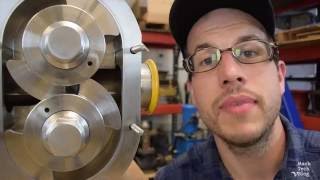
Positive displacement pumps: gear, screw, lobe, diaphragm and plunger
Laney Machine Tech

Bearings and lubrication: rolling element and hydrodynamic bearings
The Engineers Post

Compressors 1: compression basics and reciprocating compressors
Atlas Copco Compressor Technique
Lesson frames belong to the creators named in the Credits below and are shown from YouTube.
What you will learn
Convert between pressure and head and work hydraulic and shaft power; draw a system curve and find the operating point, including pumps in parallel and series; calculate NPSH available and judge the margin against NPSH3; apply the affinity laws and impeller trimming and select a pump and motor; check a selection against the API 610 operating regions and read its datasheet; size gear and metering pumps; choose a seal arrangement and API 682 piping plan; estimate bearing life and choose a lubricant; correct alignment at the feet and allow for thermal growth; work compressor discharge temperature, staging and surge margin; and commission, test and troubleshoot a pump against ISO 9906.
- Convert pressure to head, work hydraulic and shaft power, and read a centrifugal pump's parts and curves
- Build a system curve and find the operating point for one pump and for pumps in parallel and series
- Calculate NPSH available and judge the margin against NPSH3 at the worst case
- Apply the affinity laws and impeller trimming, select a pump and size its motor for end-of-curve power
- Check a selection against API 610 operating regions and choose an API 682 seal arrangement and plan
- Estimate bearing L10 life, choose a lubrication method and read an oil analysis
- Find soft foot and pipe strain, correct alignment at the feet and set thermal growth targets
- Work compressor discharge temperature, staging and surge margin, and accept a pump test to ISO 9906
For you
Taking Pumps, Compressors and Rotating Equipment from the United States
- Free in the United States, as everywhere, and self-paced: lessons, notes and the final assessment are open at any hour, so your time zone and shift pattern do not matter.
- The optional certificate for learners in the United States is a one-off US$28.99. What you get for it
- Plants across the Americas most often run Allen-Bradley, Siemens and Inductive Automation; each has its own free course to take next.
- See automation and engineering jobs in the United States, and what the industry looks like in Houston, Detroit and Chicago.
- EDWartens also has a regional site for the United States, for classroom training and local support: edwartens.com/us.
The course project · about 10 hours
Selecting, specifying and accepting a diesel transfer pump: system curve, NPSH, API 610 datasheet, installation and shop test
Take a real duty from the process data to an accepted pump, as a rotating equipment engineer on a terminal project would: build the system curve and find the operating point, check NPSH margin at the worst case, select a pump against the API 610 operating regions, size the motor for end-of-curve power, choose the seal and bearings, write the installation and alignment procedure, and judge the vendor's shop test against ISO 9906. The sample pack shows each document filled in for the scenario.
Sample document pack, 4 documents, filled in for the scenario
- ReportHydraulic calculation: system curve, operating point, NPSH margin and power for P-201A/B
- DatasheetAPI 610 pump datasheet extract: P-201A/B diesel transfer
- ProcedureInstallation, alignment and first-start procedure for P-201A/B
- Test reportShop performance test record and acceptance: P-201A to ISO 9906 grade 2B
Read inside the course and download as a workbook. The project is optional practice, marked when you submit it; the certificate needs only the modules and the final assessment.
Course content
14 modules · 76 lessons · 15h 38m
In order, at whatever pace suits you. Each module ends with a practice task that builds on the last.
- 01Rotating equipment in a plant: machine families, the engineer's job and the standards7 lessons32m
- 02Centrifugal pumps: parts, how the impeller makes head, and specific speed6 lessons1h 23m
- 03Pump curves, system curves and the operating point5 lessons1h 29m
- 04NPSH and cavitation: NPSH available, NPSH3 and margin5 lessons1h 32m
- 05Affinity laws, impeller trimming and selecting a pump6 lessons1h 17m
- 06API 610 process pumps: pump types, design rules and the datasheet5 lessons59m
- 07Positive displacement pumps: gear, screw, lobe, diaphragm and plunger3 lessons1h 7m
- 08Mechanical seals and API 682 seal arrangements and piping plans4 lessons1h 38m
Requirements
- Who it is for
- Intermediate. For mechanical and chemical engineers, maintenance engineers, technicians and operators who work with pumps and compressors, and for graduates moving into a rotating equipment role. You need school physics (pressure, energy, power) and a spreadsheet; no rotating equipment experience is needed. Vibration analysis is taught in Vibration Analysis Training, and pump energy savings in Energy Management and Energy Audit with ISO 50001.
- Software
- A spreadsheet (LibreOffice Calc is free) for system curves, NPSH, power and alignment calculations. A free online pump selection tool such as Grundfos Product Center is used to read real pump curves; it runs in a browser and needs no licence. What to download, and how
- Hardware
- None. Pumps, seals, alignment tools and compressors are shown in the lessons; you do not need your own.
Software you need
What to download, where from, what it costs and how to install it. Every link goes to the maker's own site, never a mirror.
Nothing to install
A spreadsheet is enough for every calculation, and Grundfos Product Center (product-selection.grundfos.com) runs in a browser for reading real pump curves. Pumps, seals and alignment tools are shown in the lessons.
Optional
Useful, not needed to finish the course.
- 01Free
LibreOffice
The Document Foundation
- Runs on
- Windows 10 or 11, macOS 11 or newer (Intel or Apple silicon), Linux
- Account
- None needed
- Size
- up to 1.5 GB of disk space on Windows
LibreOffice is free, open-source software under the Mozilla Public License 2.0, for any use including business. Calc is its spreadsheet.
Steps
- 1.Open the LibreOffice download page.
- 2.Check the page has picked your operating system, then select Download.
- 3.Run the installer (administrator rights are needed on Windows).
- 4.Start LibreOffice Calc for spreadsheet work.
- 5.Save as .xlsx if you need to share files with Excel users.
- Choose the latest main version unless your organisation asks for the older, more conservative release.
Official download pagelibreoffice.org
Checked against each maker's own page on 27 September 2026. Trial lengths and editions change; the maker's page is the final word.
Pumps, Compressors and Rotating Equipment at a glance
Pumps, Compressors and Rotating Equipment is a free, self-paced online course from EDWartens for mechanical, chemical and maintenance engineers, technicians and operators who specify, install, run and troubleshoot pumps and compressors. It has 14 modules and 15h 38m of video lessons by Ruhrpumpen Group, Siewert Equipment, Hydraulic Institute and others, with written notes and worked problems, a practical project with a document pack and a 15-question final assessment (pass mark 60%). Learning is free with an account; an optional certificate with a public verification code is issued when you pass. Last updated 27 September 2026.
All course factsHide course facts
- Price
- Free, for good. No trial, no card. The only paid item is the optional certificate, a small one-off fee.
- Who it is for
- Mechanical, chemical and maintenance engineers, technicians and operators who specify, install, run and troubleshoot pumps and compressors
- Format
- 14 self-paced modules, 15h 38m of video, written notes, a practice task per module and one final assessment.
- Level
- Intermediate. Intermediate. For mechanical and chemical engineers, maintenance engineers, technicians and operators who work with pumps and compressors, and for graduates moving into a rotating equipment role. You need school physics (pressure, energy, power) and a spreadsheet; no rotating equipment experience is needed. Vibration analysis is taught in Vibration Analysis Training, and pump energy savings in Energy Management and Energy Audit with ISO 50001.
- Brand
- Vendor-neutral
- Software
- A spreadsheet (LibreOffice Calc is free) for system curves, NPSH, power and alignment calculations. A free online pump selection tool such as Grundfos Product Center is used to read real pump curves; it runs in a browser and needs no licence.
- Hardware
- None. Pumps, seals, alignment tools and compressors are shown in the lessons; you do not need your own.
- Certificate
- Optional EDWartens Certificate of Completion, verifiable by code. Not a vendor credential.
- Video lessons by
- Ruhrpumpen Group, Siewert Equipment, Hydraulic Institute, HardHat Engineer, The Engineering Mindset, Mat Integrity, PSG, a Dover Company, Griswold, Grundfos, UNICEF Solar Hub, Core Engineering, Brian Bernard, MECH 241 - Fluid Mechanics I, Laney Machine Tech, JAES Company, EagleBurgmann, The Engineers Post, Rotor Dynamics 101, AmarinthPumps, Lubrication Explained, Spectro Scientific, Acoem USA, Rexnord MCS, LUDECAINC, SAIT Millwright, SKF Maintenance Products, Atlas Copco Compressor Technique, Ariel Corporation, Howden, Kimray Inc, Vibration, dynamics and noise, RATS-Rotating and Turbomachinery Society, ROTARYCOMPTECH, FS-Elliott, Solar Turbines, ECAS, AESSEAL, Sulzer, RedVectorOnline, Energy Industry Training (EIT), LynxE - Your New Learning Experience (independent creators, credited below)
- Language
- English
- Last updated
- 27 September 2026
A shareable EDWartens certificate
Finish every module and pass the final assessment, and the optional EDWartens certificate is yours. It carries a unique verification code on a public page anyone can check, so it stands up when a recruiter looks it up. See it below.
The course itself stays free whether or not you ever buy one.
Stuck? Ask a practising engineer
A free course usually means a comment section and hope. This one does not. Every module has an Ask-your-trainer panel that reaches the same engineers who teach our paid programme: people who commission panels for a living, not moderators.
Pairs well with
 FreePLC programming · FreeSiemens TIA PortalFree Siemens TIA Portal course for beginners: write ladder logic for a simulated S7-1200 and WinCC HMI. Learning is free; the certificate is optional and paid.
 FreePLC programming · FreeSiemens TIA Portal in Three HoursThe first three hours of the Siemens TIA Portal course, cut to end on a win: what a PLC is, how it is wired, a project configured in TIA Portal, and your first ladder program running in simulation. Finish it in an evening or two, earn a certificate, and carry straight on into the full course.
 FreePLC programming · FreeTIA Portal: Build a MachineOne machine, start to finish. Take a bottle filling line from a written specification and an I/O list to a structured S7-1200 program with a fill station, a capper, a reject sorter and an operator screen with alarms, then test it against a written record and archive it for hand-over. The lessons are the reference; the machine is yours, and it is what you submit.
 FreeInstrumentation · FreeInstrumentation for PLC EngineersThe half of the loop that is not code. Follow one measurement from the transmitter in the field, down the 4-20 mA loop, into the analog card, through NORM_X and SCALE_X into engineering units, out again to a valve, and back to the control room when the reading is wrong.
More free courses: Free maintenance and reliability courses
Learner reviews
No reviews yet
Reviews here are written only by learners who have finished every module of Pumps, Compressors and Rotating Equipment, and they are published exactly as written. Finish the course and yours will be the first.
Common questions
What is a pumps and compressors course?
It is training in how centrifugal and positive displacement pumps and reciprocating, screw and centrifugal compressors work, how they are selected and specified, and how they are installed, aligned, tested and kept running. This course covers pump and system curves, NPSH and cavitation, affinity laws, pump selection, mechanical seals, bearings, alignment, compressor surge and troubleshooting.
Who is this rotating equipment course for, and what do I need to know first?
It is for mechanical and chemical engineers, maintenance engineers, technicians and operators who work with pumps and compressors, and for graduates moving into a rotating equipment engineer role. You need school physics (pressure, energy and power) and basic spreadsheet skills; no rotating equipment experience is needed.
Do I need any software for the pump selection course?
No paid software is needed. A spreadsheet such as LibreOffice Calc handles every calculation, and a free browser-based selection tool such as Grundfos Product Center is used to read real pump curves and practise selection.
Is the course free to learn, and how long does it take?
Yes, every module, the notes, worked problems, practice tasks, the optional project and the final assessment are free to learn. The course takes about 23 hours at your own pace, of which about 15.6 hours is video; the optional pump selection project takes about 10 hours more.
Which standards does the course follow?
It explains the principles of ISO 13709 (API 610) for centrifugal pumps, ISO 21049 (API 682) for mechanical seals and ISO 9906 for pump acceptance tests, together with API 617, 618 and 619 for compressors, ASME B73.1 for chemical pumps and the Hydraulic Institute's NPSH margin guideline. Standards are paraphrased, never reproduced, and the purchase specification always governs.
What certificate do I get, and how is it verified?
You get a verifiable certificate of completion when you finish the modules and pass the 15-question final at 60 percent. It carries a unique certificate number and a QR code that open a public verification page showing the course, the modules covered and your final score. It is not an API, ISO or vendor certification.
Does the course teach vibration analysis?
Only as a symptom: the course shows when vibration points to a pump or compressor problem and what to give an analyst. Spectrum analysis and fault diagnosis are taught in Vibration Analysis Training and in Machinery Fault Diagnosis and Condition Monitoring.
What jobs does this lead to, including in the Gulf?
It prepares you for roles such as rotating equipment engineer, mechanical maintenance engineer, pump and compressor technician, and reliability or commissioning engineer for machinery. Refineries, gas plants, petrochemical complexes and desalination plants in Saudi Arabia, the UAE, Qatar, Kuwait and Oman hire for these roles and buy pumps and compressors to API standards.
What you walk away with
Your certificate for Pumps, Compressors and Rotating Equipment
Finish the course, pass the final, and this is the document with your name on it.

Verifiable by anyone
Adds to LinkedIn in one click
QR code on the certificate
Names what you can do
A permanent link
Earned, not attended
Learning is free. The certificate is optional.
Add it now and pay only when you have finished the course, or come back for it later. One-off, US$28.99, with a receipt.
Issued by EDWartens, the training division of Wartens, as a Certificate of Completion for this self-paced course. Sold by Wartens Ltd (England and Wales). It is not a vendor certification, a university award or a CPD-accredited activity, and it does not certify competence on live equipment. Delivered electronically; see the refund policy.
Credits
Who made the video lessons
The video lessons in this course were created by the people below, not by EDWartens. Every lesson streams from its creator's own YouTube channel; EDWartens neither hosts nor sells that footage, and the creators are not affiliated with EDWartens and do not endorse this course. What EDWartens wrote is the study plan, the notes, the practice tasks and the assessments.
- Ruhrpumpen Groupthe pump maker's short courses on system curves, NPSH and suction specific speed, selecting the right pump, curve shape and head rise to shutoff, API 610 editions, positive displacement pumps, start-up and troubleshooting, and performance testing of API 610 pumps
- Siewert Equipmentthe webinars on centrifugal pump hydraulic fundamentals, mechanical seal fundamentals and mechanical seal piping plans
- Hydraulic Institutethe pump fundamentals shorts: rotodynamic against positive displacement, pump components, operating point, specific gravity, motors and alternative drivers
- HardHat Engineerthe centrifugal pump series: working principle, types, parts, API 610 pump types, curves and cavitation
- The Engineering Mindsetcentrifugal pump basics and the long session on centrifugal compressors
- Mat IntegrityAPI 610 classifications, components, OH1 against OH2, and pump bearing housing lubrication
- PSG, a Dover Companydetermining NPSH available and the affinity law for pump speed
- Griswoldthe affinity law for impeller trimming
- Grundfosquick pump sizing by application in Grundfos Product Center
- UNICEF Solar Huba walk-through of pump selection in Grundfos Product Center
- Core Engineeringpump curve against system curve with a worked example
- Brian Bernarda pump curve and system curve example problem
- MECH 241 - Fluid Mechanics Ithe university lecture on net positive suction head
- Laney Machine Techpositive displacement pump types and hydrodynamic bearings
- JAES Companyhow mechanical seals and packing work
- EagleBurgmannthe seal maker's animation of mechanical seal functionality
- The Engineers Postbearing types and how they work
- Rotor Dynamics 101tilting pad bearings
- AmarinthPumpsfilling an oil-lubricated bearing bracket correctly
- Lubrication Explainedoil viscosity fundamentals
- Spectro Scientificpump oil analysis
- Acoem USAcouplings explained for shaft alignment
- Rexnord MCSinstalling a grid coupling
- LUDECAINCsoft foot checks and corrections and the five-step alignment procedure
- SAIT Millwrightpipe strain, soft foot and rough alignment from a millwright school
- SKF Maintenance Productsa full laser shaft alignment demonstration
- Atlas Copco Compressor Techniquethe short chapters on piston and rotary screw compressors
- Ariel Corporationa look inside a reciprocating gas compressor
- Howdenreciprocating and screw compressor animations
- Kimray Incan overview of a natural gas compressor station
- Vibration, dynamics and noisevibration and pulsation issues in reciprocating compressor systems
- RATS-Rotating and Turbomachinery Societythe technical session on reciprocating compressor capacity control
- ROTARYCOMPTECHhow an oil-flooded rotary screw compressor works
- FS-Elliotthow a centrifugal compressor works
- Solar Turbineshow a centrifugal gas compressor works
- ECASanti-surge control in gas compressors
- AESSEALdry gas seal hydrodynamic grooves
- Sulzercommissioning of a pump
- RedVectorOnlineanalysing pump vibrations, as the bridge to the vibration courses
- Energy Industry Training (EIT)the introduction to rotating equipment in oil and gas that opens the course
- LynxE - Your New Learning Experiencethe introduction to compressor types
If you are one of these creators and would like a lesson removed or credited differently, write to info@wartens.com.