Energy · Free
Energy Management and Energy Audit with ISO 50001
Energy management and energy auditing for plants and buildings: energy units and the electricity bill, the ISO 50001 energy management system clause by clause, energy reviews, EnPIs and baselines by regression and CUSUM, metering and IPMVP measurement and verification, the audit method and instruments, then motors, pumps and fans, compressed air, chillers and lighting, boilers and steam, and project economics in cost units.
Inside the course
From the lessons

Energy management and the energy audit: purpose, units and audit levels
TNV Akademi

ISO 50001 structure: PDCA, context, leadership and energy policy (clauses 1 to 5)
TNV Akademi

ISO 50001 support, operation, performance evaluation, improvement and certification (clauses 7 to 10)
TNV Akademi

Metering, monitoring and measurement and verification (IPMVP and ISO 50015)
GridPoint

Electric motors: efficiency classes, load estimation and replace or rewind decisions
ABB Motors and Generators

Compressed air systems: generation, leaks, pressure and heat recovery
Better Buildings & Better Plants
Lesson frames belong to the creators named in the Credits below and are shown from YouTube.
What you will learn
Convert any site's energy into one unit and calculate specific energy consumption; read an industrial electricity bill and size power factor correction; build and audit an ISO 50001 energy management system from context and policy to management review; run an energy review, pick significant energy uses and set EnPIs and baselines by regression with CUSUM tracking; write an IPMVP measurement and verification plan; plan and carry out an energy audit with the right instruments; find and calculate savings in motors, pumps and fans, compressed air, chillers, lighting, boilers and steam; and rank measures by payback, NPV and IRR in a report management can act on.
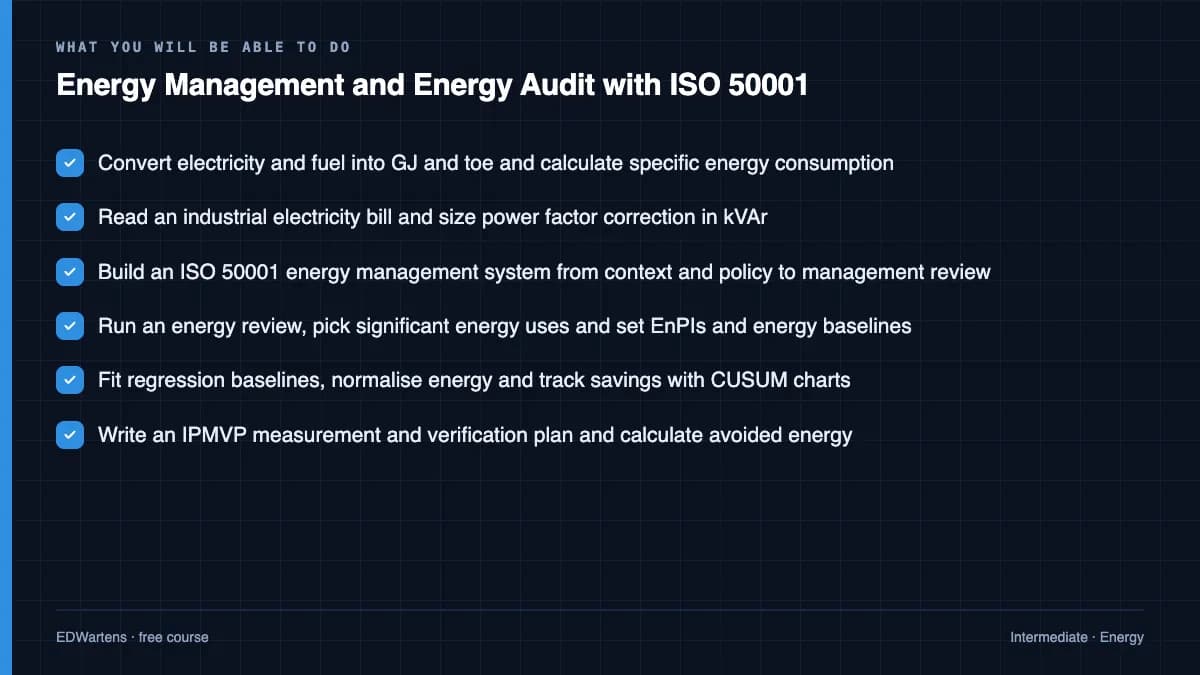
- Convert electricity and fuel into GJ and toe and calculate specific energy consumption
- Read an industrial electricity bill and size power factor correction in kVAr
- Build an ISO 50001 energy management system from context and policy to management review
- Run an energy review, pick significant energy uses and set EnPIs and energy baselines
- Fit regression baselines, normalise energy and track savings with CUSUM charts
- Write an IPMVP measurement and verification plan and calculate avoided energy
- Plan an ISO 50002-1 energy audit and measure motors, pumps, fans, compressed air, chillers and boilers
- Rank energy conservation measures by payback, NPV and IRR in cost units and write the audit report
For you
Taking Energy Management and Energy Audit with ISO 50001 from the United States
- Free in the United States, as everywhere, and self-paced: lessons, notes and the final assessment are open at any hour, so your time zone and shift pattern do not matter.
- The optional certificate for learners in the United States is a one-off US$28.99. What you get for it
- Plants across the Americas most often run Allen-Bradley, Siemens and Inductive Automation; each has its own free course to take next.
- See automation and engineering jobs in the United States, and what the industry looks like in Houston, Detroit and Chicago.
- EDWartens also has a regional site for the United States, for classroom training and local support: edwartens.com/us.
The course project · about 16 hours
Detailed energy audit and ISO 50001 energy review of a plastics packaging plant
Plan and carry out a detailed energy audit of a plastics packaging plant and turn it into the planning core of an ISO 50001 energy management system: analyse a year of bills, build a regression baseline and EnPIs, select the significant energy uses, calculate seven energy conservation measures with interactions, rank them by payback and NPV in cost units, write the M&V plan and the action plan, and set an operational control for the compressed air SEU. The sample pack shows each document for a plant in Sharjah, UAE.
Sample document pack, 5 documents, filled in for the scenario
- PlanEnergy audit plan: Corniche Packaging, Sharjah plant
- ReportEnergy review and baseline: Corniche Packaging, Sharjah plant
- RegisterRegister of energy conservation measures
- ReportAudit findings, ranking, M&V plan and ISO 50001 action plans
- ProcedureOperational control of the compressed air system (SEU)
Read inside the course and download as a workbook. The project is optional practice, marked when you submit it; the certificate needs only the modules and the final assessment.
Course content
15 modules · 61 lessons · 13h 5m
In order, at whatever pace suits you. Each module ends with a practice task that builds on the last.
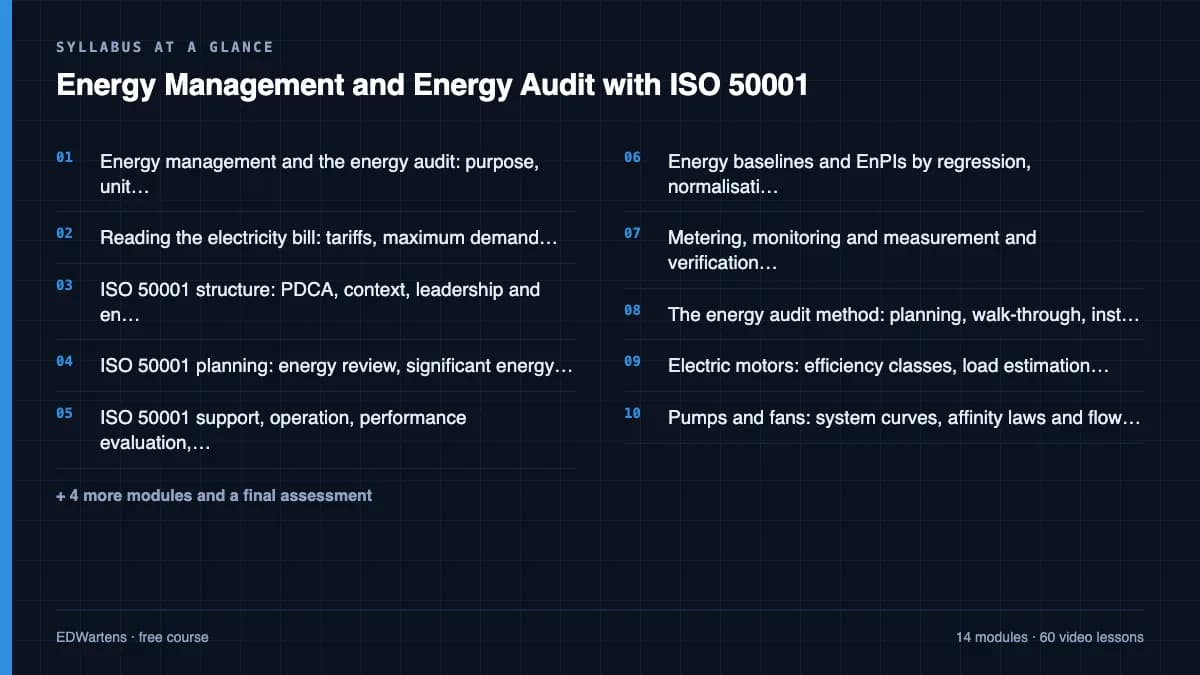
- 01Energy management and the energy audit: purpose, units and audit levels4 lessons35m
- 02Reading the electricity bill: tariffs, maximum demand, power factor and load factor3 lessons48m
- 03ISO 50001 structure: PDCA, context, leadership and energy policy (clauses 1 to 5)5 lessons50m
- 04ISO 50001 planning: energy review, significant energy uses, EnPIs, baselines and action plans3 lessons26m
- 05ISO 50001 support, operation, performance evaluation, improvement and certification (clauses 7 to 10)6 lessons1h 10m
- 06Energy baselines and EnPIs by regression, normalisation and CUSUM4 lessons45m
- 07Metering, monitoring and measurement and verification (IPMVP and ISO 50015)3 lessons1h 16m
- 08The energy audit method: planning, walk-through, instruments and the energy balance4 lessons1h 9m
Requirements
- Who it is for
- Intermediate. For electrical, mechanical, chemical and utility engineers, facility and maintenance engineers, and energy consultants starting out. You need school physics and algebra and a spreadsheet; every formula is worked step by step. A year in a plant or building services role helps but is not required.
- Software
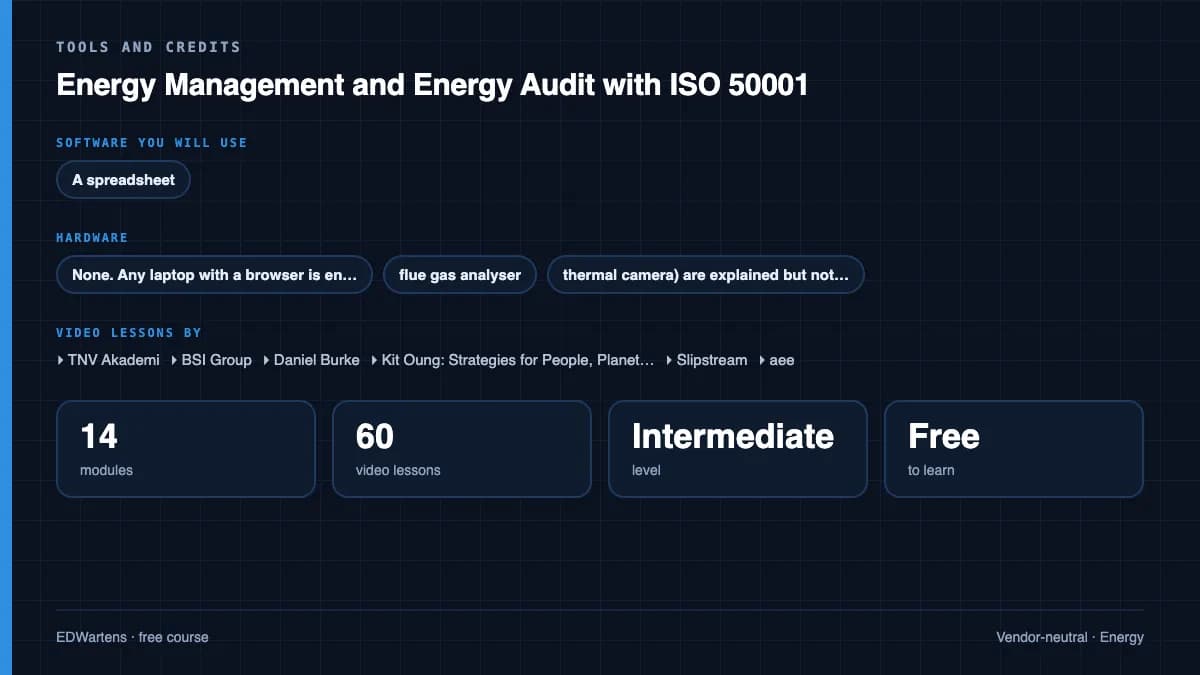
- A spreadsheet (LibreOffice Calc is free) for bills, regressions, CUSUM charts and project economics. The free US DOE MEASUR tool (desktop or measur.ornl.gov) for pump, fan, compressed air and steam calculations, and the free DOE 50001 Ready Navigator for the ISO 50001 steps. No paid software is needed. What to download, and how
- Hardware
- None. Any laptop with a browser is enough. Audit instruments (power analyser, flue gas analyser, thermal camera) are explained but not required.
Software you need
What to download, where from, what it costs and how to install it. Every link goes to the maker's own site, never a mirror.
Nothing to install
A spreadsheet is enough for every calculation; the free MEASUR tool (web or desktop) is an optional check for the pump, fan, compressed air and steam modules.
Optional
Useful, not needed to finish the course.
- 01Free
LibreOffice
The Document Foundation
- Runs on
- Windows 10 or 11, macOS 11 or newer (Intel or Apple silicon), Linux
- Account
- None needed
- Size
- up to 1.5 GB of disk space on Windows
LibreOffice is free, open-source software under the Mozilla Public License 2.0, for any use including business. Calc is its spreadsheet.
Steps
- 1.Open the LibreOffice download page.
- 2.Check the page has picked your operating system, then select Download.
- 3.Run the installer (administrator rights are needed on Windows).
- 4.Start LibreOffice Calc for spreadsheet work.
- 5.Save as .xlsx if you need to share files with Excel users.
- Choose the latest main version unless your organisation asks for the older, more conservative release.
Official download pagelibreoffice.org - 02Free
MEASUR
US Department of Energy and Oak Ridge National Laboratory, in the browser
- Runs on
- Any modern browser; desktop builds for Windows, macOS and Linux are published on GitHub
- Account
- None needed
MEASUR is free software from the US Department of Energy, developed with Oak Ridge National Laboratory; its source code is public on GitHub (ORNL-AMO/AMO-Tools-Desktop).
Steps
- 1.Open the MEASUR web version in a browser.
- 2.Start a new assessment and choose the system: pumps, fans, compressed air, steam or process heating.
- 3.Enter the measured data (flow, head or pressure, power, operating hours) for the baseline.
- 4.Add modifications such as a VFD, a lower pressure or leak repair and compare the results.
- 5.For offline work, install the desktop version from the ORNL-AMO GitHub releases page.
- Data in the web version is kept in your browser; export your assessments if you change computer.
Open MEASURmeasur.ornl.govAlternatives
- MEASUR desktop releases: Installers for Windows, macOS and Linux
Checked against each maker's own page on 27 September 2026. Trial lengths and editions change; the maker's page is the final word.
Energy Management and Energy Audit with ISO 50001 at a glance
Energy Management and Energy Audit with ISO 50001 is a free, self-paced online course from EDWartens for electrical, mechanical, chemical and utility engineers, facility engineers and new energy consultants in plants and buildings. It has 15 modules and 13h 5m of video lessons by TNV Akademi, BSI Group, Daniel Burke and others, with written notes and worked problems, a practical project with a document pack and a 15-question final assessment (pass mark 60%). Learning is free with an account; an optional certificate with a public verification code is issued when you pass. Last updated 27 September 2026.
All course factsHide course facts
- Price
- Free, for good. No trial, no card. The only paid item is the optional certificate, a small one-off fee.
- Who it is for
- Electrical, mechanical, chemical and utility engineers, facility engineers and new energy consultants in plants and buildings
- Format
- 15 self-paced modules, 13h 5m of video, written notes, a practice task per module and one final assessment.
- Level
- Intermediate. Intermediate. For electrical, mechanical, chemical and utility engineers, facility and maintenance engineers, and energy consultants starting out. You need school physics and algebra and a spreadsheet; every formula is worked step by step. A year in a plant or building services role helps but is not required.
- Brand
- Vendor-neutral
- Software
- A spreadsheet (LibreOffice Calc is free) for bills, regressions, CUSUM charts and project economics. The free US DOE MEASUR tool (desktop or measur.ornl.gov) for pump, fan, compressed air and steam calculations, and the free DOE 50001 Ready Navigator for the ISO 50001 steps. No paid software is needed.
- Hardware
- None. Any laptop with a browser is enough. Audit instruments (power analyser, flue gas analyser, thermal camera) are explained but not required.
- Certificate
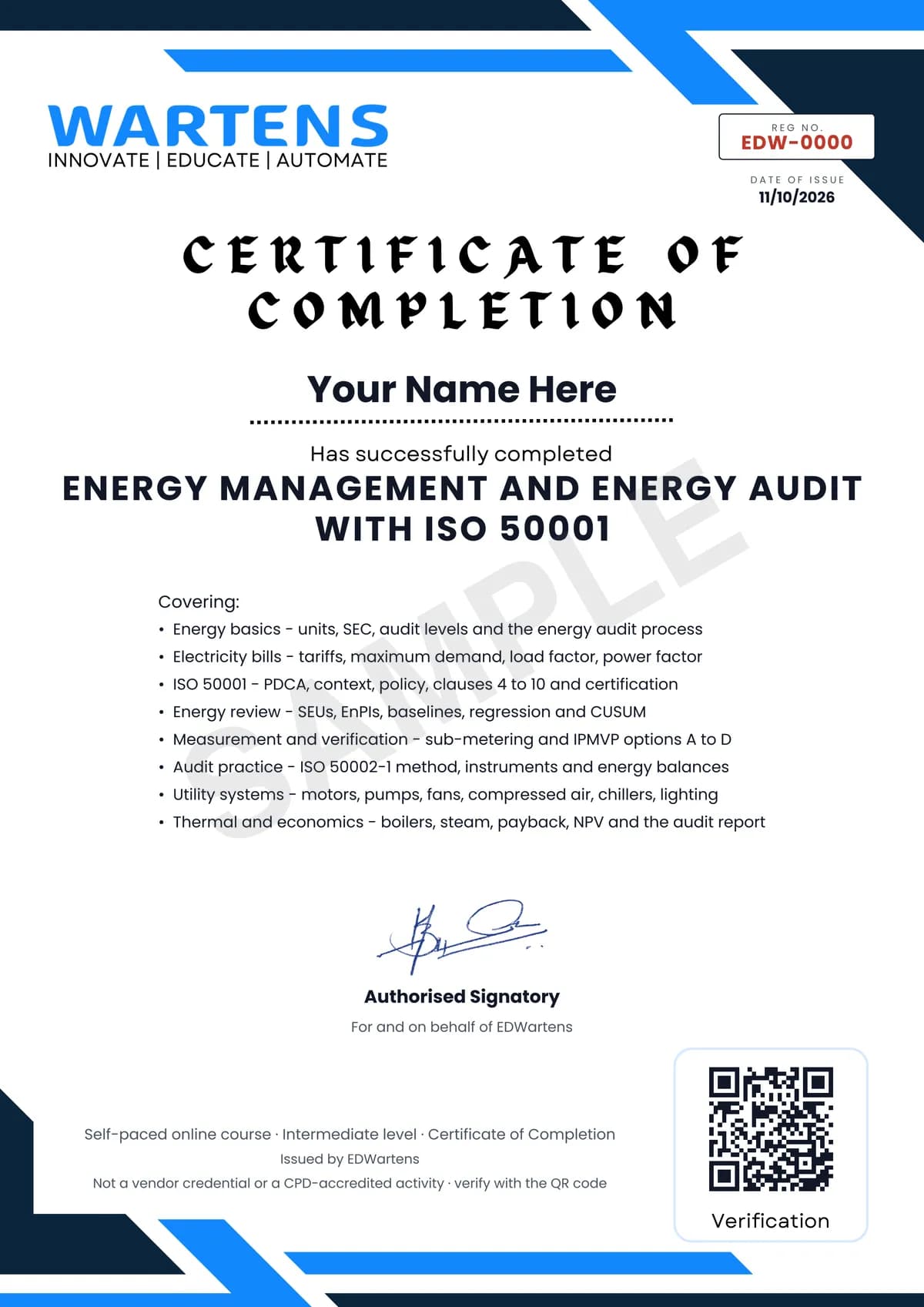
- Optional EDWartens Certificate of Completion, verifiable by code. Not a vendor credential.
- Video lessons by
- TNV Akademi, BSI Group, Daniel Burke, Kit Oung: Strategies for People, Planet, Profit, Slipstream, aee, Kenji Explains, Bleed Electrical, MrAfza79, Energy Manager Support Services, GridPoint, EMSDGOVHK, ASHRAE RAL, Sustainability Education Academy, Annette Gorelick, Advanced Test Equipment Corp. (ATEC), MRU Instruments, ABB Motors and Generators, Siemens Knowledge Hub, Bureau of Energy Efficiency, MissionMotivateMillionMinds-Prof.K.NagabhushanRaju, The Engineering Mindset, ABB Drives US, SPEC e-Learn, Kevin Dorma Consulting, Better Buildings & Better Plants, Save on Energy, FS-Elliott, Kaeser USA, James Curnow, Babu Thomas, Energy, Climate & Copper | Webinar Series, InstMates, IIT Roorkee July 2018, MEP Academy, WARE Boilers, ActOnEnergyBusiness, The Finance Storyteller, Ed Kaplan, SustainSight (independent creators, credited below)
- Language
- English
- Last updated
- 27 September 2026
A shareable EDWartens certificate
Finish every module and pass the final assessment, and the optional EDWartens certificate is yours. It carries a unique verification code on a public page anyone can check, so it stands up when a recruiter looks it up. See it below.
The course itself stays free whether or not you ever buy one.
Stuck? Ask a practising engineer
A free course usually means a comment section and hope. This one does not. Every module has an Ask-your-trainer panel that reaches the same engineers who teach our paid programme: people who commission panels for a living, not moderators.
Pairs well with
 FreePLC programming · FreeSiemens TIA PortalFree Siemens TIA Portal course for beginners: write ladder logic for a simulated S7-1200 and WinCC HMI. Learning is free; the certificate is optional and paid.
 FreePLC programming · FreeSiemens TIA Portal in Three HoursThe first three hours of the Siemens TIA Portal course, cut to end on a win: what a PLC is, how it is wired, a project configured in TIA Portal, and your first ladder program running in simulation. Finish it in an evening or two, earn a certificate, and carry straight on into the full course.
 FreePLC programming · FreeTIA Portal: Build a MachineOne machine, start to finish. Take a bottle filling line from a written specification and an I/O list to a structured S7-1200 program with a fill station, a capper, a reject sorter and an operator screen with alarms, then test it against a written record and archive it for hand-over. The lessons are the reference; the machine is yours, and it is what you submit.
 FreeInstrumentation · FreeInstrumentation for PLC EngineersThe half of the loop that is not code. Follow one measurement from the transmitter in the field, down the 4-20 mA loop, into the analog card, through NORM_X and SCALE_X into engineering units, out again to a valve, and back to the control room when the reading is wrong.
More free courses: Free electrical design and control panel courses · Free Six Sigma and quality courses
Learner reviews
No reviews yet
Reviews here are written only by learners who have finished every module of Energy Management and Energy Audit with ISO 50001, and they are published exactly as written. Finish the course and yours will be the first.
Common questions
What is this energy audit and ISO 50001 course?
It is a free-to-learn, self-paced course in energy management and energy auditing for plants and buildings. It covers electricity bills and power factor, the ISO 50001:2018 energy management system clause by clause, energy reviews, EnPIs and regression baselines, IPMVP measurement and verification, the ISO 50002-1 audit method, and savings in motors, pumps, fans, compressed air, chillers, lighting, boilers and steam, with notes, worked problems and an audit project.
Who is the energy management course for?
It is for electrical, mechanical, chemical and utility engineers, facility and maintenance engineers, and new energy consultants who want to become energy managers or energy auditors. Sustainability and EHS staff who own an ISO 50001 system will also find the planning and audit modules useful.
Do I need any prerequisites or paid software?
No paid software is needed: a spreadsheet such as LibreOffice Calc handles the bills, regressions and economics, and the free US DOE MEASUR tool covers pump, fan, compressed air and steam calculations. You need school physics, algebra and basic spreadsheet skills; every formula is worked step by step.
Which standards does the energy audit course cover?
The course explains the ISO 50000 family in our own words: ISO 50001:2018 with its 2024 climate amendment, ISO 50002-1:2025 for energy audits, ISO 50003 for certification, ISO 50005 for phased implementation, ISO 50006 for EnPIs and baselines and ISO 50015 for measurement and verification. It also uses the IPMVP protocol, ASHRAE/ACCA 211 audit levels and IEC 60034-30-1 motor efficiency classes, without reproducing any standard's text.
How long does the Energy Management and Energy Audit with ISO 50001 course take?
About 20 hours at your own pace: roughly 13 hours of video plus notes, worked problems and practice tasks across 14 modules and a final assessment. The optional plant energy audit project takes about 16 hours more.
Is the course free, and what certificate do I get?
The course is free to learn, and you can earn a verifiable certificate of completion by finishing the modules and passing the 15-question final at 60 percent. Each certificate has a unique number, a QR code and a public verification page that shows the course, the modules covered and the final score.
Does this course prepare me for the BEE energy manager and energy auditor exam or ISO 50001 auditor training?
It covers much of the knowledge in the BEE national certification examination for energy managers and energy auditors, including energy management and audit, electrical utilities and thermal utilities, so it is useful preparation, but it is not that certification. It is also not ISO 50001 lead auditor training; the EDWartens certificate is a certificate of completion.
What jobs does energy auditing lead to, and is it in demand in the Gulf?
It leads to energy manager, energy auditor, energy engineer and sustainability engineer roles with industry, utilities, facility management firms and energy service companies. ISO 50001 certificates grew by more than half worldwide between 2023 and 2024, and industrial and building owners in the Gulf, Asia and Europe are adopting energy management systems and efficiency programmes that need these skills.
What you walk away with
Your certificate for Energy Management and Energy Audit with ISO 50001
Finish the course, pass the final, and this is the document with your name on it.
Verifiable by anyone
Adds to LinkedIn in one click
QR code on the certificate
Names what you can do
A permanent link
Earned, not attended
Learning is free. The certificate is optional.
Add it now and pay only when you have finished the course, or come back for it later. One-off, US$28.99, with a receipt.
Issued by EDWartens, the training division of Wartens, as a Certificate of Completion for this self-paced course. Sold by Wartens Ltd (England and Wales). It is not a vendor certification, a university award or a CPD-accredited activity, and it does not certify competence on live equipment. Delivered electronically; see the refund policy.
Credits
Who made the video lessons
The video lessons in this course were created by the people below, not by EDWartens. Every lesson streams from its creator's own YouTube channel; EDWartens neither hosts nor sells that footage, and the creators are not affiliated with EDWartens and do not endorse this course. What EDWartens wrote is the study plan, the notes, the practice tasks and the assessments.
- TNV Akademithe ISO 50001:2018 clause-by-clause series: what the standard is, scope, terms, context, leadership, planning, support, operation, performance evaluation, improvement and the certification process
- BSI Groupthe four-part ISO 50001 series: getting started, important terms, measuring performance and top ten tips
- Daniel Burkechoosing between ASHRAE level 1, 2 and 3 energy audits, and power factor penalties and correction strategies
- Kit Oung: Strategies for People, Planet, Profitthe basics of implementing ISO 50001:2018 and how to build an energy baseline
- Slipstreamwhat a demand charge is on an electricity bill
- aeepower factor penalties on energy bills
- Kenji Explainsregression analysis in a spreadsheet, used for energy baselines
- Bleed Electricalenergy action planning and CUSUM charts
- MrAfza79a worked CUSUM lecture for energy management
- Energy Manager Support Servicesinterpreting a CUSUM chart
- GridPointhow IPMVP energy savings are calculated
- EMSDGOVHKselecting a suitable IPMVP M&V option
- ASHRAE RALthe introduction to measurement and verification lecture
- Sustainability Education Academythe energy auditing 101 webinar on the audit method
- Annette Gorelickan ASHRAE level 1 walk-through audit
- Advanced Test Equipment Corp. (ATEC)how to use a three-phase power analyser
- MRU Instrumentshow a flue gas analyser works
- ABB Motors and Generatorswhy electric motor efficiency matters
- Siemens Knowledge HubIE4 motors and tools for selecting efficient motors
- Bureau of Energy Efficiencyreplacing conventional motors with energy-efficient motors
- MissionMotivateMillionMinds-Prof.K.NagabhushanRajumotor types, performance parameters and energy efficiency aspects
- The Engineering Mindsetpump curve basics and chiller COP, efficiency improvements and replacement savings
- ABB Drives USthe affinity laws and variable frequency drive savings
- SPEC e-Learncentrifugal pump affinity laws and pump resizing
- Kevin Dorma Consultingwhen a VFD is the right way to control centrifugal pump flow
- Better Buildings & Better Plantsthe US DOE compressed air energy-saving tip
- Save on Energyhow compressed air projects save energy
- FS-Elliottthe hidden energy and life-cycle cost of compressed air
- Kaeser USAcompressed air fundamentals, air audits and heat recovery
- James Curnowcalculating energy savings for LED lighting
- Babu Thomasenergy saving in lighting systems
- Energy, Climate & Copper | Webinar Seriesthe webinar on calculating energy saving measures for indoor lighting
- InstMateshow flue gas oxygen affects boiler combustion and efficiency
- IIT Roorkee July 2018the boiler performance lecture
- MEP Academyhow steam traps work
- WARE Boilersa steam study of traps, condensate return and insulation
- ActOnEnergyBusinesssaving energy in process steam systems, and calculating payback for efficiency projects
- The Finance Storytellernet present value and internal rate of return
- Ed Kaplanpayback and NPV applied to an HVAC system
- SustainSightlife-cycle costing
If you are one of these creators and would like a lesson removed or credited differently, write to info@wartens.com.