Electrical · Free
Power Quality and Harmonics: IEEE 519 and IEC 61000
Power quality for electrical engineers in plants, buildings, utilities and data centres: sags, swells, transients, flicker and unbalance; harmonics from drives, UPS, IT loads and inverters; THD, TDD, K-factor and resonance; IEEE 519-2022 limits at the point of common coupling and the IEC 61000 family; Class A measurement and Python analysis; reactors, detuned capacitor banks, passive and active filters, active front ends and multipulse drives; and a harmonic study in the free OpenDSS simulator.

Inside the course


From the lessons

What power quality is and why plants and data centres care
Gaurav J - TheElectricalGuy

Transients, flicker and voltage unbalance
BESA Research
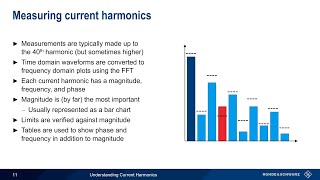
Sources of harmonics: drives, rectifiers, UPS, IT and LED loads, inverters
Rohde & Schwarz

Resonance, power factor correction and detuned capacitor banks
Eaton
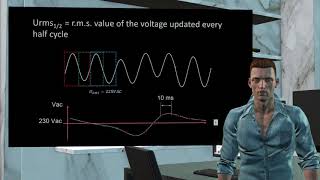
Measuring power quality: IEC 61000-4-30 Class A and analyser set-up
SCIENTIA

Mitigation 1: reactors, transformers, multipulse drives and passive filters
Eaton
Lesson frames belong to the creators named in the Credits below and are shown from YouTube.
What you will learn
Classify sags, swells, interruptions, transients, flicker and unbalance and judge equipment ride-through on the ITIC and SEMI F47 curves; calculate THD, TDD, true power factor, K-factor and neutral current from a spectrum; predict the harmonics of drives, UPS and IT loads; find parallel resonance and specify detuned capacitor banks; locate the PCC, calculate Isc/IL and test compliance with IEEE 519-2022 using its percentile rules; plan and run a Class A survey and analyse a week of data in Python; size reactors and active filters and compare multipulse, AFE and passive solutions; model a site in OpenDSS; and write a power quality report.
- Classify sags, swells, transients, flicker and unbalance and judge ride-through on ITIC and SEMI F47
- Calculate THD, TDD, true RMS, true power factor, K-factor and neutral current from a spectrum
- Predict the harmonics of six, twelve and eighteen pulse drives, UPS, IT loads and inverters
- Find parallel resonance and specify a detuned capacitor bank with the right capacitor voltage
- Locate the PCC, calculate Isc/IL and test compliance with IEEE 519-2022 percentile rules
- Plan an IEC 61000-4-30 Class A survey and analyse a week of data in Python
- Size reactors and active harmonic filters and compare multipulse, AFE and passive filters
- Model a site in OpenDSS and write a power quality report with ranked recommendations
For you
Taking Power Quality and Harmonics: IEEE 519 and IEC 61000 from the United States
- Free in the United States, as everywhere, and self-paced: lessons, notes and the final assessment are open at any hour, so your time zone and shift pattern do not matter.
- The optional certificate for learners in the United States is a one-off US$28.99. What you get for it
- Plants across the Americas most often run Allen-Bradley, Siemens and Inductive Automation; each has its own free course to take next.
- See automation and engineering jobs in the United States, and what the industry looks like in Houston, Detroit and Chicago.
- EDWartens also has a regional site for the United States, for classroom training and local support: edwartens.com/us.
The course project · about 16 hours
Harmonic compliance study and mitigation design for a data centre after a chiller drive retrofit
Investigate a data centre that started failing its utility harmonic limit after its chillers were retrofitted with six-pulse drives: build the harmonic source register, plan a Class A survey, analyse a week of data against IEEE 519-2022 at the 11 kV point of common coupling, check the existing capacitor bank for resonance, size an active harmonic filter, check operation on the standby generators and write the power quality report. The sample pack shows each document for a site in Abu Dhabi, UAE.
Sample document pack, 4 documents, filled in for the scenario
- RegisterHarmonic source register: Mussafah Data Campus
- PlanSeven-day power quality measurement plan: PCC and MSB-M1
- ReportPower quality survey and IEEE 519-2022 compliance report
- ReportMitigation design note: active filter and detuned bank for MSB-M1
Read inside the course and download as a workbook. The project is optional practice, marked when you submit it; the certificate needs only the modules and the final assessment.
Course content
15 modules · 120 lessons · 15h 36m
In order, at whatever pace suits you. Each module ends with a practice task that builds on the last.
- 01What power quality is and why plants and data centres care4 lessons28m
- 02Voltage sags, swells and interruptions: causes, ride-through and tolerance curves4 lessons1h 36m
- 03Transients, flicker and voltage unbalance7 lessons36m
- 04Harmonics fundamentals: Fourier, THD, TDD and true power factor10 lessons1h 9m
- 05Sources of harmonics: drives, rectifiers, UPS, IT and LED loads, inverters11 lessons57m
- 06Effects of harmonics: transformers, K-factor, neutrals, cables, motors and generators12 lessons1h 2m
- 07Resonance, power factor correction and detuned capacitor banks7 lessons55m
- 08IEEE 519-2022 at the PCC, and the IEC 61000 limits9 lessons1h 41m
Requirements
- Who it is for
- Intermediate. For electrical design, maintenance, utility and data centre engineers and senior electricians who already know three-phase power, per-unit values and power factor. School algebra and complex numbers at the level of phasors are enough; the Python and OpenDSS modules show every line.
- Software
- A spreadsheet for the calculations. Python 3 with numpy and pandas for the data analysis, and the free OpenDSS simulator from EPRI driven from Python through OpenDSSDirect.py; Google Colab runs both in a browser with nothing to install. Analyser vendor software and commercial study tools appear in some lessons but are not needed. What to download, and how
- Hardware
- None. Any laptop with a browser is enough. A three-phase power quality analyser is shown in the measurement lessons; using one on site needs a competent, authorised person.
Software you need
What to download, where from, what it costs and how to install it. Every link goes to the maker's own site, never a mirror.
Nothing to install
A spreadsheet is enough for the calculations, and the Python analysis and the OpenDSS harmonic study run in Google Colab in a browser (pip install opendssdirect.py). Analyser and commercial study software are not needed.
Optional
Useful, not needed to finish the course.
- 01Free, GPU time not guaranteed
Google Colab
Google, in the browser
- Runs on
- Any modern web browser
- Account
- A free Google account
Colab is free to use. In the free version GPUs and TPUs are heavily restricted and not guaranteed, sessions can run for at most 12 hours, and idle sessions are stopped. Paid plans give more reliable access.
Steps
- 1.Open colab.research.google.com and sign in with your Google account.
- 2.Click New notebook (or open the notebook your course links to).
- 3.For a GPU, choose Runtime, then Change runtime type, then pick a GPU if one is offered.
- 4.Type code in a cell and press Shift and Enter to run it.
- Save a copy to your Google Drive so your changes are kept.
- Files on the runtime are deleted when the session ends. Save outputs to Drive.
Open Google Colabcolab.research.google.com - 02Free
Python
Python Software Foundation
- Runs on
- Windows (not Windows 7 or earlier), macOS and Linux. Windows builds for x64, 32-bit and Arm64.
- Account
- None needed
Python is free, open source software. You can use it for learning and for commercial work at no cost.
Steps
- 1.Open python.org/downloads and click the download button for your system.
- 2.On Windows, run the Python install manager (or the classic 64-bit installer) you downloaded.
- 3.If you use the classic installer, tick "Add python.exe to PATH" on the first screen, then click Install Now.
- 4.Open a new Command Prompt or Terminal and run: python --version (on Windows you can also run: py --version).
- 5.Install packages with pip, for example: python -m pip install requests
- pip comes with Python. Run it as python -m pip so it always matches the Python you are using.
- Python.org now recommends the Python install manager on Windows. If it offers to add its folder to PATH, say yes so the python command works everywhere.
- Make a virtual environment for each project: python -m venv .venv
Official download pagepython.orgAlternatives
- Anaconda Distribution: Python with 600+ data science packages and Jupyter already included.
- 03Free
LibreOffice
The Document Foundation
- Runs on
- Windows 10 or 11, macOS 11 or newer (Intel or Apple silicon), Linux
- Account
- None needed
- Size
- up to 1.5 GB of disk space on Windows
LibreOffice is free, open-source software under the Mozilla Public License 2.0, for any use including business. Calc is its spreadsheet.
Steps
- 1.Open the LibreOffice download page.
- 2.Check the page has picked your operating system, then select Download.
- 3.Run the installer (administrator rights are needed on Windows).
- 4.Start LibreOffice Calc for spreadsheet work.
- 5.Save as .xlsx if you need to share files with Excel users.
- Choose the latest main version unless your organisation asks for the older, more conservative release.
Official download pagelibreoffice.org
Checked against each maker's own page on 27 September 2026. Trial lengths and editions change; the maker's page is the final word.
Power Quality and Harmonics: IEEE 519 and IEC 61000 at a glance
Power Quality and Harmonics: IEEE 519 and IEC 61000 is a free, self-paced online course from EDWartens for electrical design, maintenance, utility and data centre engineers and senior electricians dealing with drives, UPS, capacitor banks and harmonic complaints. It has 15 modules and 15h 36m of video lessons by Eaton, Gaurav J - TheElectricalGuy, Sunny Classroom and others, with written notes and worked problems, a practical project with a document pack and a 15-question final assessment (pass mark 60%). Learning is free with an account; an optional certificate with a public verification code is issued when you pass. Last updated 27 September 2026.
All course factsHide course facts
- Price
- Free, for good. No trial, no card. The only paid item is the optional certificate, a small one-off fee.
- Who it is for
- Electrical design, maintenance, utility and data centre engineers and senior electricians dealing with drives, UPS, capacitor banks and harmonic complaints
- Format
- 15 self-paced modules, 15h 36m of video, written notes, a practice task per module and one final assessment.
- Level
- Intermediate. Intermediate. For electrical design, maintenance, utility and data centre engineers and senior electricians who already know three-phase power, per-unit values and power factor. School algebra and complex numbers at the level of phasors are enough; the Python and OpenDSS modules show every line.
- Brand
- Vendor-neutral
- Software
- A spreadsheet for the calculations. Python 3 with numpy and pandas for the data analysis, and the free OpenDSS simulator from EPRI driven from Python through OpenDSSDirect.py; Google Colab runs both in a browser with nothing to install. Analyser vendor software and commercial study tools appear in some lessons but are not needed.
- Hardware
- None. Any laptop with a browser is enough. A three-phase power quality analyser is shown in the measurement lessons; using one on site needs a competent, authorised person.
- Certificate
- Optional EDWartens Certificate of Completion, verifiable by code. Not a vendor credential.
- Video lessons by
- Eaton, Gaurav J - TheElectricalGuy, Sunny Classroom, Circutor EN, Dr. David Lubkeman, Dr Hamdan UMP, BESA Research, Transient Specialists, RLC Engineering, Power Monitors, Inc., Ferguson HVAC Training, Service Group, w2aew, Rohde & Schwarz, Maddox Transformer, WattsApp with Power, Brainfiller | Jim Phillips, P.E., Skorpen Academy, Power Eng. By Afshin, Comsys AB, GalcoTV, TektronixSupport, Levine Lectronics and Lectric, SCIENTIA, Power Quality Analysers, Hioki E.E. Corporation, Chauvin Arnoux UK, Fridays With Brandon, Fluke Corporation, Signal Processing with Paul, Python Power Electronics, ABB Drives, Keentel Engineering, U.S. Drives and Automation Training, OpenDSS-G, MICATU, Inc., Data Center MEP System, Schneider Electric (independent creators, credited below)
- Language
- English
- Last updated
- 27 September 2026
A shareable EDWartens certificate
Finish every module and pass the final assessment, and the optional EDWartens certificate is yours. It carries a unique verification code on a public page anyone can check, so it stands up when a recruiter looks it up. See it below.
The course itself stays free whether or not you ever buy one.
Stuck? Ask a practising engineer
A free course usually means a comment section and hope. This one does not. Every module has an Ask-your-trainer panel that reaches the same engineers who teach our paid programme: people who commission panels for a living, not moderators.
Pairs well with
 FreeElectrical · FreeETAP Power System Analysis: Load Flow, Short Circuit, Protection, Arc Flash and StabilityFree ETAP course for electrical engineers: load flow, short circuit, protection and arc flash studies. Learning is free; the certificate is optional and paid.
 FreePLC programming · FreeSiemens TIA PortalFree Siemens TIA Portal course for beginners: write ladder logic for a simulated S7-1200 and WinCC HMI. Learning is free; the certificate is optional and paid.
 FreePLC programming · FreeSiemens TIA Portal in Three HoursThe first three hours of the Siemens TIA Portal course, cut to end on a win: what a PLC is, how it is wired, a project configured in TIA Portal, and your first ladder program running in simulation. Finish it in an evening or two, earn a certificate, and carry straight on into the full course.
 FreePLC programming · FreeTIA Portal: Build a MachineOne machine, start to finish. Take a bottle filling line from a written specification and an I/O list to a structured S7-1200 program with a fill station, a capper, a reject sorter and an operator screen with alarms, then test it against a written record and archive it for hand-over. The lessons are the reference; the machine is yours, and it is what you submit.
More free courses: Free electrical design and control panel courses · Free data centre courses · Free power system and ETAP courses
Learner reviews
No reviews yet
Reviews here are written only by learners who have finished every module of Power Quality and Harmonics: IEEE 519 and IEC 61000, and they are published exactly as written. Finish the course and yours will be the first.
Common questions
What is this power quality and harmonics course?
It is a free-to-learn, self-paced course in electrical power quality: voltage sags, swells, transients, flicker and unbalance, and harmonics from drives, UPS, IT loads and inverters. It covers THD and TDD calculations, resonance and detuned capacitor banks, IEEE 519-2022 compliance at the point of common coupling, IEC 61000-4-30 measurement, Python analysis, harmonic filters and a harmonic study in OpenDSS, with notes, worked problems and a data centre project.
Who is the power quality course for?
It is for electrical design, maintenance, utility and data centre engineers and senior electricians who deal with drives, UPS systems, capacitor banks, generators or harmonic complaints. Commissioning engineers, energy engineers and consultants who sign off IEEE 519 or grid code compliance will also find it useful.
What do I need to know before starting?
You need three-phase power, per-unit values and power factor at the level of a diploma or degree in electrical engineering, plus school algebra. No paid software is needed: a spreadsheet, Python with numpy and pandas, and the free OpenDSS simulator are enough, and Google Colab runs the Python and OpenDSS work in a browser.
Which standards does the course cover?
The course covers the IEC 61000 family (61000-2-2 and 2-4 compatibility levels, 61000-3-2 and 3-12 equipment limits, 61000-4-30 measurement, 4-7 harmonics and 4-15 flicker), EN 50160, and IEEE 519-2022 with IEEE 1159 and IEEE C57.110. The standards are explained in our own words and no tables are reproduced, so read the edition your contract names before signing a compliance report.
How long does the Power Quality and Harmonics: IEEE 519 and IEC 61000 course take?
About 24 hours at your own pace: about 15.6 hours of video plus notes, worked problems and practice tasks across 14 modules and a final assessment. The optional data centre harmonic compliance project takes about 16 hours more.
Is the course free, and what certificate do I get?
The course is free to learn, and you can earn a verifiable certificate of completion by finishing the modules and passing the 15-question final at 60 percent. Each certificate has a unique number, a QR code and a public verification page that shows the course, the modules covered and the final score; it is not an IEEE or IEC credential.
How do I check a site for IEEE 519 compliance?
Measure for at least a week with an IEC 61000-4-30 Class A analyser at the point of common coupling, calculate the short-circuit ratio Isc/IL there, and compare the weekly 95th percentile of the 10 minute TDD and voltage THD with the IEEE 519-2022 limits for that ratio and bus voltage. Modules 8 to 10 work through each step with numbers, and the project applies it to a data centre.
What jobs does power quality lead to, and is it in demand?
It leads to power quality engineer, electrical design engineer, data centre electrical engineer and utility connections engineer roles, where IEEE 519 and IEC 61000 experience is a common requirement in job adverts. Data centre growth, drive retrofits and solar and battery connections keep demand strong in the Gulf, across South Asia and in Europe and the Americas.
What you walk away with
Your certificate for Power Quality and Harmonics: IEEE 519 and IEC 61000
Finish the course, pass the final, and this is the document with your name on it.

Verifiable by anyone
Adds to LinkedIn in one click
QR code on the certificate
Names what you can do
A permanent link
Earned, not attended
Learning is free. The certificate is optional.
Add it now and pay only when you have finished the course, or come back for it later. One-off, US$28.99, with a receipt.
Issued by EDWartens, the training division of Wartens, as a Certificate of Completion for this self-paced course. Sold by Wartens Ltd (England and Wales). It is not a vendor certification, a university award or a CPD-accredited activity, and it does not certify competence on live equipment. Delivered electronically; see the refund policy.
Credits
Who made the video lessons
The video lessons in this course were created by the people below, not by EDWartens. Every lesson streams from its creator's own YouTube channel; EDWartens neither hosts nor sells that footage, and the creators are not affiliated with EDWartens and do not endorse this course. What EDWartens wrote is the study plan, the notes, the practice tasks and the assessments.
- Eatonthe harmonics FAQ series: nonlinear loads, THD and TDD, sources and symptoms, transformers, neutrals and generators, resonance, IEEE 519 and its 2022 changes, the PCC, line reactors, phase-shifting and zig-zag transformers, 18 and 24 pulse drives, passive and active filters, and the power quality troubleshooting talk
- Gaurav J - TheElectricalGuythe beginner's guide to power quality, voltage sags and interruptions, and the complete basics of harmonics
- Sunny Classroomten common power quality problems
- Circutor ENhow to interpret a recorded power quality event
- Dr. David Lubkemanuniversity lectures on power quality, the voltage sag model, harmonics in distribution systems, the OpenDSS overview and PV mitigation in OpenDSS
- Dr Hamdan UMPpower acceptability curves (CBEMA and ITIC)
- BESA Researchcapacitor switching transients, voltage imbalance in motors, harmonics and neutral currents in transformers, and VFD harmonics damaging capacitors
- Transient Specialistsan overview of power line transients
- RLC Engineeringthe impacts of voltage flicker and transient overvoltages
- Power Monitors, Inc.understanding flicker measurement
- Ferguson HVAC Training, Service Groupvoltage unbalance and its effect on motors
- w2aewmeasuring THD with an FFT on an oscilloscope
- Rohde & Schwarzunderstanding current harmonics from switch-mode and rectifier loads
- Maddox Transformerhow K-factor transformers handle harmonics
- WattsApp with Powerhow to calculate K-factor
- Brainfiller | Jim Phillips, P.E.third harmonics and neutral currents
- Skorpen Academywhy a capacitor bank can amplify harmonics
- Power Eng. By Afshinhow detuned filters work
- Comsys ABwhat changed in IEEE 519-2022
- GalcoTVa short introduction to IEEE 519
- TektronixSupportIEC 61000-3-2 current harmonic measurement
- Levine Lectronics and Lectricthe webinar on power quality, harmonics and IEEE 519-2022
- SCIENTIAhow a Class A analyser records to IEC 61000-4-30 and how to verify an analyser installation
- Power Quality Analyserssetting up an analyser to record a power quality survey
- Hioki E.E. Corporationanalyser wiring and configuration
- Chauvin Arnoux UKsetting up a three-phase power quality analyser
- Fridays With Brandona walk-through of a three-phase power quality logger
- Fluke Corporationrunning a harmonics test on a power quality analyser
- Signal Processing with Paulplotting the Fourier transform in Python
- Python Power Electronicsperforming a DFT with the numpy FFT
- ABB Drivestackling harmonics with active front end drives
- Keentel Engineeringactive harmonic filter sizing, and battery storage power quality in data centres
- U.S. Drives and Automation Trainingharmonic mitigation compared: active front end against passive filter
- OpenDSS-Ga harmonics simulation in OpenDSS
- MICATU, Inc.how harmonic disturbances cause data centre problems
- Data Center MEP Systempower quality and harmonic performance in data centres
- Schneider Electrichow PV self-consumption affects power quality
If you are one of these creators and would like a lesson removed or credited differently, write to info@wartens.com.