ELECTRICAL QA/QC
Electrical QA/QC Engineer: Duties, ITPs and Certifications
What an electrical QA/QC engineer actually does on a project, how inspection and test plans with hold and witness points work, the checks you sign off, and which certifications (ASQ, NETA, CSWIP) really exist.

An electrical QA/QC engineer makes sure that the electrical work on a project is built, tested and documented exactly as the drawings, specifications and standards require. In practice that means writing or reviewing inspection and test plans (ITPs), checking materials as they arrive, inspecting installation work, witnessing tests at agreed hold and witness points, raising non-conformance reports, and handing the owner a complete set of signed records before the system is energised.
Checked on 11 October 2026 against the sources listed under this post.
Job adverts for "electrical QA/QC engineer" appear on construction, oil and gas, data centre, rail and utility projects, and they can mix up quality assurance, quality control, testing and commissioning. This guide separates them, shows how an ITP really works using a published government specification, Queensland's MRTS50, and lists the certifications that genuinely exist, checked on each issuer's own page.
What is the difference between QA and QC?
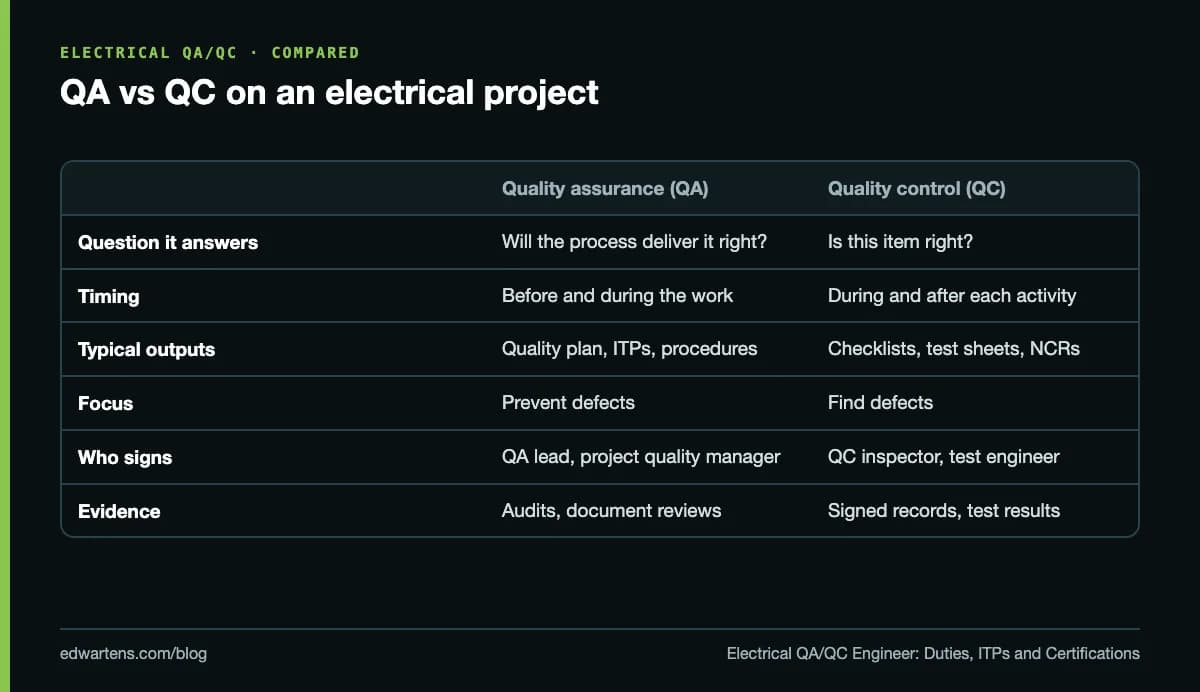
Quality assurance (QA) is the planned system that gives confidence the result will be right. ASQ, the American Society for Quality, defines it as "part of quality management focused on providing confidence that quality requirements will be fulfilled."
Quality control (QC) is the checking of the work itself. ASQ describes it as "the operational techniques and activities used to fulfill requirements for quality", and notes that QC is usually a subset of QA activities.
On an electrical project the split looks like this: QA writes the quality plan, the procedures and the ITPs, audits the subcontractors and controls the documents; QC walks the cable routes, measures, tests, signs the check sheets and raises a non-conformance report (NCR) when something is wrong. On smaller projects one engineer does both, which is why the job title joins them with a slash.
Most quality systems sit inside ISO 9001. A new edition, ISO 9001:2026, was published on 16 September 2026, and DNV reports that organisations certified to the 2015 edition "will need to transition to the new version within 3 years." For a QA/QC engineer on site, that change mostly shows up as updated company procedures rather than new inspection work.
What does an electrical QA/QC engineer do day to day?
The duties follow the project from purchase order to handover.
| Project stage | Typical QA/QC duties | Records produced |
|---|---|---|
| Before work starts | Review specifications, write or review ITPs, approve method statements, check inspector and tester competence | Approved ITPs, quality plan, competence register |
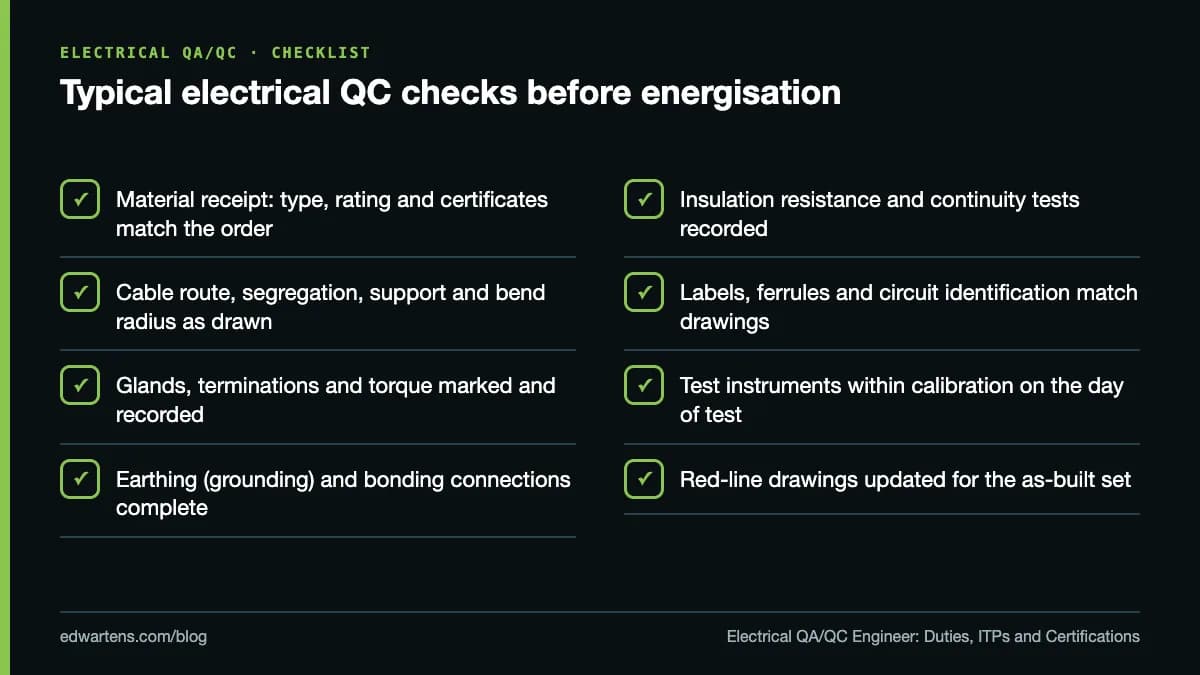
| Material receipt | Check type, rating and quantity against the order; check manufacturer test certificates and certificates of conformity | Material receiving inspection reports |
| Installation | Inspect containment, cable pulling, glanding, terminations, earthing (grounding) and labelling against drawings | Daily inspection checklists, photographs |
| Testing | Witness or perform insulation resistance, continuity, polarity and functional tests; confirm instrument calibration | Test sheets, calibration certificates |
| Non-conformance | Raise NCRs, agree the fix, re-inspect and close out | NCR log, close-out evidence |
| Handover | Compile the quality dossier, red-line drawings and test packs for commissioning | Signed test packs, as-built drawings |
Two other roles sit next to this one. The testing and commissioning engineer energises and proves the system works as a whole; our guide on how to become a commissioning engineer covers that path. The QA/QC engineer makes sure that everything handed to commissioning has been built and checked correctly, with the paperwork to prove it.
What is an inspection and test plan (ITP)?
An ITP is a table that lists every inspection and test for a scope of work, in order, with who does it, how, against what criteria, and what record proves it. It is the backbone of electrical QA/QC.
Published specifications spell out what an ITP must contain. Clause 8.2 of MRTS50, a technical specification from Queensland's Department of Transport and Main Roads (March 2025 edition), requires an ITP to include:
- the work process and its inspection and test points
- who is responsible for each inspection and test
- how often each is done
- the methods used for measurements and tests
- the criteria for acceptance
- measurements or tests that use calibrated equipment
- all witness and hold points
That list works for any electrical package, from a single distribution board to a substation. A typical row in an electrical ITP looks like this:
| Activity | Reference | Acceptance criteria | Inspection type | Record |
|---|---|---|---|---|
| Cable insulation resistance test | Project spec, test procedure | Value at or above the specified minimum | Witness (client) | IR test sheet |
| Earthing (grounding) connections | Earthing drawing | Connections complete, tight and labelled | Inspect (contractor) | Earthing checklist |
| Pre-energisation check of switchboard | Single-line diagram, vendor manual | All tests passed, NCRs closed | Hold (client release) | Signed release form |
| Material receipt of cable drums | Purchase order, datasheet | Type, size, voltage rating match | Review | Receiving inspection report |
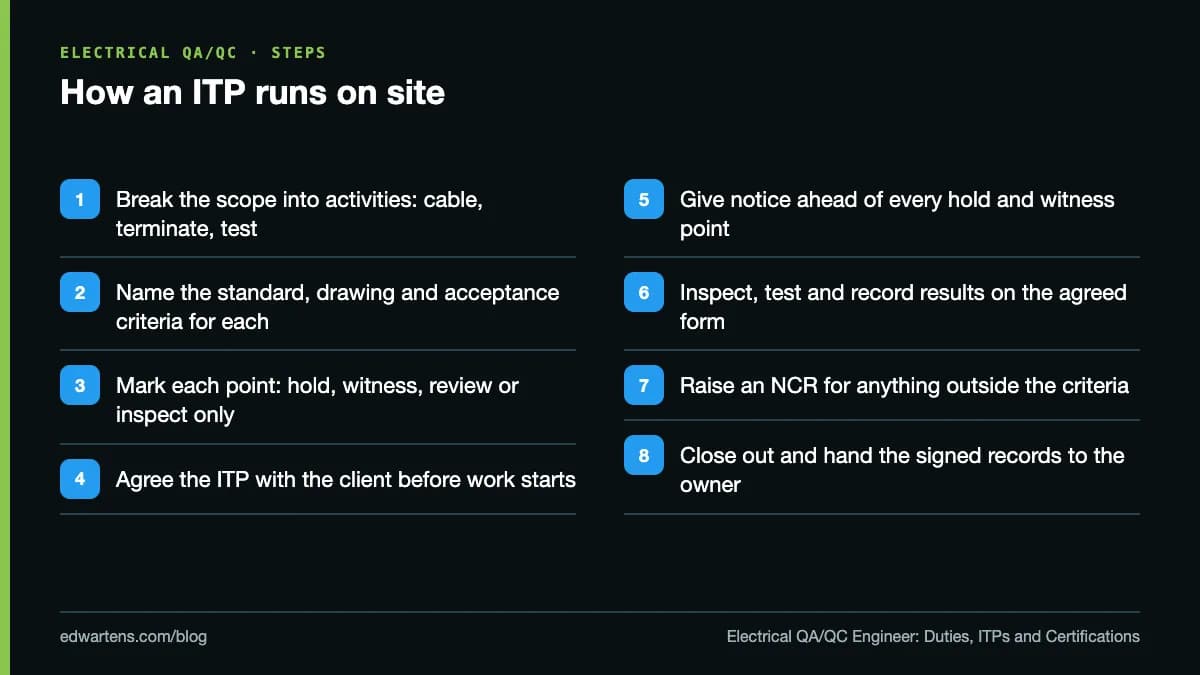
In this short video, QualityEngineers Guide walks through how an inspection and test plan is laid out and used. It is one of the lessons in our free Electrical and Instrumentation QA/QC Inspection course, where you then build ITPs and checklists for cabling, earthing and instrument installation.
What is the difference between a hold point and a witness point?
These two words cause more site arguments than any other part of an ITP, so it pays to use the exact definitions in the contract.
MRTS50 defines a hold point as "an identified point in a process beyond which the Contractor shall not proceed without written authorisation." Work stops until the named person releases it.
It defines a witness point as a point "where the Contractor is required to give the Administrator prior notice with the option to observe an activity." Unless the contract says otherwise, the notice is at least one working day, and the contractor "may proceed with the activity when the period of notice has expired" whether or not anyone attends.
Many ITPs also use a review point (documents only) and an inspect or surveillance point (the contractor's own check, recorded but not attended by the client). In electrical work, hold points are usually placed where a mistake would be costly or dangerous to undo: before cables are covered or backfilled, before a switchboard is energised, and before a protection system is put in service.
What electrical checks does QA/QC sign off?
For low-voltage installations, the international reference for inspection and testing is IEC 60364-6, which "provides requirements for initial and periodic verification of an electrical installation." National wiring rules, such as BS 7671 in the UK and the NEC in the US, set the local requirements your project specification will point to.
For power equipment, many projects in North America and beyond call up the NETA standards. NETA says its ATS-2025 acceptance testing specifications are designed to assure that tested equipment and systems "are operational, are within applicable standards and manufacturers' tolerances, and are installed in accordance with design specifications." The detailed tests on transformers, switchgear and protection relays are covered in our posts on transformer testing types and protection relay testing.
A QA/QC engineer does not need to perform every test, but must be able to read a test sheet and tell whether the result meets the acceptance criteria, whether the instrument was in calibration, and whether the right person signed it.
Which certifications exist for electrical QA/QC engineers?
There is no single licence called "electrical QA/QC engineer". The credentials that do exist come from quality bodies, from electrical testing bodies, and from welding and NDT schemes. Here is what each issuer says on its own page.
| Credential | Issuer | Who it suits | Entry requirement | Exam |
|---|---|---|---|---|
| Certified Quality Inspector (CQI) | ASQ | Inspectors early in a quality career | 3 years in the CQI body of knowledge; one education waiver of 2 years | 110 questions, computer-based, open book |
| Certified Quality Engineer (CQE) | ASQ | Experienced quality engineers | 8 years, 3 in a decision-making role; degree waives up to 5 | 175 questions, computer-based, open book |
| NETA Level 2, 3, 4 | NETA | Electrical testing technicians at NETA Accredited Companies | 2, 5 or 10 years of related experience plus training hours | 100 or 65 questions, closed book |
| CSWIP Welding Inspector and NDT | TWI Certification Ltd | Welding and NDT inspection | Set per scheme | Set per scheme |
ASQ. The CQE requires eight years of on-the-job experience, at least three of them in a role with authority over projects or processes, and a bachelor's degree waives four of those years. ASQ lists the exam fee at 550 US dollars, with members saving 100 dollars. The CQI needs three years of experience, and any one qualifying diploma or degree waives two of them; the fee is 460 US dollars. Both are general quality credentials, not electrical ones, so they work best alongside electrical qualifications.
NETA. NETA certifies electrical testing technicians in line with the ANSI/NETA ETT standard. Its technician certification page lists Level 2 (two years of related experience, 40 hours of safety and 160 hours of electrical training), Level 3 (five years, 64 and 400 hours in total) and Level 4 (ten years, 104 and 600 hours in total). NETA certified technicians must be employed by a NETA Accredited Company, and NETA's FAQ says Level 2 needs 24 continuing technical development credits every three years, and Levels 3 and 4 need 48.
CSWIP. The name stands for Certification Scheme for Personnel, and CSWIP says its schemes are provided by TWI Certification Ltd. Its two named categories are welding inspection and non-destructive testing (NDT). It is the right credential for an engineer who inspects welds, pipework and steel, not for an electrical inspector, but some QA/QC roles on oil and gas and power projects cover both disciplines.
Professional registration (a PE licence in the US, or CEng and IEng in the UK, Ireland and Australia) is a separate step that recognises you as an engineer, not as an inspector. Our guide to controls engineer certifications explains those routes.
How do you become an electrical QA/QC engineer?
Most people move into QA/QC from electrical installation, testing or site engineering after a few years, because the job depends on knowing what good work looks like. A practical route:
- Learn the documents. Read a full specification, a single-line diagram and a cable schedule, then write an ITP for one small package.
- Learn the tests. Understand insulation resistance, continuity, polarity, earth resistance and functional tests, and what makes each result acceptable.
- Learn the paperwork. Practise NCRs, receiving inspections and test packs until they are routine.
- Get site time. Ask to shadow the QC inspector or test engineer on your current project.
- Add a real credential when you qualify. CQI or NETA Level 2 early; CQE or NETA Level 3 later.
Before you list any certificate on a CV, check how an employer will verify it. Our guide to verifying an engineering training certificate explains what hiring managers look for.
Free courses to start with
Start with Electrical and Instrumentation QA/QC Inspection, which covers QA versus QC, ITPs, receiving inspection, cabling and instrument installation checks. Add Testing and Maintenance of Transformers and Switchgear for the electrical tests you will witness, and Welding Inspection and Mechanical QA/QC with NDT Basics if your projects also need mechanical inspection. If you are deciding whether a course certificate is worth having at all, read are free PLC certificates worth it; the same employer logic applies to QA/QC.
Every course is free in full. An optional EDWartens Certificate of Completion, from US$8.99, is not an ASQ, NETA or CSWIP certification and is not accredited; anyone can verify it at edwartens.com/verification.
Take the free course


Questions
What does an electrical QA/QC engineer do?
An electrical QA/QC engineer writes or reviews the quality plan and inspection and test plans (ITPs), checks materials on arrival, inspects installation work against drawings and specifications, witnesses or performs tests, raises non-conformance reports when work falls short, and compiles the signed records that the owner receives at handover.
What is the difference between QA and QC in electrical work?
Quality assurance is the planned system that gives confidence the work will meet requirements: procedures, ITPs, audits and document control. Quality control is the hands-on checking of each item against those requirements: inspections, measurements and tests. ASQ describes QC as a subset of QA activities, which matches how most projects organise the two roles.
What is a hold point in an inspection and test plan?
A hold point is a step in the work that the contractor may not pass until a named person, usually the client or their representative, has given written release. Queensland's MRTS50 specification defines it exactly that way. A witness point only requires notice, and work may continue if the witness does not attend once the notice period has passed.
Which certification is best for an electrical QA/QC engineer?
There is no single electrical QA/QC licence. ASQ's Certified Quality Inspector suits early-career inspectors and its Certified Quality Engineer suits experienced quality engineers. In US electrical testing, NETA certifies technicians at Levels 2 to 4. CSWIP is a welding inspection and NDT scheme, useful only if your role also covers mechanical or structural work.
Do I need a degree to become an electrical QA/QC engineer?
Employers usually ask for an electrical degree or a technician qualification plus site experience. The certifications reflect this: ASQ's CQE needs eight years of relevant work, with up to five waived for a degree, and NETA's Level 3 needs five years of related experience. Site experience in installation or testing is what most hiring managers check first.
Is a free QA/QC course certificate a professional certification?
No. A course certificate proves you completed a course. It is not an ASQ, NETA or CSWIP certification, is not accredited, and does not replace the experience and exams those bodies require. It is useful evidence of study when you apply for a first QC role or prepare for a real certification exam.
Sources
- ASQ: Quality Assurance and Quality Control, definitions (read 11 October 2026)
- ASQ: Certified Quality Engineer (CQE), requirements, exam and fees (read 11 October 2026)
- ASQ: Certified Quality Inspector (CQI), requirements, exam and fees (read 11 October 2026)
- NETA: Technician Certification, Levels 1 to 4 under ANSI/NETA ETT (read 11 October 2026)
- NETA: Frequently Asked Questions, recertification and CTD credits (read 11 October 2026)
- NETA: ANSI/NETA ATS-2025 Acceptance Testing Specifications (read 11 October 2026)
- Queensland Department of Transport and Main Roads: MRTS50 Specific Quality System Requirements (March 2025), clauses 8.2 and 8.3
- IEC 60364-6:2016 Low voltage electrical installations, Part 6: Verification (edition 2.0, 27 April 2016)
- DNV: The new edition of the quality management system standard ISO 9001 is released (21 September 2026)
- CSWIP: Certification Scheme for Personnel, provided by TWI Certification Ltd (read 11 October 2026)
Written by the EDWartens engineering team for general education. Product names are trademarks of their owners; mentioning them does not imply endorsement. Prices and terms of other providers were checked on the date shown and can change.

Thermography Certification Levels 1, 2 and 3 Explained

How to Become a Controls Engineer: A 2026 Roadmap

How to Become a SCADA Engineer: Skills, Tools and a Free Path

PLC Programmer Salary by Country (2026): A Free Salary Estimator

ATS-Friendly CV for Automation, PLC and Controls Engineers: Keywords, Bullets and Mistakes

How to Build an Engineering Portfolio From Course Projects (Automation and Controls)