Electrical
Testing and Maintenance of Transformers and Switchgear
Run and read the field tests that keep transformers, breakers, cables and motors in service, and turn results into a maintenance plan.
Testing and Maintenance of Transformers and Switchgear is a free, self-paced online course from EDWartens for maintenance, testing and commissioning engineers and technicians who test and maintain transformers, switchgear, cables, motors and batteries. It has 13 modules and takes about 25.5 hours, with written notes, a practice task per module, a practical project and a final assessment of 15 questions (pass mark 60%). Learning costs nothing and needs only a free account. The optional EDWartens Certificate of Completion, verifiable by code, is a one-off US$28.99 for you; it is not a vendor credential. Updated 1 November 2026.
- Free
- Intermediate
- 25.5 hours
- Self-paced
- Certificate optional
- Lab practice in your browser
No card, no trial. The course is free for good. Certificate US$28.99, optional.
- Who it is for
- Maintenance, testing and commissioning engineers and technicians who test and maintain transformers, switchgear, cables, motors and batteries
- Jobs
- Roles that use this skill: electrical design engineer, panel designer, electrical technician and maintenance engineer. No course guarantees a job.
- Tools
- A spreadsheet (LibreOffice Calc is free) for test records, temperature corrections, Duval triangle percentages and trend lines. No test-set software is needed: every test is planned and its results worked on paper. Hardware: none required. Access to an insulation tester, a micro-ohmmeter or a turns ratio tester at work or college makes the modules far more useful, but only under your site's safety rules and a permit to work.
- Updated
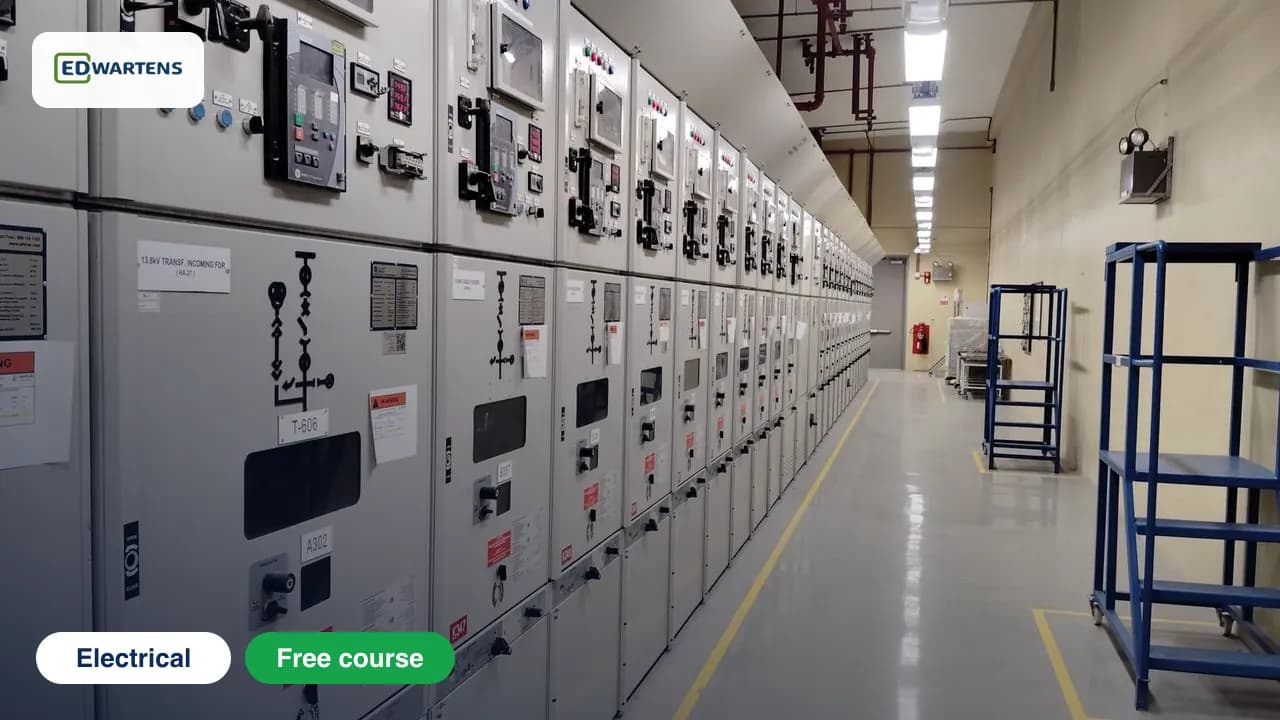
After this course you can
By the end you will be able to:
- Run and interpret insulation resistance and PI tests
- Test transformer winding resistance, turns ratio and vector group
- Interpret transformer oil breakdown and DGA results
- Test circuit breaker contact resistance and timing
- Build an annual maintenance plan from test records
Who it is for, and what you need first
Who it is for
Maintenance, testing and commissioning engineers and technicians who test and maintain transformers, switchgear, cables, motors and batteries.
Level: Intermediate. Intermediate. For maintenance engineers and technicians, testing and commissioning engineers, and final-year electrical students. You should know how a transformer, a circuit breaker and an induction motor work and be able to read a single-line diagram. Protection relays are covered in the separate Protection Relays course.
What you need
Software: A spreadsheet (LibreOffice Calc is free) for test records, temperature corrections, Duval triangle percentages and trend lines. No test-set software is needed: every test is planned and its results worked on paper..
Hardware: None required. Access to an insulation tester, a micro-ohmmeter or a turns ratio tester at work or college makes the modules far more useful, but only under your site's safety rules and a permit to work.. What to download, and how.
How this course works
Watch the lessons
Short video lessons, one module at a time, at your own pace.
Read the notes
Open the Reading tab for the written notes and diagrams of the module.
Practise in the 3D labOptional
Try the module in the free 3D lab, in your browser.
Check yourself
Answer the questions to see what stuck before you move on.
Final assessment
Pass the final once you have been through the modules.
Certificate, if you want oneOptional
Optional, with a page anyone can use to verify it.
What you learn
13 modules in order, at your own pace. 25.5 hours of video lessons, with written notes and a practice task in each module.
- 1Maintenance strategies: breakdown, preventive, predictive and RCM36m
- 2Insulation resistance, PI and DAR with an insulation tester1h 41m
- 3Transformer tests: winding resistance, turns ratio, vector group and magnetising current1h 35m
- 4Tan delta and capacitance, and SFRA (concept)2h 41m
- 5Transformer oil: breakdown voltage and DGA interpretation (Duval triangle, IEC 60599)1h 31m
- 6Circuit breakers: contact resistance, timing, coil current, SF6 and vacuum checks1h 41m
- 7Switchgear and MCC preventive maintenance and torque checks, with lab practice: 1h 29m
- 8Cables: insulation resistance, VLF and HV withstand, partial discharge (concept)56m
Show the other 5 modules
- 9Motors: insulation, winding resistance, surge test (concept) and bearings, with lab practice: 2h 3m
- 10Earth-resistance testing (fall of potential) and earth-continuity checks1h 29m
- 11Battery and UPS maintenance2h 21m
- 12Test records, trending and the annual maintenance plan1h 3m
- 13Final Assessment
Software you need
What to download, where from, what it costs and how to install it. Every link goes to the maker's own site, never a mirror.
Nothing to install
A spreadsheet is enough for the test records, temperature corrections, Duval triangle percentages and trend lines; free online Duval triangle calculators are useful for checking hand plots.
Show what to download (1 tool)
Optional
Useful, not needed to finish the course.
- 01Free
LibreOffice
The Document Foundation
- Runs on
- Windows 10 or 11, macOS 11 or newer (Intel or Apple silicon), Linux
- Account
- None needed
- Size
- up to 1.5 GB of disk space on Windows
LibreOffice is free, open-source software under the Mozilla Public License 2.0, for any use including business. Calc is its spreadsheet.
Steps
- 1.Open the LibreOffice download page.
- 2.Check the page has picked your operating system, then select Download.
- 3.Run the installer (administrator rights are needed on Windows).
- 4.Start LibreOffice Calc for spreadsheet work.
- 5.Save as .xlsx if you need to share files with Excel users.
- Choose the latest main version unless your organisation asks for the older, more conservative release.
Official download pagelibreoffice.org
Checked against each maker's own page on 27 September 2026. Trial lengths and editions change; the maker's page is the final word.
Practise in the 3D lab
Isolate a motor bucket the safe way before maintenance, and find a repeat-tripping fault from your readings.
- Safe isolation of an MCC bucketSubstation and MCC labOpen in the lab (opens in a new tab): Safe isolation of an MCC bucket
- Find a fault in the MCCSubstation and MCC labOpen in the lab (opens in a new tab): Find a fault in the MCC
Optional. Skip it whenever you like: it never blocks your progress or your certificate.
Course project, about 8 hours
Condition review of a 2 MVA transformer and its 11 kV breaker from a year of test results
Read a year of oil, DGA and electrical test results for a 2 MVA, 11/0.433 kV transformer and the vacuum breaker that feeds it. Flag what is degrading and why. Write prioritised work orders and set the next test intervals. The sample pack shows each document for a business-park cooling plant.
- 5documents in the pack
- 7steps to follow
- 5things to hand in
- 8 hof work, at your pace
- RegisterAsset and baseline register: TR-2 and CB-2
- Test report2026 test results: TR-2 oil, DGA and electrical tests, and CB-2
- ReportCondition assessment of TR-2 and CB-2, 2026
- Punch listWork-order list from the 2026 condition review
- PlanTest intervals for TR-2 and CB-2 from 2026
The project is optional practice. The certificate needs only the modules and the final assessment.
After the course, your next step
Show what you can do, then keep going in the same field.
A certificate you can verify
Finish the modules and pass the final assessment (15 questions, pass mark 60%) and you can add a certificate with a public verification page. One-off, US$28.99 for you. It is not a vendor credential.
Want a free certificate? Do the matching Free internship: 4 weeks, nothing to buy, with a free certificate of completion.
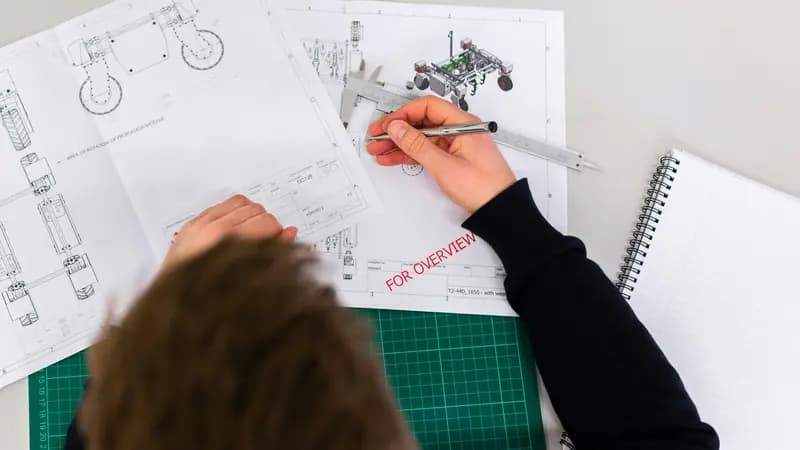
Electrical Design
Eight short weeks of single-line diagrams, load schedules, cable sizing and protection: notes, diagrams, a few videos and self-checking design exercises. Finish weeks 1 to 4 and the final, then claim a free Internship Completion Certificate with your real dates and study hours, and a QR code anyone can scan to verify it. Training, not employment.
See the internshipMore free courses
Roles that use this skill
- Electrical design engineer
- Panel designer
- Electrical technician
- Maintenance engineer
These are the kinds of roles where the skill is used. We make no promise of a job or an interview.
Plain notes
- Free: the whole course, the notes, the practice tasks, the final assessment and support from practising engineers.
- Paid, and optional: the course certificate, and the Engineer-verified internship (the Free internship costs nothing).
- No job promise: the course teaches a skill. It does not place you in a job.
- Lessons by: ElectroQC Hub, Megger, OMICRONenergy, AEMC Instruments, Safety+Health YouTube channel, Asset Insights, Electrical Superintendent. Independent creators; the lessons stream from their own channels. EDWartens wrote the study plan, notes, practice tasks and assessments.
ElectroQC Hub · Megger US · Megger · Megger Australia · OMICRONenergy · AEMC Instruments · Global Test Supply · Safety+Health YouTube channel · Vector Power · Electrical Code Academy, Inc. · GlobeCore company · Oil Analysis · Gulf Bio Analytical Group · Motwane Manufacturing · The Electrical Guy · Electrical in Industry · IPECLTD · BakerInstrumentCo · TPC Training · Electrical Superintendent · ITM Instruments Inc. · Reliability Centered Maintenance · Skill Torque · Engineering Presentations · Asset Insights. If you are one of these creators and want a lesson removed or credited differently, write to info@edwartens.com.
Practise what you learn in the free 3D lab
Technical work is judged on what you can do: wiring, commissioning, finding a fault. Doing a task yourself teaches more than watching it a second time, and a lab lets you try it safely before you meet real equipment. It does not replace working on real hardware.
- Practise safely, so a mistake costs nothing.
- The lab checks your work like a site test, so you know when it is right.
- Free, in your browser, with nothing to install.
Why learn with EDWartens
What you get with this course, and what comes after it.
- Free from the first lesson to the final assessment.
- Practice in a free 3D lab in your browser, with nothing to install.
- Video lessons with written notes and a project.
- An optional certificate that anyone can verify online.
- Free internships to keep practising afterwards.
Common questions
Who is this transformer testing course for?
Maintenance engineers and technicians, testing and commissioning engineers, and final-year electrical students who test and look after transformers, switchgear, cables, motors and batteries. It suits people applying for testing and commissioning and electrical maintenance roles worldwide, notably in the Gulf, where these tests are everyday work.
What do I need to know before starting?
How a transformer, a circuit breaker and an induction motor work, and how to read a single-line diagram. No test-set experience is needed: each test is explained from what it measures to how its result is judged.
Do I need test equipment or software?
No. Every test is planned and its results worked on paper or in a free spreadsheet such as LibreOffice Calc. Access to an insulation tester, micro-ohmmeter or turns ratio tester at work makes the course more practical, but only under your site's safety rules and permit to work.
Which standards does the course use?
It works with IEEE 43 for insulation testing of machines, IEC 60076 for transformer tests, IEC 60156, IEC 60422 and IEC 60599 for oil and dissolved gas analysis, IEC 62271 for breakers, IEEE 400.2 for VLF cable testing, IEEE 81 for earth resistance, IEEE 450 for batteries and NFPA 70B for maintenance programmes. It paraphrases these standards rather than reproducing them; check the edition your client specifies.
How is this different from the Protection Relays course?
This course tests and maintains the primary equipment: transformers, breakers, cables, motors, earthing and batteries. Protection Relays: Settings, Testing and Commissioning covers the relays that protect them, with CTs, settings, secondary injection and trip checks. Taking both covers most of a testing and commissioning engineer's work.
How long does the Testing and Maintenance of Transformers and Switchgear course take?
About 25 hours of video lessons, notes and practice, taken at your own pace; the videos alone are about 19 hours. The optional project, a condition review of a transformer and its breaker from a year of test results, takes about 8 hours more.
Is the course free, and what certificate do I get?
Every module, the notes, the project and the final assessment are free. If you pass the 15-question final at 60 percent you can get an EDWartens Certificate of Completion, with a number anyone can verify on our site. It is a certificate of completion, not a NETA certification, a licence or a qualification from any test-equipment maker.
What jobs does it lead to?
Electrical maintenance engineer and technician, testing and commissioning engineer, substation maintenance and transformer service roles with utilities, plants, facilities contractors and testing companies. Employers will still expect hands-on time with test sets, which this course prepares you to use well.
Do I have to use the lab?
No. The lab is optional practice. You can skip it whenever you like, and it never blocks your progress, the final assessment or your certificate.
Is the lab free?
Yes. Every lab level for this course opens in your browser, free, with nothing to install.
What topics does the Testing and Maintenance of Transformers and Switchgear course cover, module by module?
The Testing and Maintenance of Transformers and Switchgear course has 13 modules. It opens with "Maintenance strategies: breakdown, preventive, predictive and RCM", goes through "Insulation resistance, PI and DAR with an insulation tester", "Transformer oil: breakdown voltage and DGA interpretation (Duval triangle, IEC 60599)", "Motors: insulation, winding resistance, surge test (concept) and bearings" and "Test records, trending and the annual maintenance plan" and ends with "Final Assessment". The full list with minutes is under "What you learn" on this page.
What can I do after the Testing and Maintenance of Transformers and Switchgear course?
After the Testing and Maintenance of Transformers and Switchgear course: Choose a maintenance strategy for each asset and set test intervals from the P-F interval and condition; Run insulation resistance tests and calculate DAR and PI with temperature correction; Test winding resistance, turns ratio, vector group and excitation current on a transformer. These are the practical outcomes the course is written around, and the final assessment of 15 questions checks them.
What software and hardware do I need for the Testing and Maintenance of Transformers and Switchgear course, and does it cost anything?
For the Testing and Maintenance of Transformers and Switchgear course, software: A spreadsheet (LibreOffice Calc is free) for test records, temperature corrections, Duval triangle percentages and trend lines. No test-set software is needed: every test is planned and its results worked on paper. Hardware: none required. Access to an insulation tester, a micro-ohmmeter or a turns ratio tester at work or college makes the modules far more useful, but only under your site's safety rules and a permit to work. The course itself is free.
Is the Testing and Maintenance of Transformers and Switchgear course suitable for me, and what level is it?
Testing and Maintenance of Transformers and Switchgear is rated intermediate. Intermediate. For maintenance engineers and technicians, testing and commissioning engineers, and final-year electrical students. You should know how a transformer, a circuit breaker and an induction motor work and be able to read a single-line diagram. Protection relays are covered in the separate Protection Relays course. It is written for maintenance, testing and commissioning engineers and technicians who test and maintain transformers, switchgear, cables, motors and batteries, and takes about 25.5 hours at your own pace.
Which jobs use the skills from the Testing and Maintenance of Transformers and Switchgear course?
Skills from the Testing and Maintenance of Transformers and Switchgear course (for example: choose a maintenance strategy for each asset and set test intervals from the P-F interval and condition) are used in roles such as electrical design engineer, panel designer, electrical technician and maintenance engineer, and in electrical maintenance and testing engineer work. The course gives you practical evidence of the skill; it does not promise a job, and employers decide on experience and interview.
Start free today
Testing and Maintenance of Transformers and Switchgear, at your own pace. Add the certificate only if you want one.