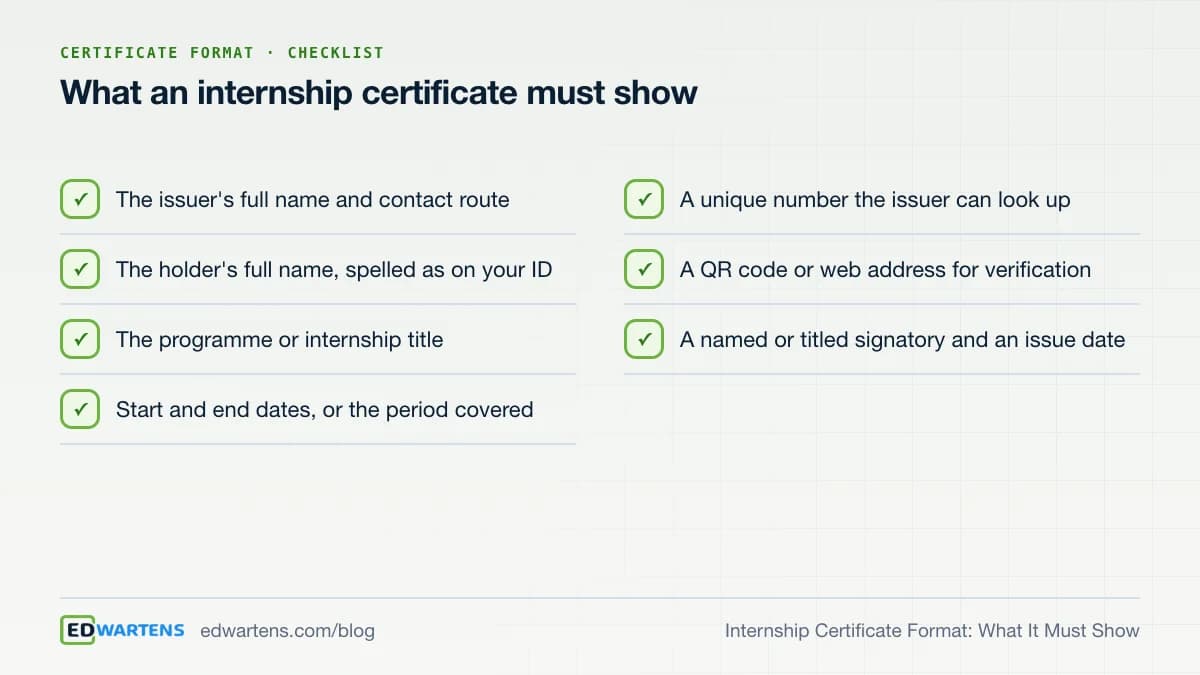
A genuine internship certificate format shows the issuer's full name, the holder's name, the internship title, the start and end dates, a unique number, a way to verify it, and a signatory with an issue date. Many colleges also want hours or duration. If most of these are missing, the certificate is weak evidence whoever issued it.
What should an internship certificate contain?
Think of the certificate as an answer to six questions a reader will ask. Who issued it? To whom? For what? When? How can I check it? Who stands behind it? Each item in the checklist above answers one of those questions.
Standards bodies for digital credentials use the same logic. The 1EdTech Open Badges standard describes a credential as carrying structured data that identifies the earner, the issuer and the criteria met, with optional evidence, and signed by the issuer so it can be checked (page read 17 October 2026). A paper or PDF certificate cannot be signed in that way, which is why a number and a verification page matter.
NACE, the US association for employers and career services, lists what makes an internship real: a mutually agreed start and end date, a position description, learning objectives and qualified supervision (page read 17 October 2026). A certificate that names the programme and the dates gives a reader a way to check those facts against the internship itself.
How do the college's formats and yours fit together?
Your college may supply its own template for a certificate, a relieving letter or an evaluation form. AICTE's internship policy includes sample formats for the student's application, a request letter from the institute, an internship synopsis, a relieving letter, a daily diary, a supervisor's evaluation, a student's evaluation and an attendance sheet. Its procedure also ends with the step: training certificate to be obtained from the industry (PDF read 17 October 2026). The policy does not ask the provider to follow one certificate layout, so what you submit is whatever your college agrees to accept.
| Document | Usually asked for by | What it proves |
|---|---|---|
| Internship certificate | College, employers | You completed a programme |
| Joining or offer letter | College | You were accepted, with dates |
| Experience letter | Employers | You worked in a role |
| Evaluation or performance report | College | How a supervisor judged you |
| Internship report | College | What you did and learned |
What makes a certificate weak or strong?
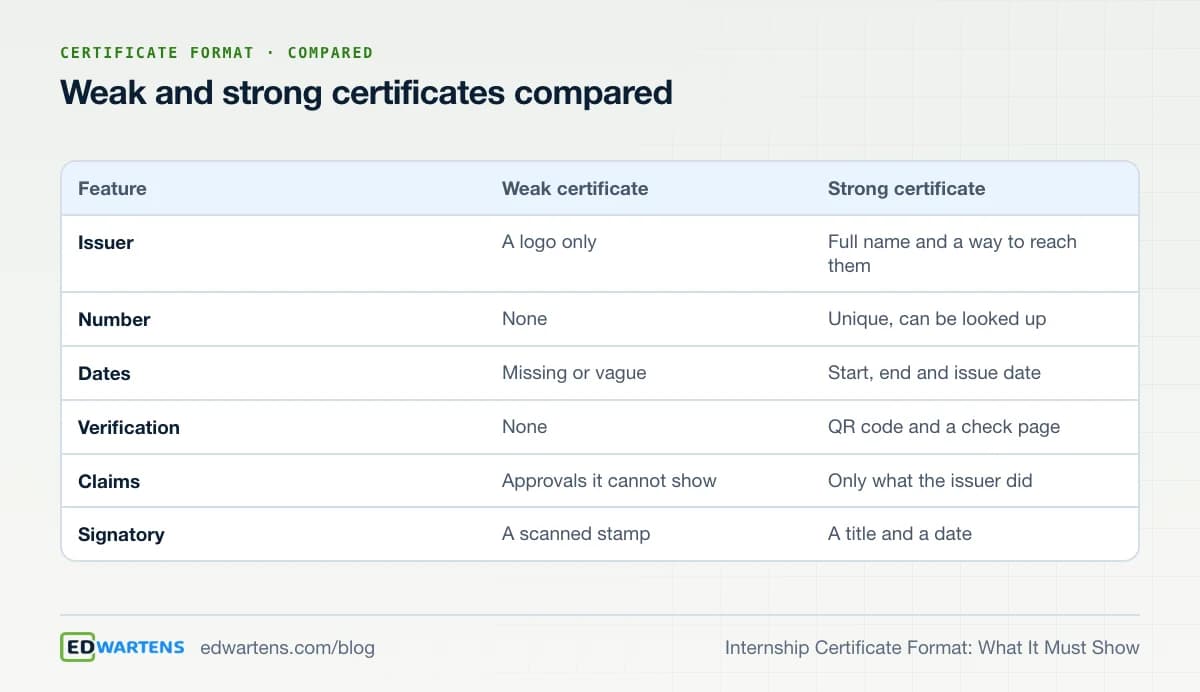
The biggest difference is verification. A certificate with a number and a check page lets a reader confirm it in half a minute. One without can only be confirmed by asking the issuer, which most readers will not do. For the routine to follow, see internship certificate verification. The UK's degree verification hub HEDD works on the same idea: it checks a claimed award against the institution's own records, with the holder's consent (page read 17 October 2026).
The second difference is honesty. If a certificate says 'approved by' a regulator, ask to see where the regulator published that approval. Do not rely on a logo. Our post on free internship with certificate: real vs scam lists signs of an issuer who makes claims they cannot support.
What do EDWartens internship documents contain?
EDWartens internships are free to join, run by Wartens Ltd (UK) and delivered through EDWartens, with the AI courses written by OFORO, the Wartens AI company. The internship certificate and other documents are optional paid add-ons, shown in your own currency before you pay. You can add them any time after you start, and you pay only for the ones you want.
Each document carries an issuer, a unique number and a QR code. Scanning the code or typing the number at /verification shows the holder's name, the internship and the date, along with the document's status. It never shows the holder's phone, email or address. The certificate can also state verified hours where the holder chooses to include them, and it says plainly that whether credit is awarded, and how much, is decided by your university.
Rather than describe the layout, look at it. The sample documents page lets you open a sample with your own name on it. Samples are marked SAMPLE and issued to no one. If you are a college officer, the colleges page explains how documents are meant to be used, and the free internships page shows what is free and what is optional. We do not claim approval from AICTE, UGC or any other body.
What does good certificate wording look like?
Plain, specific wording is better than flowery wording. A reader should be able to restate it in one sentence. A clear model is below, with the details in brackets for you to compare against your own document.
This is to certify that (full name) completed the (internship title) internship, a self-paced online training programme, between (start date) and (end date). Certificate number (number). This certificate can be verified at (address) or by scanning the QR code. Issued on (date) by (issuer's full name), signed by (title).
| Minimum fields | Helpful extras |
|---|---|
| Issuer, holder, programme | The final score or grade |
| Start, end and issue dates | Verified hours, where the issuer states them |
| Unique number | The project title |
| Verification route | A line on credit being your university's decision |
| Signatory and title | A short summary of what was covered |
Notice what the wording does not say. It does not call the programme employment, it does not promise a job and it does not claim approval from a regulator. Those are three of the commonest overclaims on weak certificates.
What if your college wants a different format?
Ask early. Some colleges accept a provider's certificate as it is and ask for a cover letter and the report. Others want their own form signed by a named supervisor. A self-paced online programme may not have a supervisor in the usual sense, so ask whether a certificate from the provider, plus your report and project, will do.
- Ask for the college's template and a deadline.
- Ask who must sign and whether a verification link is acceptable.
- Ask whether hours are needed, and in what form.
- Keep the answers in writing.
If your college wants a signed letter from an employer, a training programme may not fit, and it is better to find that out before you begin. Pair the certificate with your internship report and a finished project, and you give the reader three independent kinds of evidence.
How do hours and credit fit in?
Colleges often convert hours into credit, so the hours matter to some readers. AICTE's internship policy defines one credit as a minimum of 40 to 45 hours of work (PDF read 17 October 2026), though your university's own regulation decides how its credits are counted. A certificate can state only what the issuer is able to verify. A self-paced online provider should say plainly how hours were measured and should never inflate them to suit a credit target.
For that reason, treat any certificate that quotes a large number of hours with no explanation as a question mark. Ask how the hours were checked. And remember that credit is the university's decision, whatever the certificate says.
How do you make any certificate count?
A certificate shows that something was issued. A project shows what you can do. Put both on your CV: the programme name, the dates, the verification address and a link to the project. For a PLC student that might be a passed machine test, and for an AI student a notebook with a score. The engineering portfolio guide shows how to lay it out, and the free OpenPLC course and CODESYS course give you something concrete to build.
Keep the originals and a PDF copy, and note the number somewhere safe. If an employer asks to check it, you can answer in a minute, and that quiet efficiency tells them a great deal about you.
Practise for free
Free PLC Programming Internship
Learn, practise and get documents you can verify; no fee to join.
See the internshipTake the free course
 Free
FreePLC programming · Beginner · Free
OpenPLC: IEC 61131-3 on Arduino, ESP32 and Raspberry Pi
 Free
FreePLC programming · Beginner · Free
CODESYS and IEC 61131-3 Programming
 Free
FreeAI and machine learning · Beginner · Free
Python for AI and Engineering Data
 Free
FreeAI and machine learning · Beginner · Free
Generative AI and LLM Foundations
Questions
What should an internship certificate contain?
The issuer's name, the holder's name, the programme, the dates, a unique number, a way to verify it and a signatory with an issue date. Many colleges also want the hours or the duration. A certificate missing most of these is weak evidence, whoever issued it.
Is there a standard internship certificate format in India?
There is no single format, and colleges often supply their own. AICTE's internship policy asks for a training certificate to be obtained from the industry after the internship and includes sample formats for letters and evaluations. Follow your college's template where it has one.
Does the certificate need hours on it?
Some colleges need hours to convert into credit, and others only ask for dates. Ask your college. EDWartens documents can state verified hours where the holder chooses to include them, and whether credit is given and how much is your university's decision.
Can I get an EDWartens certificate for free?
No. The internship is free to join and everything you learn is free, but the certificate is an optional paid add-on shown in your currency before you pay. Letters and reports are also optional. You can add them later, after you finish.
How do I know a certificate is genuine?
Use the issuer's verification page: scan the QR code or type the number yourself, then compare the name, programme and dates. The linked post on internship certificate verification gives a five-step routine and a list of red flags.
Can a certificate say it is approved by AICTE or UGC?
Only if AICTE or UGC issued or published that approval for that programme. Be sceptical of any issuer that borrows a regulator's name. EDWartens makes no such claim, and credit decisions rest with your university.
Sources
- 1EdTech, Open Badges standard: earner, issuer, criteria and evidence (read 17 October 2026)
- AICTE, Internship Policy: Guidelines and Procedures: training certificate and formats (PDF, read 17 October 2026)
- NACE, internships: start and end dates, objectives, supervision (read 17 October 2026)
- HEDD, degree verification hub: what verification checks (read 17 October 2026)
Written by the EDWartens engineering team for general education. Product names are trademarks of their owners; mentioning them does not imply endorsement. Prices and terms of other providers were checked on the date shown and can change.
Internship for First Year Students: What Is Realistic
AI Internship for Students: A Free Route to Proof
Summer Internship 2027: A Month-by-Month Plan
Winter Internship 2026: What to Do in 4 to 6 Weeks
Work From Home Internship for Students: Real Options

How to Learn PLC Programming for Free, Step by Step