In the paid vs unpaid internship question, pay is only one test. A paid employer internship is usually best when you do real work. An unpaid one is worth it only if you learn something concrete, and a fee to join is a warning sign. Here is how to tell the four kinds apart.
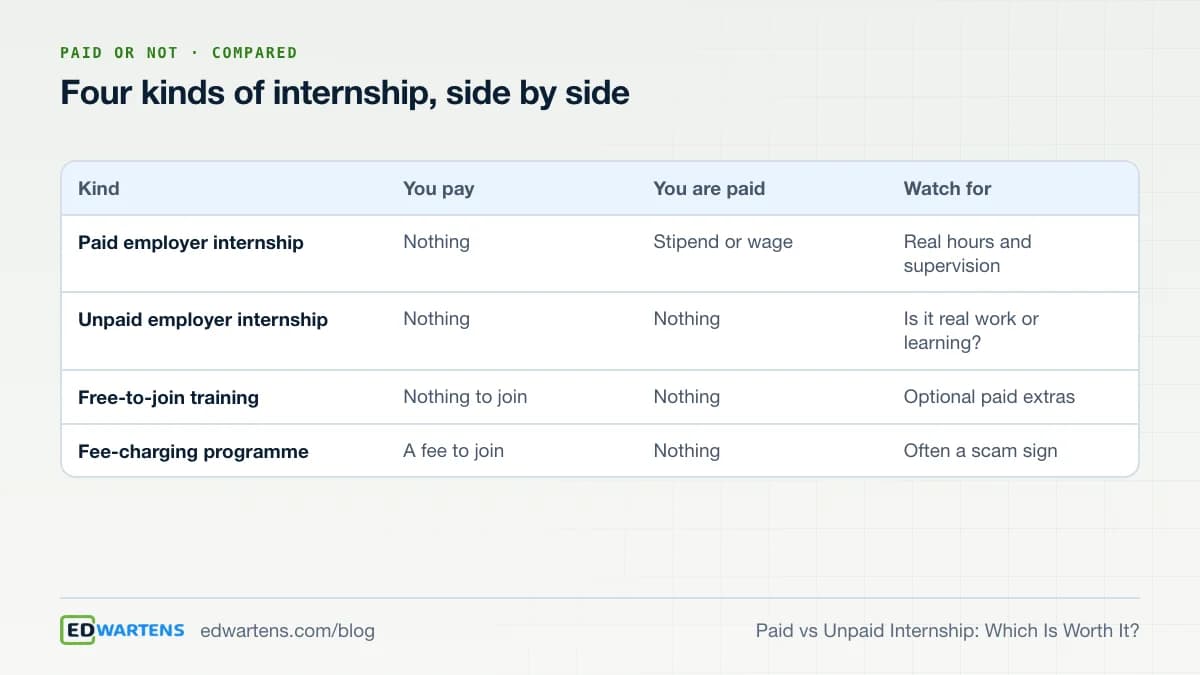
What is the difference between paid and unpaid internships?
Four kinds get called 'internship', and they are not the same deal. A paid employer internship pays a wage or stipend for work you do. An unpaid employer internship asks you to work without pay, in return for experience. A free-to-join training internship is a learning programme where you do no work for the provider and pay nothing to start. A fee-charging programme asks you to pay before you begin.
Most of the confusion comes from mixing these up. A student who finds a 'free internship' may be looking at any of the last three. Ask what you are being given, what you are giving, and whether any money moves in either direction before you join.
AICTE's internship policy is open about this. It describes an internship as a structured, short-term, supervised placement, and says it may be compensated, non-compensated or sometimes paid (PDF read 17 October 2026). So in India's own technical-education policy, unpaid is a permitted category, but it still has to be meaningful and mutually beneficial.
Is a paid internship better than an unpaid internship?
For employer internships where you do real work, the evidence says yes. NACE, the US association for employers and career services, takes the position that all internships should be paid. Its page cites its 2022 Student Survey: paid interns averaged 1.61 job offers, compared with 0.94 for unpaid interns and 0.77 for students with no internship, and the median starting salary was $62,500 for paid interns against $42,500 for unpaid (page read 17 October 2026). That is US data, and it shows association, not cause, but the direction is clear.
NACE also reports that female, Black, Hispanic and first-generation students are overrepresented in unpaid internships, and says academic credit is not adequate compensation. The fairness point matters: unpaid work favours students who can afford it. If you can choose, pick the paid employer role.
| Factor | Paid employer internship | Unpaid employer internship |
|---|---|---|
| Money | Wage or stipend | None |
| Expectation of work | Real, with output | Real, with output |
| Legal risk | Lower | Higher, depends on country |
| Supervision | Usually a named person | Varies widely |
| Best for | Anyone who can get one | Only if learning is clear |
Are unpaid internships legal?
It depends on where you are and what you actually do, not on the job title. In the UK, the government says interns must be paid at least the minimum wage if they count as a worker, and that 'unpaid intern' as a title decides nothing. Exemptions include students on a UK course whose placement is a required part of it and lasts no more than a year, and certain voluntary roles at charities and similar bodies (page read 17 October 2026).
In the US, the Department of Labor uses a primary beneficiary test with seven factors. They include whether both sides understand that no pay is expected, whether the training resembles education, whether the internship is tied to formal education or credit, whether it fits the academic calendar, whether it lasts only as long as it offers useful learning, whether the intern's work supplements rather than replaces paid staff, and whether there is no promise of a job afterwards. The fact sheet was last updated in January 2018 (page read 17 October 2026).
You do not need to be a lawyer to use that. If you are doing the organisation's regular work, for long hours, with nobody teaching you, it is probably not a legitimate unpaid internship. If you are in India, ask your college and read AICTE's guidance. This post is general information, not legal advice.
When is an unpaid internship worth it?
An unpaid or free-to-join internship is worth your time in some cases. Check all of these before you accept.
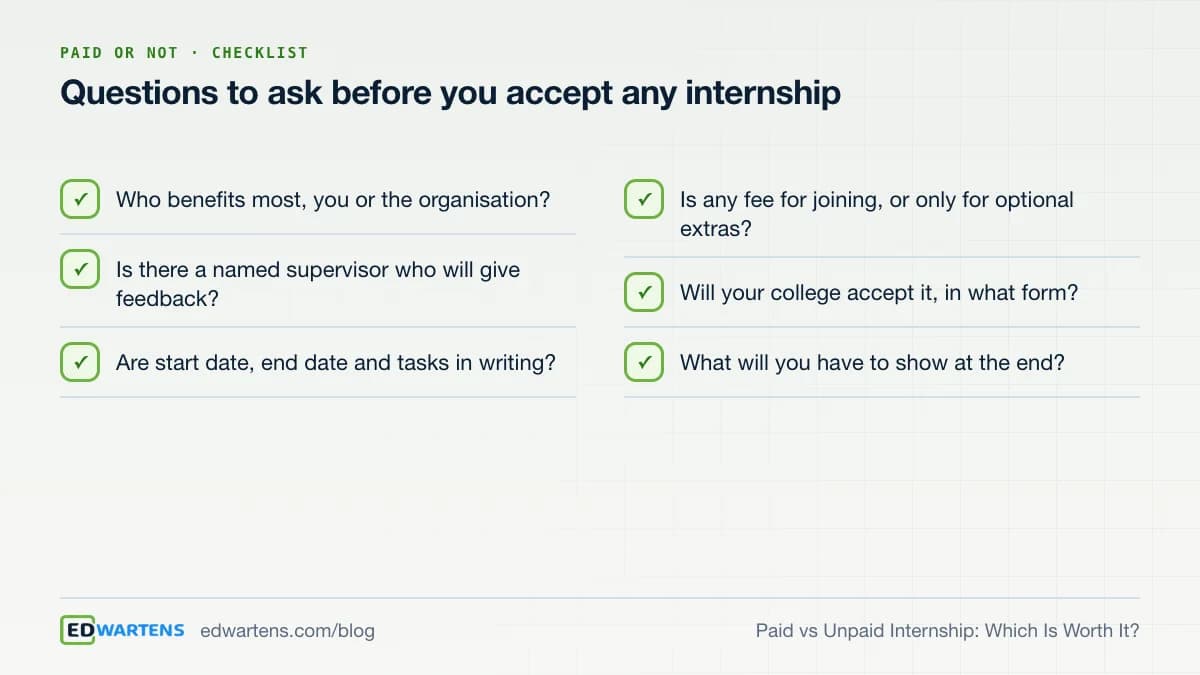
Use the checklist literally. If the answer to most questions is no, the role is not worth giving up your time for, paid or not. If the answers are yes, an unpaid internship can still be a good deal, especially when your alternative is no experience at all.
What do the rules look like in different countries?
Rules differ, so use this table as a map and not as legal advice.
| Country | What decides whether pay is due | Source |
|---|---|---|
| UK | Whether you count as a worker, with exemptions for required course placements | GOV.UK |
| US | The primary beneficiary test, with seven factors | Department of Labor |
| India | AICTE's policy allows compensated, non-compensated or sometimes paid internships | AICTE policy |
In every case, the label does not decide it. What decides it is the arrangement: hours, tasks, supervision, who benefits and what was promised. If you are unsure, ask your college's training cell or a legal adviser before you accept an unpaid role that asks for long hours.
Where do fee-charging programmes fit?
They are the one kind to treat with suspicion. The US Federal Trade Commission's job-scam advice says honest employers do not charge fees for a job, and warns about fees for certifications, 'training' or starter kits that have no real value (page read 17 October 2026). The UK government's list of job-scam signs includes being asked to pay for training, uniforms or background checks before starting (page read 17 October 2026).
Those warnings are about paying to get hired. They do not cover every case of paying for something, so use judgement: paying a fee to be accepted is the warning sign, and paying a clear price for a separate document you choose after you finish is a different decision. Our post on free internship with certificate: real vs scam gives a longer checklist, and the University of Manchester's careers service warns that overseas virtual internships from outside companies often charge fees, sometimes substantial ones (page read 17 October 2026).
Where does EDWartens stand?
Honestly, in the free-to-join training category. The 16 EDWartens internships are free to join with no fee ever, fully online, and open from any country. They are training, not employment: you do no work for us, and no stipend is paid. There is no application or interview. You start on any date and choose a length: 1 week to 24 months for the six engineering internships, 1 to 8 weeks for the ten AI internships.
The lessons, weekly checks, final quiz and any practice are free. The internship certificate, letters, reports, an extra project and a mentor call are optional paid add-ons, each priced in your currency before you pay. Every document carries a QR code and a number that anyone can check at /verification, and you can see them first on the sample documents page. Credit decisions rest with your university.
If a stipend matters to you, look at posted employer internships first. If you need structure, a finished project and documents, a free-to-join programme fills that gap, and it can sit beside a paid role. Read more on the free internships page, or compare formats on the online internships page.
How should you choose between them?
- Take a paid employer internship if you can get one and you have the time, because it pays for your effort and usually brings supervision.
- Take an unpaid employer internship only if the learning, the supervision and the reference are real.
- Add a free-to-join training programme when you need structure, a project and verifiable proof, or when no employer role is open.
- Walk away from anything that charges a fee to join.
Whatever you choose, keep a record. A short weekly log and a finished project turn any internship into evidence. See internship report format for how to write it up, and are free PLC certificates worth it for how to judge a certificate. For hands-on practice before you decide, try the OpenPLC course or machine learning with Python.
Practise for free
Free PLC Programming Internship
Learn, practise and get documents you can verify; no fee to join.
See the internshipTake the free course
 Free
FreePLC programming · Beginner · Free
Siemens TIA Portal in Three Hours
 Free
FreePLC programming · Beginner · Free
OpenPLC: IEC 61131-3 on Arduino, ESP32 and Raspberry Pi
 Free
FreeAI and machine learning · Beginner · Free
Machine Learning with Python
 Free
FreeAI and machine learning · Beginner · Free
Prompt Engineering for Engineers
Questions
Is a paid internship better than an unpaid one?
Usually, for employer internships where you do real work. NACE argues that all internships should be paid, and its survey shows paid interns report more job offers. A free training programme is a different thing: the question there is what you learn and whether you pay to join.
Is an unpaid internship legal?
It depends on the country and on the arrangement, not on the job title. In the UK, someone who counts as a worker must get the minimum wage, with exemptions such as required placements on a course. The US uses a primary beneficiary test. Ask your college or a legal adviser if unsure.
Does EDWartens pay a stipend?
No. EDWartens internships are free to join, are training and not employment, and pay no stipend. You do no work for us. Lessons, weekly checks and the final quiz are free, and documents such as the certificate are optional paid add-ons shown in your currency.
Should I ever pay to join an internship?
Be very careful. Consumer guidance on job scams warns against paying fees for certifications, training or starter kits as a condition of getting work. A fee to join is a reason to walk away. Paying for an optional document after you finish is a different decision.
Does an unpaid internship help get a job?
It can, if it gives you real skills, a reference or a finished project. NACE's survey data from the US found unpaid interns averaged fewer job offers than paid interns. So judge any unpaid role on what you will be able to show afterwards.
How do I tell a genuine unpaid internship from exploitation?
Look for written learning goals, a named supervisor, fixed dates and feedback, and check that you are not simply replacing a regular employee. If you do the organisation's normal work for free and learn nothing, that is a warning sign in most countries.
Sources
- NACE, internships: position on paid internships and survey data (read 17 October 2026)
- GOV.UK, national minimum wage: work experience and internships (read 17 October 2026)
- US Department of Labor, Fact Sheet 71: internship programs under the FLSA (read 17 October 2026)
- Federal Trade Commission, job scams (read 17 October 2026)
- AICTE, Internship Policy: Guidelines and Procedures (PDF, read 17 October 2026)
Written by the EDWartens engineering team for general education. Product names are trademarks of their owners; mentioning them does not imply endorsement. Prices and terms of other providers were checked on the date shown and can change.
AICTE Internship: Rules, Portal and Online Options
Internship for First Year Students: What Is Realistic
Winter Internship 2026: What to Do in 4 to 6 Weeks
Summer Internship 2027: A Month-by-Month Plan

How to Learn PLC Programming for Free, Step by Step
AI Internship for Students: A Free Route to Proof