AI and machine learning · Free
MLOps Model Deployment and Monitoring
The half of machine learning that starts after the notebook: a reproducible environment and a baseline model; experiment tracking, model management and the registry with MLflow; turning a notebook into a pipeline that can be re-run and backfilled; batch, web-service and streaming deployment in Docker; monitoring data quality, drift and model quality with Evidently, PostgreSQL and Grafana; and the tests, linting, make targets and GitHub Actions pipeline that let a release happen without anybody copying a file to a server.

Inside the course
From the lessons

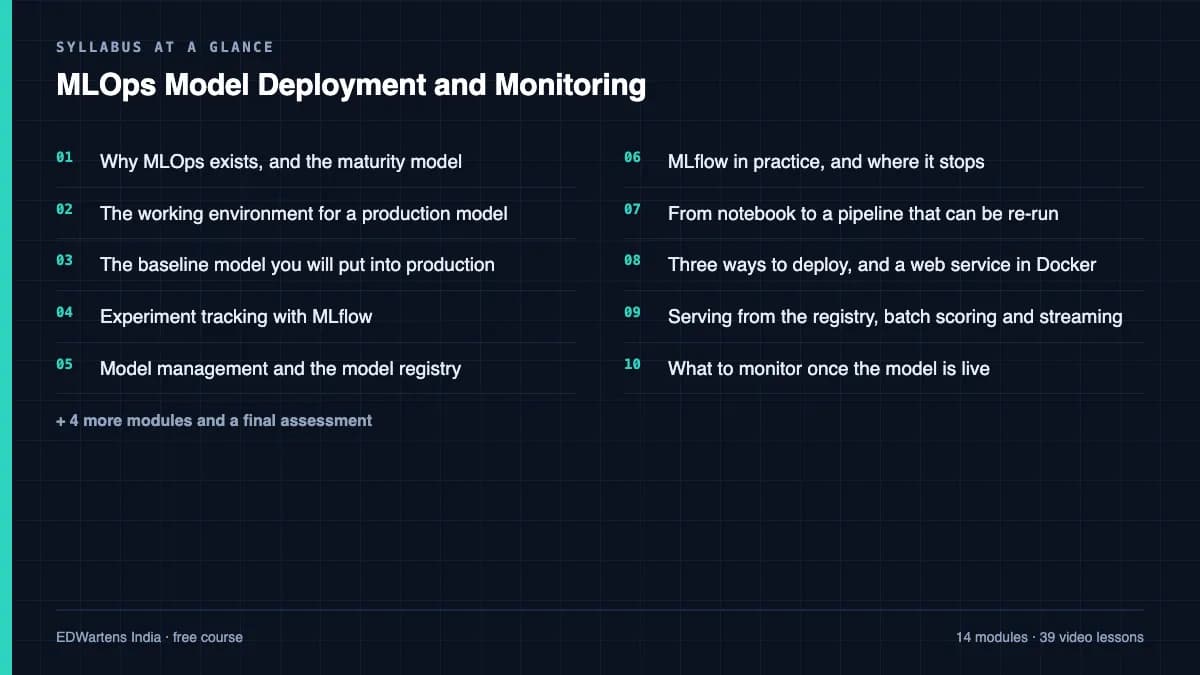
Why MLOps exists, and the maturity model
DataTalksClub
The baseline model you will put into production
DataTalksClub
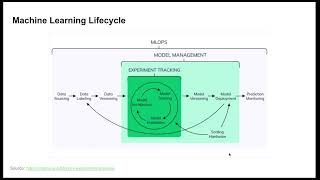
Model management and the model registry
DataTalksClub

From notebook to a pipeline that can be re-run
DataTalksClub
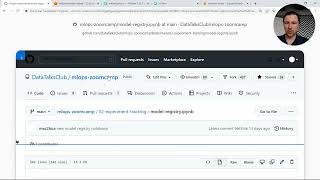
Serving from the registry, batch scoring and streaming
DataTalksClub

Metrics, dashboards and the monitoring service
DataTalksClub
Lesson frames belong to the creators named in the Credits below and are shown from YouTube.
What you will learn
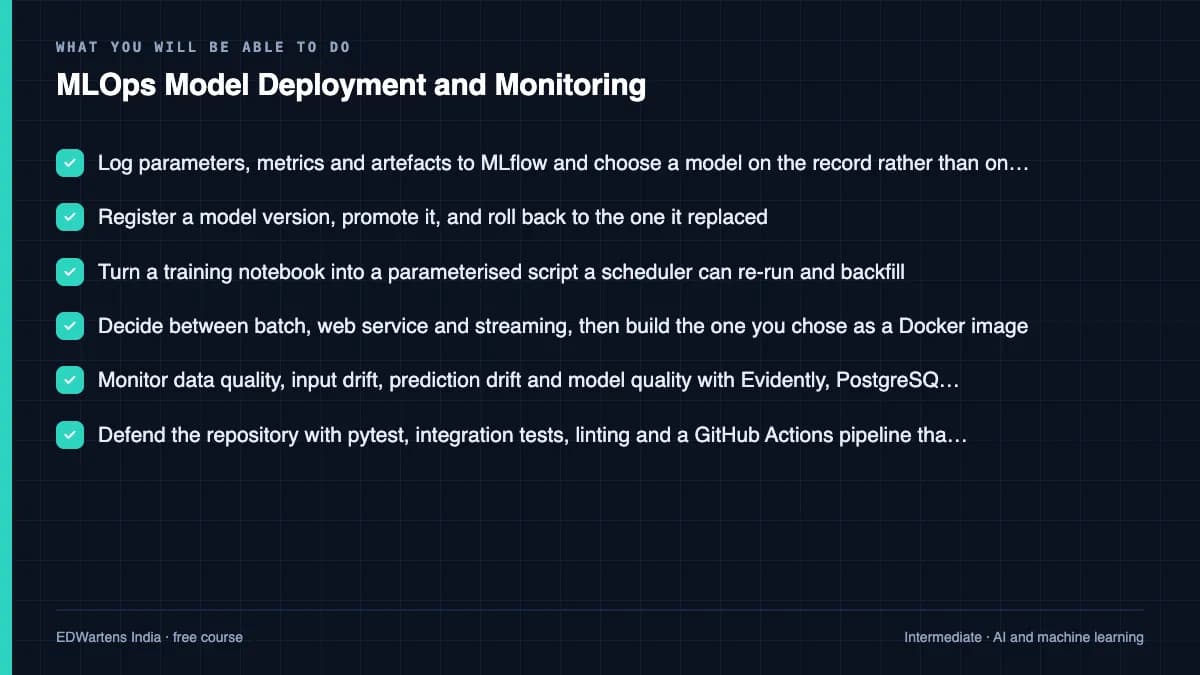
Rebuild a training environment from a pinned requirements file; log parameters, metrics and artefacts to MLflow and choose a model on the record rather than on memory; register a model version, promote it and roll it back; turn a notebook into a parameterised pipeline script; decide between batch, web service and streaming and build the one you chose as a Docker image; load a model from the registry inside the service; write a batch scoring job that saves inputs beside predictions; build a reference dataset and monitor data quality, input drift, prediction drift and model quality into PostgreSQL and Grafana; and defend the repository with pytest, integration tests, linting and a GitHub Actions pipeline that releases without a manual copy step.
- Log parameters, metrics and artefacts to MLflow and choose a model on the record rather than on memory
- Register a model version, promote it, and roll back to the one it replaced
- Turn a training notebook into a parameterised script a scheduler can re-run and backfill
- Decide between batch, web service and streaming, then build the one you chose as a Docker image
- Monitor data quality, input drift, prediction drift and model quality with Evidently, PostgreSQL and Grafana
- Defend the repository with pytest, integration tests, linting and a GitHub Actions pipeline that releases without a manual copy
For you
Taking MLOps Model Deployment and Monitoring from the United States
- Free in the United States, as everywhere, and self-paced: lessons, notes and the final assessment are open at any hour, so your time zone and shift pattern do not matter.
- The optional certificate for learners in the United States is a one-off US$28.99. What you get for it
- Plants across the Americas most often run Allen-Bradley, Siemens and Inductive Automation; each has its own free course to take next.
- See automation and engineering jobs in the United States, and what the industry looks like in Houston, Detroit and Chicago.
- EDWartens also has a regional site for the United States, for classroom training and local support: edwartens.com/us.
The course project · about 18 hours
Bearing-fault classifier as a monitored service for a 40-fan cement plant fleet
Take a trained scikit-learn bearing-fault classifier and deliver it the way a plant can run it: a pinned environment, the model registered in MLflow with a model card, a Flask service in Docker that scores 40 fans every ten minutes, a nightly batch job, Evidently drift monitoring into PostgreSQL and Grafana, pytest and a GitHub Actions pipeline, and a runbook with a rehearsed rollback. You deliver the repository, your own model register and test report, and the runbook. The sample pack shows what each one looks like when a contractor delivers it to a plant.
Sample document pack, 8 documents, filled in for the scenario
- URSUser Requirements: Fan Bearing-Fault Prediction Service
- SDSSoftware Design Specification: Fan Classifier Service
- RegisterModel Register and Model Card: fan_bearing_clf
- ProcedureRunbook: Deploy, Roll Back, Monitor and Retrain the Fan Classifier
- Test reportTest Report: Contract, Load, Drift, Rollback and Retraining Trigger
- Risk registerRisk Register: Fan Classifier Service
- O&M manualOperation and Maintenance Manual: Fan Condition Service (Control-room section)
- Change noticeDesign Change Notice: Reference Set Rebuilt and Image Retention Policy
Read inside the course and download as a workbook. The project is optional practice, marked when you submit it; the certificate needs only the modules and the final assessment.
Course content
15 modules · 39 lessons · 12h 5m
In order, at whatever pace suits you. Each module ends with a practice task that builds on the last.
- 01Why MLOps exists, and the maturity model3 lessons32m
- 02The working environment for a production model5 lessons1h 20m
- 03The baseline model you will put into production1 lesson41m
- 04Experiment tracking with MLflow3 lessons50m
- 05Model management and the model registry2 lessons52m
- 06MLflow in practice, and where it stops2 lessons54m
- 07From notebook to a pipeline that can be re-run2 lessons41m
- 08Three ways to deploy, and a web service in Docker2 lessons42m
Requirements
- Who it is for
- Intermediate. Best after the Machine Learning with Python course; you need working Python, the Linux command line, Git and enough Docker to run a container.
- Software
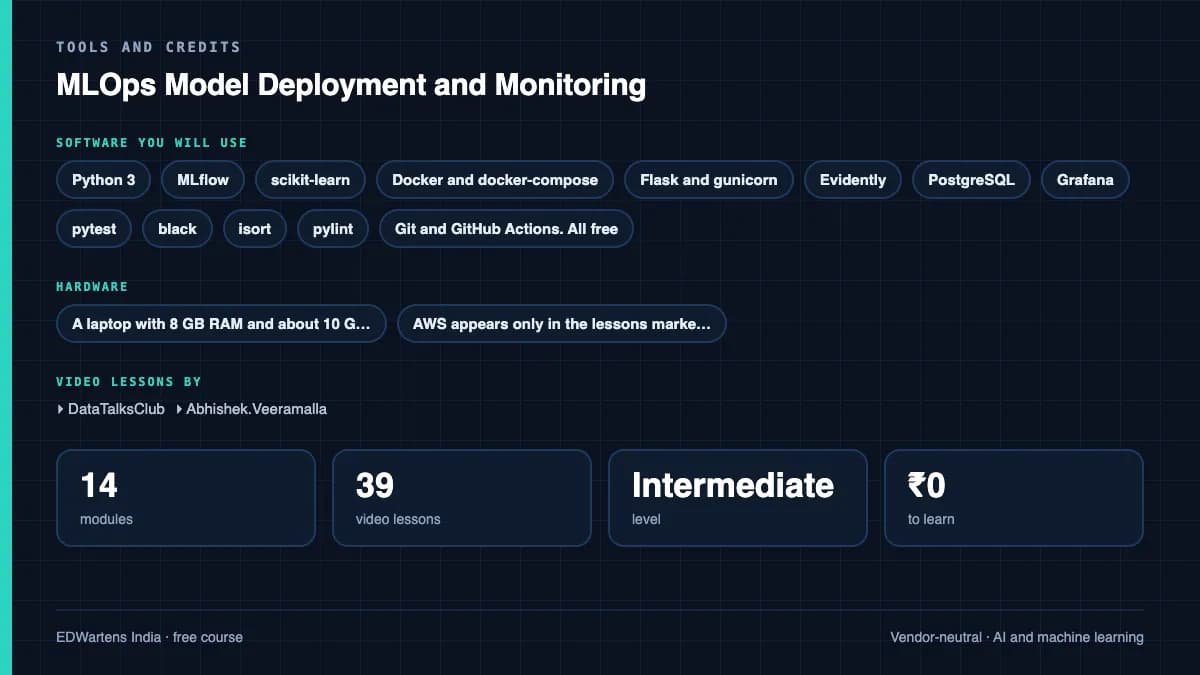
- Python 3, MLflow, scikit-learn, Docker and docker-compose, Flask and gunicorn, Evidently, PostgreSQL, Grafana, pytest, black, isort, pylint, Git and GitHub Actions. All free. What to download, and how
- Hardware
- A laptop with 8 GB RAM and about 10 GB of free disk. No GPU. No cloud account for the local route; AWS appears only in the lessons marked optional.
Software you need
What to download, where from, what it costs and how to install it. Every link goes to the maker's own site, never a mirror.
scikit-learn, Flask, gunicorn, Evidently, pytest and the linters install with pip inside the course project.
Required
- 01Free
Python
Python Software Foundation
- Runs on
- Windows (not Windows 7 or earlier), macOS and Linux. Windows builds for x64, 32-bit and Arm64.
- Account
- None needed
Python is free, open source software. You can use it for learning and for commercial work at no cost.
Steps
- 1.Open python.org/downloads and click the download button for your system.
- 2.On Windows, run the Python install manager (or the classic 64-bit installer) you downloaded.
- 3.If you use the classic installer, tick "Add python.exe to PATH" on the first screen, then click Install Now.
- 4.Open a new Command Prompt or Terminal and run: python --version (on Windows you can also run: py --version).
- 5.Install packages with pip, for example: python -m pip install requests
- pip comes with Python. Run it as python -m pip so it always matches the Python you are using.
- Python.org now recommends the Python install manager on Windows. If it offers to add its folder to PATH, say yes so the python command works everywhere.
- Make a virtual environment for each project: python -m venv .venv
Official download pagepython.orgAlternatives
- Anaconda Distribution: Python with 600+ data science packages and Jupyter already included.
- 02Free
Git
Git project (git-scm.com)
- Runs on
- Windows (x64 and ARM64), macOS, Linux
- Account
- None needed
Git is free and open source software. Use it for any purpose at no cost.
Steps
- 1.Open git-scm.com/downloads and choose your system.
- 2.On Windows, download the x64 Setup (or ARM64 Setup) and run it. The default choices are fine for most learners.
- 3.Open a new terminal and run: git --version
- 4.Set your name: git config --global user.name "Your Name"
- 5.Set your email: git config --global user.email "you@example.com"
- On Windows you can also install with: winget install --id Git.Git -e --source winget
- A portable version (no installer) is offered for PCs where you cannot install software.
Official download pagegit-scm.com - 03Free for personal use, education and small businesses
Docker Desktop
Docker, Inc.
- Runs on
- Windows 10 64-bit version 22H2 (build 19045) or Windows 11 64-bit version 23H2 (build 22631) or later, with WSL 2 and hardware virtualisation on, 8 GB RAM. Also macOS and Linux.
- Account
- None needed
Free for personal use, education, non-commercial open source projects, and businesses with fewer than 250 employees and less than 10 million US dollars in annual revenue. Larger businesses need a paid subscription. Docker Engine on Linux is open source and is not covered by these terms.
Steps
- 1.Open docker.com/products/docker-desktop and download the installer for your system.
- 2.On Windows, install WSL first (wsl --install) if you do not have it.
- 3.Run the installer and keep the WSL 2 option selected.
- 4.Restart if asked, then start Docker Desktop and accept the subscription terms.
- 5.Open a terminal and run: docker run hello-world
- Turn on virtualisation in BIOS or UEFI if Docker says it is not available.
- On Linux servers, install Docker Engine instead of Docker Desktop.
Official download pagedocker.comAlternatives
- Docker Engine (Linux): Free, open source engine for Linux. Not covered by the Docker Desktop subscription terms.
- 04Free
MLflow
MLflow project (Linux Foundation, created by Databricks), a Python or npm package
- Runs on
- Windows, macOS and Linux with Python 3.10 or later
- Account
- None needed
Free, open source under the Apache 2.0 licence.
Steps
- 1.Install Python 3.10 or later.
- 2.Create and activate a virtual environment, then run: pip install mlflow
- 3.Start the tracking server and UI with: mlflow server
- 4.Open http://localhost:5000 to see your experiments and runs.
- In your training script, point MLflow at the server with mlflow.set_tracking_uri("http://localhost:5000").
Official download pagemlflow.org
Optional
Useful, not needed to finish the course.
- 05Free
Grafana
Grafana Labs
- Runs on
- Windows, macOS, Linux (Debian/Ubuntu, RHEL/Fedora, SUSE, ARM64) and Docker
- Account
- None needed
Grafana OSS is free and open source under AGPLv3. The Grafana Enterprise download is also free to use without a licence key and is functionally identical until you buy an Enterprise licence.
Steps
- 1.Open grafana.com/grafana/download and choose the edition (Enterprise is recommended by Grafana and is free to use; OSS is fine too).
- 2.Pick your platform and download the installer or package.
- 3.Install and start the Grafana service.
- 4.Open http://localhost:3000 and sign in with the default admin account (admin / admin), then set a new password.
- 5.Add a data source, such as InfluxDB, and build your first dashboard.
- Change the default admin password straight away.
Official download pagegrafana.com - 06Free
Visual Studio Code
Microsoft
- Runs on
- Windows 64-bit (supported Windows client versions), macOS (latest and two previous releases), Linux (Ubuntu 20.04, Debian 10, RHEL 8, Fedora 36 or later)
- Account
- None needed
- Size
- Less than 200 MB download, under 500 MB installed
Free to download and use. Extensions from the Marketplace each have their own licence.
Steps
- 1.Open code.visualstudio.com/download.
- 2.Pick the installer for your system (on Windows, the User Installer is fine).
- 3.Run the installer. On Windows, tick "Add to PATH" if it is offered.
- 4.Open VS Code and install the extensions your course uses, for example the Python extension.
- Hardware needs are small: a 1.6 GHz processor and 1 GB of RAM.
- On Windows, the "Open with Code" options in the installer let you open folders from File Explorer.
Official download pagecode.visualstudio.com
Checked against each maker's own page on 27 September 2026. Trial lengths and editions change; the maker's page is the final word.
MLOps Model Deployment and Monitoring at a glance
MLOps Model Deployment and Monitoring is a free, self-paced online course from EDWartens for engineers, developers and students applying AI to real work. It has 15 modules and 12h 5m of video lessons by DataTalksClub, Abhishek.Veeramalla, with written notes and worked problems, a practical project with a document pack and a 15-question final assessment (pass mark 60%). Learning is free with an account; an optional certificate with a public verification code is issued when you pass. Last updated 27 September 2026.
All course factsHide course facts
- Price
- Free, for good. No trial, no card. The only paid item is the optional certificate, a small one-off fee.
- Who it is for
- Engineers, developers and students applying AI to real work
- Format
- 15 self-paced modules, 12h 5m of video, written notes, a practice task per module and one final assessment.
- Level
- Intermediate. Intermediate. Best after the Machine Learning with Python course; you need working Python, the Linux command line, Git and enough Docker to run a container.
- Brand
- Vendor-neutral
- Software
- Python 3, MLflow, scikit-learn, Docker and docker-compose, Flask and gunicorn, Evidently, PostgreSQL, Grafana, pytest, black, isort, pylint, Git and GitHub Actions. All free.
- Hardware
- A laptop with 8 GB RAM and about 10 GB of free disk. No GPU. No cloud account for the local route; AWS appears only in the lessons marked optional.
- Certificate
- Optional EDWartens Certificate of Completion, verifiable by code. Not a vendor credential.
- Video lessons by
- DataTalksClub, Abhishek.Veeramalla (independent creators, credited below)
- Language
- English
- Last updated
- 27 September 2026
A shareable EDWartens certificate
Finish every module and pass the final assessment, and the optional EDWartens certificate is yours. It carries a unique verification code on a public page anyone can check, so it stands up when a recruiter looks it up. See it below.
The course itself stays free whether or not you ever buy one.
Stuck? Ask a practising engineer
A free course usually means a comment section and hope. This one does not. Every module has an Ask-your-trainer panel that reaches the same engineers who teach our paid programme: people who commission panels for a living, not moderators.
Pairs well with
 PLC programming · FreeSiemens TIA PortalFrom zero electrical knowledge to a working, simulated S7-1200 program, for nothing.
 PLC programming · FreeSiemens TIA Portal in Three HoursThe first three hours of the Siemens TIA Portal course, cut to end on a win: what a PLC is, how it is wired, a project configured in TIA Portal, and your first ladder program running in simulation. Finish it in an evening or two, earn a certificate, and carry straight on into the full course.
 PLC programming · FreeTIA Portal: Build a MachineOne machine, start to finish. Take a bottle filling line from a written specification and an I/O list to a structured S7-1200 program with a fill station, a capper, a reject sorter and an operator screen with alarms, then test it against a written record and archive it for hand-over. The lessons are the reference; the machine is yours, and it is what you submit.
 Instrumentation · FreeInstrumentation for PLC EngineersThe half of the loop that is not code. Follow one measurement from the transmitter in the field, down the 4-20 mA loop, into the analog card, through NORM_X and SCALE_X into engineering units, out again to a valve, and back to the control room when the reading is wrong.
More free courses: Free AI courses for engineers
Learner reviews
No reviews yet
Reviews here are written only by learners who have finished every module of MLOps Model Deployment and Monitoring, and they are published exactly as written. Finish the course and yours will be the first.
Common questions
What do I need before this course?
Working Python, the Linux command line and Git, plus a model you have trained at least once. The Machine Learning with Python course covers that. You do not need prior Docker experience beyond running a container, because the deployment modules build the image step by step.
Do I need a cloud account or a paid subscription?
No. MLflow, Docker, Flask, Evidently, PostgreSQL, Grafana, pytest and GitHub Actions are all free, and the whole local route runs on a laptop. Two lessons demonstrate AWS Kinesis, Lambda and cloud deployment. They are marked optional, they are there for the design they teach, and nothing in the assessment depends on having an AWS account.
Do I need a GPU?
No. The model used through the course is a regression on tabular data that trains in under a minute on a CPU. There is a lesson on when a GPU is worth paying for, which for this kind of work is rarely.
Is this the same as the AWS or Google machine learning engineer certification?
No, and it is not preparation material sold by those vendors either. Those are paid, proctored vendor examinations with their own syllabus. This course teaches the practices those examinations test, using open-source tools, and it ends with an EDWartens Certificate of Completion. If you want the vendor badge you still have to sit and pay for the vendor's exam.
What will I have worked through by the end?
One model taken the whole way: tracked in MLflow, registered and promoted, served both as a Flask endpoint in Docker and as a batch scoring job, monitored for data quality and drift on a Grafana dashboard, and released by a GitHub Actions pipeline that runs the linter and the tests first.
Is the MLOps Model Deployment and Monitoring course really free?
Yes. Every module, practice task and assessment. You create an account so your progress is saved and the assessments can be marked. The certificate is the only paid item, and only if you want it.
What certificate does the MLOps Model Deployment and Monitoring course give?
An EDWartens Certificate of Completion, issued when you have finished every module and passed the final assessment, with a verification code anyone can check. It is not a vendor credential and is never described as one.
Who made the video lessons in the MLOps Model Deployment and Monitoring course?
The creators named in the Credits block at the foot of this page, on their own YouTube channels. EDWartens did not make the videos and the creators are not affiliated with EDWartens. What EDWartens wrote is the study plan, the notes, the practice tasks and the assessments.
What you walk away with
Your certificate for MLOps Model Deployment and Monitoring
Finish the course, pass the final, and this is the document with your name on it.
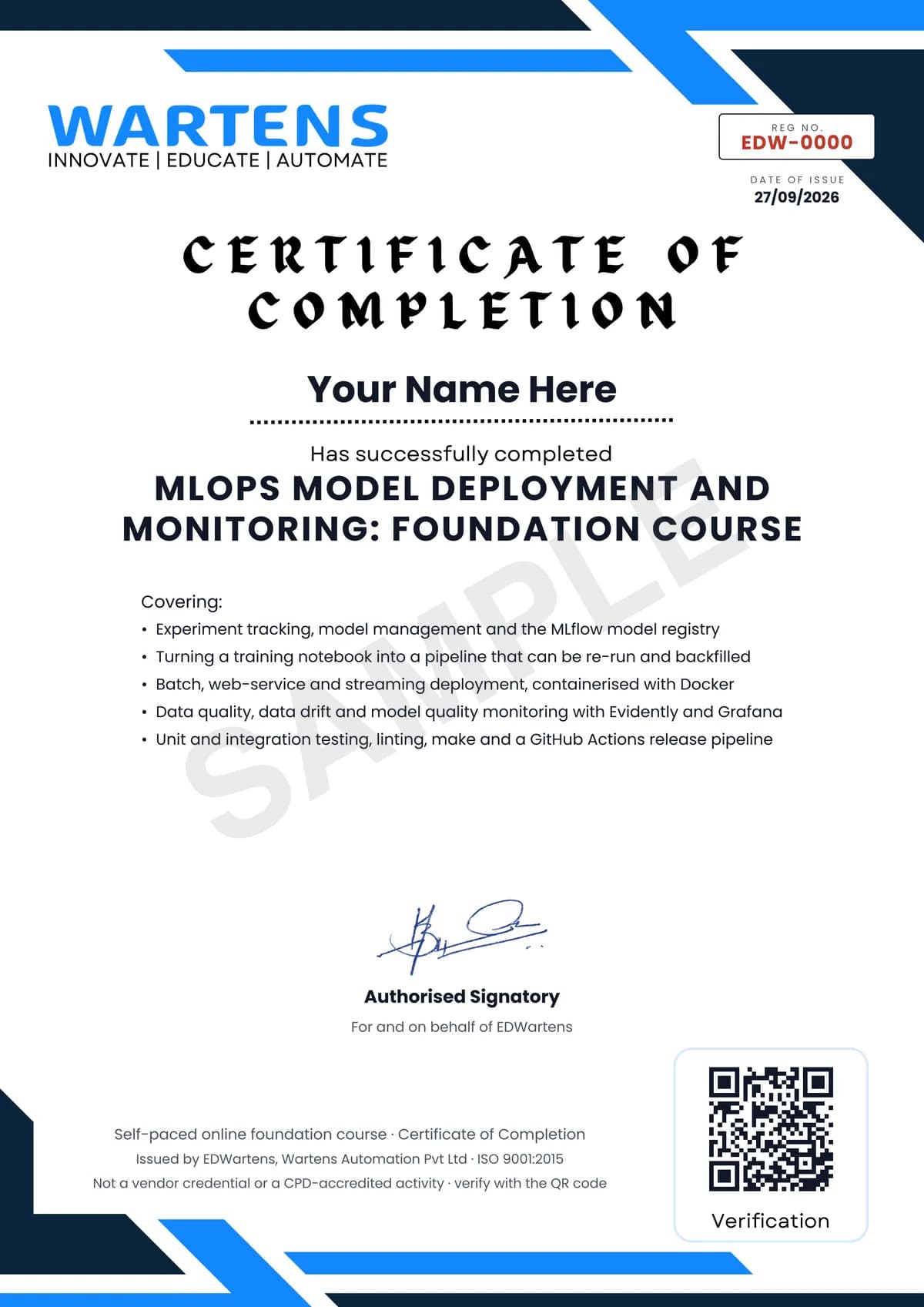
Verifiable by anyone
Adds to LinkedIn in one click
QR code on the certificate
Names what you can do
A permanent link
Earned, not attended
Learning is free. The certificate is optional.
Add it now and pay only when you have finished the course, or come back for it later. One-off, US$28.99, with a receipt.
Issued by EDWartens, the training division of Wartens, as a Certificate of Completion for this self-paced course. Sold by Wartens Ltd (England and Wales). It is not a vendor certification, a university award or a CPD-accredited activity, and it does not certify competence on live equipment. Delivered electronically; see the refund policy.
Credits
Who made the video lessons
The video lessons in this course were created by the people below, not by EDWartens. Every lesson streams from its creator's own YouTube channel; EDWartens neither hosts nor sells that footage, and the creators are not affiliated with EDWartens and do not endorse this course. What EDWartens wrote is the study plan, the notes, the practice tasks and the assessments.
- DataTalksClubthe MLOps Zoomcamp lessons: environment and baseline model, MLflow tracking and the model registry, pipelines, Flask, Docker and batch deployment, monitoring with Evidently and Grafana, pytest and integration tests, linting, make and GitHub Actions
- Abhishek.Veeramallathe plain-language explanation of MLOps against AIOps, and the CPU against GPU lesson in the environment module
If you are one of these creators and would like a lesson removed or credited differently, write to info@wartens.com.