AI and machine learning · Free
Predictive Maintenance with Machine Learning
The industrial AI application with a budget behind it, built end to end: failure modes and what each sensor sees, signals to condition indicators, anomaly detection on normal data, fault classification, deep learning on windows, remaining useful life on NASA's run-to-failure engines, and the alerting and deployment that decide whether anyone acts.

Inside the course


From the lessons
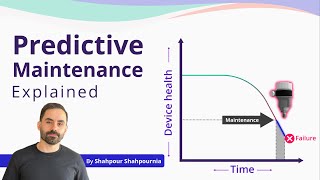
Why predictive, and the P-F curve
RealPars

Failure modes and what each sensor sees
ADASH
Signals: sampling, windows, spectra
MATLAB
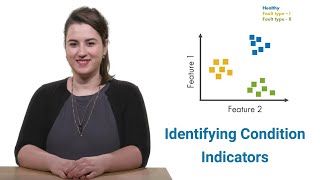
Condition indicators
MATLAB
Anomaly detection on normal data
Dave Ebbelaar
Fault classification
Intelligent Machines
Lesson frames belong to the creators named in the Credits below and are shown from YouTube.
What you will learn
Choose sensors by the P-F curve; recognise bearing, imbalance, misalignment, rotor-bar and insulation signatures; compute spectra, envelopes and condition indicators from windows; build a per-asset anomaly detector with a percentile threshold and persistence; train a fault classifier with grouped validation and cost-aware thresholds; estimate remaining useful life on the C-MAPSS benchmark; design alerts that get acted on; and deploy and measure the whole loop.
- Choose the sensor by the warning time you need, and name the failure mode from its spectrum
- Turn windows into condition indicators — kurtosis, band energies, envelope peaks — and rank them
- Build a per-asset anomaly detector on healthy data with a threshold and persistence that stop alert floods
- Train a fault classifier with grouped validation and thresholds set by cost
- Estimate remaining useful life on the NASA C-MAPSS benchmark with the right target and metrics
- Design alerts a technician acts on, deploy the loop on an edge box, and measure the programme
For you
Taking Predictive Maintenance with Machine Learning from the United States
- Free in the United States, as everywhere, and self-paced: lessons, notes and the final assessment are open at any hour, so your time zone and shift pattern do not matter.
- The optional certificate for learners in the United States is a one-off US$28.99. What you get for it
- Plants across the Americas most often run Allen-Bradley, Siemens and Inductive Automation; each has its own free course to take next.
- See automation and engineering jobs in the United States, and what the industry looks like in Houston, Detroit and Chicago.
- EDWartens also has a regional site for the United States, for classroom training and local support: edwartens.com/us.
The course project · about 6 hours
Remaining useful life on NASA's turbofan engines (C-MAPSS FD001)
One hundred engines run to failure with 21 sensors per cycle. Build the clipped RUL target, drop constant sensors, add rolling features, train a gradient-boosting regressor with grouped cross-validation, evaluate on the benchmark's last-cycle test set with RMSE and the asymmetric score, and plot predicted against true RUL for three engines.
The course project · about 5 hours
Anomaly detection and fault classification on the track's vibration and motor-fleet data
Build the two lower rungs on the track's own data: condition indicators from the 2 kHz vibration windows, an IsolationForest anomaly detector fitted on healthy windows with a percentile threshold and a persistence rule, then a fault classifier with grouped cross-validation on the motor-fleet readings, and alert text a technician could act on.
Course content
12 modules · 27 lessons · 9h 46m
In order, at whatever pace suits you. Each module ends with a practice task that builds on the last.
- 01Why predictive, and the P-F curve3 lessons23m
- 02Failure modes and what each sensor sees2 lessons11m
- 03Signals: sampling, windows, spectra1 lesson43m
- 04Condition indicators2 lessons22m
- 05Anomaly detection on normal data3 lessons1h 54m
- 06Fault classification3 lessons28m
- 07Deep learning on windows4 lessons42m
- 08Remaining useful life on NASA's engines3 lessons55m
Requirements
- Who it is for
- Intermediate. Needs the Machine Learning with Python course; the Deep Learning course helps for module 7.
- Software
- Google Colab; NumPy, SciPy, Pandas, scikit-learn; TensorFlow for the optional deep-learning module. What to download, and how
- Hardware
- None. Wireless vibration sensors and a gateway are discussed, not required.
Software you need
What to download, where from, what it costs and how to install it. Every link goes to the maker's own site, never a mirror.
NumPy, SciPy, pandas, scikit-learn and TensorFlow are already installed in Colab.
Required
- 01Free, GPU time not guaranteed
Google Colab
Google, in the browser
- Runs on
- Any modern web browser
- Account
- A free Google account
Colab is free to use. In the free version GPUs and TPUs are heavily restricted and not guaranteed, sessions can run for at most 12 hours, and idle sessions are stopped. Paid plans give more reliable access.
Steps
- 1.Open colab.research.google.com and sign in with your Google account.
- 2.Click New notebook (or open the notebook your course links to).
- 3.For a GPU, choose Runtime, then Change runtime type, then pick a GPU if one is offered.
- 4.Type code in a cell and press Shift and Enter to run it.
- Save a copy to your Google Drive so your changes are kept.
- Files on the runtime are deleted when the session ends. Save outputs to Drive.
Open Google Colabcolab.research.google.com
Checked against each maker's own page on 27 September 2026. Trial lengths and editions change; the maker's page is the final word.
Predictive Maintenance with Machine Learning at a glance
Predictive Maintenance with Machine Learning is a free, self-paced online course from EDWartens for engineers, developers and students applying AI to real work. It has 12 modules and 9h 46m of video lessons by MATLAB, RealPars, ADASH and others, with written notes and worked problems, a practical project with a document pack and a 15-question final assessment (pass mark 60%). Learning is free with an account; an optional certificate with a public verification code is issued when you pass. Last updated 27 September 2026.
All course factsHide course facts
- Price
- Free, for good. No trial, no card. The only paid item is the optional certificate, a small one-off fee.
- Who it is for
- Engineers, developers and students applying AI to real work
- Format
- 12 self-paced modules, 9h 46m of video, written notes, a practice task per module and one final assessment.
- Level
- Intermediate. Intermediate. Needs the Machine Learning with Python course; the Deep Learning course helps for module 7.
- Brand
- Vendor-neutral
- Software
- Google Colab; NumPy, SciPy, Pandas, scikit-learn; TensorFlow for the optional deep-learning module.
- Hardware
- None. Wireless vibration sensors and a gateway are discussed, not required.
- Certificate
- Optional EDWartens Certificate of Completion, verifiable by code. Not a vendor credential.
- Video lessons by
- MATLAB, RealPars, ADASH, Intelligent Machines, Dave Ebbelaar, Data Science with Marco, NeuralNine, Krish Naik, Victor Tan, Data Bowl Recipes, JCharisTech, InfluxData, AIEngineering (independent creators, credited below)
- Language
- English
- Last updated
- 27 September 2026
A shareable EDWartens certificate
Finish every module and pass the final assessment, and the optional EDWartens certificate is yours. It carries a unique verification code on a public page anyone can check, so it stands up when a recruiter looks it up. See it below.
The course itself stays free whether or not you ever buy one.
Stuck? Ask a practising engineer
A free course usually means a comment section and hope. This one does not. Every module has an Ask-your-trainer panel that reaches the same engineers who teach our paid programme: people who commission panels for a living, not moderators.
Pairs well with
 PLC programming · FreeSiemens TIA PortalFrom zero electrical knowledge to a working, simulated S7-1200 program, for nothing.
 PLC programming · FreeSiemens TIA Portal in Three HoursThe first three hours of the Siemens TIA Portal course, cut to end on a win: what a PLC is, how it is wired, a project configured in TIA Portal, and your first ladder program running in simulation. Finish it in an evening or two, earn a certificate, and carry straight on into the full course.
 PLC programming · FreeTIA Portal: Build a MachineOne machine, start to finish. Take a bottle filling line from a written specification and an I/O list to a structured S7-1200 program with a fill station, a capper, a reject sorter and an operator screen with alarms, then test it against a written record and archive it for hand-over. The lessons are the reference; the machine is yours, and it is what you submit.
 Instrumentation · FreeInstrumentation for PLC EngineersThe half of the loop that is not code. Follow one measurement from the transmitter in the field, down the 4-20 mA loop, into the analog card, through NORM_X and SCALE_X into engineering units, out again to a valve, and back to the control room when the reading is wrong.
More free courses: Free AI courses for engineers · Free maintenance and reliability courses
Learning paths with this course
- Industrial AI engineer · 4 coursesAI where the machines are: where it sits beside PLC and SCADA, predictive maintenance on real run-to-failure data, machine vision quality inspection with YOLO, and plant data over Modbus and OPC UA in Python.
Learner reviews
5.0
1 review from learners who finished the course
- 51
- 40
- 30
- 20
- 10
- Zohaib· finished the course · September 2026
Feedbaack
Good over all but certificate should be free
Common questions
Do I need vibration sensors?
No. The course uses the track's vibration windows and motor-fleet readings, and NASA's public engine dataset. The module on sensors tells you what to buy and where to mount it when you do.
What do I need before this course?
The Machine Learning with Python course, or equivalent: features, splits, cross-validation, metrics. Module 7 uses the Deep Learning course's tools but is optional.
What are the projects in the Predictive Maintenance with Machine Learning course?
Remaining useful life on NASA's C-MAPSS FD001 engines, evaluated the way the benchmark is — and the two lower rungs on the track's own data: an anomaly detector with persistence on vibration windows and a fault classifier with cost-aware thresholds on the motor fleet, with alert text a technician could act on.
Is the Predictive Maintenance with Machine Learning course really free?
Yes. Every module, practice task, project and assessment. You create an account so your progress is saved and the assessments can be marked. The certificate is the only paid item, and only if you want it.
What certificate does the Predictive Maintenance with Machine Learning course give?
An EDWartens Certificate of Completion, issued when you have finished the modules and passed the final assessment (the project is optional practice), with a verification code anyone can check. It is not a vendor credential and is never described as one.
Who made the video lessons in the Predictive Maintenance with Machine Learning course?
The creators named in the Credits block at the foot of this page, on their own YouTube channels. EDWartens did not make the videos and the creators are not affiliated with EDWartens. What EDWartens wrote is the study plan, the notes, the practice tasks, the projects and the assessments.
How long does the Predictive Maintenance with Machine Learning course take?
Plan on about 16 hours in all, including the video lessons, notes and practice tasks. It is self-paced, so you work through the twelve modules at your own speed.
What you walk away with
Your certificate for Predictive Maintenance with Machine Learning
Finish the course, pass the final, and this is the document with your name on it.

Verifiable by anyone
Adds to LinkedIn in one click
QR code on the certificate
Names what you can do
A permanent link
Earned, not attended
Learning is free. The certificate is optional.
Add it now and pay only when you have finished the course, or come back for it later. One-off, US$28.99, with a receipt.
Issued by EDWartens, the training division of Wartens, as a Certificate of Completion for this self-paced course. Sold by Wartens Ltd (England and Wales). It is not a vendor certification, a university award or a CPD-accredited activity, and it does not certify competence on live equipment. Delivered electronically; see the refund policy.
Credits
Who made the video lessons
The video lessons in this course were created by the people below, not by EDWartens. Every lesson streams from its creator's own YouTube channel; EDWartens neither hosts nor sells that footage, and the creators are not affiliated with EDWartens and do not endorse this course. What EDWartens wrote is the study plan, the notes, the practice tasks and the assessments.
- MATLABthe predictive maintenance series, the signal-processing talk and the prognostics case study
- RealParspredictive maintenance explained and machine learning for predictive maintenance
- ADASHvibration analysis for beginners
- Intelligent Machinesmachine learning and deep learning for fault diagnosis, and the turbofan RUL videos
- Dave Ebbelaardetecting outliers in sensor data
- Data Science with Marcoanomaly detection in time series
- NeuralNineanomaly detection for time-series data
- Krish Naikthe complete anomaly detection tutorial
- Victor Tanthe end-to-end predictive maintenance workflow
- Data Bowl Recipespredictive maintenance with machine learning
- JCharisTechpredictive maintenance with machine learning in Python
- InfluxDataa lesson in "Deploying and measuring"
- AIEngineeringa lesson in "Deploying and measuring"
If you are one of these creators and would like a lesson removed or credited differently, write to info@wartens.com.