NLP FOR ENGINEERS
Natural Language Processing for Engineers: From Maintenance Logs to Manual Search
Plants hold years of text in work orders, shift logs and manuals. What NLP can do with it, classic methods against LLMs, and an honest free route.

Natural language processing training, or NLP training, teaches you how software sorts, searches and extracts meaning from text. For engineers that text is work orders, shift logs, alarm descriptions and manuals. The practical toolkit is Python, classic text classification, embeddings for search and large language models for extraction, and you can learn its core free on edwartens.com.
In this episode from Microsoft Learn, part of its AI-901 exam series, the core concepts of natural language processing are introduced. It sits in the free Azure AI Fundamentals (AI-901) exam preparation course. Watch it for the vocabulary, then read on for how those ideas apply to engineering text.
Why engineers should care about text
Plants record a great deal in words. A work order says "pmp 3 brg noisy, replaced DE brg". A shift log says the dryer tripped twice on high temperature. A drive manual has the fault code table you need at 2 a.m. Most of that text is never analysed, because it is messy, full of local abbreviations, and too long to read.
NLP makes some of it usable:
- Classifying work orders into failure modes, so reliability engineers can count what actually breaks, which feeds AI predictive maintenance.
- Extracting entities: equipment tags, part numbers, dates, from free text.
- Finding similar past jobs, so a technician sees how the last three occurrences were fixed.
- Searching manuals by meaning rather than exact words.
- Summarising a long equipment history into a paragraph.
The building blocks
Tokenisation splits text into units: words, sub-words or characters. Everything else is built on it. Plant text makes this harder than textbook text, because "DE brg" and "drive end bearing" mean the same thing.
Normalisation tidies the text: lower-casing, expanding abbreviations, fixing common misspellings, standardising tag formats. With engineering records, a good abbreviation list often improves results more than a better model.
TF-IDF turns each document into a vector of word weights; scikit-learn's text feature extraction guide shows the maths and the code. A word counts for more when it is frequent in this document and rare across the others. Feed those vectors to logistic regression or a linear SVM, and you have a text classifier that trains in seconds and shows you which words drove each decision.
Embeddings turn a sentence or paragraph into a vector that captures meaning, so "bearing overheating" and "high DE temperature" land close together even with no shared words. They power semantic search and grouping, and the open-source Sentence Transformers library is a common way to compute them locally.
Transformers use attention to read each word in the context of the others, an architecture introduced in the paper Attention Is All You Need. They underpin modern language models, from small models used for classification to the large models behind chat assistants.
Three ways to handle a text problem
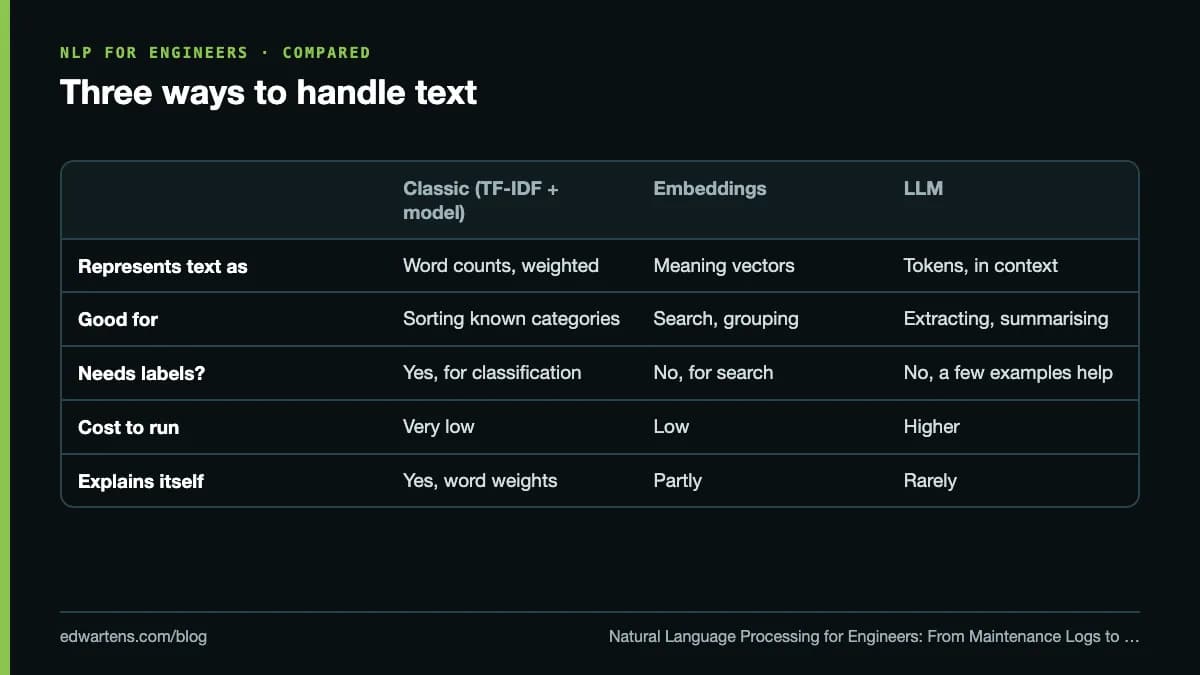
Start with the cheapest method that works. If you have a few thousand work orders already coded into failure categories, TF-IDF with logistic regression is a strong baseline and easy to explain to a reliability engineer. If the question is "find me similar records" or "search the manuals", embeddings are the right tool. If the job is to pull structured fields out of messy free text, or to summarise, an LLM with a strict output format and a refusal rule is often the quickest route, provided someone checks the results.
The common NLP tasks, in engineering terms
- Text classification: this work order is a seal failure.
- Named entity recognition: in this sentence, "P-301" is equipment and "6205-2RS" is a part.
- Semantic search: which manual pages answer this question.
- Clustering: which groups of complaints keep recurring.
- Summarisation: the last two years of this compressor in one paragraph.
- Question answering with retrieval: an answer to a question, citing the manual page it came from.
How to judge a text model honestly
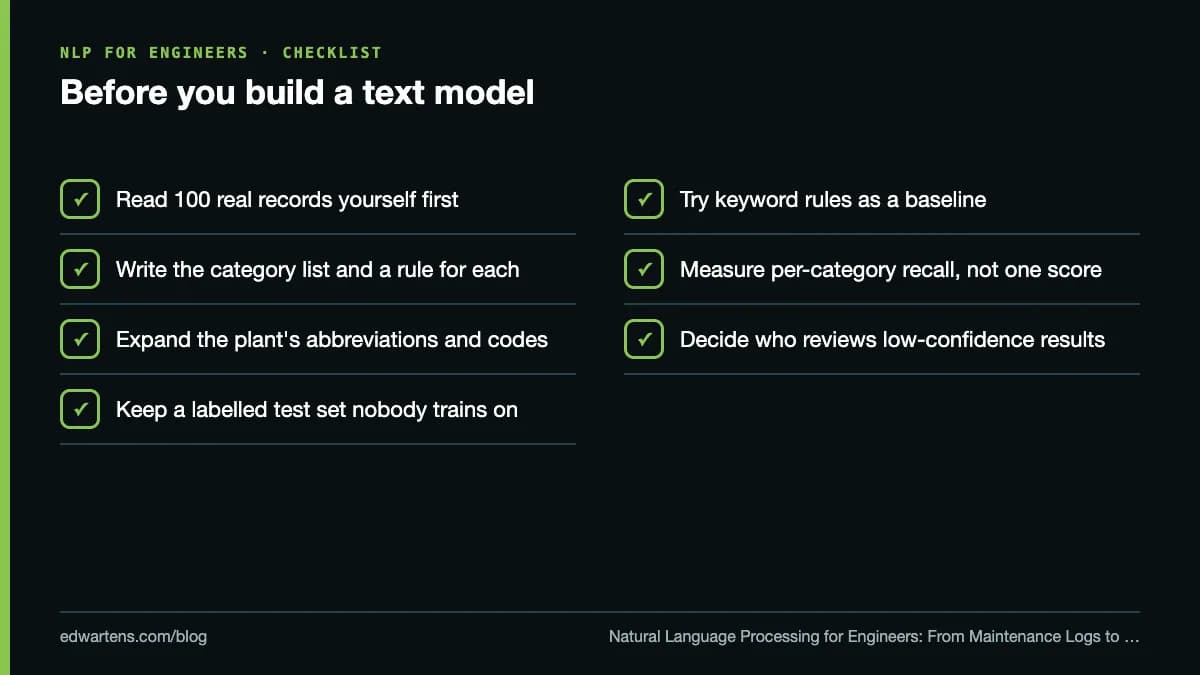
Text models fail quietly. A classifier with a good overall score can be poor on the rare categories that matter most, such as safety-related failures. Keep a labelled test set that nobody trains on, measure recall for each category, and compare against a keyword-rule baseline. The same habits are set out in machine learning for beginners. If a handful of rules gets you most of the way, you may not need a model at all.
For search and question answering, build a small set of real questions with known answers and page numbers. Measure whether the right page is retrieved, whether the answer is correct, and whether the system says "not found" when the answer is not in the documents. That last check is the one most demos skip.
Natural language processing training, free
EDWartens does not run a standalone NLP course. The language skills are taught inside the AI track, which is where engineers most often need them:
- [Python for AI and Engineering Data](/free/python-for-ai-and-engineering-data), beginner. Strings, files, lists and dictionaries, and Pandas for loading and cleaning records.
- [Machine Learning with Python](/free/machine-learning-with-python), beginner in ML. Classification, confusion matrices, pipelines and cross-validation, which is everything a TF-IDF classifier needs apart from the vectoriser.
- [Generative AI and LLM Foundations](/free/generative-ai-and-llm-foundations), beginner. Tokens, embeddings, attention, prompting with a NOT FOUND rule, and a tested datasheet assistant.
- [RAG and Chatbots with LangChain](/free/rag-and-chatbots-with-langchain), intermediate. Loading and chunking manuals so parameter tables survive, local embeddings, hybrid keyword and vector search with re-ranking, cited answers and an evaluation on a real question set.
For the LLM side in more depth, read the generative AI guide for engineers. For a worked build, Build a RAG Chatbot for Equipment Manuals takes you through the steps. The Applied AI engineer path groups machine learning, vision, deep learning and RAG.
A first project
Export a few hundred work orders from your maintenance system, removing names and anything confidential. Read a hundred yourself and write five to eight failure categories with a one-line rule for each. Label a few hundred, keep a quarter aside, train a TF-IDF plus logistic regression classifier on the rest, and report recall per category against a keyword baseline. Then try embedding search: pick ten new work orders and check whether the most similar past jobs really are similar. A one-page write-up of that project is worth more in an interview than any list of libraries.
Start the free courses
Create a free account and begin with the course that fits your level. All of them are listed under free AI courses for engineers. Each ends with one 15-question final assessment, a 60% pass mark and three attempts, then a 24-hour wait and a fresh paper.
Learning is free in full. The optional EDWartens Certificate of Completion is a small one-off fee, US$8.99 for a beginner course. Anyone can check it at edwartens.com/verification. It is not a vendor certification or an accredited qualification.
Take the free course
 Free
FreeAI and machine learning · Beginner · Free
Python for AI and Engineering Data
 Free
FreeAI and machine learning · Beginner · Free
Machine Learning with Python
 Free
FreeAI and machine learning · Beginner · Free
Generative AI and LLM Foundations
 Free
FreeAI and machine learning · Intermediate · Free
RAG and Chatbots with LangChain
Questions
What is NLP in simple words?
Natural language processing is the set of methods that let software work with human language: sorting, searching, extracting information from and generating text.
Is NLP the same as an LLM?
No. Large language models are one family of NLP methods. Classic techniques such as TF-IDF with a classifier, and embedding search, are older, cheaper and often enough for sorting and searching engineering text.
Does edwartens.com have a dedicated NLP course?
Not a standalone one. The language side is taught through Generative AI and LLM Foundations (tokens, embeddings, prompting) and RAG and Chatbots with LangChain (chunking, embeddings, hybrid search and evaluation), with Python and machine learning underneath.
What can NLP do with maintenance records?
Sort free-text work orders into failure categories, pull out equipment tags and parts, find similar past jobs, and summarise long histories. Results should be checked by someone who knows the equipment.
Is the course free?
Yes. The courses on this route are free in full; the optional EDWartens certificate is a small one-off fee, and checkout shows your price.
Sources
- scikit-learn: Feature extraction, including text and TF-IDF
- Sentence Transformers documentation
- Vaswani et al. (arXiv): Attention Is All You Need
- Hugging Face: LLM Course
Written by the EDWartens engineering team for general education. Product names are trademarks of their owners; mentioning them does not imply endorsement. Prices and terms of other providers were checked on the date shown and can change.

Free Machine Learning Course for Mechanical and Electrical Engineers

Best Free AI Courses With Certificate for Engineers (2026)

Deep Learning Explained: Neural Networks, CNNs and LSTMs, and When You Need Them

AI Engineer Career Path: A Realistic Route From Engineering or From Scratch

Free Generative AI and Prompt Engineering Courses With Certificate, Compared

Predict Machine Failure From Sensor Data in Google Colab (Video)