AI for professionals · Free
AI for Doctors: Clinical Notes, Research and Safe Use
Use AI tools safely in clinical work: how models learn, prompting for clinicians, AI scribes and documentation, reading evidence with AI, judging whether a model is any good, and the bias, privacy and legal questions every doctor now meets. Built on NBEMS's free AI in Healthcare lectures.

Inside the course


From the lessons

Where AI already sits in a doctor's day
AI for Physicians - Bridging Healthcare & MedTech
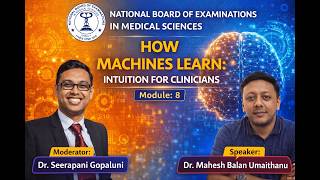
How machines learn: intuition for clinicians
NBEMS

Prompt thinking for clinicians
NBEMS

Documentation, AI scribes and the tools worth paying for
My AI Doctor | AI in Healthcare with Dr. Saab

Reading journals and synthesising evidence with AI
NBEMS
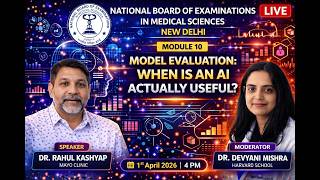
When is an AI actually useful? Evaluating a model
NBEMS
Lesson frames belong to the creators named in the Credits below and are shown from YouTube.
What you will learn
Explain in plain words how a clinical AI model learns and why its accuracy can fail in a new population; write de-identified prompts that produce useful drafts; use an AI scribe with consent and a proper review; speed up evidence reading without trusting an AI summary blindly; calculate what a model's sensitivity and specificity mean for your patients; recognise bias and demand explanations; and work within data-protection law and your hospital's policy, with India's DPDP Act and ICMR guidance as the worked example.
- Explain how a clinical AI model learns, and why it can fail on a new population
- Write de-identified prompts that give useful clinical drafts
- Use an AI scribe with consent and a proper review before signing
- Speed up literature reading without trusting AI summaries blindly
- Calculate what sensitivity, specificity and prevalence mean for a positive result
- Recognise bias and ask a vendor the right questions
- Work out PPV, NPV and number needed to treat for your own patients
- Work within data-protection law and hospital policy (worked example: India's DPDP Act and ICMR)
For you
Taking AI for Doctors: Clinical Notes, Research and Safe Use from the United States
- Free in the United States, as everywhere, and self-paced: lessons, notes and the final assessment are open at any hour, so your time zone and shift pattern do not matter.
- The optional certificate for learners in the United States is a one-off US$23.99. What you get for it
- Plants across the Americas most often run Allen-Bradley, Siemens and Inductive Automation; each has its own free course to take next.
- See automation and engineering jobs in the United States, and what the industry looks like in Houston, Detroit and Chicago.
- EDWartens also has a regional site for the United States, for classroom training and local support: edwartens.com/us.
The course project · about 8 hours
Evaluating an AI scribe for a hospital department: an evaluation plan, a risk register, a safe-use procedure and a pilot report
Plan and evaluate the introduction of an ambient AI scribe in a hospital outpatient department, as the clinical lead responsible for patient safety: write the evaluation protocol, build the risk register, write the safe-use procedure with consent and review steps, and report a four-week pilot with error rates and time saved. The sample pack shows each document for a district hospital's medicine outpatient clinic. No real patient data is used at any point.
Sample document pack, 4 documents, filled in for the scenario
- PlanEvaluation protocol: ambient AI scribe pilot, medicine OPD
- Risk registerRisk register: ambient AI scribe pilot
- ProcedureSafe use of the ambient AI scribe in medicine OPD
- ReportPilot report: ambient AI scribe, medicine OPD, weeks 1 to 4
Read inside the course and download as a workbook. The project is optional practice, marked when you submit it; the certificate needs only the modules and the final assessment.
Course content
9 modules · 16 lessons · 7h 25m
In order, at whatever pace suits you. Each module ends with a practice task that builds on the last.
- 01Where AI already sits in a doctor's day2 lessons11m
- 02How machines learn: intuition for clinicians1 lesson59m
- 03Prompt thinking for clinicians1 lesson1h 2m
- 04Documentation, AI scribes and the tools worth paying for3 lessons35m
- 05Reading journals and synthesising evidence with AI1 lesson1h 3m
- 06When is an AI actually useful? Evaluating a model1 lesson1h 2m
- 07Bias, fairness and the black box3 lessons1h 5m
- 08Ethics, privacy, law and trust3 lessons1h 25m
Requirements
- Who it is for
- Beginner. For doctors, residents and senior medical students. No statistics beyond what you used in medical school, and no coding.
- Software
- A free account on one general AI assistant, and a free PubMed account. Nothing to install. Never use patient-identifiable data in a public tool. What to download, and how
- Hardware
- Any computer or phone with a browser.
Software you need
What to download, where from, what it costs and how to install it. Every link goes to the maker's own site, never a mirror.
Never use patient-identifiable data in a public AI tool.
Required
- 01Free
PubMed and My NCBI
US National Library of Medicine (NCBI), in the browser
- Runs on
- Any modern web browser
- Account
- None needed
PubMed is free to search. Many articles link to free full text; others are behind the publisher's paywall.
Steps
- 1.Open pubmed.ncbi.nlm.nih.gov and type your search terms.
- 2.Use the filters on the left, such as Free full text and publication date.
- 3.To save searches, click Log in and sign in with Login.gov, Google, ORCID, Microsoft, eRA Commons or an NIH account.
- 4.Use Save or Create alert under the search box to keep a search or get email updates.
- Tick the Free full text filter to find articles you can read without a subscription.
Open PubMed and My NCBIpubmed.ncbi.nlm.nih.gov
One AI assistant
Any one is enough.
- 02Free plan with limits
ChatGPT
OpenAI, in the browser
- Runs on
- Any modern web browser, plus mobile and desktop apps
- Account
- A free OpenAI account
The Free plan allows everyday text chats. File uploads, image creation, voice and data analysis have tighter limits than paid plans, and ads may appear in some countries. Paid plans raise the limits.
Steps
- 1.Open chatgpt.com.
- 2.Click Sign up and create an account with your email, or a Google, Microsoft or Apple account.
- 3.Verify your email and confirm your details.
- 4.Type your question in the message box.
- Do not paste personal data, passwords or confidential work files.
- ChatGPT tells you when you reach a limit. Wait for it to reset or switch to a lighter task.
Open ChatGPTchatgpt.com - 03Free plan with limits
Claude
Anthropic, in the browser
- Runs on
- Any modern web browser, plus desktop and mobile apps
- Account
- A free Claude account (you must be 18 or over)
The Free plan covers chat on web, desktop and mobile, web search, file creation and Artifacts. Usage limits reset on a rolling five-hour window and depend on message length and features used. Paid plans give more usage.
Steps
- 1.Open claude.ai (or see the plans at claude.com/pricing).
- 2.Sign up with your email or Google account and confirm your email.
- 3.Confirm you are 18 or over and accept the terms.
- 4.Type your question in the message box.
- Long conversations and large files use up your limit faster. Start a new chat for a new topic.
- Do not paste personal data or confidential work files.
Open Claudeclaude.com - 04Free with limits
Google Gemini
Google, in the browser
- Runs on
- Any modern web browser, plus Android and iOS apps
- Account
- A free Google account
Free with a Google account, including a Flash model, limited access to the Pro model, image generation, Deep Research and Gems. Paid Google AI plans give higher limits. Some features require you to be 18 or over.
Steps
- 1.Open gemini.google.com.
- 2.Sign in with your Google account.
- 3.Accept the terms the first time you use it.
- 4.Type your question or upload a file in the prompt box.
- Use a personal Google account. Work or school accounts depend on your administrator's settings.
Open Google Geminigemini.google.com - 05Free
Microsoft Copilot and Microsoft 365 Copilot Chat
Microsoft, in the browser
- Runs on
- Any modern web browser, plus Windows, macOS, Android and iOS apps
- Account
- None needed
Microsoft Copilot is free for individuals; you must be at least 13 (older in some countries). Microsoft 365 Copilot Chat is included at no extra cost for organisations with an eligible Microsoft 365 licence and needs a work or school (Microsoft Entra ID) account.
Steps
- 1.Open copilot.microsoft.com.
- 2.Optionally click Sign in and use your personal Microsoft account.
- 3.Type your question in the message box.
- 4.For work or school use, sign in at microsoft365.com with your organisation account and open Copilot Chat.
- Copilot Chat with a work or school account adds enterprise data protection. Use it for work material if your organisation provides it.
Open Microsoft Copilot and Microsoft 365 Copilot Chatcopilot.microsoft.com
Checked against each maker's own page on 27 September 2026. Trial lengths and editions change; the maker's page is the final word.
AI for Doctors: Clinical Notes, Research and Safe Use at a glance
AI for Doctors: Clinical Notes, Research and Safe Use is a free, self-paced online course from EDWartens for doctors, residents and medical students. It has 9 modules and 7h 25m of video lessons by NBEMS, AI for Physicians, My AI Doctor, with written notes and worked problems, a practical project with a document pack and a 15-question final assessment (pass mark 60%). Learning is free with an account; an optional certificate with a public verification code is issued when you pass. Last updated 27 September 2026.
All course factsHide course facts
- Price
- Free, for good. No trial, no card. The only paid item is the optional certificate, a small one-off fee.
- Who it is for
- Doctors, residents and medical students
- Format
- 9 self-paced modules, 7h 25m of video, written notes, a practice task per module and one final assessment.
- Level
- Beginner. Beginner. For doctors, residents and senior medical students. No statistics beyond what you used in medical school, and no coding.
- Brand
- Vendor-neutral
- Software
- A free account on one general AI assistant, and a free PubMed account. Nothing to install. Never use patient-identifiable data in a public tool.
- Hardware
- Any computer or phone with a browser.
- Certificate
- Optional EDWartens Certificate of Completion, verifiable by code. Not a vendor credential.
- Video lessons by
- NBEMS, AI for Physicians, My AI Doctor (independent creators, credited below)
- Language
- English
- Last updated
- 27 September 2026
A shareable EDWartens certificate
Finish every module and pass the final assessment, and the optional EDWartens certificate is yours. It carries a unique verification code on a public page anyone can check, so it stands up when a recruiter looks it up. See it below.
The course itself stays free whether or not you ever buy one.
Stuck? Ask a practising engineer
A free course usually means a comment section and hope. This one does not. Every module has an Ask-your-trainer panel that reaches the same engineers who teach our paid programme: people who commission panels for a living, not moderators.
Pairs well with
 AI for professionals · FreeMicrosoft 365 Copilot and Copilot Studio AgentsUse Microsoft 365 Copilot well and build your first agent: what Copilot, Copilot Chat and Copilot Studio each are, how grounding works, Copilot in Word, Excel, Outlook and PowerPoint, prompting and saved prompts, the Researcher and Analyst agents, building and grounding an agent in Copilot Studio, and responsible use.
 PLC programming · FreeSiemens TIA PortalFrom zero electrical knowledge to a working, simulated S7-1200 program, for nothing.
 PLC programming · FreeSiemens TIA Portal in Three HoursThe first three hours of the Siemens TIA Portal course, cut to end on a win: what a PLC is, how it is wired, a project configured in TIA Portal, and your first ladder program running in simulation. Finish it in an evening or two, earn a certificate, and carry straight on into the full course.
 PLC programming · FreeTIA Portal: Build a MachineOne machine, start to finish. Take a bottle filling line from a written specification and an I/O list to a structured S7-1200 program with a fill station, a capper, a reject sorter and an operator screen with alarms, then test it against a written record and archive it for hand-over. The lessons are the reference; the machine is yours, and it is what you submit.
More free courses: Free AI courses for professionals · Free AI in healthcare courses
Learner reviews
No reviews yet
Reviews here are written only by learners who have finished every module of AI for Doctors: Clinical Notes, Research and Safe Use, and they are published exactly as written. Finish the course and yours will be the first.
Common questions
Is this course medical advice?
No. It teaches doctors how to use AI tools safely in their own work: documentation, evidence reading, evaluating tools, and the ethics and law around them. It never tells you how to treat a patient, and nothing in it replaces your clinical judgement.
Who is the AI for Doctors: Clinical Notes, Research and Safe Use course for?
Practising doctors, residents and senior medical students. Nurses and allied health professionals will find most of it useful too, and there is a separate course written for them.
How is it different from the NBEMS AI in Healthcare programme?
It is built on NBEMS's free public lectures, credited on each module, but it is not the NBEMS programme and is not affiliated with NBEMS. EDWartens added short lessons on scribes and tools, notes with worked problems, a hospital evaluation project and an assessment. If you can attend the NBEMS programme itself, we recommend it.
How long does the AI for Doctors: Clinical Notes, Research and Safe Use course take?
About 11 hours of lessons, notes and practice, which most doctors spread over two to four weeks. The optional project, evaluating an AI scribe for a hospital department, adds about eight hours.
Do I need statistics or coding?
No coding. The only statistics are sensitivity, specificity and predictive values, worked through with simple tables.
Can I use patient data in the exercises?
No. Every exercise uses invented or de-identified cases. The course teaches you never to put identifiable patient information into a public AI tool.
Is the AI for Doctors: Clinical Notes, Research and Safe Use course really free?
Yes. Every module, the notes, the project and the final assessment. The only paid item is the certificate, if you want it.
What certificate does the AI for Doctors: Clinical Notes, Research and Safe Use course give?
An EDWartens Certificate of Completion, issued when you pass the final assessment, with a number anyone can verify on our site. It is not a medical qualification, CME credit or regulatory approval of any kind, and we never describe it as one.
What you walk away with
Your certificate for AI for Doctors: Clinical Notes, Research and Safe Use
Finish the course, pass the final, and this is the document with your name on it.

Verifiable by anyone
Adds to LinkedIn in one click
QR code on the certificate
Names what you can do
A permanent link
Earned, not attended
Learning is free. The certificate is optional.
Add it now and pay only when you have finished the course, or come back for it later. One-off, US$23.99, with a receipt.
Issued by EDWartens, the training division of Wartens, as a Certificate of Completion for this self-paced course. Sold by Wartens Ltd (England and Wales). It is not a vendor certification, a university award or a CPD-accredited activity, and it does not certify competence on live equipment. Delivered electronically; see the refund policy.
Credits
Who made the video lessons
The video lessons in this course were created by the people below, not by EDWartens. Every lesson streams from its creator's own YouTube channel; EDWartens neither hosts nor sells that footage, and the creators are not affiliated with EDWartens and do not endorse this course. What EDWartens wrote is the study plan, the notes, the practice tasks and the assessments.
- National Board of Examinations in Medical Sciences (NBEMS)the AI in Healthcare lecture series: how machines learn, prompt thinking for clinicians, journal reading, model evaluation, bias and explainability, ethics, privacy and trust
- AI for Physiciansthe short introduction on how a doctor can start with AI
- My AI Doctorlessons on AI scribes and documentation tools
If you are one of these creators and would like a lesson removed or credited differently, write to info@wartens.com.