AI and machine learning · Free
Computer Vision with OpenCV
Classical image processing on the pictures a plant produces: parts on a belt, caps on bottles, a scratch on a surface. Images as arrays, thresholds, morphology, edges, contours and measurement, video and background subtraction, tracking and counting, Hough and template matching, and the camera, lens and lighting decisions that come before any code.

Inside the course
From the lessons
An image is an array
ProgrammingKnowledge

Drawing, arithmetic, masks and HSV colour
ProgrammingKnowledge

Thresholding and morphology
ProgrammingKnowledge

Smoothing, gradients and Canny edges
ProgrammingKnowledge
Contours, shapes and measurement
ProgrammingKnowledge

Video, motion and background subtraction
ProgrammingKnowledge
Lesson frames belong to the creators named in the Credits below and are shown from YouTube.
What you will learn
Read, convert, crop and measure images in OpenCV; detect by colour in HSV; threshold and clean binary images; find edges and contours and turn them into counts and millimetre measurements; process video, subtract background and track objects across a counting line; use histograms, template matching and Hough transforms; choose cameras, lenses, lighting and triggers; and evaluate a counter against ground truth.
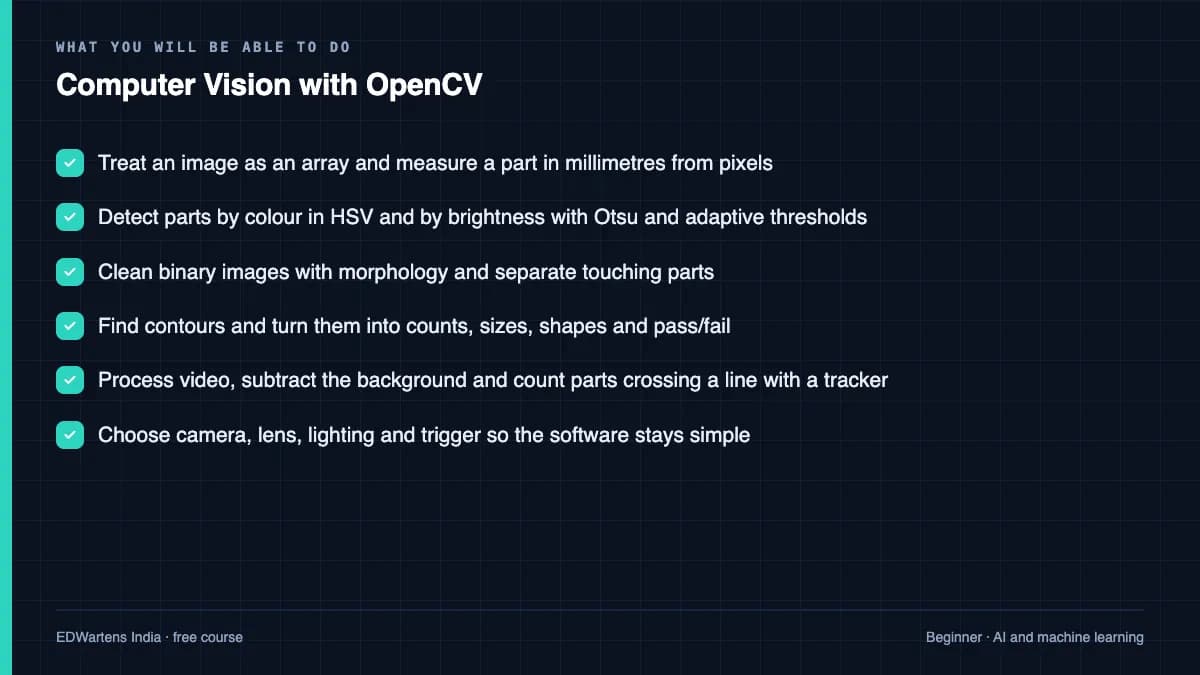
- Treat an image as an array and measure a part in millimetres from pixels
- Detect parts by colour in HSV and by brightness with Otsu and adaptive thresholds
- Clean binary images with morphology and separate touching parts
- Find contours and turn them into counts, sizes, shapes and pass/fail
- Process video, subtract the background and count parts crossing a line with a tracker
- Choose camera, lens, lighting and trigger so the software stays simple
For you
Taking Computer Vision with OpenCV from the United States
- Free in the United States, as everywhere, and self-paced: lessons, notes and the final assessment are open at any hour, so your time zone and shift pattern do not matter.
- The optional certificate for learners in the United States is a one-off US$23.99. What you get for it
- Plants across the Americas most often run Allen-Bradley, Siemens and Inductive Automation; each has its own free course to take next.
- See automation and engineering jobs in the United States, and what the industry looks like in Houston, Detroit and Chicago.
- EDWartens also has a regional site for the United States, for classroom training and local support: edwartens.com/us.
The course project · about 6 hours
Count parts on a conveyor: a synthetic belt with known truth, then your own video
Build a part counter — detection, morphology, contours, a centroid tracker and a counting line — debug it on a synthetic belt video whose true count you know, then run it on thirty seconds of your own phone footage and report misses and double counts separately.
The course project · about 3 hours
Sort bottle caps by colour and check their size, from your own photos
Photograph a tray of mixed bottle caps (or any small coloured parts) under fixed light, detect each cap by HSV colour, measure its diameter in millimetres against a ruler in the frame, and produce a table and an annotated image — a two-station inspection in one script.
Course content
12 modules · 34 lessons · 15h 5m
In order, at whatever pace suits you. Each module ends with a practice task that builds on the last.
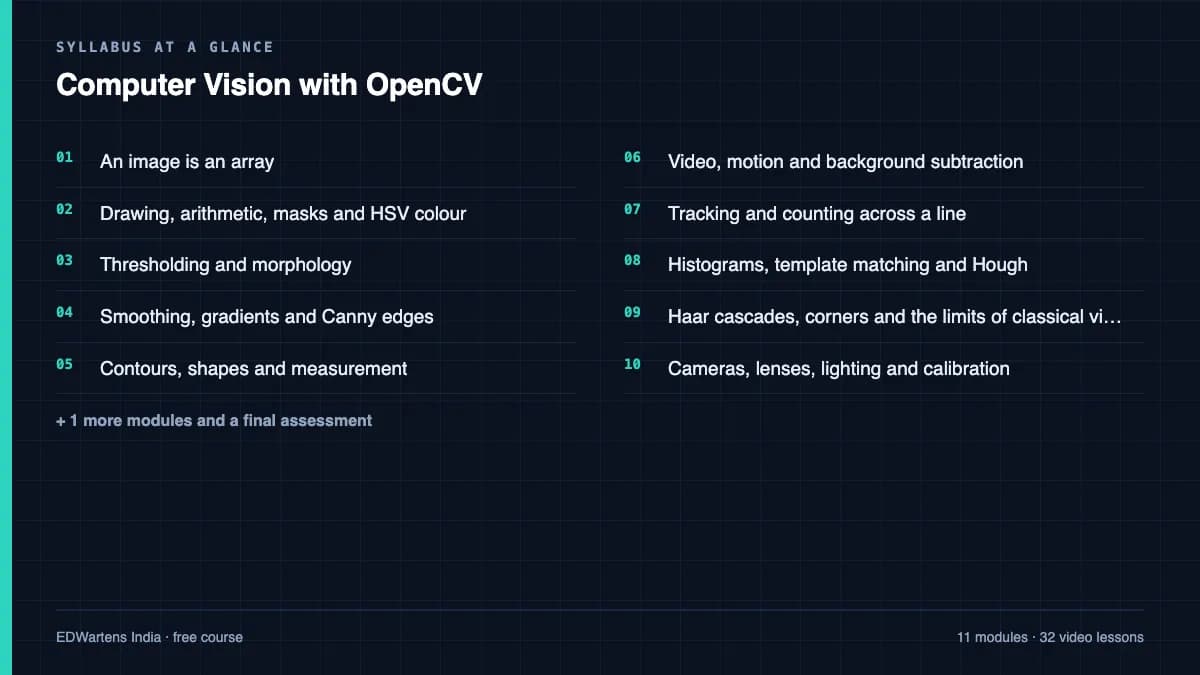
- 01An image is an array2 lessons24m
- 02Drawing, arithmetic, masks and HSV colour5 lessons1h 25m
- 03Thresholding and morphology3 lessons45m
- 04Smoothing, gradients and Canny edges3 lessons40m
- 05Contours, shapes and measurement2 lessons30m
- 06Video, motion and background subtraction3 lessons49m
- 07Tracking and counting across a line2 lessons27m
- 08Histograms, template matching and Hough5 lessons1h 11m
Requirements
- Who it is for
- Beginner in vision. Needs basic Python and NumPy — the Python for AI course, or equivalent.
- Software
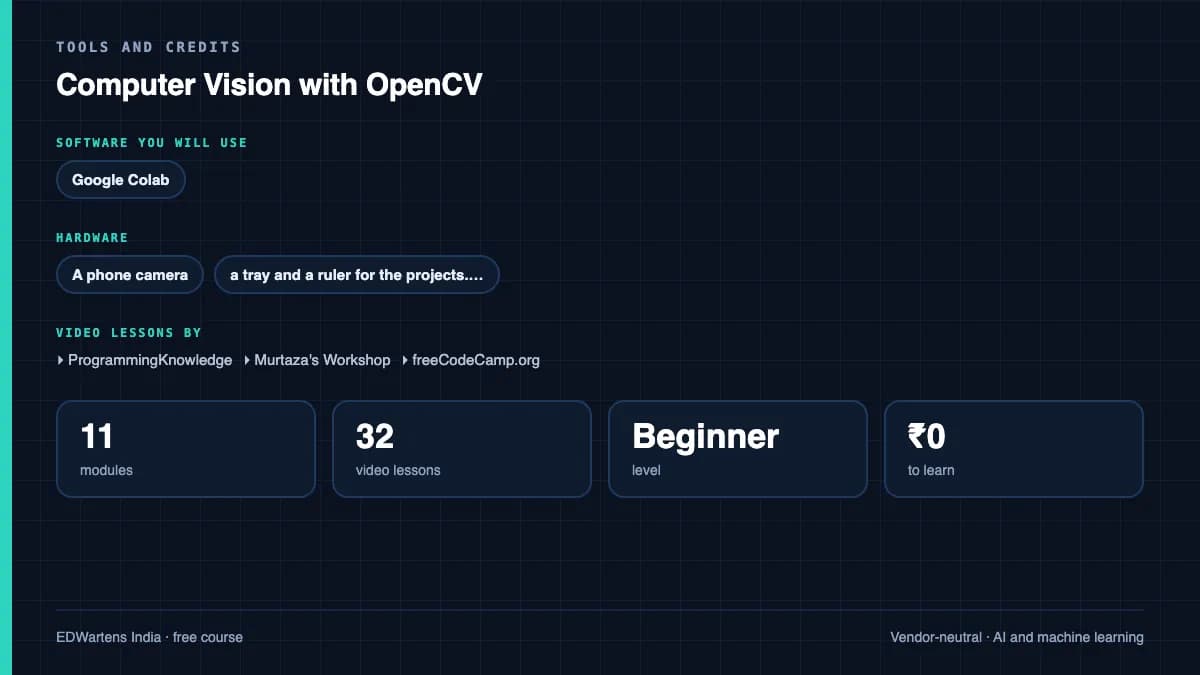
- Google Colab (free) with OpenCV pre-installed. A phone camera for the projects. What to download, and how
- Hardware
- A phone camera, a tray and a ruler for the projects. No industrial camera needed.
Software you need
What to download, where from, what it costs and how to install it. Every link goes to the maker's own site, never a mirror.
OpenCV is already installed in Colab. A phone camera is enough for the projects.
Required
- 01Free, GPU time not guaranteed
Google Colab
Google, in the browser
- Runs on
- Any modern web browser
- Account
- A free Google account
Colab is free to use. In the free version GPUs and TPUs are heavily restricted and not guaranteed, sessions can run for at most 12 hours, and idle sessions are stopped. Paid plans give more reliable access.
Steps
- 1.Open colab.research.google.com and sign in with your Google account.
- 2.Click New notebook (or open the notebook your course links to).
- 3.For a GPU, choose Runtime, then Change runtime type, then pick a GPU if one is offered.
- 4.Type code in a cell and press Shift and Enter to run it.
- Save a copy to your Google Drive so your changes are kept.
- Files on the runtime are deleted when the session ends. Save outputs to Drive.
Open Google Colabcolab.research.google.com
Optional
Useful, not needed to finish the course.
- 02Free
OpenCV (opencv-python)
OpenCV, a Python or npm package
- Runs on
- Windows, macOS and Linux with Python 3
- Account
- None needed
Free, open source under the Apache 2.0 licence.
Steps
- 1.Install Python 3 and create a virtual environment.
- 2.Run: pip install opencv-python
- 3.Test it: python -c "import cv2; print(cv2.__version__)"
- Install only one OpenCV package per environment: opencv-python, opencv-contrib-python, or their headless versions. They all use the same cv2 name and clash.
- Use opencv-contrib-python if your course needs the extra modules.
- On servers or Docker without a screen, use opencv-python-headless.
Official download pagepypi.org
Checked against each maker's own page on 27 September 2026. Trial lengths and editions change; the maker's page is the final word.
Computer Vision with OpenCV at a glance
Computer Vision with OpenCV is a free, self-paced online course from EDWartens for engineers, developers and students applying AI to real work. It has 12 modules and 15h 5m of video lessons by ProgrammingKnowledge, Murtaza's Workshop, freeCodeCamp.org and others, with written notes and worked problems, a practical project with a document pack and a 15-question final assessment (pass mark 60%). Learning is free with an account; an optional certificate with a public verification code is issued when you pass. Last updated 27 September 2026.
All course factsHide course facts
- Price
- Free, for good. No trial, no card. The only paid item is the optional certificate, a small one-off fee.
- Who it is for
- Engineers, developers and students applying AI to real work
- Format
- 12 self-paced modules, 15h 5m of video, written notes, a practice task per module and one final assessment.
- Level
- Beginner. Beginner in vision. Needs basic Python and NumPy — the Python for AI course, or equivalent.
- Brand
- Vendor-neutral
- Software
- Google Colab (free) with OpenCV pre-installed. A phone camera for the projects.
- Hardware
- A phone camera, a tray and a ruler for the projects. No industrial camera needed.
- Certificate
- Optional EDWartens Certificate of Completion, verifiable by code. Not a vendor credential.
- Video lessons by
- ProgrammingKnowledge, Murtaza's Workshop, freeCodeCamp.org, SmartVisionLights, Nicolai Nielsen (independent creators, credited below)
- Language
- English
- Last updated
- 27 September 2026
A shareable EDWartens certificate
Finish every module and pass the final assessment, and the optional EDWartens certificate is yours. It carries a unique verification code on a public page anyone can check, so it stands up when a recruiter looks it up. See it below.
The course itself stays free whether or not you ever buy one.
Stuck? Ask a practising engineer
A free course usually means a comment section and hope. This one does not. Every module has an Ask-your-trainer panel that reaches the same engineers who teach our paid programme: people who commission panels for a living, not moderators.
Pairs well with
 PLC programming · FreeSiemens TIA PortalFrom zero electrical knowledge to a working, simulated S7-1200 program, for nothing.
 PLC programming · FreeSiemens TIA Portal in Three HoursThe first three hours of the Siemens TIA Portal course, cut to end on a win: what a PLC is, how it is wired, a project configured in TIA Portal, and your first ladder program running in simulation. Finish it in an evening or two, earn a certificate, and carry straight on into the full course.
 PLC programming · FreeTIA Portal: Build a MachineOne machine, start to finish. Take a bottle filling line from a written specification and an I/O list to a structured S7-1200 program with a fill station, a capper, a reject sorter and an operator screen with alarms, then test it against a written record and archive it for hand-over. The lessons are the reference; the machine is yours, and it is what you submit.
 Instrumentation · FreeInstrumentation for PLC EngineersThe half of the loop that is not code. Follow one measurement from the transmitter in the field, down the 4-20 mA loop, into the analog card, through NORM_X and SCALE_X into engineering units, out again to a valve, and back to the control room when the reading is wrong.
More free courses: Free AI courses for engineers
Learning paths with this course
- Applied AI engineer · 4 coursesThe four skills AI job posts name most: machine learning with scikit-learn, computer vision with OpenCV, deep learning with TensorFlow and Keras, and RAG chatbots with LangChain — each with a plant project.
Learner reviews
No reviews yet
Reviews here are written only by learners who have finished every module of Computer Vision with OpenCV, and they are published exactly as written. Finish the course and yours will be the first.
Common questions
Do I need an industrial camera?
No. Every exercise runs on images and videos you make with a phone, plus a synthetic belt video the notebook generates with a known part count. The module on cameras and lighting tells you what to buy when the time comes.
Is this deep learning?
No — deliberately. This course is the classical toolbox that solves most fixed-camera inspection jobs at a fraction of the cost, and it is what the Deep Learning and Machine Vision courses build on. It also teaches you to measure when classical methods fail, so a neural network is a decision, not a reflex.
What are the projects in the Computer Vision with OpenCV course?
A conveyor part counter — detection, tracking, a counting line — debugged on a synthetic belt video with a known count and then run on your own phone video, with misses and double counts reported separately; and a colour-sorting plus size-check station on photos of bottle caps.
Is the Computer Vision with OpenCV course really free?
Yes. Every module, practice task, project and assessment. You create an account so your progress is saved and the assessments can be marked. The certificate is the only paid item, and only if you want it.
What certificate does the Computer Vision with OpenCV course give?
An EDWartens Certificate of Completion, issued when you have finished the modules and passed the final assessment (the project is optional practice), with a verification code anyone can check. It is not a vendor credential and is never described as one.
Who made the video lessons in the Computer Vision with OpenCV course?
The creators named in the Credits block at the foot of this page, on their own YouTube channels. EDWartens did not make the videos and the creators are not affiliated with EDWartens. What EDWartens wrote is the study plan, the notes, the practice tasks, the projects and the assessments.
How long does the Computer Vision with OpenCV course take?
Plan on about 19 hours in all, including the video lessons, notes and practice tasks. It is self-paced, so you work through the twelve modules at your own speed.
What you walk away with
Your certificate for Computer Vision with OpenCV
Finish the course, pass the final, and this is the document with your name on it.
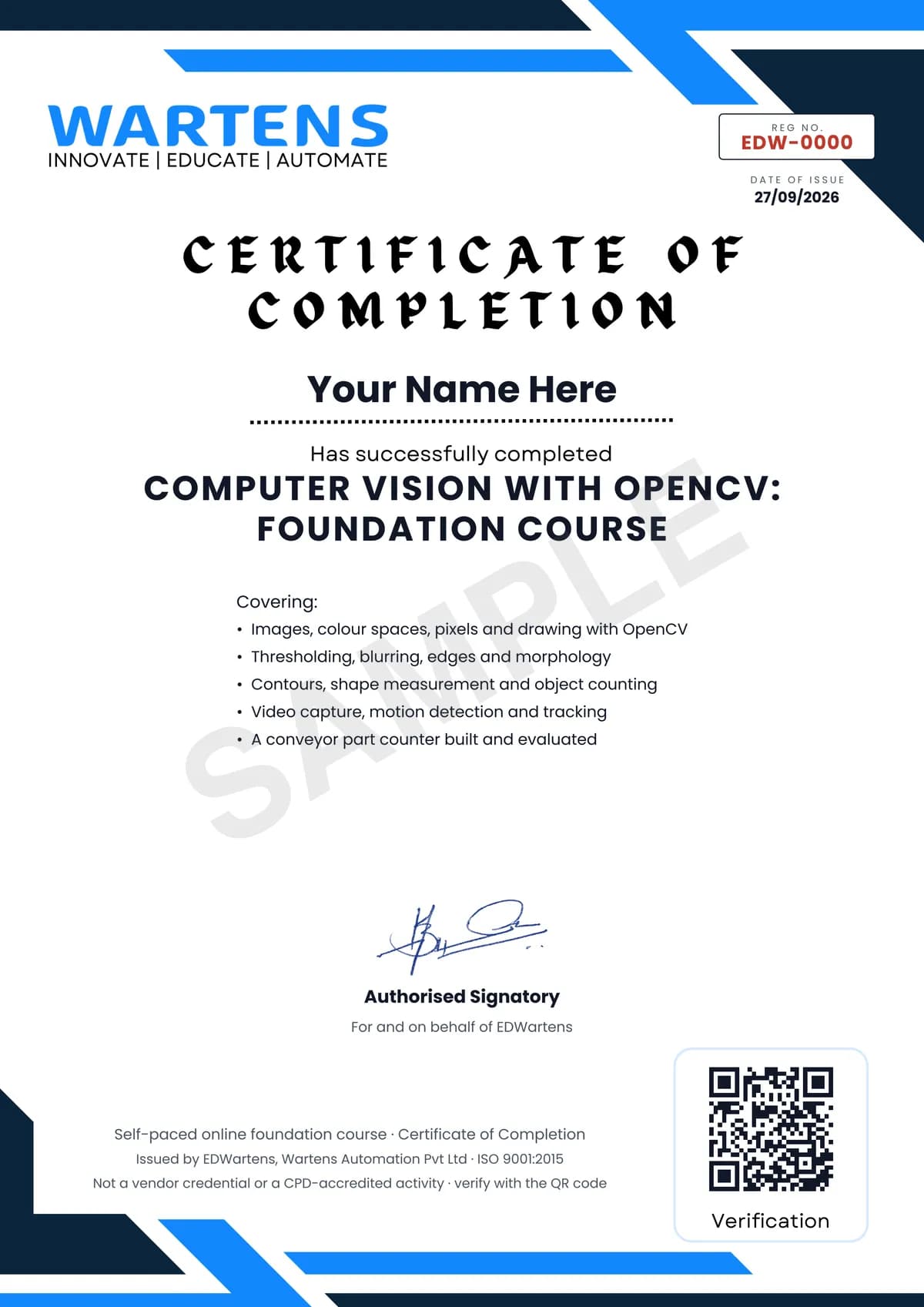
Verifiable by anyone
Adds to LinkedIn in one click
QR code on the certificate
Names what you can do
A permanent link
Earned, not attended
Learning is free. The certificate is optional.
Add it now and pay only when you have finished the course, or come back for it later. One-off, US$23.99, with a receipt.
Issued by EDWartens, the training division of Wartens, as a Certificate of Completion for this self-paced course. Sold by Wartens Ltd (England and Wales). It is not a vendor certification, a university award or a CPD-accredited activity, and it does not certify competence on live equipment. Delivered electronically; see the refund policy.
Credits
Who made the video lessons
The video lessons in this course were created by the people below, not by EDWartens. Every lesson streams from its creator's own YouTube channel; EDWartens neither hosts nor sells that footage, and the creators are not affiliated with EDWartens and do not endorse this course. What EDWartens wrote is the study plan, the notes, the practice tasks and the assessments.
- ProgrammingKnowledgethe OpenCV Python tutorial for beginners series
- Murtaza's WorkshopLearn OpenCV in 3 hours with three projects
- freeCodeCamp.orgthe OpenCV full course
- SmartVisionLightsa lesson in "Cameras, lenses, lighting and calibration"
- Nicolai Nielsena lesson in "Cameras, lenses, lighting and calibration"
If you are one of these creators and would like a lesson removed or credited differently, write to info@wartens.com.