Electrical · Free
Earthing and Lightning Protection Design
Design an earthing system and lightning protection that pass inspection: TN, TT and IT systems, soil resistivity by the Wenner method, rod, plate and strip electrodes to IS 3043 and BS 7430, conductor sizing with the adiabatic equation, IEEE 80 touch and step voltage and grid design, bonding, the IEC 62305 risk assessment, air terminals and the rolling sphere, SPD selection, special cases and testing.
Inside the course
From the lessons

Why we earth: system earthing, protective earthing, TN, TT and IT
Railway Engineering Insights

Earth electrodes: rod, pipe, plate and strip calculations (IS 3043 and BS 7430)
Railway Engineering Insights

Touch and step voltage: the shock model behind IEEE 80
Railway Engineering Insights

Equipotential bonding in buildings and plants
John Ward (jwflame)

Air terminals, rolling sphere, protection angle and down conductors
Railway Engineering Insights

Special cases: solar PV, telecom towers, tanks and hazardous areas
Axis Electricals
Lesson frames belong to the creators named in the Credits below and are shown from YouTube.
What you will learn
Explain why systems and equipment are earthed and identify TN, TT and IT systems; measure and interpret soil resistivity with the Wenner method; calculate rod, pipe, plate and strip electrode resistance to IS 3043 and combine electrodes with the BS 7430 method; size earthing and protective conductors with the adiabatic equation and the IEEE 80 equation; calculate tolerable touch and step voltages and check an earth grid to IEEE 80; design main and supplementary bonding; run an IEC 62305-2 risk assessment and choose the LPS class; place air terminals with the rolling sphere, angle and mesh methods and size down conductors; select and coordinate Type 1, 2 and 3 SPDs; handle PV, towers, tanks and hazardous areas; and test, inspect and report an earthing and lightning protection system.
- Identify TN-S, TN-C-S, TT and IT systems and explain how each clears an earth fault
- Turn a Wenner survey into a design soil resistivity
- Calculate rod, pipe, plate and strip electrodes to IS 3043 and combine rods with the BS 7430 method
- Size earthing and protective conductors with the adiabatic and IEEE 80 equations
- Calculate tolerable touch and step voltages and check an earth grid to IEEE 80
- Run an IEC 62305-2 risk assessment and choose the lightning protection class
- Lay out air terminals with the rolling sphere and mesh methods, down conductors and separation distances
- Select and coordinate Type 1, 2 and 3 SPDs, and test and inspect the finished system
For you
Taking Earthing and Lightning Protection Design from the United States
- Free in the United States, as everywhere, and self-paced: lessons, notes and the final assessment are open at any hour, so your time zone and shift pattern do not matter.
- The optional certificate for learners in the United States is a one-off US$28.99. What you get for it
- Plants across the Americas most often run Allen-Bradley, Siemens and Inductive Automation; each has its own free course to take next.
- See automation and engineering jobs in the United States, and what the industry looks like in Houston, Detroit and Chicago.
- EDWartens also has a regional site for the United States, for classroom training and local support: edwartens.com/us.
The course project · about 16 hours
Earthing and lightning protection design for a factory building: soil data to electrodes, risk, LPS layout and SPD schedule
Design the earthing and lightning protection of a single-storey packaging factory: turn a Wenner survey into a design resistivity, size the ring and rod electrodes and the main earthing conductor, plan the bonding, run the IEC 62305-2 risk assessment, choose the LPS class, lay out the air termination and down conductors with the separation distance, write the SPD schedule and the test plan, and bring it together in a design report. A complete sample pack shows each document for the same building.
Sample document pack, 4 documents, filled in for the scenario
- ReportEarthing and lightning protection design report, production building
- ReportLightning risk assessment to IS/IEC 62305-2 (2010), production building
- RegisterSPD schedule, production building
- Test reportSoil resistivity survey and earth resistance test record
Read inside the course and download as a workbook. The project is optional practice, marked when you submit it; the certificate needs only the modules and the final assessment.
Course content
13 modules · 45 lessons · 14h 1m
In order, at whatever pace suits you. Each module ends with a practice task that builds on the last.
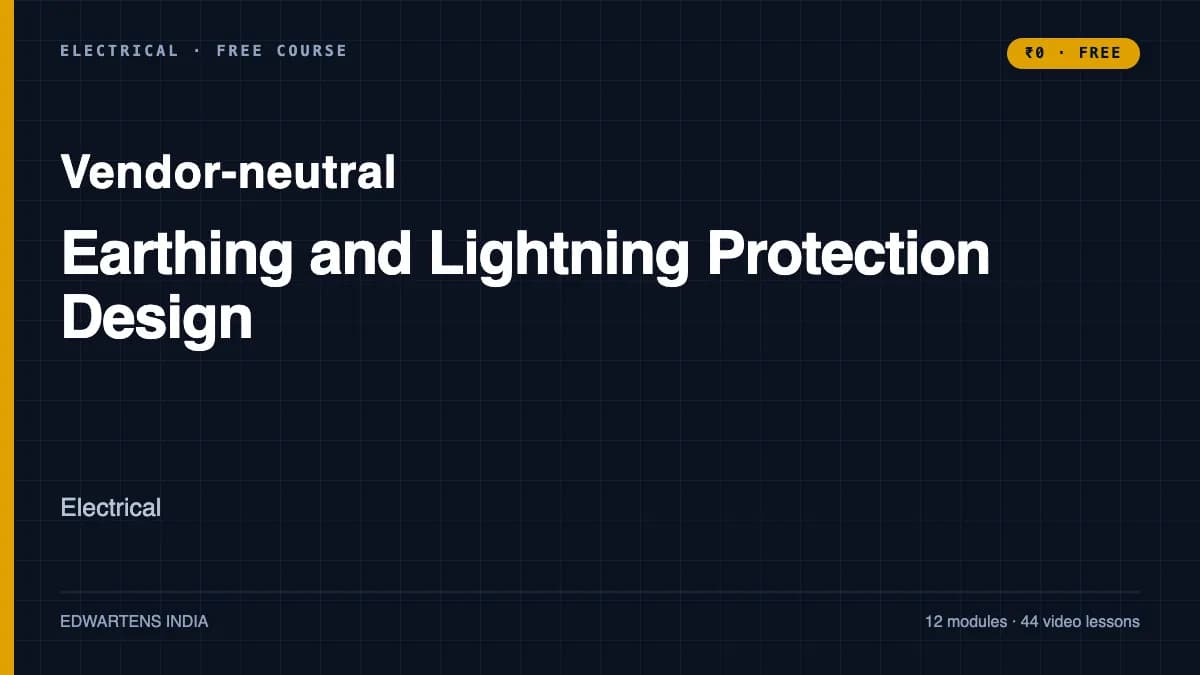
- 01Why we earth: system earthing, protective earthing, TN, TT and IT3 lessons36m
- 02Soil resistivity: the Wenner test and reading the results2 lessons29m
- 03Earth electrodes: rod, pipe, plate and strip calculations (IS 3043 and BS 7430)4 lessons1h 37m
- 04Sizing earth conductors: the adiabatic equation4 lessons54m
- 05Touch and step voltage: the shock model behind IEEE 803 lessons49m
- 06Earth-grid design to IEEE 80: resistance, GPR, mesh and step voltage4 lessons1h 10m
- 07Equipotential bonding in buildings and plants3 lessons45m
- 08Lightning physics and the IEC 62305 risk assessment3 lessons2h 5m
Requirements
- Who it is for
- Intermediate. For electrical design, MEP, substation and maintenance engineers, and final-year electrical students. You should know Ohm's law, three-phase basics and what a fault current is; the Electrical Design Engineering course is the natural step before this one.
- Software
- A spreadsheet for every calculation (LibreOffice Calc is free); you build the IS 3043 and IEEE 80 sheets yourself in the modules. A free online IEC 62305-2 risk calculator is used to check the hand risk assessment, and LibreCAD (free) or any CAD tool can draw the layouts. ETAP, CDEGS and similar packages are mentioned but not required. What to download, and how
- Hardware
- None. An earth tester is shown in the videos; you do not need one.
Software you need
What to download, where from, what it costs and how to install it. Every link goes to the maker's own site, never a mirror.
Nothing to install
A spreadsheet is enough for every earthing, grid and risk calculation; a free online IEC 62305-2 calculator and LibreCAD are optional.
Optional
Useful, not needed to finish the course.
- 01Free
LibreOffice
The Document Foundation
- Runs on
- Windows 10 or 11, macOS 11 or newer (Intel or Apple silicon), Linux
- Account
- None needed
- Size
- up to 1.5 GB of disk space on Windows
LibreOffice is free, open-source software under the Mozilla Public License 2.0, for any use including business. Calc is its spreadsheet.
Steps
- 1.Open the LibreOffice download page.
- 2.Check the page has picked your operating system, then select Download.
- 3.Run the installer (administrator rights are needed on Windows).
- 4.Start LibreOffice Calc for spreadsheet work.
- 5.Save as .xlsx if you need to share files with Excel users.
- Choose the latest main version unless your organisation asks for the older, more conservative release.
Official download pagelibreoffice.org
Checked against each maker's own page on 27 September 2026. Trial lengths and editions change; the maker's page is the final word.
Earthing and Lightning Protection Design at a glance
Earthing and Lightning Protection Design is a free, self-paced online course from EDWartens for electrical design, MEP, substation and maintenance engineers who design, check and test earthing and lightning protection worldwide. It has 13 modules and 14h 1m of video lessons by Railway Engineering Insights, Engr. Ahmed / Khadija Academy, Rashid iqubal and others, with written notes and worked problems, a practical project with a document pack and a 15-question final assessment (pass mark 60%). Learning is free with an account; an optional certificate with a public verification code is issued when you pass. Last updated 27 September 2026.
All course factsHide course facts
- Price
- Free, for good. No trial, no card. The only paid item is the optional certificate, a small one-off fee.
- Who it is for
- Electrical design, MEP, substation and maintenance engineers who design, check and test earthing and lightning protection worldwide
- Format
- 13 self-paced modules, 14h 1m of video, written notes, a practice task per module and one final assessment.
- Level
- Intermediate. Intermediate. For electrical design, MEP, substation and maintenance engineers, and final-year electrical students. You should know Ohm's law, three-phase basics and what a fault current is; the Electrical Design Engineering course is the natural step before this one.
- Brand
- Vendor-neutral
- Software
- A spreadsheet for every calculation (LibreOffice Calc is free); you build the IS 3043 and IEEE 80 sheets yourself in the modules. A free online IEC 62305-2 risk calculator is used to check the hand risk assessment, and LibreCAD (free) or any CAD tool can draw the layouts. ETAP, CDEGS and similar packages are mentioned but not required.
- Hardware
- None. An earth tester is shown in the videos; you do not need one.
- Certificate
- Optional EDWartens Certificate of Completion, verifiable by code. Not a vendor credential.
- Video lessons by
- Railway Engineering Insights, Engr. Ahmed / Khadija Academy, Rashid iqubal, Axis Electricals, John Ward (jwflame), Smart Educare, Mohamad Nassereddine, ABB Learning, Bentley EasyPower Software, CITEL, AEMC Instruments, Megger US (independent creators, credited below)
- Language
- English
- Last updated
- 27 September 2026
A shareable EDWartens certificate
Finish every module and pass the final assessment, and the optional EDWartens certificate is yours. It carries a unique verification code on a public page anyone can check, so it stands up when a recruiter looks it up. See it below.
The course itself stays free whether or not you ever buy one.
Stuck? Ask a practising engineer
A free course usually means a comment section and hope. This one does not. Every module has an Ask-your-trainer panel that reaches the same engineers who teach our paid programme: people who commission panels for a living, not moderators.
Pairs well with
 Electrical · FreeETAP Power System Analysis: Load Flow, Short Circuit, Protection, Arc Flash and StabilityThe power-system studies every substation, plant and data-centre project needs, done in ETAP: single-line modelling, load flow and the per-unit system, cable and transformer sizing, short circuit by IEC 60909 and ANSI, relay setting and coordination with Star view, differential, distance, busbar and motor protection, arc flash, capacitor placement and power factor, motor starting and re-acceleration, transient stability, harmonics and filters, and earthing grid design.
 PLC programming · FreeSiemens TIA PortalFrom zero electrical knowledge to a working, simulated S7-1200 program, for nothing.
 PLC programming · FreeSiemens TIA Portal in Three HoursThe first three hours of the Siemens TIA Portal course, cut to end on a win: what a PLC is, how it is wired, a project configured in TIA Portal, and your first ladder program running in simulation. Finish it in an evening or two, earn a certificate, and carry straight on into the full course.
 PLC programming · FreeTIA Portal: Build a MachineOne machine, start to finish. Take a bottle filling line from a written specification and an I/O list to a structured S7-1200 program with a fill station, a capper, a reject sorter and an operator screen with alarms, then test it against a written record and archive it for hand-over. The lessons are the reference; the machine is yours, and it is what you submit.
More free courses: Free electrical design and control panel courses · Free power system and ETAP courses
Learner reviews
No reviews yet
Reviews here are written only by learners who have finished every module of Earthing and Lightning Protection Design, and they are published exactly as written. Finish the course and yours will be the first.
Common questions
Who is this earthing and lightning protection course for?
It is for electrical design, MEP, substation and maintenance engineers and final-year electrical students who design, check or maintain earthing and lightning protection, including those on industrial, commercial and utility projects worldwide. You should know Ohm's law, three-phase basics and what a fault current is.
Is the course free to learn?
Yes. Every module, the notes, the worked problems, the project and the final assessment are free. Only the certificate is paid, if you want one.
Which standards does it cover?
IS 3043 and BS 7430 for electrodes, IEC 60364-5-54 for protective conductors, IEEE 80 for substation touch and step voltage and grid design, IEEE 81 for testing, and IEC 62305 (adopted in India as IS/IEC 62305) for lightning risk, the LPS and SPDs. The notes paraphrase the standards and show which edition a calculation uses; buy the editions your project cites.
Do I need ETAP or other earthing software?
No. Every calculation is done by hand or in a spreadsheet you build, and every worked number was checked. A free online risk calculator is used to check the IEC 62305-2 assessment. Go on to the ETAP Power System Analysis course to see a grid study in software.
How long does the Earthing and Lightning Protection Design course take?
About 21 hours of video, notes and practice at your own pace, of which about 14 hours is video. The optional factory project takes about 16 hours more.
What certificate does the Earthing and Lightning Protection Design course give?
An EDWartens Certificate of Completion, issued when you pass the 15-question final at 60 percent, with a number anyone can verify on our site. It is not a licence or a certificate from BIS, IEEE, IEC or any electrical authority, and it does not authorise you to sign off an installation where a licensed person is required.
What should I take before this course?
The Electrical Design Engineering course covers loads, cables and breakers and is the natural step before this one. After it, go on to Substation Design, Protection Relays or Hazardous Areas, which build on the earthing, fault clearing and bonding taught here.
What job does earthing and lightning protection design lead to?
It covers the earthing and lightning work of an electrical design engineer at a consultant or EPC contractor, an MEP engineer on commercial buildings, and the testing and inspection a maintenance or commissioning engineer does on plants and substations.
What you walk away with
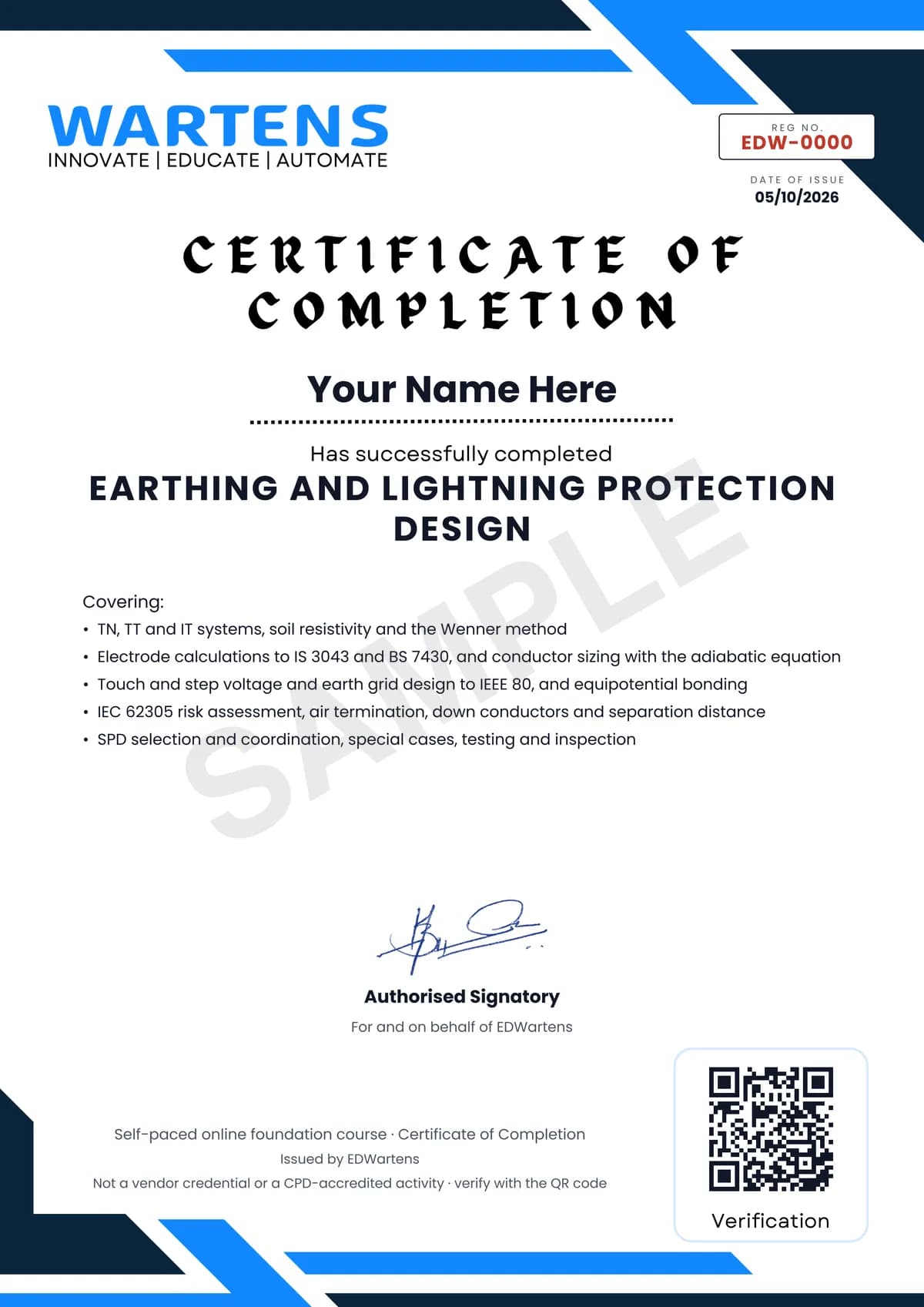
Your certificate for Earthing and Lightning Protection Design
Finish the course, pass the final, and this is the document with your name on it.
Verifiable by anyone
Adds to LinkedIn in one click
QR code on the certificate
Names what you can do
A permanent link
Earned, not attended
Learning is free. The certificate is optional.
Add it now and pay only when you have finished the course, or come back for it later. One-off, US$28.99, with a receipt.
Issued by EDWartens, the training division of Wartens, as a Certificate of Completion for this self-paced course. Sold by Wartens Ltd (England and Wales). It is not a vendor certification, a university award or a CPD-accredited activity, and it does not certify competence on live equipment. Delivered electronically; see the refund policy.
Credits
Who made the video lessons
The video lessons in this course were created by the people below, not by EDWartens. Every lesson streams from its creator's own YouTube channel; EDWartens neither hosts nor sells that footage, and the creators are not affiliated with EDWartens and do not endorse this course. What EDWartens wrote is the study plan, the notes, the practice tasks and the assessments.
- Railway Engineering Insightsthe Earthing and Bonding lecture series (definitions, earth resistance, the shock model, surface material, conductor sizing, rod resistance, dedicated electrodes, earth resistance testing) and the three External Lightning Protection System lectures (air termination, protection angle, rolling sphere)
- Engr. Ahmed / Khadija Academythe Earthing Design Course lessons on factors affecting soil resistivity, vertical earthing electrodes and multiple electrodes to BS 7430
- Rashid iqubalthe lessons on earthing system design and calculation, lightning protection design with the rolling sphere and angle methods, and SPD types and selection
- Axis Electricalsthe lessons on TT, IT and TN systems, substation earthing design steps, bonding versus earthing, the rolling sphere method, lightning protection for rooftop PV and the basics of lightning protection and earthing
- SCIENTIAthe lesson on how TN, TT and IT systems protect against indirect contact
- Circuit Masterclassthe lesson on soil resistivity testing by the Wenner method
- JPElectricthe lesson on the adiabatic equation
- Graham Mackiethe lesson on protective conductor size selection with the adiabatic equation
- Smart Educarethe two lessons on earthing grid design in Excel to IEEE 80
- Mohamad Nassereddinethe lecture on substation earth grid resistance calculation to IEEE 80
- John Ward (jwflame)the lesson on main protective equipotential bonding
- Pecos Hankthe high-speed footage explaining how lightning works
- CIKIT Electricals and Technologiesthe lecture on lightning protection risk analysis to IS/IEC 62305-2
- ABB Learningthe webinar on the major changes in IEC 62305:2024
- Bentley EasyPower Softwarethe DEHN webinar on surge protection measures and the webinar on bonded and isolated lightning protection for explosive areas
- CITELthe clips on Type 1 and Type 2 SPD installation rules and on lightning protection zones
- Square D by Schneider Electricthe lesson on surge protective device types
- ELEK Softwarethe guide to earthing design and modelling for renewable energy projects
- iFluids Engineeringthe explanation of API RP 545 lightning protection for aboveground storage tanks
- AEMC Instrumentsthe demonstration of the simplified fall-of-potential (62 percent) method
- Megger USthe demonstration of a fall-of-potential test with a DET2/3 ground tester
If you are one of these creators and would like a lesson removed or credited differently, write to info@wartens.com.