Building automation · Free
HVAC Design: Heat Load, Ducts and Chilled Water
HVAC design from first principles to drawings: the psychrometric chart, sensible and latent heat, the refrigeration cycle, choosing between split, VRF, packaged and chilled-water systems, heat load by hand and in Carrier HAP, ventilation to ASHRAE 62.1, duct sizing, chilled-water pipe sizing and pump head, AHUs, FCUs, chillers and cooling towers, the controls handoff and the schedules on the drawings.

Inside the course


From the lessons

How HVAC design works: the system, comfort and units
The Engineering Mindset

Psychrometric processes: sensible heat, latent heat and SHR
HVAC On Air

System types: split, VRF, packaged and chilled water
MEP Academy

Heat load with software: Carrier HAP
Carrier Commercial HVAC

Duct design: equal friction and velocity limits
The Engineering Mindset
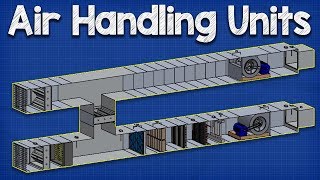
Air handling units and fan coil units
The Engineering Mindset
Lesson frames belong to the creators named in the Credits below and are shown from YouTube.
What you will learn
Read any state on the psychrometric chart and calculate sensible, latent and total heat; explain the refrigeration cycle and calculate COP and kW/TR; choose between split, VRF, packaged and chilled-water systems; calculate a space cooling load by hand with CLTD/CLF and explain the RTS method; set up and check a load model in Carrier HAP; calculate outdoor air to ASHRAE 62.1; size ducts by equal friction within velocity limits; size chilled-water pipes and calculate pump head and power; select AHU and FCU coils; size chillers and cooling towers; and hand a sequence of operations, a points list and consistent schedules to the controls contractor, working in both SI and IP units.
- Read the psychrometric chart and calculate sensible, latent and total heat in SI and IP
- Explain the refrigeration cycle and convert between COP, kW/TR and EER
- Choose between split, VRF, packaged and chilled-water systems
- Calculate a cooling load by hand with CLTD/CLF and explain the RTS method
- Build and check a load model in Carrier HAP
- Calculate outdoor air to ASHRAE 62.1 for single and multiple-zone systems
- Size ducts by equal friction and chilled-water pipes by friction and velocity, and calculate fan and pump duty
- Select AHUs, FCUs, chillers and cooling towers, and hand a testable sequence and points list to the controls contractor
For you
Taking HVAC Design: Heat Load, Ducts and Chilled Water from the United States
- Free in the United States, as everywhere, and self-paced: lessons, notes and the final assessment are open at any hour, so your time zone and shift pattern do not matter.
- The optional certificate for learners in the United States is a one-off US$23.99. What you get for it
- Plants across the Americas most often run Allen-Bradley, Siemens and Inductive Automation; each has its own free course to take next.
- See automation and engineering jobs in the United States, and what the industry looks like in Houston, Detroit and Chicago.
- EDWartens also has a regional site for the United States, for classroom training and local support: edwartens.com/us.
The course project · about 16 hours
HVAC design for a typical office floor: loads, outdoor air, ducts, chilled water, AHU selection and the controls handoff
Design the air conditioning for one typical floor of a six-storey office building on a humid Gulf coast: write the design basis, calculate the cooling load by hand and check it in software, set the outdoor air to ASHRAE 62.1, size the ducts and the chilled-water branch, select the AHU, and hand the controls contractor a sequence of operations and a points list. A complete sample pack shows each document for the same floor.
Sample document pack, 5 documents, filled in for the scenario
- ReportDesign basis and cooling load summary, typical floor
- RegisterDuct and chilled-water sizing register, floor 3
- DatasheetAir handling unit AHU-03 datasheet
- Control narrativeSequence of operations, AHU-03 and its VAV boxes
- Points listPoints list, AHU-03
Read inside the course and download as a workbook. The project is optional practice, marked when you submit it; the certificate needs only the modules and the final assessment.
Course content
14 modules · 40 lessons · 7h 47m
In order, at whatever pace suits you. Each module ends with a practice task that builds on the last.
- 01How HVAC design works: the system, comfort and units2 lessons28m
- 02Psychrometrics: reading the chart2 lessons23m
- 03Psychrometric processes: sensible heat, latent heat and SHR2 lessons27m
- 04The refrigeration cycle3 lessons26m
- 05System types: split, VRF, packaged and chilled water4 lessons39m
- 06Heat load by hand: CLTD/CLF and the RTS method3 lessons47m
- 07Heat load with software: Carrier HAP3 lessons34m
- 08Ventilation to ASHRAE 62.13 lessons34m
Requirements
- Who it is for
- Beginner to intermediate. For mechanical and MEP engineers and graduates. You should be comfortable with basic thermodynamics, unit conversion and a spreadsheet; no design experience is needed.
- Software
- A spreadsheet and a psychrometric chart (printed or online). Carrier HAP is used in one module: Carrier offers a 60-day trial on request, and every exercise can also be done by hand. What to download, and how
- Hardware
- None.
Software you need
What to download, where from, what it costs and how to install it. Every link goes to the maker's own site, never a mirror.
Nothing to install
Any spreadsheet (Excel, Google Sheets or LibreOffice Calc) is enough for the calculations.
Carrier HAP is used in HVD7 and the project's software check; every calculation can also be done by hand or in a spreadsheet.
Optional
Useful, not needed to finish the course.
- 01Free trial: 60 days
Carrier HAP (Hourly Analysis Program)
Carrier
- Runs on
- Windows desktop software. Carrier's product pages do not list system requirements; confirm them with Carrier when you request the trial
- Account
- A trial request form on carrier.com (name, email, company and address); Carrier emails download instructions
Carrier offers 60-day trial versions of its eDesign software, including HAP, at no charge on request. After the trial HAP is licensed software; a licence includes program updates and technical support from Carrier's HVAC engineers. The current release named on Carrier's site is HAP v6.40.
Steps
- 1.Open Carrier's eDesign trial software page.
- 2.Fill in the trial request form for HAP.
- 3.Wait for Carrier's email with download and installation instructions, usually within one or two business days.
- 4.Install HAP on a Windows PC and open a new project.
- 5.Follow the HVD7 notes: weather, schedules, assemblies, spaces, then air systems.
- Plan the HVD7 exercise and the project's software check inside the 60 days.
- Check every HAP report against a hand calculation for one room on each facade before using it.
Official download pagecarrier.comAlternatives
- EnergyPlus (US Department of Energy): Free and open-source building energy and load simulation.
- OpenStudio: Free graphical front end and toolkit for EnergyPlus.
- 02Free
LibreOffice
The Document Foundation
- Runs on
- Windows 10 or 11, macOS 11 or newer (Intel or Apple silicon), Linux
- Account
- None needed
- Size
- up to 1.5 GB of disk space on Windows
LibreOffice is free, open-source software under the Mozilla Public License 2.0, for any use including business. Calc is its spreadsheet.
Steps
- 1.Open the LibreOffice download page.
- 2.Check the page has picked your operating system, then select Download.
- 3.Run the installer (administrator rights are needed on Windows).
- 4.Start LibreOffice Calc for spreadsheet work.
- 5.Save as .xlsx if you need to share files with Excel users.
- Choose the latest main version unless your organisation asks for the older, more conservative release.
Official download pagelibreoffice.org
Checked against each maker's own page on 27 September 2026. Trial lengths and editions change; the maker's page is the final word.
HVAC Design: Heat Load, Ducts and Chilled Water at a glance
HVAC Design: Heat Load, Ducts and Chilled Water is a free, self-paced online course from EDWartens for mechanical and MEP engineers designing HVAC for buildings and data centres. It has 14 modules and 7h 47m of video lessons by The Engineering Mindset, MEP Academy, Trane and others, with written notes and worked problems, a practical project with a document pack and a 15-question final assessment (pass mark 60%). Learning is free with an account; an optional certificate with a public verification code is issued when you pass. Last updated 27 September 2026.
All course factsHide course facts
- Price
- Free, for good. No trial, no card. The only paid item is the optional certificate, a small one-off fee.
- Who it is for
- Mechanical and MEP engineers designing HVAC for buildings and data centres
- Format
- 14 self-paced modules, 7h 47m of video, written notes, a practice task per module and one final assessment.
- Level
- Beginner. Beginner to intermediate. For mechanical and MEP engineers and graduates. You should be comfortable with basic thermodynamics, unit conversion and a spreadsheet; no design experience is needed.
- Brand
- Vendor-neutral
- Software
- A spreadsheet and a psychrometric chart (printed or online). Carrier HAP is used in one module: Carrier offers a 60-day trial on request, and every exercise can also be done by hand.
- Hardware
- None.
- Certificate
- Optional EDWartens Certificate of Completion, verifiable by code. Not a vendor credential.
- Video lessons by
- The Engineering Mindset, MEP Academy, Trane, Carrier, MEP BOOSTER (independent creators, credited below)
- Language
- English
- Last updated
- 27 September 2026
A shareable EDWartens certificate
Finish every module and pass the final assessment, and the optional EDWartens certificate is yours. It carries a unique verification code on a public page anyone can check, so it stands up when a recruiter looks it up. See it below.
The course itself stays free whether or not you ever buy one.
Stuck? Ask a practising engineer
A free course usually means a comment section and hope. This one does not. Every module has an Ask-your-trainer panel that reaches the same engineers who teach our paid programme: people who commission panels for a living, not moderators.
Pairs well with
 PLC programming · FreeSiemens TIA PortalFrom zero electrical knowledge to a working, simulated S7-1200 program, for nothing.
 PLC programming · FreeSiemens TIA Portal in Three HoursThe first three hours of the Siemens TIA Portal course, cut to end on a win: what a PLC is, how it is wired, a project configured in TIA Portal, and your first ladder program running in simulation. Finish it in an evening or two, earn a certificate, and carry straight on into the full course.
 PLC programming · FreeTIA Portal: Build a MachineOne machine, start to finish. Take a bottle filling line from a written specification and an I/O list to a structured S7-1200 program with a fill station, a capper, a reject sorter and an operator screen with alarms, then test it against a written record and archive it for hand-over. The lessons are the reference; the machine is yours, and it is what you submit.
 Instrumentation · FreeInstrumentation for PLC EngineersThe half of the loop that is not code. Follow one measurement from the transmitter in the field, down the 4-20 mA loop, into the analog card, through NORM_X and SCALE_X into engineering units, out again to a valve, and back to the control room when the reading is wrong.
More free courses: Free BMS and building automation courses
Learner reviews
No reviews yet
Reviews here are written only by learners who have finished every module of HVAC Design: Heat Load, Ducts and Chilled Water, and they are published exactly as written. Finish the course and yours will be the first.
Common questions
Who is the HVAC Design: Heat Load, Ducts and Chilled Water course for?
Mechanical and MEP engineers, graduates and site engineers who want to design HVAC systems, including those working on Gulf, Indian and data-centre projects. Basic thermodynamics and a spreadsheet are enough to start.
Do I need Carrier HAP?
No. One module teaches HAP, and Carrier offers a free 60-day trial of its eDesign software on request. Every calculation in the course can also be done by hand or in a spreadsheet, and the notes check software results against hand calculations.
Are the calculations in SI or IP units?
Both, wherever engineers need them: kW and TR, L/s and CFM, Pa and in. wg, kPa and feet of water, with every conversion worked and checked.
Does it follow ASHRAE standards?
It teaches the ventilation rate procedure of ASHRAE 62.1, whose current edition is 62.1-2025, the CLTD/CLF and RTS load methods from the ASHRAE Handbook of Fundamentals, and AHRI chiller ratings. Always use the edition your project adopts. EDWartens is not affiliated with ASHRAE, Carrier or Trane.
How is it different from the BMS and data centre courses?
This course designs the HVAC system and stops at the handoff to controls. The Building Management Systems course covers BMS architecture and protocols, and the Data Centre Cooling, BMS and DCIM course applies these skills to data halls.
Is the HVAC Design: Heat Load, Ducts and Chilled Water course really free?
Yes. Every module, the notes, the project and the final assessment. The only paid item is the certificate, if you want it.
What certificate does the HVAC Design: Heat Load, Ducts and Chilled Water course give?
An EDWartens Certificate of Completion, issued when you pass the final assessment, with a number anyone can verify on our site. It is not an ASHRAE certification or a professional engineering licence.
How long does the HVAC Design: Heat Load, Ducts and Chilled Water course take?
About 12.5 hours of video lessons, notes and practice questions, taken at your own pace. The optional project takes about 16 hours more.
What is the project in the HVAC Design: Heat Load, Ducts and Chilled Water course?
You design the air conditioning for a typical floor of a six-storey office building on the Gulf coast: design basis, cooling load by hand and in software, outdoor air, duct and chilled-water sizing, the AHU datasheet, and the sequence of operations and points list. A complete sample pack shows each document.
What you walk away with
Your certificate for HVAC Design: Heat Load, Ducts and Chilled Water
Finish the course, pass the final, and this is the document with your name on it.

Verifiable by anyone
Adds to LinkedIn in one click
QR code on the certificate
Names what you can do
A permanent link
Earned, not attended
Learning is free. The certificate is optional.
Add it now and pay only when you have finished the course, or come back for it later. One-off, US$23.99, with a receipt.
Issued by EDWartens, the training division of Wartens, as a Certificate of Completion for this self-paced course. Sold by Wartens Ltd (England and Wales). It is not a vendor certification, a university award or a CPD-accredited activity, and it does not certify competence on live equipment. Delivered electronically; see the refund policy.
Credits
Who made the video lessons
The video lessons in this course were created by the people below, not by EDWartens. Every lesson streams from its creator's own YouTube channel; EDWartens neither hosts nor sells that footage, and the creators are not affiliated with EDWartens and do not endorse this course. What EDWartens wrote is the study plan, the notes, the practice tasks and the assessments.
- The Engineering Mindsetthe lessons on how a chiller, cooling tower and AHU work together, thermal comfort, the basic refrigeration cycle, thermostatic expansion valves, ductwork sizing with a full worked example, pump head, air handling units, fan coil units, chiller basics, cooling towers and reading chilled-water schematics
- MEP Academythe lessons on reading a psychrometric chart, the refrigeration cycle, split systems, VRF heat pump and heat recovery, packaged rooftop units, air- and water-cooled chillers with AHUs, calculating ventilation air, static, velocity and total pressure, fan laws, GPM and TDH for coils, pump curves and selection, water coils, chilled-water pumping options, designing DDC controls and DDC points for an air handler
- Trane Commercial HVAC North Americathe two lessons on the ASHRAE 62.1 ventilation rate procedure: zone calculations and system calculations
- Carrier Commercial HVACthe overview of HAP v6 for load calculation and energy modelling
- MEP BOOSTERthe HAP lesson on entering internal loads, from its HAP heat load series
- MEP Engineering Tutorialsthe worked heat load calculation in HAP
- HVAC Easy Maththe CLTD method with ASHRAE design temperatures
- VRF Wizardthe lesson on calculating cooling loads and room airflow
- aircondloungethe simple cooling load procedure and the lesson on sizing chilled-water pipe
- HVAC TVthe tutorial on reading a psychrometric chart
- HVAC On Airthe lesson on the sensible heat ratio
- Mechanical PE Exam Prepthe worked psychrometric problems on SHR, apparatus dew point and reheat
- Plan and Specthe lesson on reading mechanical (HVAC) drawings
If you are one of these creators and would like a lesson removed or credited differently, write to info@wartens.com.