Category · Free · No card

Free BMS and building automation courses with certificate

Building management systems, free and complete: architecture, sensors and actuators, BACnet, Modbus, LonWorks and KNX, HVAC and pump control applications, integration, DDC panels, the front end, commissioning and BACnet with Python, with notes, quizzes and an optional verifiable certificate.

87 modules · 69h 4m of video · Updated 1 November 2026
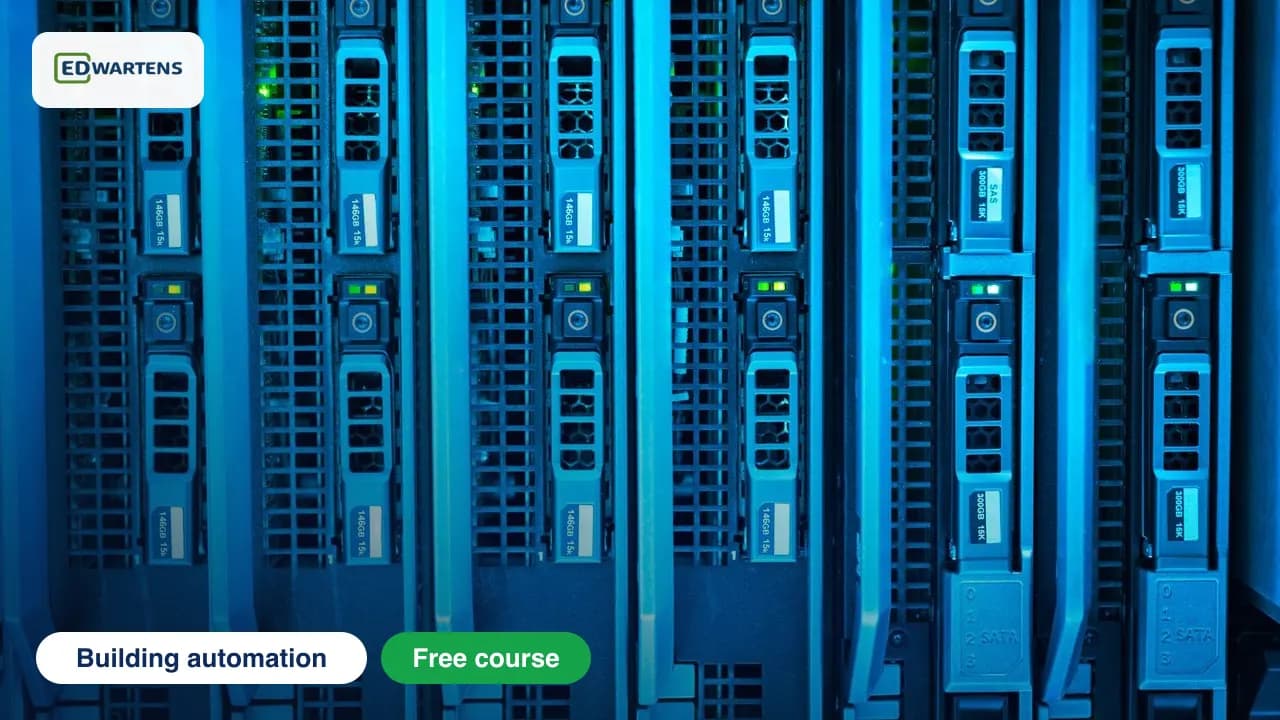
Data Centre Cooling, BMS and DCIM course coverFree
FreeBuilding automationIntermediate

Data Centre Cooling, BMS and DCIM

How data centres are cooled, controlled and run: hot and cold aisles, CRAC and CRAH units, chilled water plant, economisers, liquid and immersion cooling for AI racks, cooling redundancy and continuous cooling, BMS design, DCIM and operations, and PUE, WUE and CUE. Built on MEP Academy, TEQNYAT and Bryce Anderson lessons.

  • Trace the heat path and calculate the airflow and water flow a load needs
  • Compare CRAC and CRAH units, containment options and air- and water-cooled plant
  • Explain economisers and calculate chiller COP and kW per ton
9 modules 2h 42mView course
HVAC Design: Heat Load, Ducts and Chilled Water course coverFree
FreeBuilding automationBeginner

HVAC Design: Heat Load, Ducts and Chilled Water

HVAC design from first principles to drawings: the psychrometric chart, sensible and latent heat, the refrigeration cycle, choosing between split, VRF, packaged and chilled-water systems, heat load by hand and in Carrier HAP, ventilation to ASHRAE 62.1, duct sizing, chilled-water pipe sizing and pump head, AHUs, FCUs, chillers and cooling towers, the controls handoff and the schedules on the drawings.

  • Read the psychrometric chart and calculate sensible, latent and total heat in SI and IP
  • Explain the refrigeration cycle and convert between COP, kW/TR and EER
  • Choose between split, VRF, packaged and chilled-water systems
14 modules 7h 48mView course
Fire Alarm and ELV Systems Design: NFPA 72 and BS 5839 course coverFree
FreeBuilding automationBeginner

Fire Alarm and ELV Systems Design: NFPA 72 and BS 5839

Design fire alarm and ELV systems the way MEP consultants and contractors submit them: system types and loops, detector and call point layouts to NFPA 72 and BS 5839-1, sounders and strobes, battery and voltage drop calculations, the cause and effect matrix and its interfaces, drawings, testing and commissioning, then CCTV, access control, PA/VA and structured cabling.

  • Explain what a fire alarm system must do and how NFPA 72, BS 5839-1 and the EN 54 product standards divide the work
  • Choose conventional, addressable or analogue addressable, and plan loops, isolators and pathway classes
  • Pick a BS 5839-1 category or NFPA 72 coverage and zone a building against the area and search limits
13 modules 10h 56mView course
Fire Fighting Design: Sprinklers, Fire Pumps and Hydrants course coverFree
FreeBuilding automationIntermediate

Fire Fighting Design: Sprinklers, Fire Pumps and Hydrants

Design the water-based fire protection package that MEP consultants and contractors submit for approval: system types, hazard classification, sprinkler layout, hydraulic calculation by hand and in a spreadsheet, standpipes, hydrants and water supply, fire pump selection and the pump room, special systems, then testing, commissioning and maintenance.

  • Explain what sprinklers, standpipes, hydrants and fire pumps do and how NFPA 13, 14, 20, 24 and 25 and EN 12845 divide the work
  • Choose wet, dry, preaction or deluge systems and apply the design area adjustments that come with each
  • Classify hazards, read design densities and work Q = K x sqrt(P) for any sprinkler
15 modules 14h 47mView course
Plumbing and Drainage Design for Buildings course coverFree
FreeBuilding automationBeginner

Plumbing and Drainage Design for Buildings

How a public health engineer designs the water and drainage systems of a building: the codes (IPC, UPC, BS EN 806 and BS EN 12056, NBC Part 9), water demand and storage tanks, fixture units and pipe sizing, booster pumps and pressure zones, backflow and water hammer, hot water heaters, recirculation and Legionella control, sanitary drainage and venting, stormwater and roof drainage, sewage lifting and interceptors, schematics, testing and handover.

  • Set population, daily water demand and storage, and size underground and roof tanks
  • Add fixture or loading units and size water pipes by velocity and Hazen-Williams friction
  • Zone a tall building, size transfer and booster pumps, and place pressure reducing valves
14 modules 13h 55mView course
Cybersecurity for Building Automation: BMS and BACnet course coverFree
FreeCybersecurityIntermediate

Cybersecurity for Building Automation: BMS and BACnet

Secure the building management systems you design, install or run: real building hacks, BMS network architecture and its weak points, hardening controllers and front ends, secure design with zones and conduits, BACnet Secure Connect, defence in depth for BACnet/IP, secure vendor remote access and zero trust.

  • Explain how buildings have been hacked and why a BMS can be a way into the business
  • Describe BMS architecture and find the weak points in BACnet, Modbus and MS/TP networks
  • Harden controllers, servers and accounts in the building's priorities
9 modules 5h 11mView course

Compare the Building automation courses

CourseLevelModulesVideoBrand
Building Management Systems (BMS): HVAC Control, BACnet and Building AutomationBeginner1313h 46mVendor-neutral
Data Centre Cooling, BMS and DCIMIntermediate92h 42mVendor-neutral
HVAC Design: Heat Load, Ducts and Chilled WaterBeginner147h 48mVendor-neutral
Fire Alarm and ELV Systems Design: NFPA 72 and BS 5839Beginner1310h 56mVendor-neutral
Fire Fighting Design: Sprinklers, Fire Pumps and HydrantsIntermediate1514h 47mVendor-neutral
Plumbing and Drainage Design for BuildingsBeginner1413h 55mVendor-neutral
Cybersecurity for Building Automation: BMS and BACnetIntermediate95h 11mVendor-neutral

What this leads to

Internship

MEP and Building Services

Free internship: 4 weeks, a free certificate and nothing to buy. The Engineer-verified internship adds an engineer's review and the graded certificate.

See the internship

Lab

PLC lab

Practise in your browser. Free, nothing to install.

Open the lab (opens in a new tab)

Roles

Building automation

Roles that ask for this skill, 109 open in this country now. Free to see and to apply. We are not a recruitment agency.

See roles

Practise what you learn in the free 3D lab

Technical work is judged on what you can do: wiring, commissioning, finding a fault. Doing a task yourself teaches more than watching it a second time, and a lab lets you try it safely before you meet real equipment. It does not replace working on real hardware.

Questions

Which brands?
Concepts apply to Honeywell, Siemens, Johnson Controls, Schneider, Trane and Distech; the hands-on modules use open BACnet with Python.
Is BMS the same as PLC programming?
It shares the logic but uses BACnet, KNX and DDC controllers and a different vocabulary of HVAC, lighting and access control. The courses start from that vocabulary.