Condition monitoring
Infrared Thermography Training
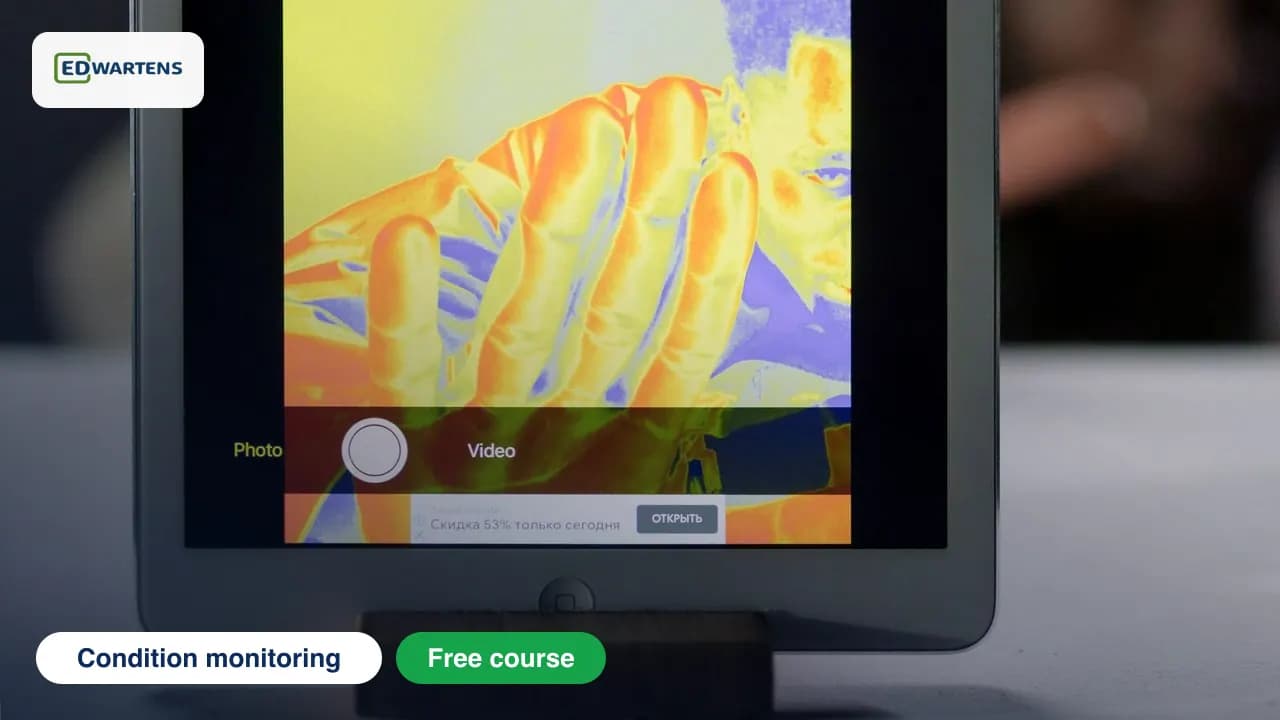
Learn to read thermal images correctly: set up the camera, survey electrical and mechanical plant, buildings and solar arrays.
Infrared Thermography Training is a free, self-paced online course from EDWartens for maintenance and reliability engineers and technicians. It has 6 modules and takes about 4.7 hours, with written notes, a practice task per module, a practical project and a final assessment of 15 questions (pass mark 60%). Learning costs nothing and needs only a free account. The optional EDWartens Certificate of Completion, verifiable by code, is a one-off US$23.99 for you; it is not a vendor credential. Updated 1 November 2026.
- Free
- Beginner
- 4.7 hours
- Self-paced
- Certificate optional
- 5.0 from 1 learner review
No card, no trial. The course is free for good. Certificate US$23.99, optional.
- Who it is for
- Maintenance and reliability engineers and technicians
- Jobs
- Roles that use this skill: maintenance engineer, reliability engineer, condition monitoring analyst and service technician. No course guarantees a job.
- Tools
- None required. Camera makers' free report software is discussed in the notes, not needed to finish the course. Hardware: none. A thermal camera, or a clip-on thermal module for a phone, makes every practice task real; each task also has a version you can do with a notebook.
- Updated
After this course you can
By the end you will be able to:
- Set emissivity and reflected apparent temperature before trusting a reading
- Classify a hot electrical joint by comparing it with the other phases
- Read motor, bearing, coupling and belt drive heat patterns
- Trace hot cell and bypass diode patterns in a solar array to their causes
- Write a finding with load, ambient, severity and a re-inspection date
Who it is for, and what you need first
Who it is for
Maintenance and reliability engineers and technicians.
Level: Beginner. Beginner. No prior thermography experience needed. Any electrical or mechanical maintenance background helps, and a thermal camera makes the practice tasks real but is not required.
What you need
Software: None required. Camera makers' free report software is discussed in the notes, not needed to finish the course..
Hardware: None. A thermal camera, or a clip-on thermal module for a phone, makes every practice task real; each task also has a version you can do with a notebook..
How this course works
Watch the lessons
Short video lessons, one module at a time, at your own pace.
Read the notes
Open the Reading tab for the written notes and diagrams of the module.
Check yourself
Answer the questions to see what stuck before you move on.
Final assessment
Pass the final once you have been through the modules.
Certificate, if you want oneOptional
Optional, with a page anyone can use to verify it.
What you learn
6 modules in order, at your own pace. 4.7 hours of video lessons, with written notes and a practice task in each module.
- 1What a thermal camera actually measures19m
- 2Electrical and mechanical inspection17m
- 3Building envelope, insulation and moisture25m
- 4Solar PV inspection31m
- 5Route surveys, and where infrared stops45m
- 6Final assessment
What you practise
Course project, about 12 hours
Loaded infrared survey of a steel rolling mill: MCCs, transformers, busducts and bearings, classified by ΔT
Plan and execute a route survey of a reinforcing-bar mill's electrical and mechanical assets under load. Write the procedure that fixes load conditions, emissivity, reflected temperature, camera settings and arc-flash boundaries. Build the inspection-point register. Check the camera against a reference source. Survey with three-phase comparison and same-machine comparison. Classify every finding by ΔT to the NETA bands, and to any limits in the client's contract. Turn the findings into a repair plan with re-inspection dates. You deliver your own procedure, register, report, calibration record and plan. The sample pack shows what a thermographer hands to the mill's electrical head.
- 6documents in the pack
- 8steps to follow
- 6things to hand in
- 12 hof work, at your pace
- ProcedureProcedure: Infrared Thermographic Survey of Electrical and Mechanical Assets
- RegisterInspection-Point Register: Quarterly Thermographic Route
- ReportThermographic Survey Report: Baseline Survey of 08-Sep and 09-Sep-2026
- PlanRepair-Priority Plan from the September 2026 Survey
- Calibration recordCamera Verification Record: FLIR E76 and the Mill's Older Camera Against a Reference Source
- Training recordTraining Record: Quarterly Thermographic Route
The project is optional practice. The certificate needs only the modules and the final assessment.
Free 3D lab
Electrical lab
Practise in your browser. Free, nothing to install.
After the course, your next step
Show what you can do, then keep going in the same field.
A certificate you can verify
Finish the modules and pass the final assessment (15 questions, pass mark 60%) and you can add a certificate with a public verification page. One-off, US$23.99 for you. It is not a vendor credential.
Want a free certificate? Do the matching Free internship: 4 weeks, nothing to buy, with a free certificate of completion.
Commissioning and Maintenance
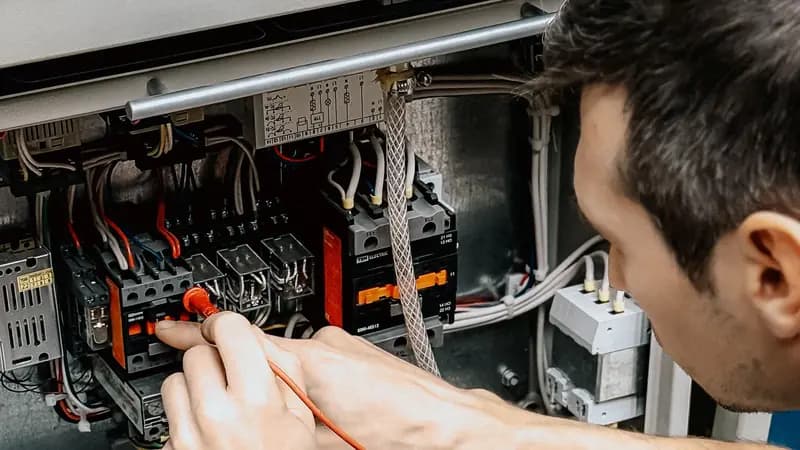
Eight short weeks of safe commissioning, loop checks, fault-finding and maintenance planning: notes, diagrams, a few videos and Panel Lab tasks. Finish weeks 1 to 4 and the final, then claim a free Internship Completion Certificate with your real dates and study hours, and a QR code anyone can scan to verify it. Training, not employment.
See the internshipMore free courses
Roles that use this skill
- Maintenance engineer
- Reliability engineer
- Condition monitoring analyst
- Service technician
These are the kinds of roles where the skill is used. We make no promise of a job or an interview.
Plain notes
- Free: the whole course, the notes, the practice tasks, the final assessment and support from practising engineers.
- Paid, and optional: the course certificate, and the Engineer-verified internship (the Free internship costs nothing).
- No job promise: the course teaches a skill. It does not place you in a job.
- Lessons by: Infrared Training Center, Online Infrared Training Center, Pass Thermal. Independent creators; the lessons stream from their own channels. EDWartens wrote the study plan, notes, practice tasks and assessments.
Infrared Training Center · Online Infrared Training Center · Pass Thermal. If you are one of these creators and want a lesson removed or credited differently, write to info@edwartens.com.
Why learn with EDWartens
What you get with this course, and what comes after it.
- Free from the first lesson to the final assessment.
- Video lessons with written notes and a project.
- An optional certificate that anyone can verify online.
- Free internships to keep practising afterwards.
Common questions
Do I need a thermal camera?
No. The course teaches what to point a camera at, in what conditions, and how to judge what comes back. That is the part most camera owners are missing. Every practice task has a version you can do with a notebook and a plant walk. If you do have a camera, or a clip-on thermal module for your phone, use it.
What do I need before starting?
Nothing formal. It is written for electrical and mechanical maintenance staff, substation and MCC technicians, plant reliability engineers and solar site staff. If you can read a single line diagram or identify a bearing housing, you have enough.
Is this the same as a Level 1 thermographer certification?
No, and it must not be described as one. Level 1 thermographer courses are paid and classroom based. They include a practical examination with a camera in your hands. They come from bodies such as the Infrared Training Center, or are built on ISO 18436-7 and ASNT SNT-TC-1A. This course is preparation and background reading for that. EDWartens is not affiliated with any of those bodies and issues no credential on their behalf.
Which standards does it follow?
Most published severity tables online come from American practice such as NFPA and NETA. That includes the delta-T criteria quoted everywhere. The notes say so plainly. They teach the method that transfers: compare like with like under similar load, and record the conditions. Then set your own plant's action thresholds in writing. Do not borrow a table you cannot justify.
How long is the course?
Five content modules and a final. That is about two and a half hours of video lessons, and roughly five hours in total with the practice tasks and practice questions. It is a short foundation course, not a full Level 1 syllabus. It says so rather than padding itself out.
Is the Infrared Thermography Training course really free?
Yes. Every module, practice task and assessment. You create an account so your progress is saved and the assessments can be marked. The certificate is the only paid item, and only if you want it.
What certificate does the Infrared Thermography Training course give?
An EDWartens Certificate of Completion, issued when you have finished every module and passed the final at 60 percent, with a verification code anyone can check. It is not a vendor credential and is never described as one.
Who made the video lessons in the Infrared Thermography Training course?
The creators named in the Credits block at the foot of this page, on their own YouTube channels. EDWartens did not make the videos and the creators are not affiliated with EDWartens. What EDWartens wrote is the study plan, the notes, the practice tasks and the assessments.
What topics does the Infrared Thermography Training course cover, module by module?
The Infrared Thermography Training course has 6 modules. It opens with "What a thermal camera actually measures", goes through "Electrical and mechanical inspection", "Building envelope, insulation and moisture", "Solar PV inspection" and "Route surveys, and where infrared stops" and ends with "Final assessment". The full list with minutes is under "What you learn" on this page.
What can I do after the Infrared Thermography Training course?
After the Infrared Thermography Training course: Set emissivity and reflected apparent temperature, and recognise when a shiny surface has made a reading worthless; Plan a loaded electrical survey, record load and ambient with every image, and work safely with an authorised electrician; Classify a hot joint by comparing it with the same connection on the other two phases. These are the practical outcomes the course is written around, and the final assessment of 15 questions checks them.
What software and hardware do I need for the Infrared Thermography Training course, and does it cost anything?
For the Infrared Thermography Training course, software: None required. Camera makers' free report software is discussed in the notes, not needed to finish the course. Hardware: none. A thermal camera, or a clip-on thermal module for a phone, makes every practice task real; each task also has a version you can do with a notebook. The course itself is free.
Is the Infrared Thermography Training course suitable for me, and what level is it?
Infrared Thermography Training is rated beginner. Beginner. No prior thermography experience needed. Any electrical or mechanical maintenance background helps, and a thermal camera makes the practice tasks real but is not required. It is written for maintenance and reliability engineers and technicians, and takes about 4.7 hours at your own pace.
Which jobs use the skills from the Infrared Thermography Training course?
Skills from the Infrared Thermography Training course (for example: set emissivity and reflected apparent temperature, and recognise when a shiny surface has made a reading worthless) are used in roles such as maintenance engineer, reliability engineer, condition monitoring analyst and service technician, and in reliability engineer work. The course gives you practical evidence of the skill; it does not promise a job, and employers decide on experience and interview.
Start free today
Infrared Thermography Training, at your own pace. Add the certificate only if you want one.