AI and machine learning · Free
ISO 42001 and AI Governance
The standard customers have started asking for by name: what an AI management system is, ISO/IEC 42001 clause by clause from context and leadership through the clause 6.1.2 risk assessment and the clause 6.1.4 impact assessment to documented information, the Annex A controls on policy, roles, resources, lifecycle, data, use and third parties, operation, internal audit, management review and certification, the NIST AI RMF and the OECD principles, training data and intellectual property, and the EU AI Act obligations a supplier is asked to evidence.

Inside the course
From the lessons

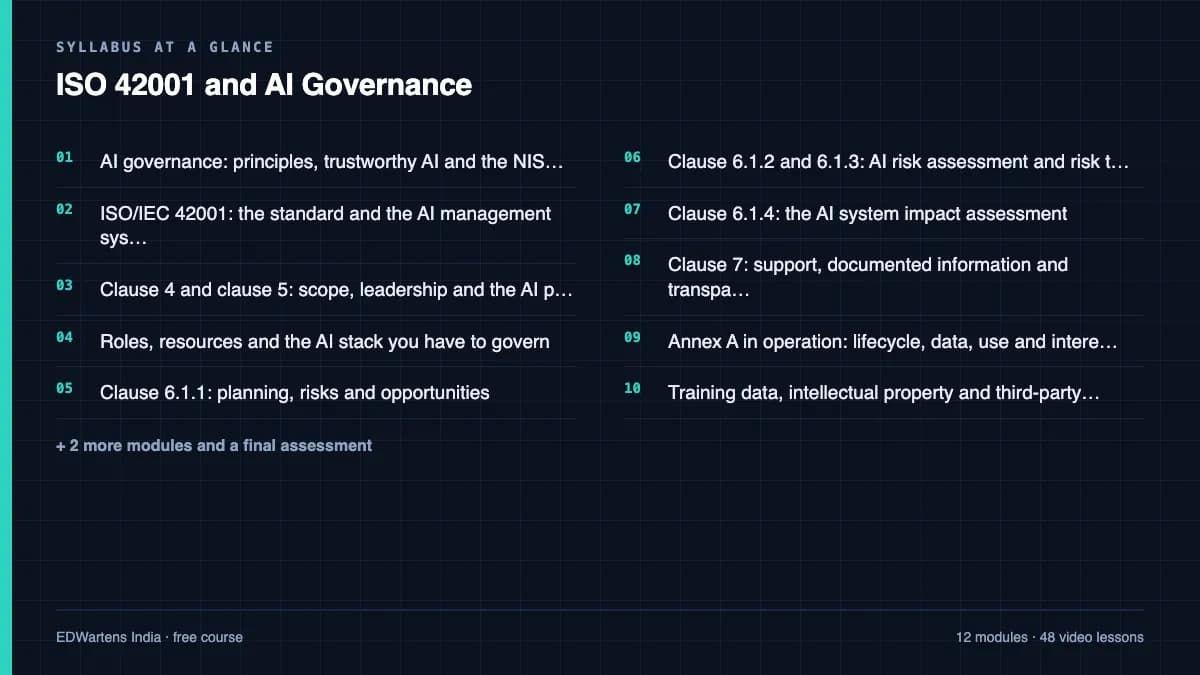
AI governance: principles, trustworthy AI and the NIST AI RMF
Dr. David, Privacy & AI Educator

Clause 4 and clause 5: scope, leadership and the AI policy
Hemang Doshi

Clause 6.1.1: planning, risks and opportunities
Hemang Doshi

Clause 6.1.4: the AI system impact assessment
Hemang Doshi

Annex A in operation: lifecycle, data, use and interested parties
risk3sixty

The EU AI Act: risk tiers, operator roles, deployer duties and penalties
Dr. David, Privacy & AI Educator
Lesson frames belong to the creators named in the Credits below and are shown from YouTube.
What you will learn
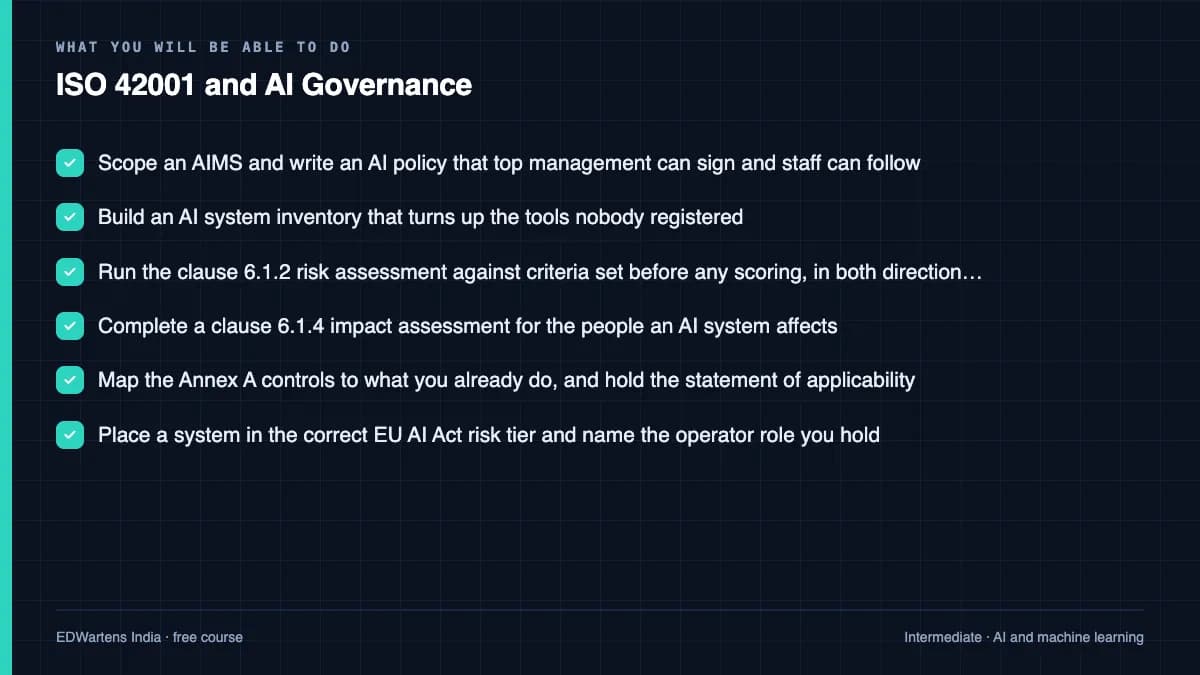
Scope an AIMS and write an AI policy top management can sign; build an AI system inventory that finds the entries nobody registered; run the clause 6.1.2 risk assessment against criteria you defined before any scoring, and record who accepted the residual risk; complete the clause 6.1.4 AI system impact assessment on a system you already run; map the Annex A controls to what your organisation already does and hold the statement of applicability; assemble the documented information an auditor asks for first; and place a system in the correct EU AI Act risk tier and operator role.
- Scope an AIMS and write an AI policy that top management can sign and staff can follow
- Build an AI system inventory that turns up the tools nobody registered
- Run the clause 6.1.2 risk assessment against criteria set before any scoring, in both directions of risk
- Complete a clause 6.1.4 impact assessment for the people an AI system affects
- Map the Annex A controls to what you already do, and hold the statement of applicability
- Run operation, internal audit and management review, correct nonconformities, and prepare for certification (clauses 8 to 10)
- Place a system in the correct EU AI Act risk tier and name the operator role you hold
For you
Taking ISO 42001 and AI Governance from the United States
- Free in the United States, as everywhere, and self-paced: lessons, notes and the final assessment are open at any hour, so your time zone and shift pattern do not matter.
- The optional certificate for learners in the United States is a one-off US$28.99. What you get for it
- Plants across the Americas most often run Allen-Bradley, Siemens and Inductive Automation; each has its own free course to take next.
- See automation and engineering jobs in the United States, and what the industry looks like in Houston, Detroit and Chicago.
- EDWartens also has a regional site for the United States, for classroom training and local support: edwartens.com/us.
The course project · about 14 hours
An ISO/IEC 42001 AI management system for a Coventry weld shop with AI vision and an LLM assistant
Scope, document and internally audit an AI management system for a fabrication plant that inspects welds with a vision model and answers maintenance questions with an LLM assistant, and that has bought or borrowed six more AI tools nobody registered. You deliver the AIMS plan and policy, your own AI system inventory and risk-and-impact register, the statement of applicability, the lifecycle procedure, an internal audit report with classified findings, and the operator-role call for the EU customer. The sample pack shows what each document looks like when a plant hands it to a customer's auditor.
Sample document pack, 8 documents, filled in for the scenario
- PlanAI Management System Plan: Scope, Policy, Roles and Programme
- RegisterAI System Inventory
- Risk registerAI Risk Assessment (6.1.2) and AI System Impact Assessment (6.1.4) Register
- RegisterStatement of Applicability: Annex A Controls
- ProcedureAI System Lifecycle Procedure: Data, Development, Deployment, Monitoring and Incidents
- ReportInternal Audit Report: AIMS against ISO/IEC 42001 Clauses 4 to 10
- Training recordAIMS Awareness and Role Training Record
- Change noticeChange Notice: Weld Vision Model Release v2.3
Read inside the course and download as a workbook. The project is optional practice, marked when you submit it; the certificate needs only the modules and the final assessment.
Course content
13 modules · 53 lessons · 5h 38m
In order, at whatever pace suits you. Each module ends with a practice task that builds on the last.
- 01AI governance: principles, trustworthy AI and the NIST AI RMF4 lessons33m
- 02ISO/IEC 42001: the standard and the AI management system4 lessons24m
- 03Clause 4 and clause 5: scope, leadership and the AI policy4 lessons28m
- 04Roles, resources and the AI stack you have to govern4 lessons25m
- 05Clause 6.1.1: planning, risks and opportunities4 lessons27m
- 06Clause 6.1.2 and 6.1.3: AI risk assessment and risk treatment4 lessons23m
- 07Clause 6.1.4: the AI system impact assessment4 lessons23m
- 08Clause 7: support, documented information and transparency4 lessons21m
Requirements
- Who it is for
- Intermediate. Best if you have worked inside a management system such as ISO 9001, IATF 16949 or ISO 27001, or have shipped an AI system that somebody else now audits. No coding required.
- Software
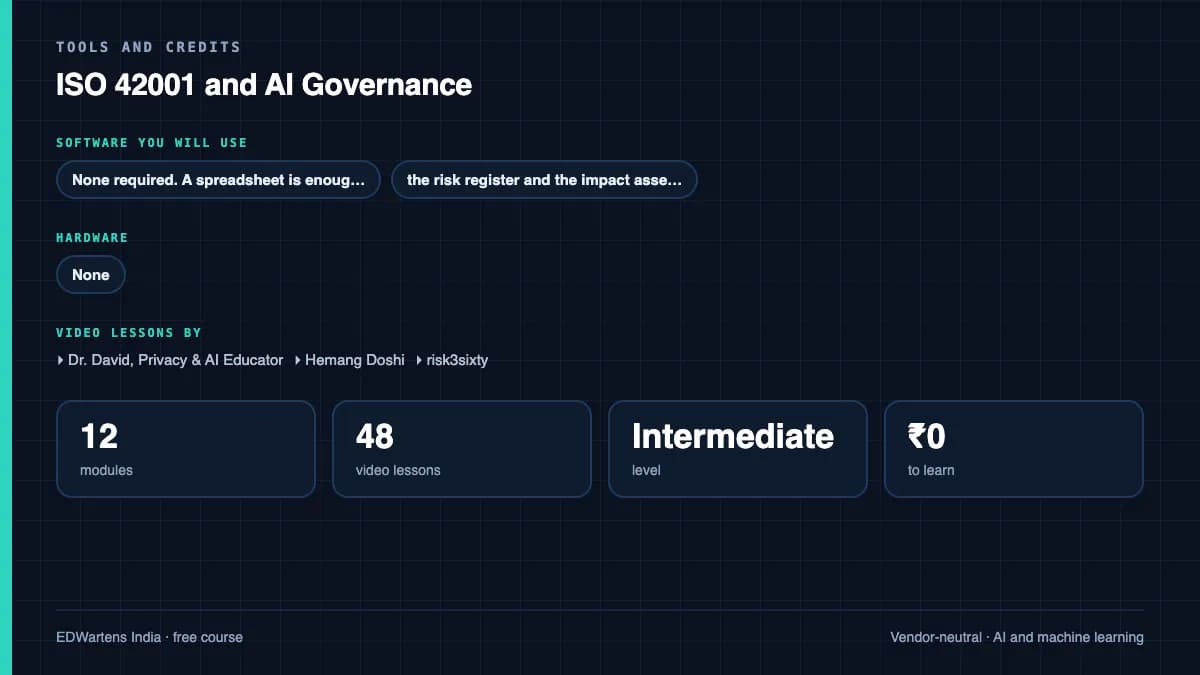
- None required. A spreadsheet is enough for the AI system inventory, the risk register and the impact assessment. What to download, and how
- Hardware
- None.
Software you need
What to download, where from, what it costs and how to install it. Every link goes to the maker's own site, never a mirror.
Nothing to install
A spreadsheet is enough for the AI system inventory, the risk register and the impact assessment.
Optional
Useful, not needed to finish the course.
- 01Free
LibreOffice
The Document Foundation
- Runs on
- Windows 10 or 11, macOS 11 or newer (Intel or Apple silicon), Linux
- Account
- None needed
- Size
- up to 1.5 GB of disk space on Windows
LibreOffice is free, open-source software under the Mozilla Public License 2.0, for any use including business. Calc is its spreadsheet.
Steps
- 1.Open the LibreOffice download page.
- 2.Check the page has picked your operating system, then select Download.
- 3.Run the installer (administrator rights are needed on Windows).
- 4.Start LibreOffice Calc for spreadsheet work.
- 5.Save as .xlsx if you need to share files with Excel users.
- Choose the latest main version unless your organisation asks for the older, more conservative release.
Official download pagelibreoffice.org
Checked against each maker's own page on 27 September 2026. Trial lengths and editions change; the maker's page is the final word.
ISO 42001 and AI Governance at a glance
ISO 42001 and AI Governance is a free, self-paced online course from EDWartens for engineers, developers and students applying AI to real work. It has 13 modules and 5h 38m of video lessons by Dr. David, Privacy & AI Educator, Hemang Doshi, risk3sixty, with written notes and worked problems, a practical project with a document pack and a 15-question final assessment (pass mark 60%). Learning is free with an account; an optional certificate with a public verification code is issued when you pass. Last updated 27 September 2026.
All course factsHide course facts
- Price
- Free, for good. No trial, no card. The only paid item is the optional certificate, a small one-off fee.
- Who it is for
- Engineers, developers and students applying AI to real work
- Format
- 13 self-paced modules, 5h 38m of video, written notes, a practice task per module and one final assessment.
- Level
- Intermediate. Intermediate. Best if you have worked inside a management system such as ISO 9001, IATF 16949 or ISO 27001, or have shipped an AI system that somebody else now audits. No coding required.
- Brand
- Vendor-neutral
- Software
- None required. A spreadsheet is enough for the AI system inventory, the risk register and the impact assessment.
- Hardware
- None.
- Certificate
- Optional EDWartens Certificate of Completion, verifiable by code. Not a vendor credential.
- Video lessons by
- Dr. David, Privacy & AI Educator, Hemang Doshi, risk3sixty (independent creators, credited below)
- Language
- English
- Last updated
- 27 September 2026
A shareable EDWartens certificate
Finish every module and pass the final assessment, and the optional EDWartens certificate is yours. It carries a unique verification code on a public page anyone can check, so it stands up when a recruiter looks it up. See it below.
The course itself stays free whether or not you ever buy one.
Stuck? Ask a practising engineer
A free course usually means a comment section and hope. This one does not. Every module has an Ask-your-trainer panel that reaches the same engineers who teach our paid programme: people who commission panels for a living, not moderators.
Pairs well with
 PLC programming · FreeSiemens TIA PortalFrom zero electrical knowledge to a working, simulated S7-1200 program, for nothing.
 PLC programming · FreeSiemens TIA Portal in Three HoursThe first three hours of the Siemens TIA Portal course, cut to end on a win: what a PLC is, how it is wired, a project configured in TIA Portal, and your first ladder program running in simulation. Finish it in an evening or two, earn a certificate, and carry straight on into the full course.
 PLC programming · FreeTIA Portal: Build a MachineOne machine, start to finish. Take a bottle filling line from a written specification and an I/O list to a structured S7-1200 program with a fill station, a capper, a reject sorter and an operator screen with alarms, then test it against a written record and archive it for hand-over. The lessons are the reference; the machine is yours, and it is what you submit.
 Instrumentation · FreeInstrumentation for PLC EngineersThe half of the loop that is not code. Follow one measurement from the transmitter in the field, down the 4-20 mA loop, into the analog card, through NORM_X and SCALE_X into engineering units, out again to a valve, and back to the control room when the reading is wrong.
More free courses: Free AI courses for engineers
Learner reviews
No reviews yet
Reviews here are written only by learners who have finished every module of ISO 42001 and AI Governance, and they are published exactly as written. Finish the course and yours will be the first.
Common questions
Who is the ISO 42001 and AI Governance course for?
Quality and internal-audit staff who already run ISO 9001, IATF 16949 or ISO 27001 and are being asked to add AI, and engineers in plants, GCCs and IT services firms who have shipped a model that a customer's auditor now wants to see governed. IT services firms and global technology centres were among the first organisations certified to ISO 42001, and they recruit AI governance analysts and AI auditors out of exactly these roles.
Does this make me an AIGP or an ISO 42001 lead auditor?
No, and the page will never say otherwise. The IAPP AI Governance Professional certification and the ISO/IEC 42001 lead implementer and lead auditor qualifications are paid, externally examined credentials awarded by those bodies, and this course is neither of them. The lessons here come from AIGP masterclass material and from AI governance practitioners, so the body of knowledge overlaps closely, but what you finish with is an EDWartens Certificate of Completion. Employers who ask for a lead auditor certificate will still ask for it, and classroom lead implementer or lead auditor training is a paid, multi-day course that typically costs from several hundred to a few thousand US dollars.
What do I need before this course?
No coding and no experience of building AI systems. Time inside any management system helps a great deal, because clauses 4 to 10 will already look familiar; if you have never worked in one, the first two modules build that vocabulary before the clause work starts.
Do I need to buy a copy of ISO/IEC 42001?
Not to complete the course. The modules teach the clause structure and what each clause asks an organisation to produce, using freely available lessons. The standard itself is a copyrighted document sold by ISO and by national standards bodies, and this course does not reproduce its text. Any organisation actually implementing an AIMS should buy a copy.
What are the practice tasks?
Each module ends with a task on a system you can see: an AI system inventory, six risk statements scored against your own criteria, a one-page clause 6.1.4 impact assessment, a document gap list marked exists, uncontrolled or missing, a lifecycle record reconstructed backwards, and an EU AI Act tier and operator-role call for three systems. If your organisation builds nothing, run all of them against a bought-in tool your team already uses, such as a chatbot or a coding copilot.
Is the ISO 42001 and AI Governance course really free?
Yes. Every module, practice task and assessment. You create an account so your progress is saved and the assessments can be marked. The certificate is the only paid item, and only if you want it.
What certificate does the ISO 42001 and AI Governance course give?
An EDWartens Certificate of Completion, issued when you have finished every module and passed the final assessment at 60 per cent, with a verification code anyone can check. It is not a vendor credential, not an accredited certification, and is never described as one.
Who made the video lessons in the ISO 42001 and AI Governance course?
The creators named in the Credits block at the foot of this page, on their own YouTube channels. EDWartens did not make the videos and the creators are not affiliated with EDWartens. What EDWartens wrote is the study plan, the notes, the practice tasks and the assessments.
What you walk away with
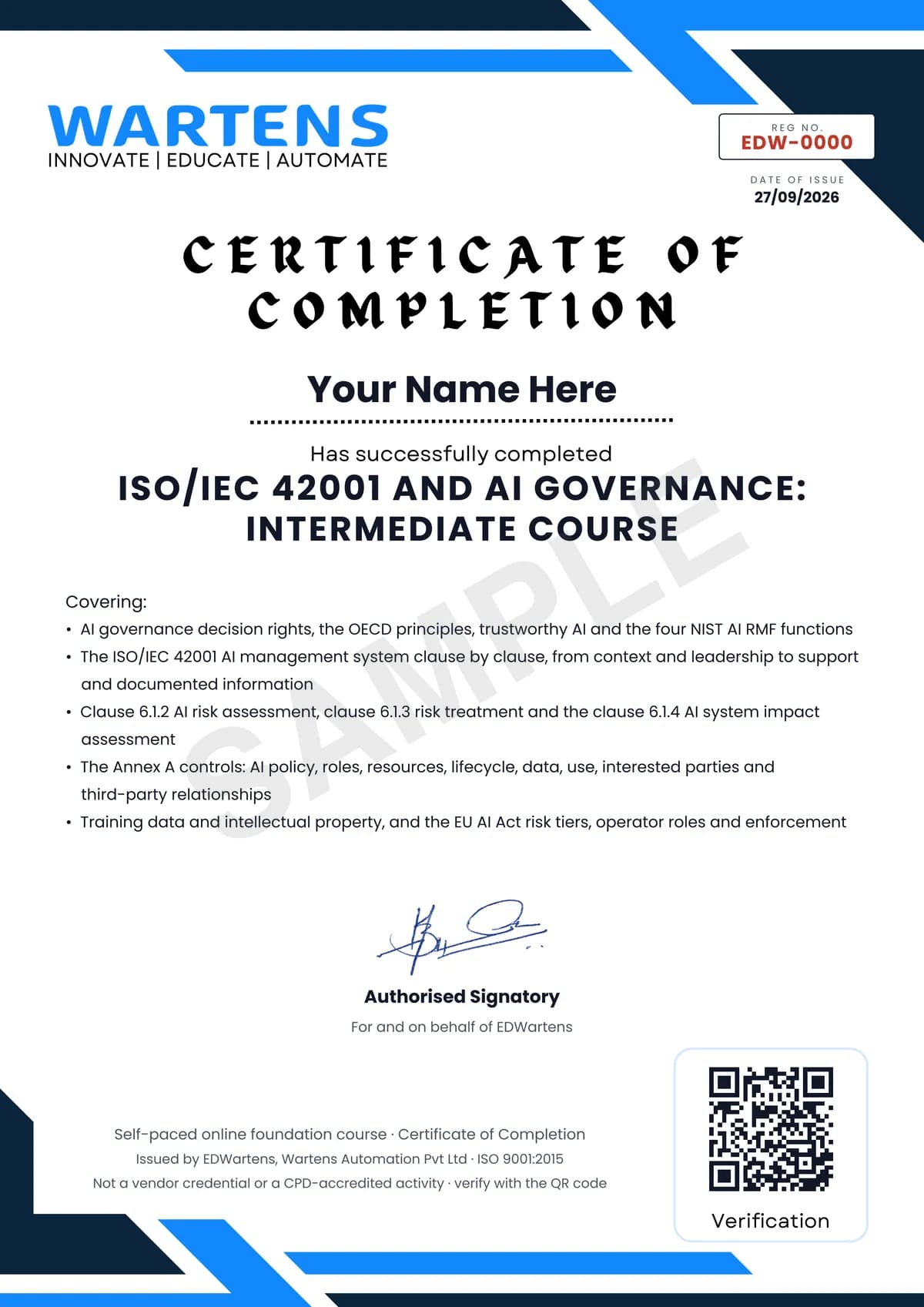
Your certificate for ISO 42001 and AI Governance
Finish the course, pass the final, and this is the document with your name on it.
Verifiable by anyone
Adds to LinkedIn in one click
QR code on the certificate
Names what you can do
A permanent link
Earned, not attended
Learning is free. The certificate is optional.
Add it now and pay only when you have finished the course, or come back for it later. One-off, US$28.99, with a receipt.
Issued by EDWartens, the training division of Wartens, as a Certificate of Completion for this self-paced course. Sold by Wartens Ltd (England and Wales). It is not a vendor certification, a university award or a CPD-accredited activity, and it does not certify competence on live equipment. Delivered electronically; see the refund policy.
Credits
Who made the video lessons
The video lessons in this course were created by the people below, not by EDWartens. Every lesson streams from its creator's own YouTube channel; EDWartens neither hosts nor sells that footage, and the creators are not affiliated with EDWartens and do not endorse this course. What EDWartens wrote is the study plan, the notes, the practice tasks and the assessments.
- Dr. David, Privacy & AI Educatorthe AIGP certification masterclass lessons used for the framework layer: governance principles, trustworthy AI, the OECD principles, the NIST AI RMF, risk management, standing up a governance body, the AI tech stack, intellectual property and web scraping, and the EU AI Act tiers, operators and enforcement
- Hemang Doshithe ISO/IEC 42001 implementation lectures that give the course its clause spine, from clause 4 to clause 7.5, including 6.1.2 risk assessment, 6.1.3 risk treatment and 6.1.4 impact assessment
- risk3sixtythe ISO Bytes walkthroughs of the Annex A controls: AI policy, AI roles, resources, impact assessment, the AI system lifecycle, data, information for interested parties, use, and third-party and customer relationships
If you are one of these creators and would like a lesson removed or credited differently, write to info@wartens.com.