Robotics · Free
Universal Robots Cobot Programming with PolyScope
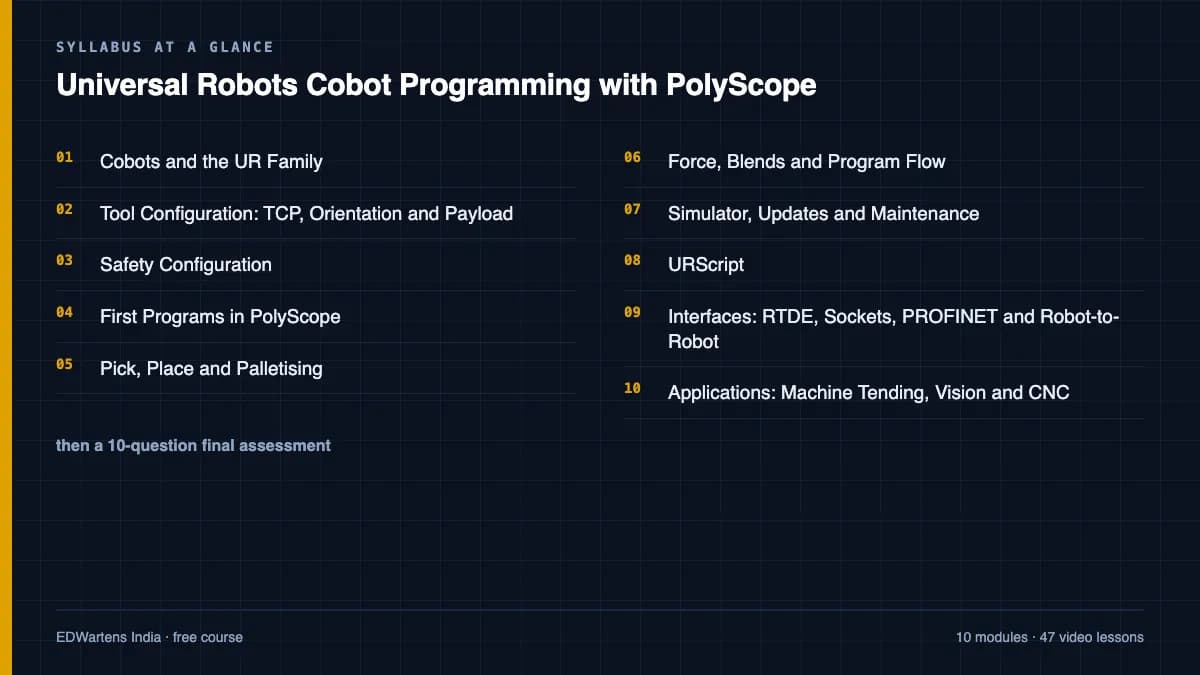
Collaborative robots the way integrators use them: the UR family, tool and payload setup, the safety configuration, PolyScope programs, pick-and-place and palletising, force and blends, URSim, URScript, RTDE, sockets, PROFINET and real machine-tending and vision applications.

Inside the course
From the lessons

Cobots and the UR Family
Ray Fulks
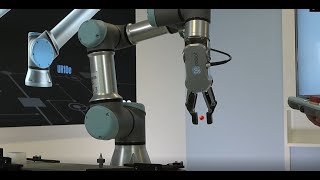
Tool Configuration: TCP, Orientation and Payload
Ray Fulks
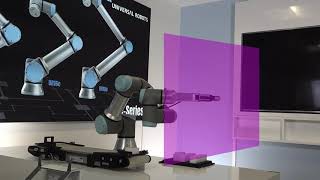
Safety Configuration
Ray Fulks

First Programs in PolyScope
Ray Fulks
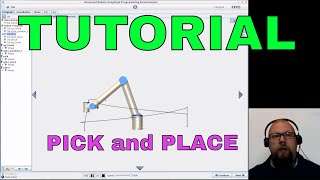
Pick, Place and Palletising
Ray Fulks

Force, Blends and Program Flow
Ray Fulks
Lesson frames belong to the creators named in the Credits below and are shown from YouTube.
What you will learn
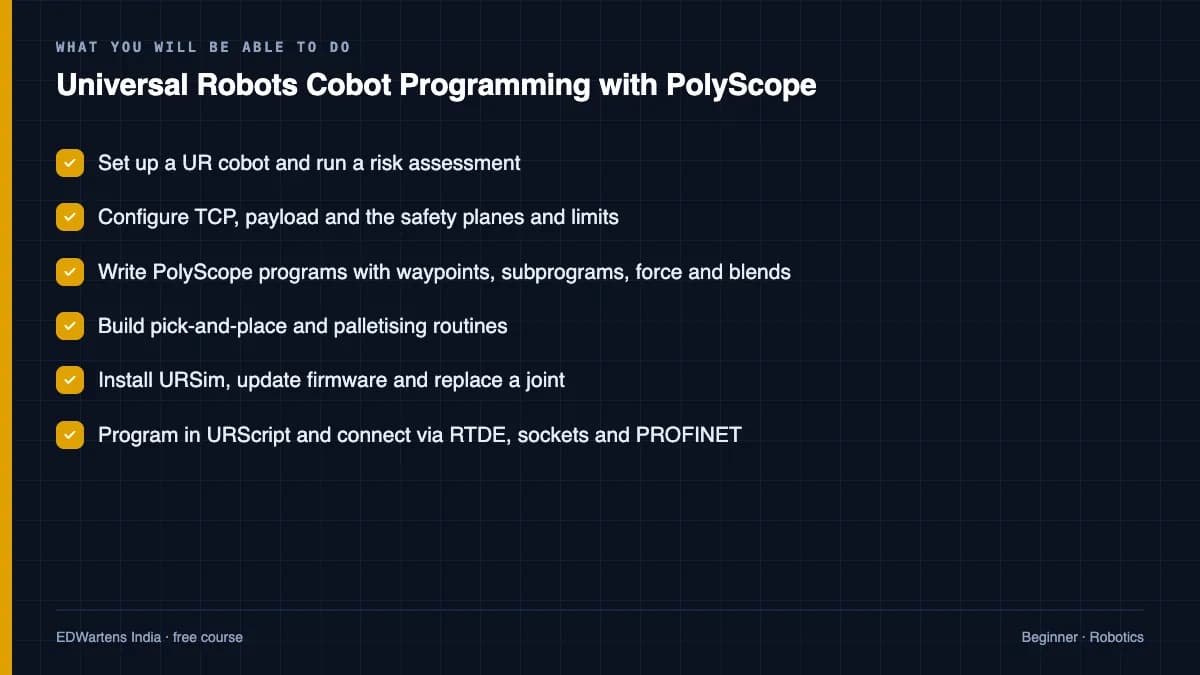
Set up a UR cobot from unboxing to safe operation, configure TCP, payload, safety planes and limits, write PolyScope programs with waypoints, subprograms, force and blends, build pick-and-place and pallet routines, use URSim, maintain the arm and talk to it from URScript, RTDE, sockets and a PLC over PROFINET.
- Set up a UR cobot and run a risk assessment
- Configure TCP, payload and the safety planes and limits
- Write PolyScope programs with waypoints, subprograms, force and blends
- Build pick-and-place and palletising routines
- Install URSim, update firmware and replace a joint
- Program in URScript and connect via RTDE, sockets and PROFINET
For you
Taking Universal Robots Cobot Programming with PolyScope from the United States
- Free in the United States, as everywhere, and self-paced: lessons, notes and the final assessment are open at any hour, so your time zone and shift pattern do not matter.
- The optional certificate for learners in the United States is a one-off US$23.99. What you get for it
- Plants across the Americas most often run Allen-Bradley, Siemens and Inductive Automation; each has its own free course to take next.
- See automation and engineering jobs in the United States, and what the industry looks like in Houston, Detroit and Chicago.
- EDWartens also has a regional site for the United States, for classroom training and local support: edwartens.com/us.
The course project · about 18 hours
Screwdriving and kitting station on a UR10e: PolyScope program, ISO/TS 15066 limits and an S7-1200 handshake
Design, program, safeguard and document a UR10e cell that drives the four (or six) self-tapping screws into smart-meter housings on a conveyor stop, then lifts each finished meter into a shipping tote on a bench it shares with an operator, started and interlocked by a Siemens S7-1200 line PLC over PROFINET. You deliver the PolyScope program with its URScript, your own handshake table and risk register, a safety configuration with its checksum, an ISO/TS 15066 force and pressure argument, a cell FAT record and the operator's note. The sample pack shows what a cobot integrator hands over.
Sample document pack, 8 documents, filled in for the scenario
- Cell layoutStation ST-14 Layout and Safeguarding: Screwdriving and Kitting Cobot Cell
- Risk registerRisk Assessment Register: Station ST-14 (ISO 12100, task-based, with ISO/TS 15066)
- SRSSafety Requirements Specification: Station ST-14 Safety Functions
- I/O handshakePLC-Robot I/O Handshake Table: L2-PLC to UR10e ST-14
- Control narrativeCycle Description and Modes: Station ST-14 Screwdriving and Kitting
- Test reportCollaborative Contact Force and Pressure Measurement and Stopping Performance: UR10e at ST-14
- FATCell Acceptance Test Record: Station ST-14 at the Integrator's Workshop
- O&M manualOperation and Maintenance Manual: Station ST-14 (Operation and Recovery sections)
Read inside the course and download as a workbook. The project is optional practice, marked when you submit it; the certificate needs only the modules and the final assessment.
Course content
11 modules · 47 lessons · 4h 43m
In order, at whatever pace suits you. Each module ends with a practice task that builds on the last.
- 01Cobots and the UR Family4 lessons33m
- 02Tool Configuration: TCP, Orientation and Payload4 lessons12m
- 03Safety Configuration5 lessons13m
- 04First Programs in PolyScope3 lessons17m
- 05Pick, Place and Palletising4 lessons26m
- 06Force, Blends and Program Flow4 lessons24m
- 07Simulator, Updates and Maintenance7 lessons30m
- 08URScript5 lessons32m
Requirements
- Who it is for
- Beginner to intermediate. Basic PLC or robot awareness helps.
- Software
- URSim offline simulator (free) and PolyScope What to download, and how
- Hardware
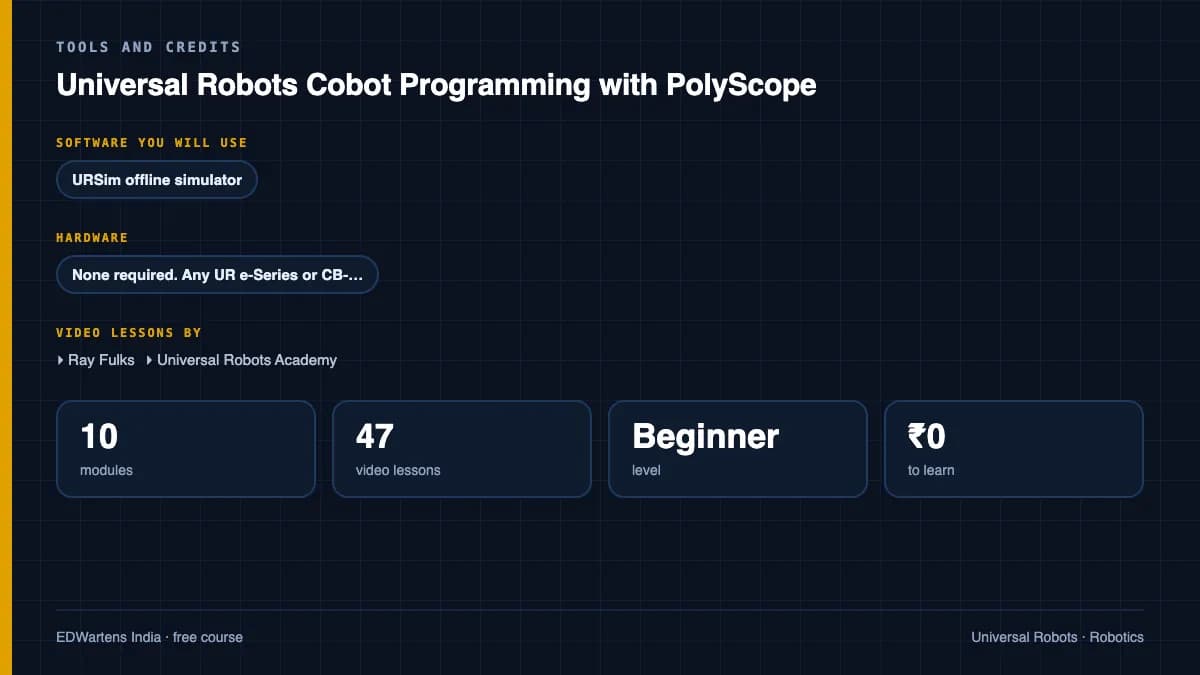
- None required. Any UR e-Series or CB-series arm makes the safety and I/O modules real.
Software you need
What to download, where from, what it costs and how to install it. Every link goes to the maker's own site, never a mirror.
Required
- 01Free
URSim offline simulator
Universal Robots
- Runs on
- Linux natively; Windows or macOS through a virtual machine (VMware Player or VirtualBox); also available as a Docker image
- Account
- A free Universal Robots website account (login is required to download)
Universal Robots offers URSim as a free download for offline programming and simulation of UR robot programs. The non-Linux package is a virtual machine with simulators for UR3e, UR5e, UR10e and UR20, and only one simulator runs at a time.
Steps
- 1.Open the Universal Robots download centre and choose the Offline Simulator for your system (Linux, or non-Linux for Windows and macOS).
- 2.Sign in or create a free Universal Robots account to access the files.
- 3.For Windows or macOS, install VMware Player or VirtualBox and a tool such as 7-Zip.
- 4.Extract the RAR archive and import or open the virtual machine in your VM player.
- 5.Start the VM and launch the simulator for the robot model you need.
- Allow at least 8 GB of free disk space and a screen of at least 1280x800.
- Docker users can run the official universalrobots/ursim_e-series image instead of a full VM.
- Pick the PolyScope version that matches your course or your real robot.
Official download pageuniversal-robots.comAlternatives
- URSim Docker image: UR's own guide to running URSim in Docker, handy on Linux or for ROS work.
Optional
Useful, not needed to finish the course.
- 02Free
Oracle VirtualBox
Oracle
- Runs on
- Windows, macOS (Intel and Apple Silicon), Linux and Solaris hosts
- Account
- None needed
The VirtualBox platform packages are free and open source under GPL version 3. The separate Extension Pack is free only for personal and educational use (PUEL licence); business use of the Extension Pack needs a commercial licence from Oracle.
Steps
- 1.Open virtualbox.org/wiki/Downloads.
- 2.Click the package for your host system (for example, Windows hosts).
- 3.Run the installer and accept the network driver prompts.
- 4.Open VirtualBox, click New, choose your ISO file (for example Ubuntu or Windows) and follow the wizard.
- Turn on hardware virtualisation (Intel VT-x or AMD-V) in your PC's BIOS or UEFI if VirtualBox says it is not available.
- You do not need the Extension Pack for normal lab work. Install it only if you need its extra features and your use is personal or educational.
Official download pagevirtualbox.org
Checked against each maker's own page on 27 September 2026. Trial lengths and editions change; the maker's page is the final word.
Universal Robots Cobot Programming with PolyScope at a glance
Universal Robots Cobot Programming with PolyScope is a free, self-paced online course from EDWartens for engineering students, ITI and diploma holders, and working engineers in manufacturing and robotics. It has 11 modules and 4h 43m of video lessons by Ray Fulks, Universal Robots Academy, with written notes and worked problems, a practical project with a document pack and a 15-question final assessment (pass mark 60%). Learning is free with an account; an optional certificate with a public verification code is issued when you pass. Last updated 27 September 2026.
All course factsHide course facts
- Price
- Free, for good. No trial, no card. The only paid item is the optional certificate, a small one-off fee.
- Who it is for
- Engineering students, ITI and diploma holders, and working engineers in manufacturing and robotics
- Format
- 11 self-paced modules, 4h 43m of video, written notes, a practice task per module and one final assessment.
- Level
- Beginner. Beginner to intermediate. Basic PLC or robot awareness helps.
- Brand
- Universal Robots
- Software
- URSim offline simulator (free) and PolyScope
- Hardware
- None required. Any UR e-Series or CB-series arm makes the safety and I/O modules real.
- Certificate
- Optional EDWartens Certificate of Completion, verifiable by code. Not a vendor credential.
- Video lessons by
- Ray Fulks, Universal Robots Academy (independent creators, credited below)
- Language
- English
- Last updated
- 27 September 2026
A shareable EDWartens certificate
Finish every module and pass the final assessment, and the optional EDWartens certificate is yours. It carries a unique verification code on a public page anyone can check, so it stands up when a recruiter looks it up. See it below.
The course itself stays free whether or not you ever buy one.
Stuck? Ask a practising engineer
A free course usually means a comment section and hope. This one does not. Every module has an Ask-your-trainer panel that reaches the same engineers who teach our paid programme: people who commission panels for a living, not moderators.
Pairs well with
 Robotics · FreeFANUC Robot Programming with the Teach Pendant and ROBOGUIDEFrom jogging and frames to TP programs, registers, branching, offsets, pick-and-place, ROBOGUIDE simulation, palletising, error recovery and PLC integration.
 Robotics · FreeABB Robot Programming with RobotStudio and RAPIDRobotStudio from install to a running pick-and-place: stations, jogging, the FlexPendant, frames, paths, RAPID, collision checking, signals, physics, sharing and RobotStudio Cloud.
 Robotics · FreeKUKA Robot Programming with KUKA.Sim, smartPAD and WorkVisualSimulation in KUKA iiQWorks.Sim (formerly KUKA.Sim), KRL structure and programming on the smartPAD, WorkVisual configuration, fieldbus and PLC integration, safety, advanced KRL, backups and the new KRC5 micro with iiQKA.OS.
 Robotics · FreeYaskawa Motoman Robot ProgrammingMotoman robots the way welding and handling shops run them: DX100, DX200 and YRC1000 controllers and pendants, jobs and interpolation, TCP, user frames and home, variables, counters and I/O, arc welding with weaving and anti-sticking, spot welding and tip dressing, alarms and recovery, backups, the Smart Pendant and MotoSim offline programming.
More free courses: Free Universal Robots cobot course · Free industrial robot programming courses
Learning paths with this course
- Industrial robotics · 7 coursesFANUC, ABB and KUKA, three of the robot brands most common on automotive and electronics lines, plus the servo and motion control they sit on.
Learner reviews
No reviews yet
Reviews here are written only by learners who have finished every module of Universal Robots Cobot Programming with PolyScope, and they are published exactly as written. Finish the course and yours will be the first.
Common questions
Do I need a robot?
No. URSim runs PolyScope on a PC or virtual machine, so every program in the course can be written and tested without hardware.
Which UR models does this cover?
The e-Series (UR3e to UR16e) with notes on the CB3 series still common in plants; the programming is the same.
Is URScript necessary?
Not for a first job, but the module shows what the pendant generates and how a PC or PLC talks to the robot, which is where integrator work goes.
Is the Universal Robots Cobot Programming with PolyScope course really free?
Yes. Every module, practice task and assessment. You create an account so your progress is saved and the assessments can be marked. The certificate is the only paid item, and only if you want it.
What certificate do I get, and is it a vendor qualification?
An EDWartens Certificate of Completion, issued when you pass the final assessment, with a verification code anyone can check. It is not a vendor credential and is never described as one.
Who made the video lessons in the Universal Robots Cobot Programming with PolyScope course?
The creators named in the Credits block at the foot of this page, on their own YouTube channels. EDWartens did not make the videos and the creators are not affiliated with EDWartens. What EDWartens wrote is the study plan, the notes, the practice tasks and the assessments.
How long does the Universal Robots Cobot Programming with PolyScope course take?
Plan on about 10 hours in all, including the video lessons, notes and practice tasks. It is self-paced, so you work through the eleven modules at your own speed.
What you walk away with
Your certificate for Universal Robots Cobot Programming with PolyScope
Finish the course, pass the final, and this is the document with your name on it.
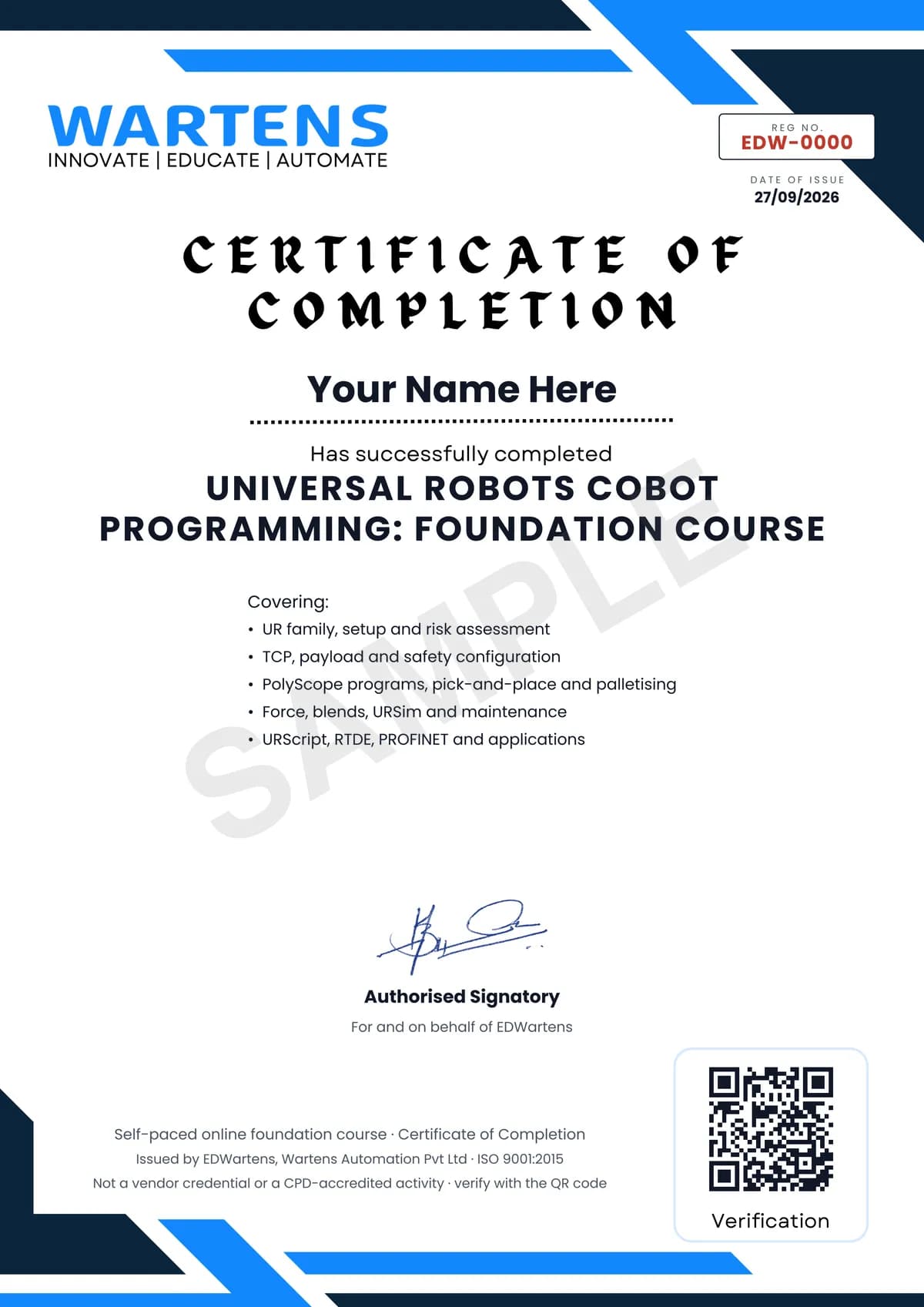
Verifiable by anyone
Adds to LinkedIn in one click
QR code on the certificate
Names what you can do
A permanent link
Earned, not attended
Learning is free. The certificate is optional.
Add it now and pay only when you have finished the course, or come back for it later. One-off, US$23.99, with a receipt.
Issued by EDWartens, the training division of Wartens, as a Certificate of Completion for this self-paced course. Sold by Wartens Ltd (England and Wales). It is not a vendor certification, a university award or a CPD-accredited activity, and it does not certify competence on live equipment. Delivered electronically; see the refund policy.
Credits
Who made the video lessons
The video lessons in this course were created by the people below, not by EDWartens. Every lesson streams from its creator's own YouTube channel; EDWartens neither hosts nor sells that footage, and the creators are not affiliated with EDWartens and do not endorse this course. What EDWartens wrote is the study plan, the notes, the practice tasks and the assessments.
- Ray Fulksthe Universal Robots playlist of setup, programming, safety and application videos
- Universal Robots Academythe URScript tutorial series
If you are one of these creators and would like a lesson removed or credited differently, write to info@wartens.com.