Power systems · Free
Data Centre Electrical and Critical Power
The electrical side of data centres, where the hiring is: the power path from grid to rack, tiers and redundancy, UPS and generators, the calculations, load flow, short-circuit and arc flash studies, PUE, monitoring, and what AI GPU racks change.
Inside the course


From the lessons

How a data centre works, from grid to rack
MEP Academy

Tiers, standards and redundancy
MEP Academy
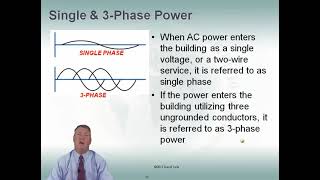
Power fundamentals and calculations
GogoTraining - PeopleCert Accredited (ATO)

UPS, generators and the power train
MEP Academy

The data centre electrical power system in depth
EngineersIreland

Power studies, arc flash and the digital twin
ETAP Software
Lesson frames belong to the creators named in the Credits below and are shown from YouTube.
What you will learn
Trace the power path from utility to rack and explain each piece of equipment; compare N, N+1 and 2N redundancy and the Uptime Institute tiers; size UPS and cable current from rack loads; explain the load flow, short-circuit, coordination and arc flash studies a data centre needs; calculate PUE and find where power is lost; describe electrical monitoring and DCIM; and explain what high-density AI racks change in the electrical design.
- Trace data centre power from the utility to the rack
- Compare N, N+1 and 2N redundancy and the Uptime Institute tiers
- Calculate rack current, kVA and kW for single and three-phase feeds
- Size UPS and generators for a 2N design
- Explain load flow, short-circuit, coordination and arc flash studies
- Calculate PUE and reduce electrical losses
- Find hidden single points of failure and read arc flash labels safely
- Explain what AI GPU racks change in electrical design
For you
Taking Data Centre Electrical and Critical Power from the United States
- Free in the United States, as everywhere, and self-paced: lessons, notes and the final assessment are open at any hour, so your time zone and shift pattern do not matter.
- The optional certificate for learners in the United States is a one-off US$28.99. What you get for it
- Plants across the Americas most often run Allen-Bradley, Siemens and Inductive Automation; each has its own free course to take next.
- See automation and engineering jobs in the United States, and what the industry looks like in Houston, Detroit and Chicago.
- EDWartens also has a regional site for the United States, for classroom training and local support: edwartens.com/us.
The course project · about 10 hours
Electrical design basis for a 1.2 MW colocation data hall: load list, single-line description, design basis and integrated systems test
Write the electrical design basis for a new 1.2 MW IT data hall as the electrical design engineer: build the load list, describe the 2N single-line arrangement from utility to rack, write the design basis with redundancy, UPS and generator sizing and the studies required, and plan the integrated systems test that proves it works. The sample pack shows each document for a colocation hall in Melbourne.
Sample document pack, 4 documents, filled in for the scenario
- Load listLoad list: Hall 1
- Single lineSingle-line description: Hall 1, 2N arrangement
- PlanElectrical design basis: Hall 1
- Commissioning procedureIntegrated systems test plan: Hall 1 electrical
Read inside the course and download as a workbook. The project is optional practice, marked when you submit it; the certificate needs only the modules and the final assessment.
Course content
9 modules · 23 lessons · 5h 47m
In order, at whatever pace suits you. Each module ends with a practice task that builds on the last.
- 01How a data centre works, from grid to rack2 lessons14m
- 02Tiers, standards and redundancy3 lessons35m
- 03Power fundamentals and calculations3 lessons53m
- 04UPS, generators and the power train4 lessons33m
- 05The data centre electrical power system in depth1 lesson55m
- 06Power studies, arc flash and the digital twin4 lessons51m
- 07Efficiency and PUE2 lessons48m
- 08Monitoring, BMS and the AI data centre3 lessons52m
Requirements
- Who it is for
- Intermediate. You should know basic electrical theory: voltage, current, power factor, single and three-phase supplies, and what a breaker does.
- Software
- None required. ETAP is shown in the lessons; a spreadsheet is enough for the calculations. What to download, and how
- Hardware
- None.
Software you need
What to download, where from, what it costs and how to install it. Every link goes to the maker's own site, never a mirror.
Nothing to install
ETAP is shown in the lessons; a spreadsheet is enough for the calculations.
Optional
Useful, not needed to finish the course.
- 01Free
LibreOffice
The Document Foundation
- Runs on
- Windows 10 or 11, macOS 11 or newer (Intel or Apple silicon), Linux
- Account
- None needed
- Size
- up to 1.5 GB of disk space on Windows
LibreOffice is free, open-source software under the Mozilla Public License 2.0, for any use including business. Calc is its spreadsheet.
Steps
- 1.Open the LibreOffice download page.
- 2.Check the page has picked your operating system, then select Download.
- 3.Run the installer (administrator rights are needed on Windows).
- 4.Start LibreOffice Calc for spreadsheet work.
- 5.Save as .xlsx if you need to share files with Excel users.
- Choose the latest main version unless your organisation asks for the older, more conservative release.
Official download pagelibreoffice.org
Checked against each maker's own page on 27 September 2026. Trial lengths and editions change; the maker's page is the final word.
Data Centre Electrical and Critical Power at a glance
Data Centre Electrical and Critical Power is a free, self-paced online course from EDWartens for electrical engineers and facility engineers moving into data centres. It has 9 modules and 5h 47m of video lessons by MEP Academy, ETAP Software, GogoTraining and others, with written notes and worked problems, a practical project with a document pack and a 15-question final assessment (pass mark 60%). Learning is free with an account; an optional certificate with a public verification code is issued when you pass. Last updated 27 September 2026.
All course factsHide course facts
- Price
- Free, for good. No trial, no card. The only paid item is the optional certificate, a small one-off fee.
- Who it is for
- Electrical engineers and facility engineers moving into data centres
- Format
- 9 self-paced modules, 5h 47m of video, written notes, a practice task per module and one final assessment.
- Level
- Intermediate. Intermediate. You should know basic electrical theory: voltage, current, power factor, single and three-phase supplies, and what a breaker does.
- Brand
- Vendor-neutral
- Software
- None required. ETAP is shown in the lessons; a spreadsheet is enough for the calculations.
- Hardware
- None.
- Certificate
- Optional EDWartens Certificate of Completion, verifiable by code. Not a vendor credential.
- Video lessons by
- MEP Academy, ETAP Software, GogoTraining, TEQNYAT (independent creators, credited below)
- Language
- English
- Last updated
- 27 September 2026
A shareable EDWartens certificate
Finish every module and pass the final assessment, and the optional EDWartens certificate is yours. It carries a unique verification code on a public page anyone can check, so it stands up when a recruiter looks it up. See it below.
The course itself stays free whether or not you ever buy one.
Stuck? Ask a practising engineer
A free course usually means a comment section and hope. This one does not. Every module has an Ask-your-trainer panel that reaches the same engineers who teach our paid programme: people who commission panels for a living, not moderators.
Pairs well with
 PLC programming · FreeSiemens TIA PortalFrom zero electrical knowledge to a working, simulated S7-1200 program, for nothing.
 PLC programming · FreeSiemens TIA Portal in Three HoursThe first three hours of the Siemens TIA Portal course, cut to end on a win: what a PLC is, how it is wired, a project configured in TIA Portal, and your first ladder program running in simulation. Finish it in an evening or two, earn a certificate, and carry straight on into the full course.
 PLC programming · FreeTIA Portal: Build a MachineOne machine, start to finish. Take a bottle filling line from a written specification and an I/O list to a structured S7-1200 program with a fill station, a capper, a reject sorter and an operator screen with alarms, then test it against a written record and archive it for hand-over. The lessons are the reference; the machine is yours, and it is what you submit.
 Instrumentation · FreeInstrumentation for PLC EngineersThe half of the loop that is not code. Follow one measurement from the transmitter in the field, down the 4-20 mA loop, into the analog card, through NORM_X and SCALE_X into engineering units, out again to a valve, and back to the control room when the reading is wrong.
More free courses: Free electrical design and control panel courses · Free data centre courses · Free power system and ETAP courses
Learner reviews
No reviews yet
Reviews here are written only by learners who have finished every module of Data Centre Electrical and Critical Power, and they are published exactly as written. Finish the course and yours will be the first.
Common questions
Who is the Data Centre Electrical and Critical Power course for?
Electrical engineers, MEP engineers and electrical technicians who want to work on data centres, and automation engineers moving into critical facilities. Basic electrical theory is assumed.
Why data centres?
AI has driven a wave of data centre construction, and operators report that skilled electrical, MEP and commissioning staff are hard to recruit. The electrical side is where much of the design and commissioning work is.
How long does the Data Centre Electrical and Critical Power course take?
About 8.7 hours of video lessons across eight teaching modules, plus the notes, practice questions, the final assessment and an optional project of around 10 hours. At a few hours a week it fits into three to four weeks.
What is the project in the Data Centre Electrical and Critical Power course?
You write the electrical design basis for a 1.2 MW colocation data hall in Melbourne, Australia: a load list, a 2N single-line description, UPS, transformer and generator sizing, and an integrated systems test plan. A worked sample pack shows each document.
Do I need ETAP?
No. The ETAP lessons show how power studies are done, and every calculation in the course can be done by hand or in a spreadsheet.
Does this lead to an Uptime Institute or CDCP certification?
No. It is an EDWartens course built on free public lessons, credited on each module, and EDWartens is not affiliated with the Uptime Institute or any certification body. It covers concepts those programmes use, but it is not one of them.
Is the Data Centre Electrical and Critical Power course really free?
Yes. Every module, the notes, the project and the final assessment. The only paid item is the certificate, if you want it.
What certificate does the Data Centre Electrical and Critical Power course give?
An EDWartens Certificate of Completion, issued when you pass the final assessment, with a number anyone can verify on our site.
What you walk away with
Your certificate for Data Centre Electrical and Critical Power
Finish the course, pass the final, and this is the document with your name on it.

Verifiable by anyone
Adds to LinkedIn in one click
QR code on the certificate
Names what you can do
A permanent link
Earned, not attended
Learning is free. The certificate is optional.
Add it now and pay only when you have finished the course, or come back for it later. One-off, US$28.99, with a receipt.
Issued by EDWartens, the training division of Wartens, as a Certificate of Completion for this self-paced course. Sold by Wartens Ltd (England and Wales). It is not a vendor certification, a university award or a CPD-accredited activity, and it does not certify competence on live equipment. Delivered electronically; see the refund policy.
Credits
Who made the video lessons
The video lessons in this course were created by the people below, not by EDWartens. Every lesson streams from its creator's own YouTube channel; EDWartens neither hosts nor sells that footage, and the creators are not affiliated with EDWartens and do not endorse this course. What EDWartens wrote is the study plan, the notes, the practice tasks and the assessments.
- MEP Academyshort lessons on how data centres work, power flow, redundancy, electrical systems, UPS and AI data centres
- ETAP Softwarethe digital twin, DC arc flash, critical power and eSCADA lessons for data centres
- GogoTrainingthe Fundamentals of Data Center Power lessons on power, calculations and circuit breakers
- TEQNYATthe data centre design and operations course episodes on standards and certifications
- Bryce Andersonthe lesson BMS Data Centre Design
- Engineering and Donutsthe lesson Part 2: Power Distribution for Data Centers and UPS
- EngineersIrelandthe lesson The Electrical Power System
- IEEE Young Professionalsthe lesson Energy Efficient Data Center Power Design
- MEP Engineersthe lesson PUE in Data Center
- MSP TVthe lesson The Secret Formula for Data Centre Electrical Power Distribution
- RagingWire Data Centersthe lesson RagingWire Dallas TX1 Data Center Virtual Tour
If you are one of these creators and would like a lesson removed or credited differently, write to info@wartens.com.