CAREERS NEWS
2.3 Million Technician Openings: Deloitte-MI Study on AI and Skills
A September 2026 study from Deloitte and The Manufacturing Institute says technician jobs could grow six times faster than production jobs, with 2.3 million openings to fill. What the numbers mean, which adjacent roles transfer, and a free eight-week bridge plan.

The manufacturing technician shortage is set to get worse before it gets better. A study released on 10 September 2026 by Deloitte and The Manufacturing Institute (MI) says US manufacturing technician employment could grow about six times faster than production employment between 2025 and 2030, and that employers may need to fill 2.3 million technician openings in that period. Its proposed answer: recruit from adjacent industries and use AI to shorten training.
Checked 5 October 2026 against the Deloitte Insights study, the press release, NAM and DC Velocity.
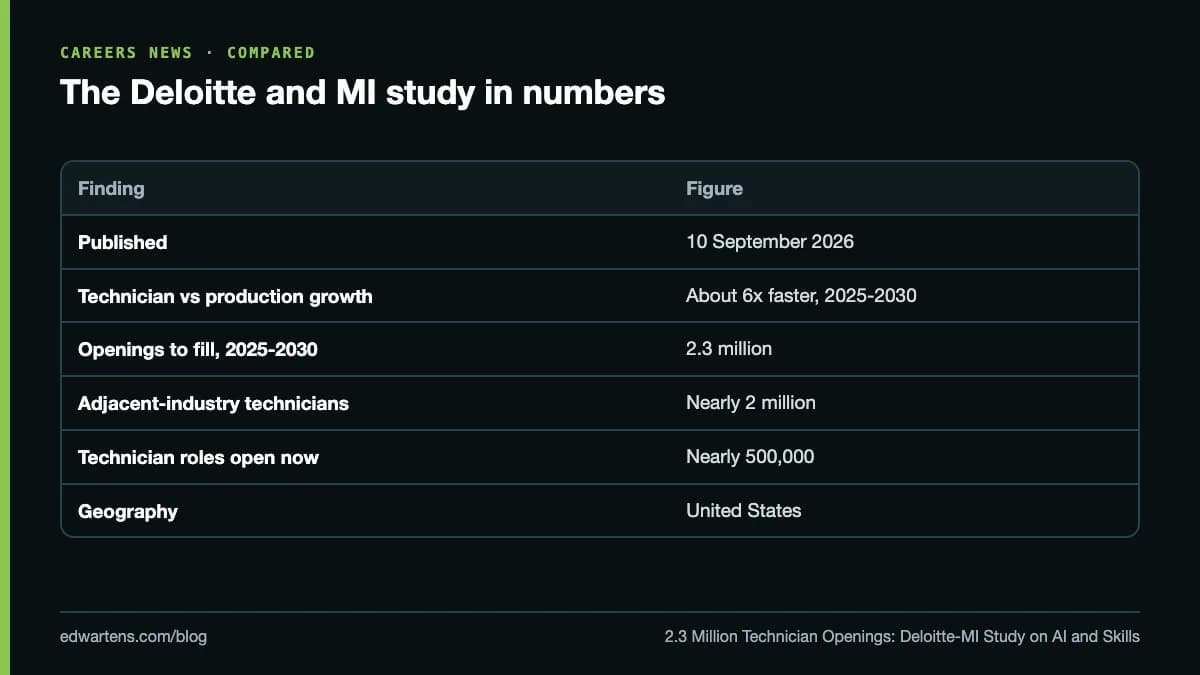
What the Deloitte and MI study found
The headline numbers, from the press release and the full Deloitte Insights study:
- Six times faster growth. Technician employment in manufacturing could grow about six times faster than employment in production occupations between 2025 and 2030.
- 2.3 million openings. Employers may need to fill 2.3 million job openings across manufacturing and adjacent-industry technician occupations over the same period, driven by growth plus retirements, other exits and people changing occupations.
- Nearly 500,000 open now. Nearly half a million manufacturing technician roles are currently unfilled.
- Nearly 2 million potential recruits. Technicians in adjacent industries whose broad skills may transfer into manufacturing.
The projections come from historical growth rates for each technician occupation from 2010 to 2025, and the skills comparison uses the US Department of Labor's O*NET database.
MI president Carolyn Lee said AI could change not only how manufacturing work gets done but how people prepare for it. Deloitte's Steve Shepley argued AI could make technical expertise more accessible while preserving the judgement of the people doing the work.
Who counts as a manufacturing technician?
The study groups technician roles into three families:
- Advanced manufacturing technicians: industrial, electrical and electronic, mechanical, electro-mechanical and mechatronics, aerospace engineering technicians, and calibration roles.
- Maintenance and repair technicians: industrial machinery mechanics, general maintenance and repair workers, machinery maintenance workers and commercial and industrial equipment repairers.
- Quality and laboratory technicians: quality control analysts, chemical technicians and food science technicians.
It is the second family, the people who keep automated lines running, that most automation careers start from. These are not production operators; they are the people called when the line stops.
Why the manufacturing technician shortage is growing
The logic is straightforward. As plants add robots, sensors, drives and software, they need fewer people doing repetitive production tasks and more people who can install, program, maintain and repair the equipment. Every robot cell shown at events such as IMTS 2026 adds to technician demand rather than reducing it. Our manufacturing skills gap 2026 analysis looks at the wider numbers; this study narrows the focus to technicians.
Which adjacent roles transfer, and what do they need?
The study names occupations outside manufacturing with overlapping skills, including aircraft mechanics, automotive service technicians, computer repairers, farm equipment mechanics, and heating and refrigeration installers. If you are one of them, you already have the hardest thing to teach: a systematic approach to fault-finding on real equipment.
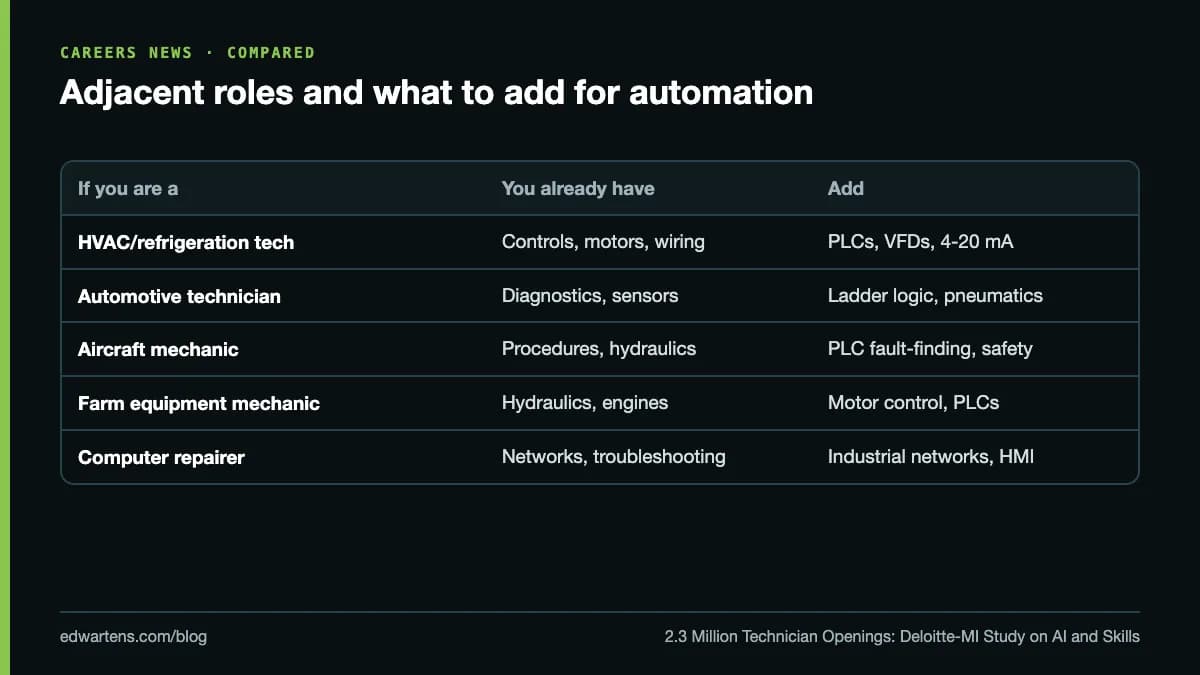
The usual gap is the automation layer itself. A typical HVAC technician, for example, already wires contactors, reads control diagrams and sets up variable-speed drives on fans. What is new on a factory line is the PLC that ties those devices together, the 4-20 mA signals from process instruments, and the networks between them.
A worked example: one fault, two backgrounds
Take a conveyor that stops at random. An automation technician would:
- Check the HMI alarm history for the stop reason and time.
- Open the PLC program online and find the rung that drops the motor run output.
- Watch which input in that rung goes false when the stop happens: say, a photo-eye.
- Check the sensor's LED, wiring and alignment; measure 24 V at the input card.
- Find a loose M12 connector on a vibrating bracket, fix it and record it in the maintenance log.
An automotive or HVAC technician would do steps 4 and 5 well already. Steps 1 to 3, reading the HMI and following the PLC logic online, are what a few weeks of focused study add.
Can AI really shorten technician training?
The study's argument is that AI can capture the knowledge of experienced technicians before they retire and put it in front of newer ones at the moment of need. The use cases it describes:
- analysing a video of an equipment problem and suggesting troubleshooting steps;
- AI embedded in work instructions and diagnostic tools;
- real-time coaching within the workflow;
- help interpreting complex data;
- oversight of collaborative robots.
In practice, the most useful tool a technician can learn today is the simplest: searching manuals, fault-code lists and the maintenance history in plain language. A large language model connected to a plant's own documents can answer what fault F0002 means on that drive faster than paging through a PDF. It still needs checking, and it never replaces lockout, isolation and proving dead.
Which AI tools should a technician actually learn?
Not every AI product is worth a technician's time. The ones that already help on the shop floor:
| Tool type | What it does for a technician | What to watch for |
|---|---|---|
| General AI assistant | Explains fault codes, drafts reports, translates manuals | Can be confidently wrong; check the manual |
| Document search over plant files | Answers questions from your own manuals and logs | Only as good as the documents loaded |
| Predictive maintenance alerts | Flags rising vibration or temperature early | Needs good sensors and a baseline |
| AI vision on the line | Spots defects and misfeeds | Needs retraining when products change |
The common thread is judgement. AI can tell you where to look, but the technician still isolates the equipment, takes the measurement and decides what to replace. Coverage of the study in DC Velocity makes the same point: the aim is to make expertise easier to reach, not to remove it.
What employers can do with the findings
The study is written for manufacturers, and its recommendations translate into a few concrete moves any maintenance manager can make:
- Widen the job advert. Ask for fault-finding experience on electrical or mechanical equipment, not for years in your exact sector.
- Write down what your best technicians know before they retire: fault trees, tricky machines, the checks that are never in the manual.
- Pair new starters with AI-searchable documentation and a named mentor, rather than one or the other.
- Fund short, specific courses in PLCs, drives and instruments for people who already have the trade basics.
Is this only a US problem?
The study's figures are US-only and should not be applied elsewhere. Employers in the UK, Germany, the Gulf, Australia and Canada also report difficulty hiring maintenance and controls technicians, and apprenticeship and recognition systems differ by country, but those markets have their own statistics. What does travel is the method: recruit from adjacent trades, teach the automation layer, and use AI as a knowledge tool. Our guide to automation jobs by country explains how to search internationally.
How to read the numbers sensibly
Projections like these are useful for direction, not precision. The 2.3 million figure counts openings, not net new jobs, so it includes every role vacated by a retirement or a move to another occupation. It also covers adjacent-industry technician occupations as well as manufacturing ones. The six-times growth comparison is relative: technician employment is projected to grow much faster than production employment, which says as much about the slow growth of production jobs as about the technician boom. Whichever way you read it, the direction is the same as every other skills study of the past few years: demand is moving toward people who can maintain and program equipment.
An eight-week bridge plan, free
If you are a technician in an adjacent field, this plan uses our free courses and fits around a full-time job at about six to eight hours a week.
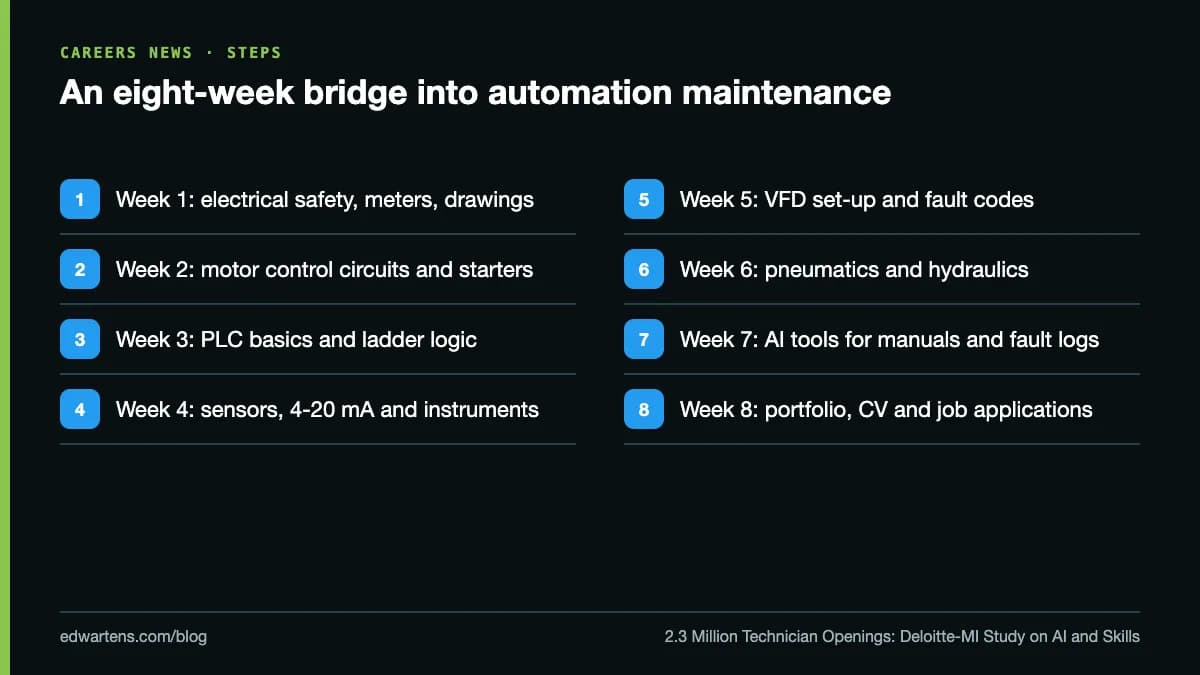
- Weeks 1 and 2: Electrical Fundamentals for Technicians and Industrial Motor Control.
- Weeks 3 to 6: PLC basics, instruments, drives and fluid power from the plc-foundations learning path.
- Week 7: AI Essentials for Work for using AI assistants safely, then Predictive Maintenance with Machine Learning if you want to go further.
- Week 8: build a short portfolio and apply. Our automation engineer career guide and free learning paths show what comes next, and the skills gap finder compares your skills with a job ad. For pay by country, see PLC programmer salary by country.
When you are ready, browse maintenance and controls roles on our job board, or by country, for example the UK, Germany or the UAE. Learning is free in full; an optional EDWartens Certificate of Completion, from US$2.99, can be checked at edwartens.com/verification. It is not a vendor certification and is not accredited.
Take the free course

Electrical · Beginner · Free
Electrical Fundamentals for Technicians: Volts to Multimeter to Drawings

Electrical · Beginner · Free
Industrial Motor Control

AI for professionals · Beginner · Free
AI Essentials for Work: ChatGPT, Claude, Gemini and Copilot

AI and machine learning · Intermediate · Free
Predictive Maintenance with Machine Learning
Questions
How many manufacturing technician jobs are open?
Deloitte and The Manufacturing Institute said in September 2026 that nearly 500,000 manufacturing technician roles in the US are currently open, and that employers may need to fill 2.3 million openings across manufacturing and adjacent-industry technician occupations between 2025 and 2030.
What is an adjacent-industry technician?
Someone doing similar technical work outside manufacturing, such as in construction, services, retail or government. The study names roles such as aircraft mechanics, automotive service technicians, computer repairers, farm equipment mechanics and heating and refrigeration installers, and counts nearly 2 million such technicians with skills that may transfer.
Can AI help train maintenance technicians?
The study argues it can, by digitising experienced technicians' knowledge, embedding guidance in work instructions and diagnostic tools, and coaching people as they work. It presents this as shortening on-the-job training, not replacing hands-on skill or judgement.
Which technician skills transfer into industrial automation?
Electrical safety, reading drawings, using a multimeter, systematic fault-finding, and experience with motors, hydraulics or controls all transfer. Most people then need PLC basics, motor control, sensors and 4-20 mA signals, and drives to work on automated equipment.
Is this shortage only in the US?
The study's numbers are for the United States only. Employers in the UK, Europe, the Gulf and Australia also report difficulty hiring maintenance and controls technicians, but those countries have their own data and the figures are not comparable.
Sources
- PR Newswire: Deloitte and MI study shows potential for AI to accelerate manufacturing skills training (10 September 2026)
- Deloitte Insights: The skilled manufacturing workforce and AI
- NAM: MI, Deloitte study: AI could help close skills gap
- DC Velocity: Manufacturers could use AI to address workforce shortages
- Smart Industry: As technician demand in manufacturing explodes, AI and adjacent industries could help
Written by the EDWartens engineering team for general education. Product names are trademarks of their owners; mentioning them does not imply endorsement. Prices and terms of other providers were checked on the date shown and can change.

Contactor vs Relay: Differences, Ratings and When to Use Each
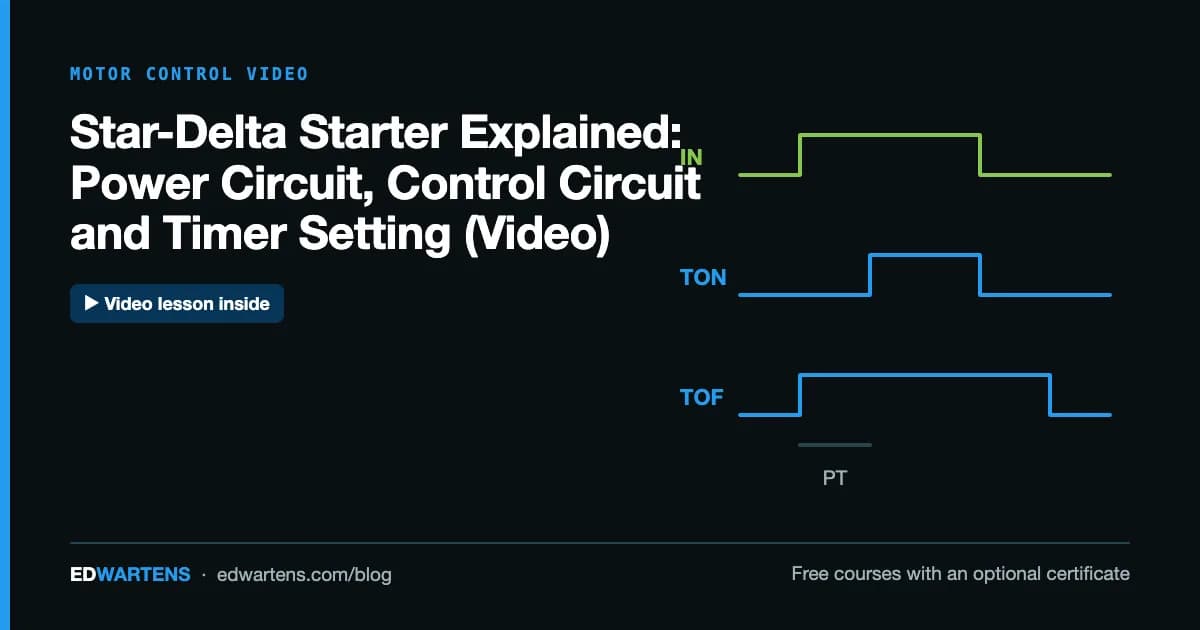
Star-Delta Starter Explained: Power Circuit, Control Circuit and Timer Setting (Video)
How to Become a Commissioning Engineer in Automation: Skills, Site Work and a First-Year Plan

Intrinsic Open-Sources Intrinsic Core at ROSCon 2026: What It Means

Iran-Linked PLC Attacks in 2026: CISA's Warning and a UK Power Plant Outage
PACK EXPO International 2026: Automation to Watch (Oct 18-21)