ROBOTICS NEWS
Intrinsic Open-Sources Intrinsic Core at ROSCon 2026: What It Means
Intrinsic, now part of Google, has released Intrinsic Core under Apache 2.0, plus an open CNC machine-tending reference design for FANUC and Universal Robots. What is in it, how it relates to ROS 2 and MoveIt, and how to learn the skills.
The Intrinsic Core open source release is real and usable today. On 22 September 2026, at ROSCon 2026 in Toronto, Intrinsic released the robot control, motion and grasp planning, pose estimation, simulation and calibration software it uses in its own industrial deployments under the permissive Apache 2.0 licence. It runs on local hardware, is built on ROS, and ships with an open reference design for CNC machine tending that supports FANUC and Universal Robots arms.
Checked 5 October 2026 against The Robot Report, SiliconANGLE, the Open Source Robotics Alliance and the GitHub repositories.
What Intrinsic announced
Intrinsic started as a project inside Alphabet's X and joined Google itself earlier in 2026. Its commercial product is Flowstate, a platform for building and running robot cells. What it has now published on GitHub is the layer underneath: the code that moves the robot, sees the parts and plans the motion.
The release has two parts:
- Intrinsic Core, described in its README as an open, local runtime, SDK and hardware-agnostic real-time control framework for industrial robotics. The repository is intrinsic-ai/intrinsic-core.
- The Open Machine Tending Solution (OMTS), a reference design for an AI-enabled cell that loads and unloads a CNC machine. It is published as intrinsic-ai/intrinsic-omts and supports robots from FANUC and Universal Robots.
Intrinsic's CTO, Brian Gerkey, who previously led Open Robotics, told The Robot Report the release is meant as a lasting commitment to the community. Applications built on Intrinsic Core can later be moved onto Flowstate and Intrinsic's cloud services without a rewrite, which is the commercial logic behind giving the core away.
What is in the Intrinsic Core open source release?
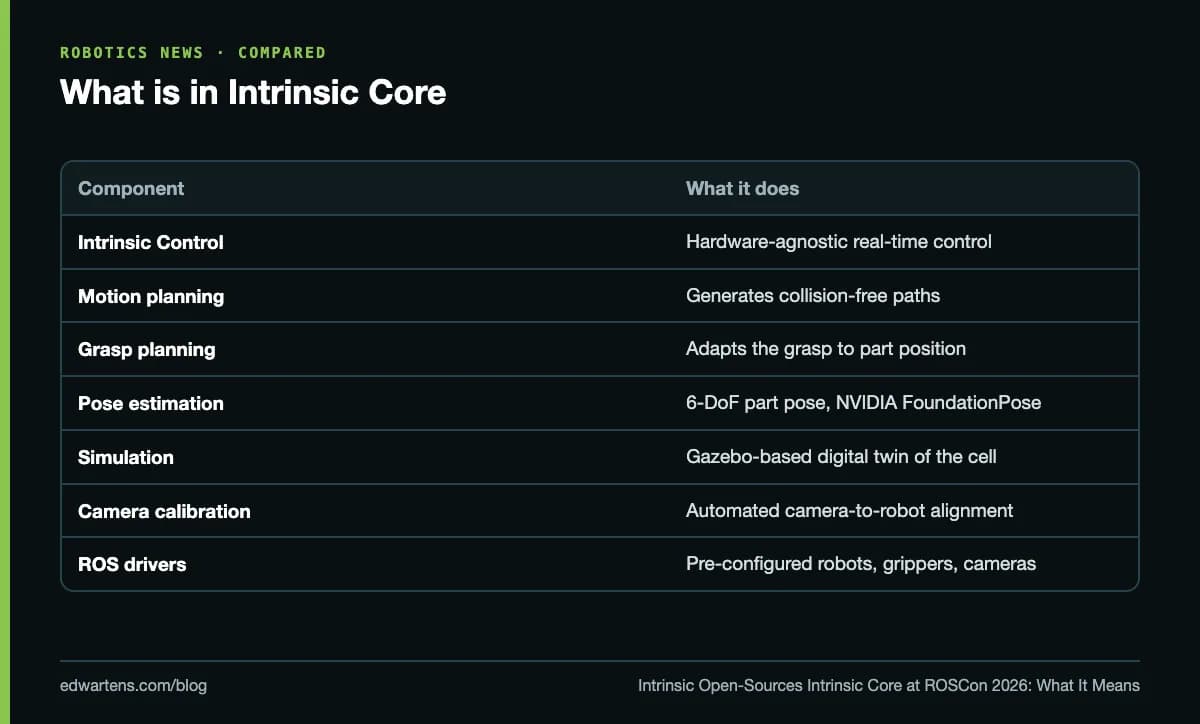
The pieces that matter most to a controls or robotics engineer:
- Intrinsic Control is a real-time control framework that does not assume one robot brand. It can adjust a trajectory while the robot is moving, based on sensor data, which is what you need for anything more adaptive than a taught path.
- Pose estimation uses NVIDIA's FoundationPose model to find a part's position and orientation in six degrees of freedom from a 3D camera. That is the step that lets a robot pick parts that are not in a fixture.
- Motion and grasp planning generate collision-free paths and adapt the gripper's approach to where the part actually is.
- Simulation and calibration use Gazebo for a digital twin of the cell and automate camera-to-robot calibration, one of the most tedious jobs in commissioning a vision-guided cell.
- ROS drivers come pre-configured for supported robots, grippers and 3D cameras.
The README lists ROS 2 Lyrical Luth as the target distribution on Ubuntu 24.04 or 26.04, with Ubuntu 22.04 also supported. The Robot Report notes it covers robot arms only: no mobile robots or humanoids.
How it relates to ROS 2 and MoveIt
Intrinsic Core does not replace ROS 2. The Open Source Robotics Alliance calls it the first of a new generation of ROS distributions: opinionated collections of packages built on top of ROS, Gazebo, ros2_control and Open-RMF for a particular kind of work. ROS stays the plumbing; Intrinsic Core is a ready-assembled kit for industrial arm cells.
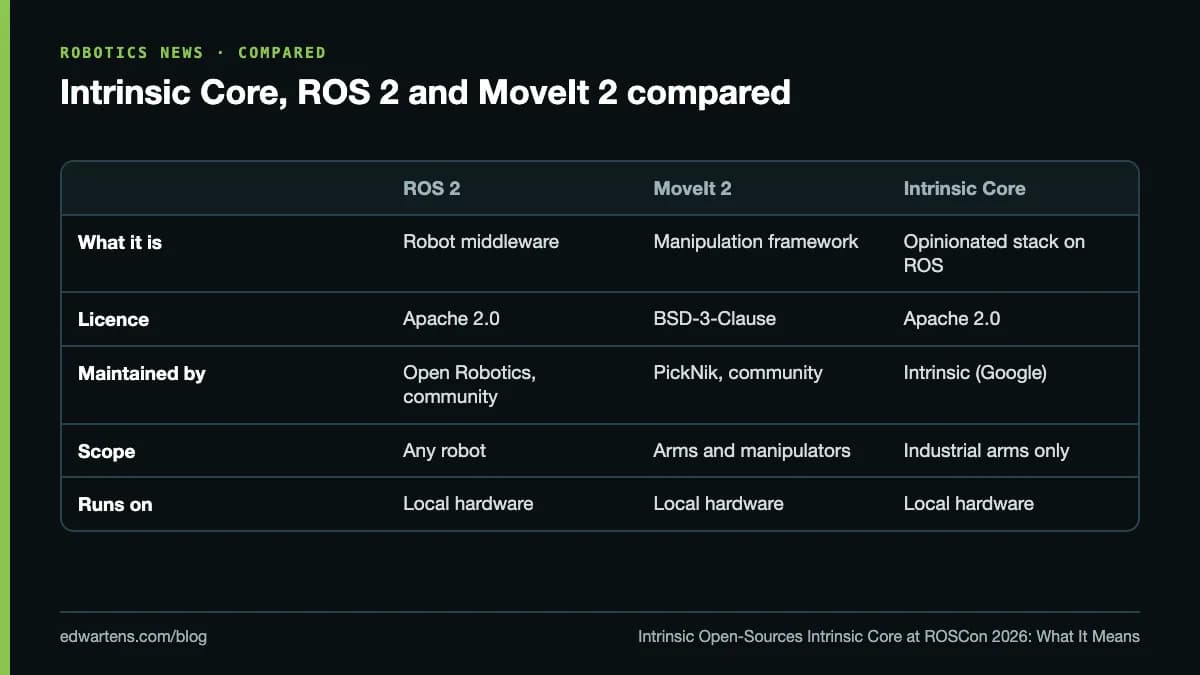
MoveIt 2 also stays in the picture. The OMTS reference uses MoveIt 2 for motion planning, and Intrinsic publishes a MoveIt integration repository alongside the core. The same week, Qualcomm agreed to buy PickNik, MoveIt's maintainer, and promised to keep MoveIt open source; we cover that deal in Qualcomm to buy PickNik: what happens to MoveIt.
Why machine tending first?
Machine tending, a robot loading raw parts into a CNC machine and unloading finished ones, is one of the most common robot jobs in metalworking and one of the hardest to justify in a small, high-mix shop. Every new part traditionally means a new fixture, new teach points and new code. Intrinsic's pitch is that a camera plus AI pose estimation removes the fixture, and planning removes most of the teaching.
The same idea was on the floor at IMTS 2026 in Chicago the week before, where Okuma showed a robot cell with Intrinsic. Our IMTS 2026 highlights cover what else machine-tool builders showed.
What it means for engineers
For robotics engineers and integrators, the release lowers the cost of trying an AI-assisted cell. You can study production-grade code for real-time control, perception and calibration instead of stitching those together from research packages. The licence allows commercial use.
For PLC and CNC engineers, nothing about your side of the cell goes away. A machine-tending cell still needs the CNC door, chuck and cycle-start handshake, a safety system that stops the robot when someone opens the guard, and an interlock scheme that never lets the robot reach into a running machine. Open-source planning software does not certify a cell; the risk assessment and safety functions are still yours to design to ISO 10218 and, in Europe, the Machinery Regulation.
For learners, it is a strong signal about which skills are worth having: ROS 2, simulation, motion planning and 3D vision, on top of classic robot programming. Our guide to free robot programming simulators compares the tools you can use to practise without hardware.
A worked example: what a tending cell's handshake looks like
Whatever runs the robot, the cell is coordinated by signals between the robot controller, the CNC and usually a cell PLC. A typical minimal set:
| Signal | From | To | Meaning |
|---|---|---|---|
| Door open | CNC | Robot | Safe to enter the machine |
| Chuck clamped | CNC | Robot | Part is held, robot may release |
| Robot clear | Robot | CNC | Robot is outside the machine |
| Cycle start | Robot or PLC | CNC | Begin machining |
| Cycle complete | CNC | Robot | Part ready to unload |
| Guard closed | Safety relay | All | Automatic operation permitted |
Intrinsic Core plans how the arm reaches the part. It does not decide when the arm may move. That decision belongs to the interlock logic above, and getting it right is a controls job.
What does Apache 2.0 let you do?
The licence is the reason this release matters to companies, not just researchers. Apache 2.0 is a permissive open-source licence. In practice it means:
- Commercial use is allowed. You can build Intrinsic Core into a product or a customer's cell and charge for it.
- You can modify it and keep your changes private. Unlike copyleft licences such as the GPL, there is no obligation to publish your changes.
- You must keep the notices. Ship the licence text and any NOTICE file, and mark files you changed.
- There is an explicit patent licence from contributors, which is one reason large companies favour Apache 2.0.
It does not mean every dependency carries the same terms. A robot cell built on Intrinsic Core will also pull in ROS packages, drivers and machine-learning models with their own licences. Check them before you ship, exactly as you would with any other software bill of materials.
How does it compare with vendor robot software?
Most industrial robots today are programmed with the manufacturer's own tools: a teach pendant, plus offline software such as FANUC ROBOGUIDE, ABB RobotStudio or URSim for Universal Robots. Those tools are excellent for taught, repeatable paths, and every robot technician should know at least one of them.
| Question | Vendor tools | Intrinsic Core |
|---|---|---|
| Who supports it? | The robot maker | Intrinsic and the community |
| Works across brands? | No, one brand each | Yes, through drivers |
| Taught paths | Core strength | Possible, not the focus |
| Vision and AI planning | Add-on options | Built in |
| Cost | Licence fees for offline tools | Free, Apache 2.0 |
The two are not rivals for most engineers. In a machine-tending cell built on Intrinsic Core, the robot still runs on its own controller with its own safety functions; the open stack sends it motion commands through a driver. Knowing the vendor side is what lets you commission and fault-find such a cell.
What we do not know yet
How many companies will build on Intrinsic Core, how quickly drivers for other robot brands appear, and how Intrinsic will govern outside contributions are all open questions. A permissive licence makes adoption easy; long-term maintenance is what makes it safe to depend on. Watch the repository's issue activity and release cadence over the next few months before betting a product on it.
Learn the skills free
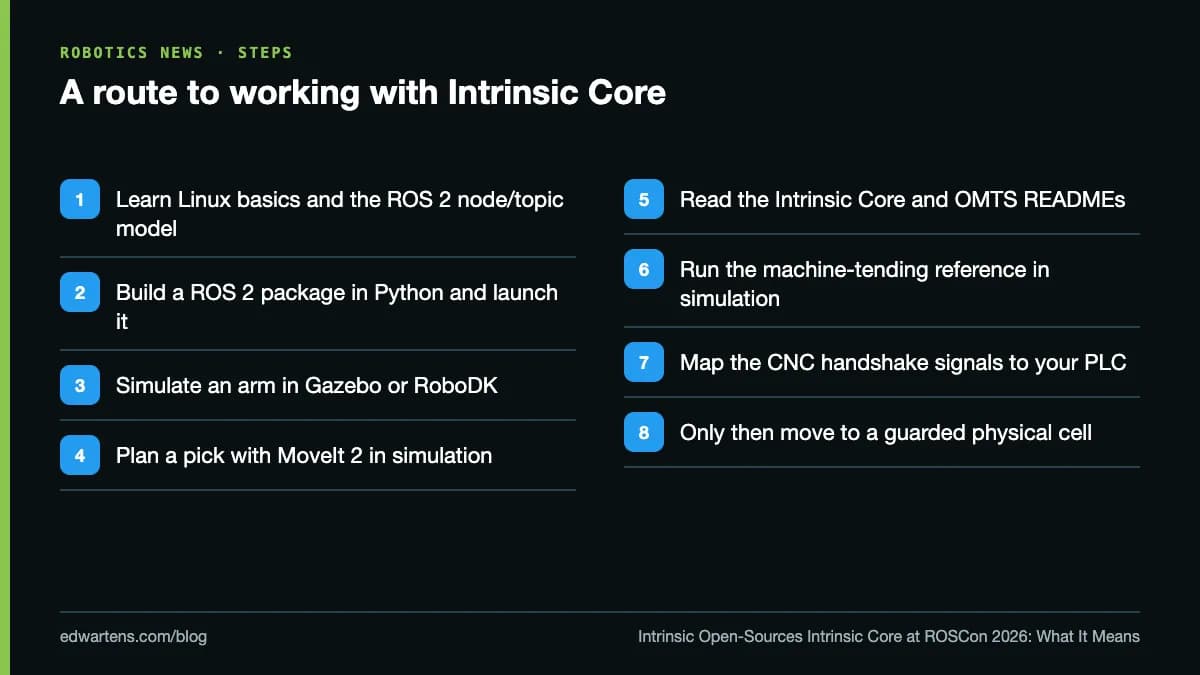
Start with the free ROS 2 Robot Programming with Python course for nodes, topics, launch files and simulation. Practise cell layout and reach studies in RoboDK Offline Programming, then learn the two robot families OMTS supports in Universal Robots with PolyScope and FANUC Robot Programming. The robotics learning path puts them in order, and our industrial robotics training guide explains how the pieces fit. For the wider picture, read our digital twins in manufacturing explainer. Our Universal Robots pick-and-place tutorial is a quick first program on one of those arms.
All courses are free in full. An optional EDWartens Certificate of Completion, from US$2.99, is available after the final assessment and can be checked at edwartens.com/verification. It is not a vendor certification and is not accredited.
Take the free course


Questions
What is Intrinsic Core?
Intrinsic Core is an open-source set of ROS-compatible capabilities for building industrial robot applications: real-time control, motion and grasp planning, pose estimation, simulation, camera calibration and pre-configured drivers. Intrinsic, the robotics group that joined Google in 2026, released it at ROSCon 2026 in Toronto on 22 September 2026.
Is Intrinsic Core free to use commercially?
It is released under the Apache 2.0 licence, a permissive licence that allows commercial use, modification and redistribution as long as you keep the licence and notices. As with any open-source dependency, check the licences of the third-party packages it pulls in, such as the pose-estimation model.
Does Intrinsic Core replace ROS 2?
No. It is built on top of ROS and the Open Robotics suite (ROS, Gazebo, ros2_control and Open-RMF). The Open Source Robotics Alliance describes it as the first of a new generation of ROS distributions: opinionated collections of packages for a specific job.
Which robots does Intrinsic Core support?
It targets industrial robot arms, not mobile robots or humanoids. The Open Machine Tending Solution released with it supports robots from FANUC and Universal Robots, and the drivers cover a range of grippers and 3D cameras.
What is the Open Machine Tending Solution?
It is an open reference design, published alongside Intrinsic Core, for an AI-enabled robot cell that loads and unloads a CNC machine. It shows the whole loop from cell set-up and simulation to MoveIt 2 motion planning and deployment on hardware, and can be customised for different machines and robots.
Sources
- The Robot Report: Intrinsic open sources key parts of its platform (22 September 2026)
- SiliconANGLE: Google's robotics unit Intrinsic open-sources its foundational infrastructure
- Open Source Robotics Alliance: Intrinsic Core, the first of a new generation of ROS distributions
- Robotics & Automation News: Intrinsic open sources core industrial robotics technology
- GitHub: intrinsic-ai/intrinsic-core (Apache 2.0)
- GitHub: intrinsic-ai/intrinsic-omts (Open Machine Tending Solution)
Written by the EDWartens engineering team for general education. Product names are trademarks of their owners; mentioning them does not imply endorsement. Prices and terms of other providers were checked on the date shown and can change.

Humanoid Robots in Factories in 2026: Real Deployments vs Hype

Your First FANUC Teach Pendant Program, Step by Step (Video)
Cobot Training: How to Program Collaborative Robots Safely

IFR World Robotics 2026: 5 Million Robots and What It Means for Engineers

Free Industrial Robotics Courses With Certificate (for Adults and Engineers)

ABB RobotStudio: Your First Pick-and-Place in RAPID (Video)