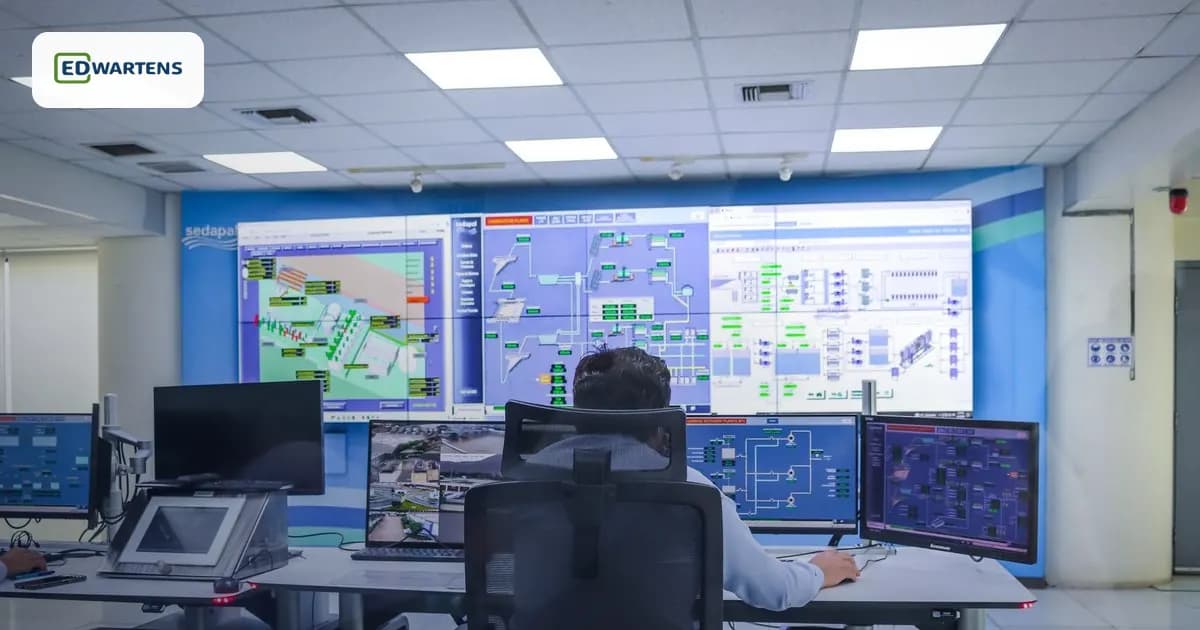
An OT security career starts with learning how a plant control system works, then how it is attacked and defended. You can begin with no experience: about 12 weeks of free study covers control basics, protocols, zones, IEC 62443 and monitoring, and a simulated plant lets you practise the job's main tasks without one. This guide gives the route week by week, the skills list the US NICE framework uses, the free training that exists, and an honest note on what no course can promise.
OT means operational technology: the PLCs, drives, HMIs and networks that run physical processes. OT security protects those from cyber attack without stopping the plant. The Mike Holcomb video below is a good eight-minute start.
What an OT security analyst does in a week
The NICE Workforce Framework (NIST SP 800-181 Rev 1) names this work. Its role "Operational Technology (OT) Cybersecurity Engineering" (ID DD-WRL-009, version 2.2.0) lists 38 tasks, 44 knowledge items and 26 skills, which we read on 23 November 2026. Among them are building OT asset inventories, assigning assets to zones, and knowing the levels of the Purdue model.
Put plainly, a week usually mixes these jobs:
- Inventory. Finding what is on the plant network and writing it down. You cannot protect a device nobody knows about.
- Monitoring. Watching network traffic for things that should not be there, such as a new device or a remote session.
- Vulnerability triage. Deciding which weakness matters, and what can wait for a planned outage.
- Incident response with the plant team. Working with operators and engineers, because the right answer may be to keep the process running.
This is our summary of the framework, not a job description from one employer. Real posts vary a lot, so read the ones you want.
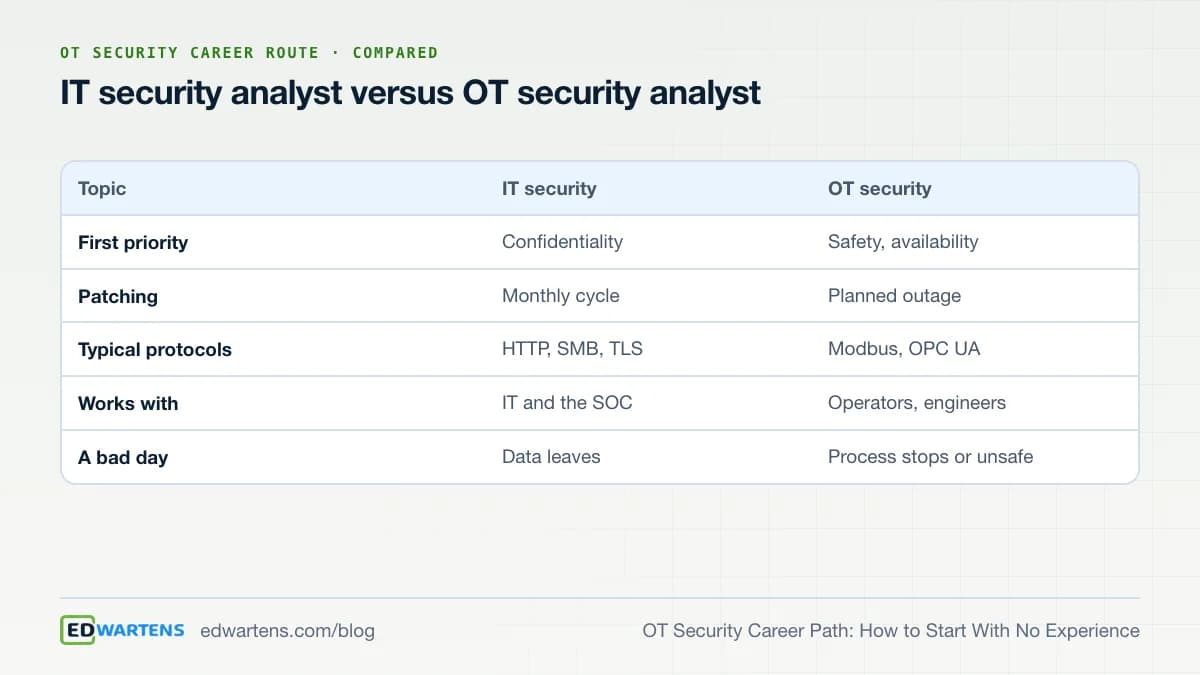
Which background you start from
Where you begin decides what to learn first.
| You are | You already have | Learn first |
|---|---|---|
| IT security staff | Networks, logs, risk, access control | What a PLC, HMI and SCADA do, and the scan cycle |
| Controls or PLC engineer | The plant, the process, the vocabulary | Network basics and security fundamentals |
| Student or career changer | Time and curiosity | Both, in the order of the route below |
If you come from controls, our cybersecurity for PLC programmers course starts from controllers you already program. If you come from IT, the ICS Security Foundations course assumes no plant knowledge and takes about five hours.
The five things to learn, in order
- Control system basics. What a PLC does, how it scans, what an HMI and SCADA are. See our cybersecurity in industrial automation overview.
- Industrial protocols. Modbus and OPC UA first. They were designed for reliability, and many have no built-in security, which is why you segment networks.
- The Purdue model, zones and conduits. A way to draw a plant network in levels and decide what may talk to what. Read the Purdue model explained.
- IEC 62443. The family of standards for industrial automation security. Start with what IEC 62443 is and the IEC 62443 explained guide.
- Monitoring. Passive network monitoring is a common first technique in plants, because it does not touch the process. See Zeek for ICS.
Do not skip step 1 because it looks easy. Most beginner mistakes in OT come from not knowing how a plant works.
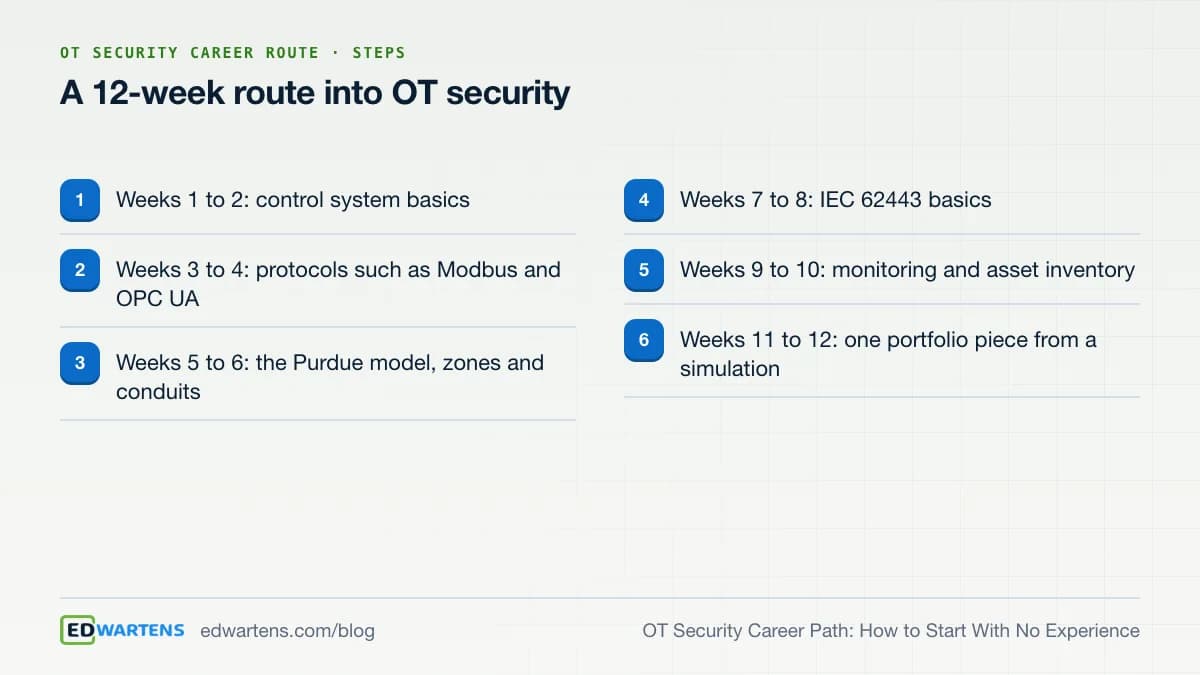
Your OT security career in 12 weeks
This route assumes about one focused study block a day. It is a plan, not a promise of a job.
A zone map is the output people find hardest to picture, so here is a small illustrative one. It follows the Purdue levels and is an example we made up, not a real plant.
| Zone | Purdue level | Typical contents | An example rule |
|---|---|---|---|
| Enterprise | 4 and 5 | Business systems, email | Never talks straight to the control zone |
| Demilitarised zone | 3.5 | Remote-access gateway, data relay | The only path between business and plant |
| Site operations | 3 | Historian, SCADA servers | Only the historian may send data up to the DMZ |
| Area control | 2 | HMIs, engineering stations | Engineering station can program only its own PLCs |
| Control and field | 1 and 0 | PLCs, drives, sensors | Accepts commands only from the zone above |
A conduit is the controlled path between two zones, and each conduit has a rule about what may use it. Writing a rule like the examples above, with a reason, is the skill a hiring manager wants to see.
| Weeks | Focus | Output you keep |
|---|---|---|
| 1 to 2 | Control basics | A one-page diagram of a plant's control layers |
| 3 to 4 | Protocols | Notes on what Modbus and OPC UA expose |
| 5 to 6 | Purdue model, zones | A zone and conduit map |
| 7 to 8 | IEC 62443 basics | A summary of the requirements you would apply |
| 9 to 10 | Monitoring, inventory | An asset inventory of a simulated network |
| 11 to 12 | Portfolio piece | One written case, such as a remote-access incident |
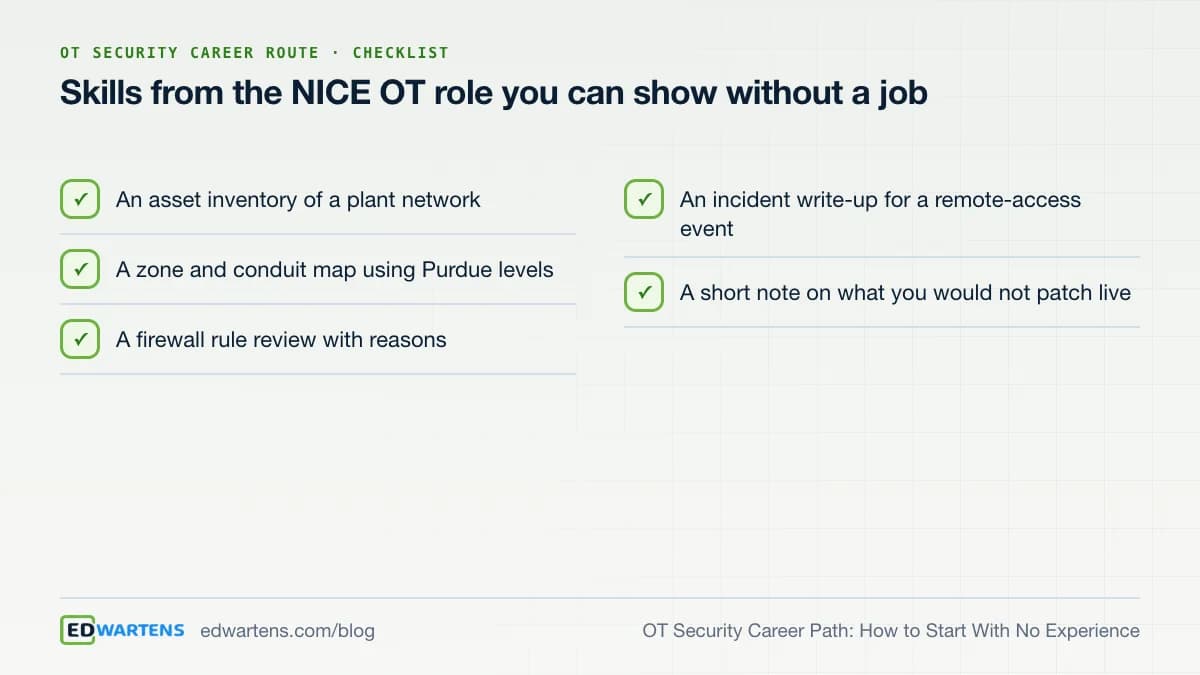
The outputs matter more than the weeks. A hiring manager cannot see that you studied, but can read a zone map.
Free training you can start today
From CISA. The US Cybersecurity and Infrastructure Security Agency lists ICS training available through CISA, which we read on 23 November 2026. It includes self-paced online courses of about an hour each, for example ICS Cybersecurity Practices (100W), and regional instructor-led events named Introduction to ICS Cybersecurity (101) with no tuition cost. Know the limits: registration for the online courses needs a corporate, government, military or educational email address, and CISA selects who may take them. It is not open enrolment.
From EDWartens. These courses are free to learn in full, with a free account: ICS Security Foundations, OT and ICS Cybersecurity with ISA/IEC 62443 and OT Security Assessment. The hub is on the OT and ICS course page. The optional certificate of completion for a beginner course is a one-off US$8.99. Anyone can check it at verification, and it is an EDWartens certificate, not a vendor credential.
Practise with no plant
Reading about zones is not the same as drawing them. Two EDWartens tools let you practise safely.
- The OT security lab in EDWartens Lab: segment a plant network and spot what should not be there. It is free with a free account and runs in the browser.
- The OT Security Analyst job simulation: a working day at a simulated company with an asset inventory, zones and conduits, and a remote-access incident. It is free to start. It is practice, not a job, and the company is simulated.
The free Cybersecurity internship runs for 4 weeks, online, with IT and OT topics and IEC 62443 zones. It is a training programme, not employment, and pays no stipend.
Mistakes beginners make
- Starting with tools. Learning a packet analyser before you know what a PLC does gives you traffic you cannot read.
- Patching like IT. A fix that needs a restart may need a planned outage, and the plant team decides when.
- Ignoring the people. Operators and maintenance staff know the process. A good analyst asks them first.
- Collecting certificates instead of proof. A zone map and an incident write-up say more than a list of course names.
Certifications, and when to take them
GovInfoSecurity's career piece of 9 October 2024 suggests this order: IT security basics (Security+ or CISSP), then OT systems and GICSP, then NERC CIP and ISA/IEC 62443 knowledge. We cannot verify the whole path for you, and the author's pay figure is a single 2024 source, so we do not quote it.
Our advice is simple. Do the free work first. You will know within a few weeks whether you like the job, and you can then choose an exam with a reason. Be cautious about buying an expensive exam as step one. For the entry-level exam question, read our view of whether ISC2 CC is worth it and the guide to free IEC 62443 training.
What a first application looks like
Keep it short and show your work. A CV with a link to a short portfolio beats a long list of course titles. Add the asset inventory, the zone map and the incident write-up. Describe the training honestly: "free course and simulation", not "work experience". Our post on an engineering portfolio from course projects shows how to present them.
Look for roles on the EDWartens jobs board, which lists roles from company career pages by country and skill. Applications happen on the employer's own page. EDWartens is not a recruitment agency and promises no job.
OT security also touches new AI tools: if your plant is thinking about connecting AI to controllers, our guide to MCP for engineers shows why security comes first. And if you are crossing over from software, see software engineer to controls engineer.
Practise with us
Internship
Cybersecurity (IT and OT)
Free internship: 4 weeks, a free certificate and nothing to buy. The Engineer-verified internship adds an engineer's review and the graded certificate.
See the internshipRoles
OT security
Roles that ask for this skill, 3 open in this country now. Free to see and to apply. We are not a recruitment agency.
See rolesTake the free course
 Free
Cybersecurity · Beginner · Free
ICS Security Foundations: Control Systems, Defence in Depth and the 62443 Requirements
 Free
Cybersecurity · Intermediate · Free
OT and ICS Cybersecurity with ISA/IEC 62443
 Free
Cybersecurity · Intermediate · Free
OT Security Assessment: Testing a Plant Without Stopping It
 Free
Cybersecurity · Intermediate · Free
Cybersecurity for PLC Programmers: Hardening Siemens and Rockwell Controllers
Questions
How do I get into OT security with no experience?
Learn how a plant control system works first, then the Purdue model, zones and conduits, IEC 62443 and monitoring. Build one portfolio piece, such as an asset inventory and zone map, from free training and a simulation, then apply.
Do I need a PLC or engineering background for OT security?
Not to start, but you need to understand what a PLC, an HMI and a SCADA system do, because you protect them. IT security staff can learn that in a few weeks; controls engineers need the security vocabulary instead.
What is the difference between IT and OT security?
IT security protects data first. OT security protects safe, continuous physical processes first, so patching waits for planned outages and a wrong move can stop a plant. The tools overlap, but the priorities and the people you work with differ.
Which certifications matter for ICS and OT security?
GovInfoSecurity's 2024 career piece suggests IT basics such as Security+ or CISSP, then GICSP for OT, then NERC CIP and ISA/IEC 62443 knowledge. An EDWartens certificate of completion is not any of these and says so on its face.
Is OT security a good career in 2026?
It is a named work role in the NICE framework, and trade press has described growing demand. No one can promise you a job, so test the fit cheaply first: take the free courses and a simulation before you invest in an exam.
Can I practise OT security without access to a real plant?
Yes. A simulated plant lets you do asset inventory, zones and conduits and incident handling safely. EDWartens Lab has an OT security lab, and the OT Security Analyst job simulation gives you those tasks as a working day. Both are training, not employment.
Sources
- NICE Framework work role: Operational Technology (OT) Cybersecurity Engineering, DD-WRL-009, v2.2.0 (read 23 November 2026)
- CISA: ICS training available through CISA (read 23 November 2026)
- GovInfoSecurity: Career Spotlight, Growing Demand for OT Security Experts, 9 October 2024 (read 23 November 2026)
Written by the EDWartens engineering team for general education. Product names are trademarks of their owners; mentioning them does not imply endorsement. Prices and terms of other providers were checked on the date shown and can change.

Iran-Linked PLC Attacks in 2026: CISA's Warning and a UK Power Plant Outage

Cyber Resilience Act Reporting Obligations: What Machine Builders and OEMs Must Do Now

Building Automation Cybersecurity: Risks and Standards

Fake Internship Checklist: 10 Signs and How to Check

Controls Engineer Certifications: CAP, CCST and More

Do Online Courses Count as CPD or PDH for Engineers?