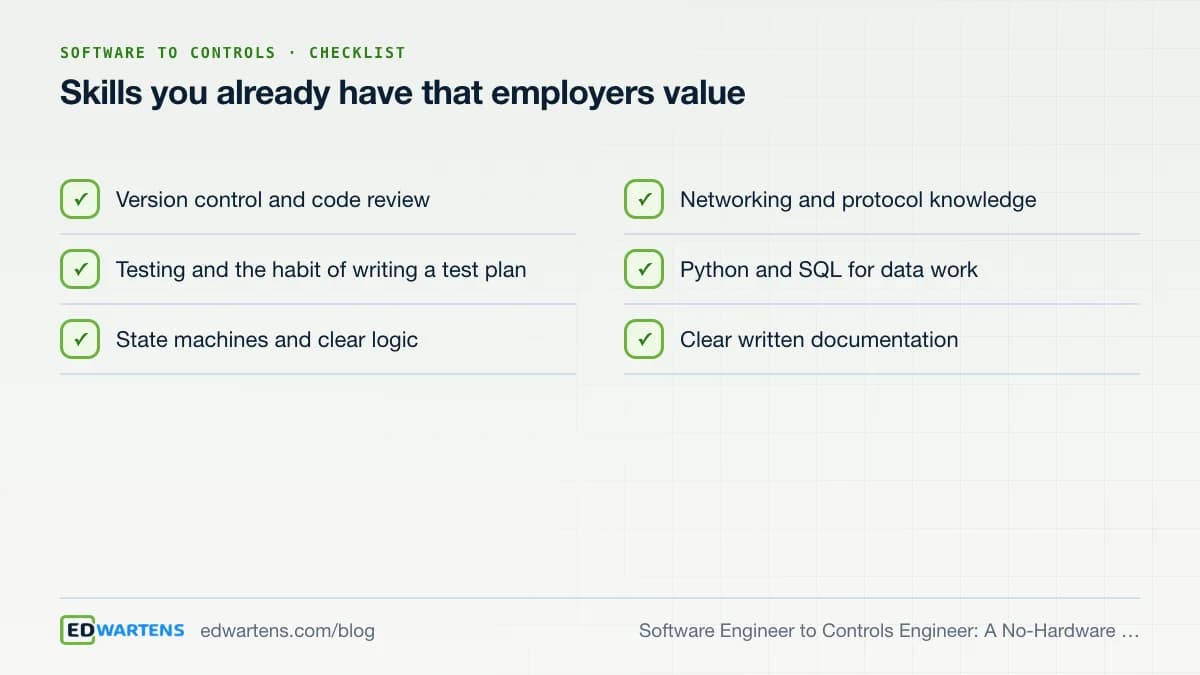
Software engineer to controls engineer is a realistic move, and you can start without buying any hardware. Your logic, testing and state-machine habits carry over. What is new is the scan cycle, input and output wiring, electrical basics and safety. You can learn the logic on a free soft PLC and a browser lab, and then decide with evidence whether plant work suits you. This guide shows what carries over, what does not, and a 12-week plan.
We do not promise a job or a salary. Controls work is not for everyone, and the honest first step is to try it cheaply.
Software engineer to controls engineer: who it suits
It suits you if you like seeing code move something physical, you are comfortable in a plant or a workshop, and you accept that safety rules slow you down on purpose. It may not suit you if you want to work only from home, deploy many times a day or avoid travel. Controls work often includes time on site and changes made during planned stops. Ask about that in every interview.
It also may not suit you if you dislike safety paperwork. Lockout, permits and sign-off forms are part of the work, and they exist because a mistake can hurt someone. If that sounds like a reasonable price for seeing your code run a machine, read on.
The wider job market is part of why people look. The US Bureau of Labor Statistics projects employment of software developers, quality assurance analysts and testers to grow 10 per cent from 2025 to 2035. For electrical and electronics engineers it projects 8 per cent over the same years, with about 16,300 openings a year (both read 23 November 2026). The New York Fed reports unemployment among recent graduates, all majors, at 5.2 per cent in 2026 Q3. None of that tells you whether controls suits you. It only shows that the picture is mixed, and that planning a second route is reasonable.
What carries over, and what is new
| You already know | How it helps | What is new |
|---|---|---|
| Logic and state machines | Sequences are state machines | The program runs as a repeating scan |
| Testing | You will write test plans naturally | Tests are formal and signed off |
| Version control | Projects need it too | Check how your PLC software stores projects first |
| Networking | Industrial networks are networks | Protocols such as Modbus and OPC UA, and isolated plant networks |
| Python and SQL | Useful for data and tools | They sit beside the PLC, not inside it |
| Documentation | Clear specs matter more | Drawings and I/O lists are the documents |
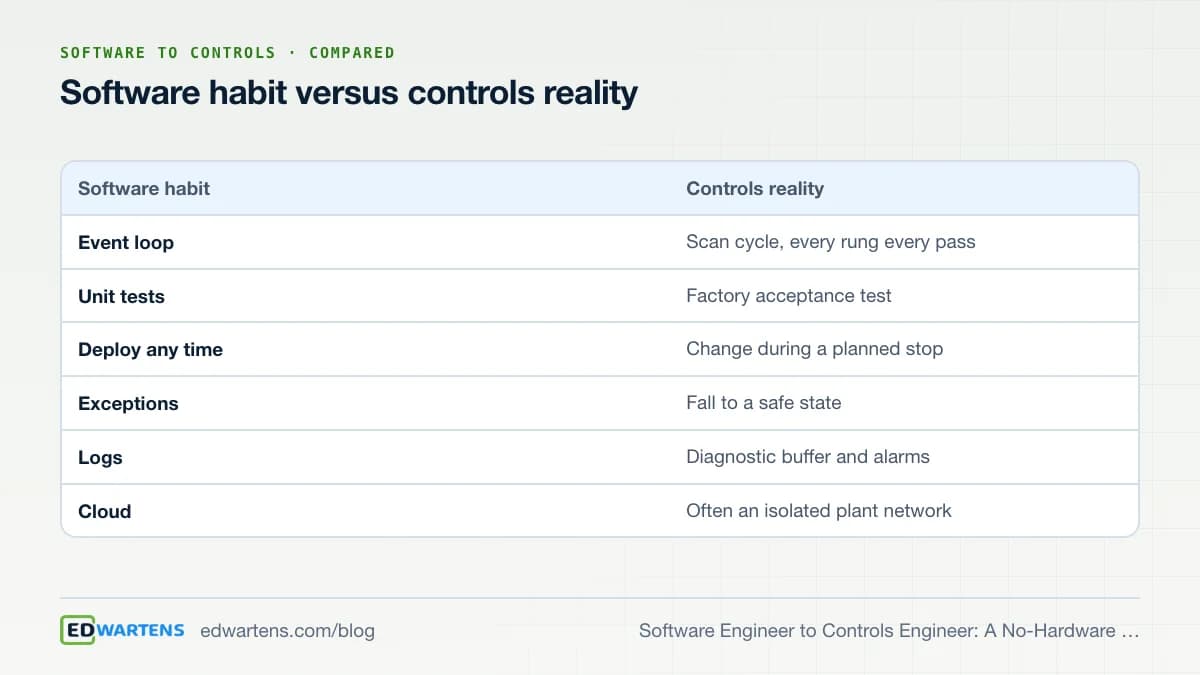
Two differences matter most. The first is that the output is physical. A bug in a web app shows an error. A bug in a motor starter can damage a machine or hurt someone, which is why controls teams test heavily and change slowly. The second is that safety is not decided by your code. Safety functions use certified devices and rules, and the control program works inside those limits.
The one idea to learn first: the scan cycle
A PLC does not wait for events the way an event loop does. It repeats a fixed cycle: read all the inputs, run the program from the top, write all the outputs, then start again. Every rung runs on every pass, whether or not anything changed.
That changes how you think. Order matters, because a value set later in the program is read earlier on the next scan. A timer is a counter driven by scans, not a callback. A one-shot is an edge detected by comparing this scan to the last one.
The video below explains the cycle in under ten minutes, and our PLC scan cycle explained post goes into detail.
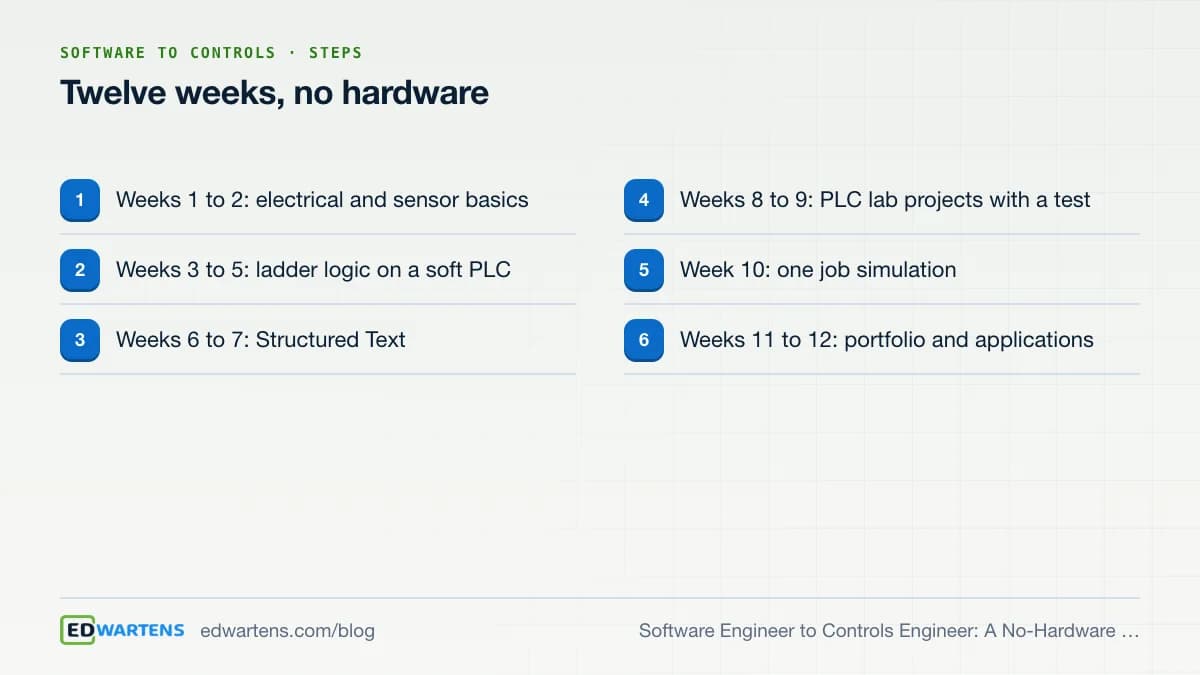
A no-hardware practice plan
Everything in this plan runs on your computer.
- Electrical and sensor basics. Volts, amps, a contactor, a sensor with a sinking or sourcing output. The free Electrical Fundamentals for Technicians course covers these.
- A soft PLC. CODESYS and OpenPLC are free and follow IEC 61131-3. Write start/stop, a seal-in, timers and counters.
- A brand course. Siemens TIA Portal in Three Hours is a fast look at the most common brand. See TIA Portal or Studio 5000 for the choice.
- Lab projects with a test. Run the lab's machines until the automatic test passes.
- A job simulation. Do a working day as a PLC programmer, then write what you learned.
What your first week could look like
A realistic first week uses about an hour a day, and none of it needs hardware.
| Day | Task | What you learn |
|---|---|---|
| 1 | Install CODESYS or OpenPLC, write start/stop with a seal-in | Latching and the scan |
| 2 | Add a timer so the motor stops after ten seconds | Timers are scan-driven |
| 3 | Add a counter that stops a conveyor after twelve parts | Counters and resets |
| 4 | Read a simple wiring diagram, write the I/O list | How logic meets wiring |
| 5 | Write a short test plan, run it, note one surprise | Testing as a habit |
By the end you will know whether the work holds your interest.
IEC 61131-3 for programmers
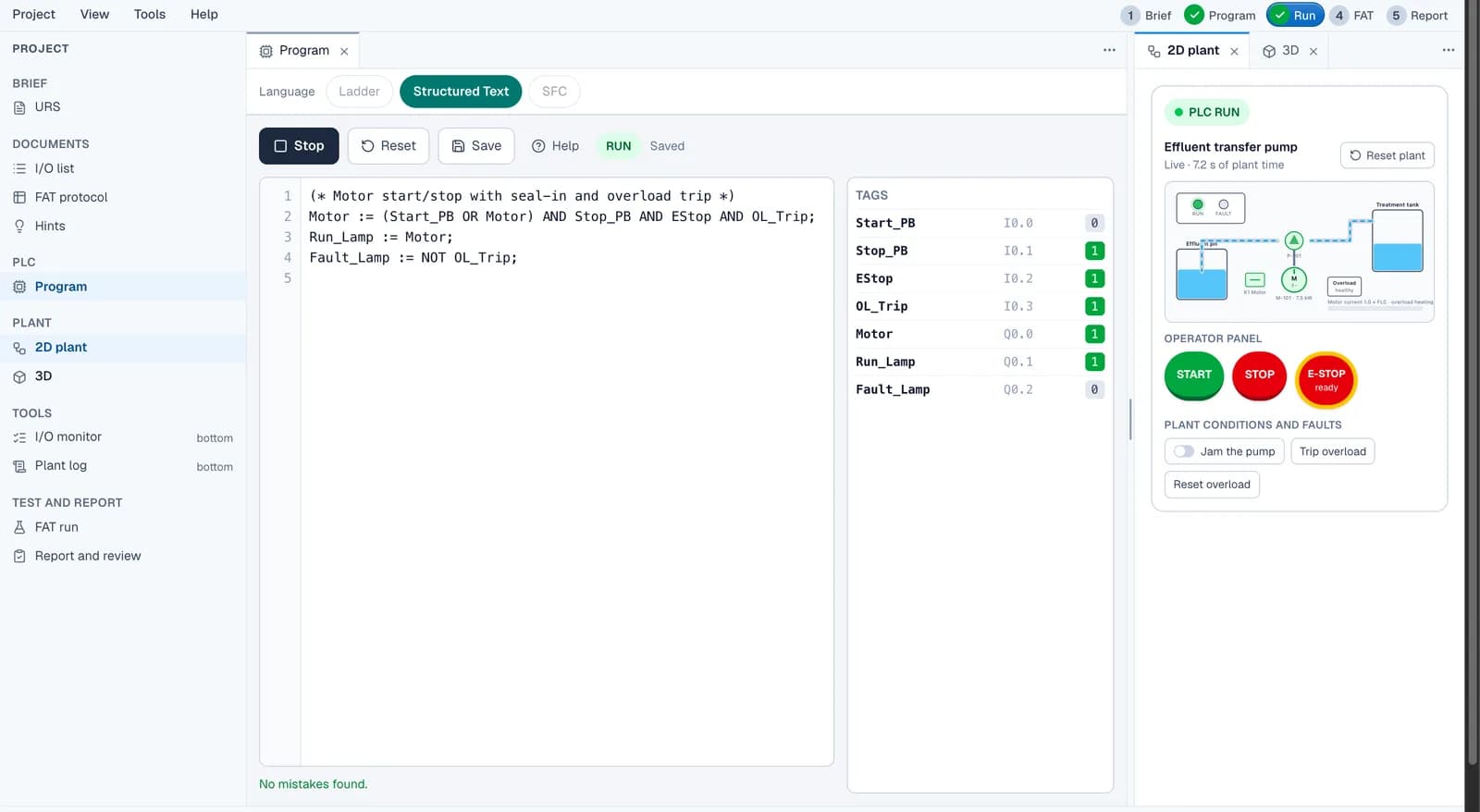
IEC 61131-3 is the standard that defines the PLC languages. Ladder logic is graphical and mirrors relay circuits. Structured Text looks like Pascal and will feel familiar. Function blocks and sequential function charts arrange larger programs. Our top PLC programming languages in 2026 post compares them.
Do not skip ladder because Structured Text feels comfortable. Maintenance staff often read ladder on the shop floor, and many existing programs are written in it. A good controls engineer reads both, and uses text for maths and data handling.
Our post on Python for automation engineers shows where your Python skills fit. If you use an AI coding assistant, the AI Coding for Engineers course covers how to use one safely in engineering work.
Entry roles and where software skills help
Do not copy a job title. Read real posts, and compare what they ask for. Areas where a software background often helps include data collection and dashboards, SCADA and HMI development, test tools, and commissioning support. The how to become a controls engineer guide describes the usual routes and the controls engineer certifications guide describes the exams that exist. The EDWartens jobs board lists roles from company career pages by country and skill. Applying happens on the employer's own page, and EDWartens is not a recruitment agency.
Questions to ask a controls employer
Because the day-to-day varies, ask direct questions before you accept a role.
- How much of the work is on site, and how much is at a desk?
- Who signs off a change, and how is it tested?
- Which PLC brands and which software versions do you use?
- How do you handle work during planned stops, including out-of-hours work?
- What training and supervision does a new starter get?
The answers tell you more than a job title does.
A 12-week plan and a portfolio that proves it
The plan above is a schedule you can follow. For how long learning takes in general, see how long to learn PLC programming. For the free route in detail, see how to learn PLC programming for free.
A portfolio proves what a CV only claims. Keep three items.
- A PLC program with its I/O list and a pass result on a test.
- A short write-up of one fault you found and how you fixed it.
- One project of your own, such as the PLC traffic light with a pedestrian crossing.
Our guide to an engineering portfolio from course projects shows how to present them.
Practise in a free lab
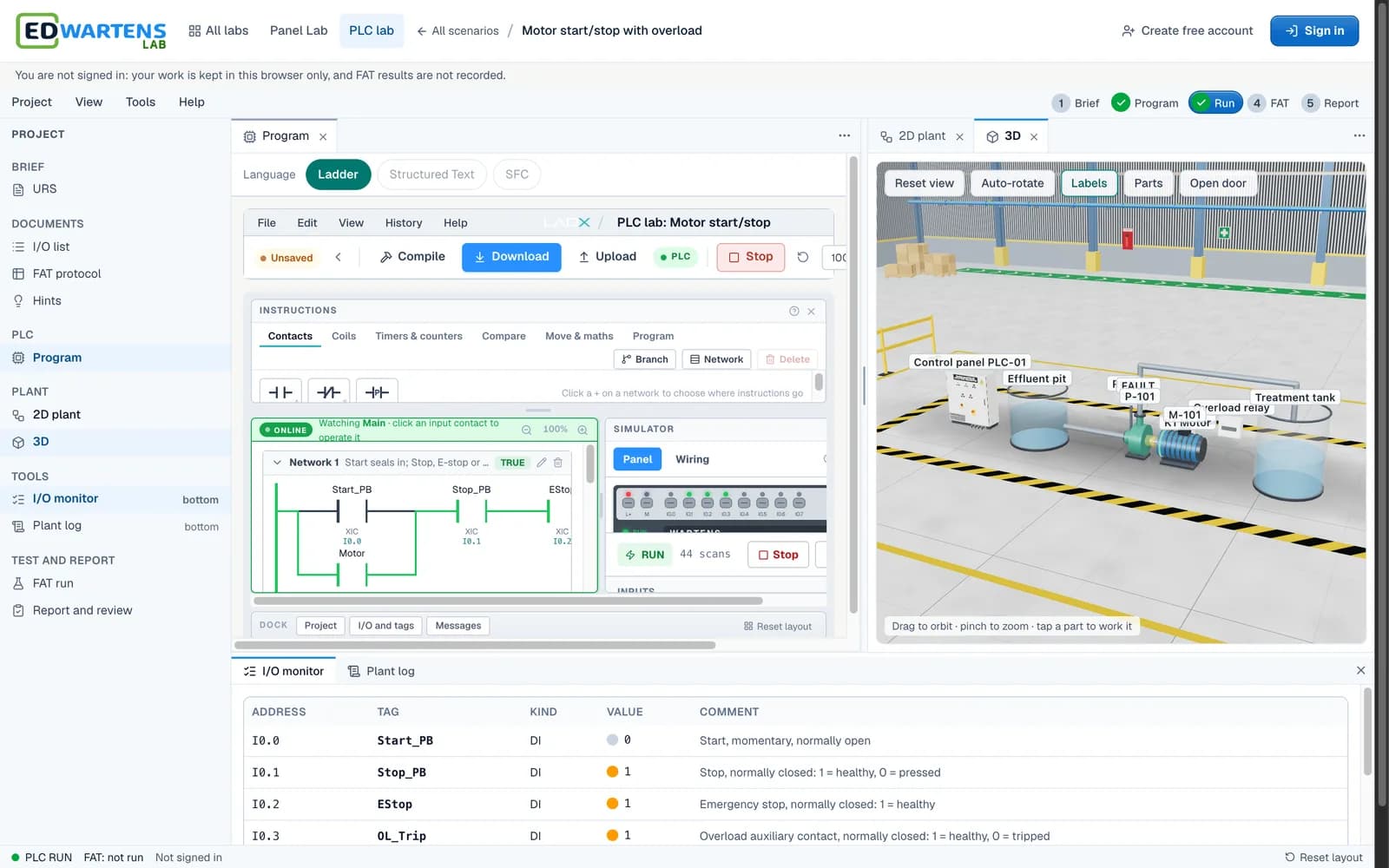
EDWartens Lab has a PLC lab with eight machines. You program in ladder, Structured Text or SFC, the machine responds in 2D and 3D, and a numbered factory acceptance test runs automatically. It is free with a free account and runs in the browser. It is a learning engine with Siemens-style addressing, not a vendor PLC. For a simple start, read the free PLC simulator guide and how to become a PLC programmer.
The PLC Programmer job simulation walks you through an I/O list, a program, a test and a change request as a working day at a simulated company. It is practice, not employment. The free PLC internship runs for 4 weeks online and is a training programme with no stipend.
Every course is free to learn in full. The optional certificate of completion for a beginner course is a one-off US$8.99, and anyone can check it on the verification page. It is an EDWartens certificate, not a vendor credential.
Practise with us
Internship
PLC Programming
Free internship: 4 weeks, a free certificate and nothing to buy. The Engineer-verified internship adds an engineer's review and the graded certificate.
See the internshipRoles
PLC and automation
Roles that ask for this skill, 177 open in this country now. Free to see and to apply. We are not a recruitment agency.
See rolesTake the free course
 Free
PLC programming · Beginner · Free
CODESYS and IEC 61131-3 Programming
 Free
PLC programming · Beginner · Free
OpenPLC: IEC 61131-3 on Arduino, ESP32 and Raspberry Pi
 Free
PLC programming · Beginner · Free
Siemens TIA Portal in Three Hours
 Free
AI and machine learning · Beginner · Free
AI Coding for Engineers: Claude Code, Cursor and Copilot
Questions
Can a software engineer become a PLC programmer?
Yes. Programmers already hold the hardest habit, logical thinking. The new parts are the scan cycle, input and output wiring, electrical basics and safety. A free soft PLC and a lab let you learn them before you apply for any role.
Do I need an electrical engineering degree to be a controls engineer?
Many controls engineers have an electrical or automation degree, and the US Bureau of Labor Statistics says electrical and electronics engineers typically need a bachelor's degree. Controls roles vary, so read real job posts and see what they ask for.
How long does it take a programmer to learn PLC programming?
It depends on your time and your target role. Our 12-week plan is a schedule, not a measured average. Most programmers can write simple ladder logic quickly. Wiring, safety and commissioning knowledge take longer and come with practice.
Is controls engineering a good career change from software?
It suits people who like machines and see the result of code in the real world. It involves plant visits, safety rules and changes made during planned stops. Try the free steps first and decide on evidence, not on a headline.
Which PLC software should a programmer start with?
Start with CODESYS or OpenPLC, because both are free and follow IEC 61131-3. Then learn the brand your target employers use, usually Siemens TIA Portal or Rockwell Studio 5000. Read job posts in your region before you choose.
Can I learn PLC programming without buying a PLC?
Yes. A soft PLC runs on your computer, and a browser lab such as EDWartens Lab runs ladder logic with a simulated machine and an automatic test. Hardware helps later, but it is not needed to learn the logic.
Sources
- US Bureau of Labor Statistics: Software Developers, Quality Assurance Analysts, and Testers, page modified 27 August 2026 (read 23 November 2026)
- US Bureau of Labor Statistics: Electrical and Electronics Engineers (read 23 November 2026)
- New York Fed: The Labor Market for Recent College Graduates (read 23 November 2026)
Written by the EDWartens engineering team for general education. Product names are trademarks of their owners; mentioning them does not imply endorsement. Prices and terms of other providers were checked on the date shown and can change.

PLC Counters CTU, CTD and CTUD Explained With a Video Demo
CODESYS for Free: Learn IEC 61131-3 Without Buying a PLC

Automation Engineer Career Guide 2026: Roles, Skills and a Free Learning Route

AICTE Internship: Rules, Portal and Online Options

Internship Certificate Format: What It Must Show

Internship Certificate Verification: How to Check One