PACK EXPO 2026
PACK EXPO International 2026: Automation to Watch (Oct 18-21)
PACK EXPO International 2026 opens in Chicago on 18 October with more than 2,600 exhibitors. The show facts, the controls technology behind the booth headlines, what to ask exhibitors, and how to learn each skill free.
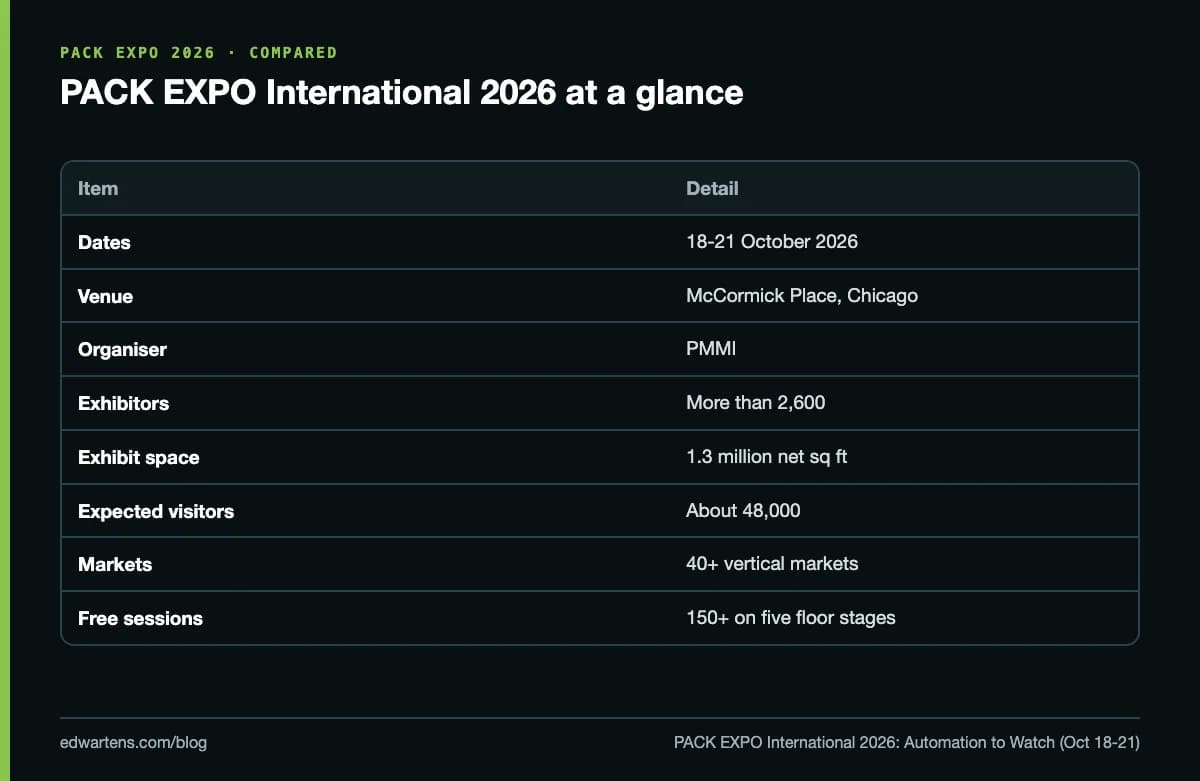
PACK EXPO 2026, formally PACK EXPO International 2026, runs from 18 to 21 October 2026 at McCormick Place in Chicago. PMMI, the organiser, expects more than 2,600 exhibitors on 1.3 million net square feet and about 48,000 visitors from over 40 markets, and calls it the largest edition yet. For controls engineers, the show is a preview of where packaging machines are going: more servo, more independent-cart transport, recipe-driven changeovers, vision-guided robots and standard machine states.
Checked 5 October 2026 against PMMI's announcement and exhibitor press releases. We will update this post after the show.
PACK EXPO 2026: the show in brief
PMMI, The Association for Packaging and Processing Technologies, holds PACK EXPO International in Chicago every two years. PMMI's show announcement lists themed pavilions, including Logistics, Confectionery, PACKage Printing, Healthcare Packaging, Containers and Materials, Reusable Packaging and a Food and Beverage Processing Zone, plus more than 150 free education sessions on five floor stages. It highlights AI-driven equipment, robotics, automation and sustainability as answers to the workforce shortages packaging plants face.
Exhibitor announcements give a flavour of the automation on show. ABB's Machine Automation division (B&R) will show adaptive automation in booth S-2451, including a new compact conveyor demonstration with integrated diversion, intelligent motion control, simulation and hygienic automation. RND Automation will run a pouching machine live and display a FANUC M-710 industrial robot in booth N-5115, according to its press release. Expect many similar stands across the halls.
The controls technology behind the booth headlines
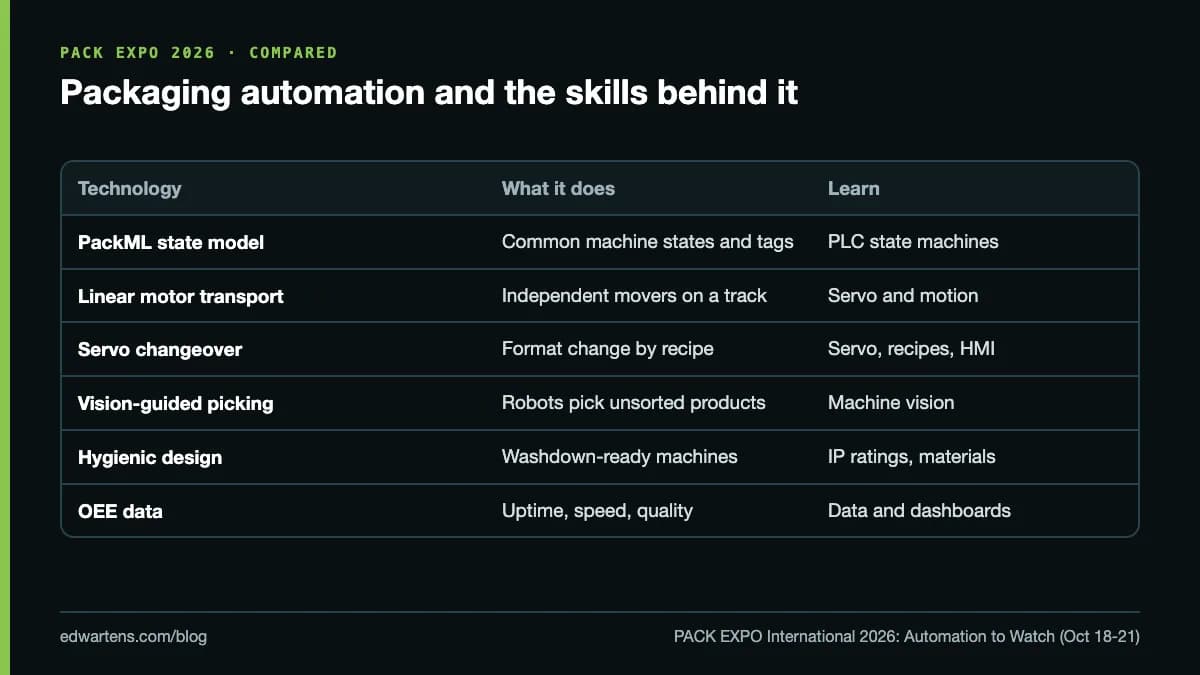
Packaging machines are some of the most motion-intensive machines in any plant. Behind the marketing words, five technologies do the work.
PackML: one language for every machine
A packaging line often combines a filler, capper, labeller, case packer and palletiser from different builders. PackML gives them a common structure. Defined in ANSI/ISA-TR88.00.02, latest edition 2022, and promoted by OMAC, it specifies:
- States, 17 of them, including Idle, Starting, Execute, Completing, Complete, Holding, Held, Suspending, Suspended, Stopping, Stopped, Aborting, Aborted, Clearing and Resetting.
- Modes, such as Production, Maintenance and Manual.
- PackTags, standard data tags for commands, status and admin data such as counts and stop reasons.
A worked example: a case packer runs in Execute. The downstream palletiser fills up and its PackML status tells the line controller it is blocked, so the case packer goes to Suspended, waiting without a fault. When the palletiser clears, the case packer moves through Unsuspending back to Execute, without an operator touching anything. Because every machine reports the same states, the line's OEE calculation can tell downtime caused by a fault (Held or Aborted) from starvation and blockage (Suspended). Our food and beverage automation guide covers PackML alongside CIP and hygienic design.
A worked example: OEE from PackML data
PackML's value shows up in the numbers. Suppose a flow wrapper is scheduled for an 8-hour shift (480 minutes), rated at 120 packs a minute:
| OEE factor | Data from PackTags | Result |
|---|---|---|
| Availability | Execute for 420 of 480 minutes | 87.5% |
| Performance | 45,360 packs made vs 50,400 possible in 420 min | 90.0% |
| Quality | 44,906 good of 45,360 | 99.0% |
| OEE | 0.875 x 0.900 x 0.990 | 78.0% |
Because the machine reports why it left Execute, the 60 lost minutes can be split into faults (Held, Aborted), starvation and blockage (Suspended) and planned stops. That tells you whether to fix the wrapper or the machine feeding it. Our free Lean Manufacturing, OEE and TPM course goes deeper.
Linear motor transport: independent movers
Instead of a chain or belt where every product moves together, a linear motor transport system uses a track of motor segments with independently controlled movers. Each mover can speed up, stop, change pitch or carry a different product. B&R's ACOPOStrak, Beckhoff's XTS and Rockwell's iTRAK are well-known examples. Programming one is a motion control job: each mover is an axis, and the PLC coordinates hundreds of them with collision avoidance on the track. Our servo drives and motion control guide explains the basics.
What changes for the controls engineer is the programming model. On a chain conveyor you control one motor. On an independent-cart system you control every mover as its own axis: you define stations on the track, write sequences that send movers to them, set rules for spacing and queueing, and handle recovery when a mover stops in the wrong place. Vendors provide libraries for most of this, and simulation of the whole track before commissioning is now normal practice. The payoff is flexibility: a format change can be a software change rather than a day of swapping change parts.
Servo changeover and recipes
Brand owners want more SKUs in shorter runs, so changeover time is money. Machines that once needed mechanical change parts now move servo axes to new positions from a recipe stored in the PLC and selected on the HMI. Some builders add guided changeover screens that walk operators through any remaining manual steps.
For the PLC programmer, a recipe-driven changeover is mostly data handling. Each format becomes a record of set points: axis positions, speeds, cam profiles, sensor offsets, label lengths and reject limits. The HMI lets an authorised user select or edit a record, the PLC checks it against limits, and a sequence moves each axis to its new position in a safe order, often with the machine in a PackML maintenance or changeover mode. The engineering work is in validation and permissions: who may change a recipe, how changes are logged, and what the machine does if a value is out of range. In regulated sectors such as pharmaceuticals, those records fall under data-integrity rules as well.
Vision-guided picking and inspection
Robots picking randomly placed products from a conveyor rely on a camera to find each item's position and orientation. The same cameras check labels, codes and seals. Our guide to AI quality inspection in manufacturing explains when deep learning helps and when rule-based vision is enough.
Safety on fast machines
Packaging machines combine high speed with frequent operator access for clearing jams and changing reels, so the safety design matters as much as the motion. Expect to see interlocked guards wired to safety relays or safety PLCs, safe torque off on servo drives so an axis cannot produce torque while a door is open, and safe speed functions that let an operator jog a machine slowly with the guard open. In Europe these functions are designed to ISO 13849-1 performance levels; North American buyers will also ask for UL and NFPA 79 compliance. Our guide to safety PLCs, SIL and SIS explains the underlying ideas.
Hygienic design
Food, dairy and pharmaceutical lines are washed down, sometimes daily, with water and chemicals. That pushes builders toward stainless frames with sloped surfaces, motors and drives mounted on the machine with high IP ratings so control cabinets can shrink, and cable routes that leave nowhere for product to collect. For a controls engineer it changes component choice: connectors, sensors and drives must all survive the cleaning regime, not just the production run.
Packaging automation for a global audience
PACK EXPO is in the US, but many visitors buy for plants elsewhere, and many exhibitors build in Europe and Asia. If you are specifying a machine for another region, check the details that change by market:
- Power supply: 120/480 V at 60 Hz in North America; 230/400 V at 50 Hz across Europe, the UK, the Gulf, Australia and much of Asia. Motors, drives and transformers must match.
- Electrical standards: UL 508A panels and NFPA 79 in the US; IEC 60204-1 and CE marking in the EU, UKCA in Great Britain.
- Control platform: many plants standardise on Rockwell in North America and Siemens or B&R in Europe. Ask whether the builder can supply your platform.
What to look for if you go
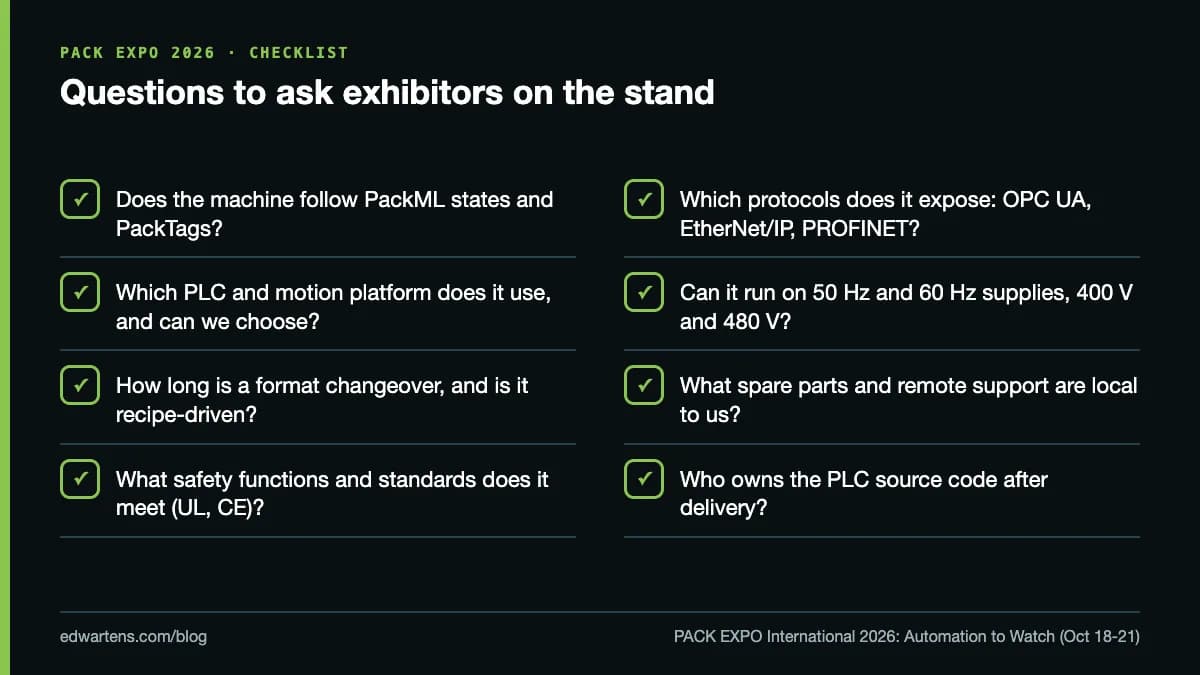
Visit with a list. Ask every machine builder to show you the HMI's state model, the changeover procedure and the alarm list, not just the machine running at speed. Ask how the machine reports OEE data and which protocol it uses. If you are early in your career, the student programmes, including the Amazing Packaging Race, the PACK Challenge and a Future Innovators Robotics Showcase, are a good way to meet employers.
If you cannot go, much of the technology is covered by the free courses below. Our Industry 4.0 guide shows how packaging machines feed plant-level data systems.
Learn the packaging controls stack free
Start with Servo Drives and Motion Control for axes, tuning and electronic cams, then Allen-Bradley Kinetix Servo Motion or Beckhoff TwinCAT 3, the platforms behind many North American and European packaging machines. Add Machine Vision and Quality Inspection for cameras and AI inspection. The machine-builder PLCs learning path and the drives and motion courses bring them together. Our IMTS 2026 highlights cover the machine-tool side of the same trends, and for washdown machines, our IP rating chart explains IP69K.
Learning is free in full. An optional EDWartens Certificate of Completion, from US$2.99, can be checked at edwartens.com/verification; it is not a vendor certification and is not accredited. Packaging machine builders hire controls engineers all year: see the job board or US roles.
Take the free course

Motion control · Intermediate · Free
Servo Drives and Motion Control

Motion control · Intermediate · Free
Allen-Bradley Kinetix Servo Motion with Studio 5000

AI and machine learning · Intermediate · Free
Machine Vision and Quality Inspection

PLC programming · Intermediate · Free
Beckhoff TwinCAT 3 PLC Programming
Questions
When is PACK EXPO International 2026?
PACK EXPO International 2026 runs from 18 to 21 October 2026 at McCormick Place in Chicago. It is organised by PMMI, The Association for Packaging and Processing Technologies, and is held every two years.
How many exhibitors are at PACK EXPO 2026?
PMMI says more than 2,600 exhibitors on 1.3 million net square feet, with about 48,000 attendees expected from more than 40 vertical markets. It also lists more than 150 free education sessions on five stages on the show floor.
What is PackML?
PackML is a standard way of structuring a packaging machine's control software, defined in ANSI/ISA-TR88.00.02 (latest edition 2022). It gives every machine the same set of states, such as Idle, Execute, Held and Stopped, the same modes and the same data tags (PackTags), so lines from different builders can be integrated and measured consistently.
What is a linear motor transport system?
It is a track of linear motor segments carrying independently controlled movers, or carts. Each mover can accelerate, stop and change pitch on its own, so one track can replace chains, cams and changeover parts. Examples include B&R ACOPOStrak, Beckhoff XTS and Rockwell iTRAK.
Is PACK EXPO open to students?
Yes. PMMI runs student programmes at the show, including the Amazing Packaging Race, the PACK Challenge and a Future Innovators Robotics Showcase. Check PMMI's registration pages for current student terms.
Sources
- PMMI: PACK EXPO International showcases solutions to the industry's most pressing challenges
- PACK EXPO International 2026: official site
- WhatTheyThink: ABB's Machine Automation division (B&R) at PACK EXPO International 2026
- PR Newswire: RND Automation at PACK EXPO International 2026
- OMAC: PackML
- Wikipedia: PackML
Written by the EDWartens engineering team for general education. Product names are trademarks of their owners; mentioning them does not imply endorsement. Prices and terms of other providers were checked on the date shown and can change.
Iran-Linked PLC Attacks in 2026: CISA's Warning and a UK Power Plant Outage

Schneider Electric to Buy PTC for US$22.6 Billion: What It Means for Engineers

Cyber Resilience Act Reporting Obligations: What Machine Builders and OEMs Must Do Now
2.3 Million Technician Openings: Deloitte-MI Study on AI and Skills
Intrinsic Open-Sources Intrinsic Core at ROSCon 2026: What It Means

Qualcomm to Buy PickNik: What Happens to MoveIt and ROS 2 Users