MOTOR STARTING
Soft Starter vs VFD: Which Motor Starter Fits Your Application?
A soft starter softens the start and stop; a VFD controls motor speed all the time. Starting current, torque, energy, harmonics, size and cost compared, with a pump energy example and a decision guide.
Soft starter vs VFD comes down to one question: does the motor need to run at different speeds? A soft starter only ramps the voltage up during the start (and down during the stop) to cut the starting current and the mechanical shock, then runs the motor at full speed. A variable frequency drive (VFD) controls the motor's frequency and voltage all the time, so it starts gently and sets the speed. If you only need a soft start, a soft starter is cheaper, smaller and simpler. If you need speed control or energy savings on a variable load, you need a VFD.
The rest of this guide gives the numbers behind that answer: starting current and torque for each method, energy, harmonics, starts per hour, bypass contactors, and a worked pump example.
How does a soft starter work?
A soft starter uses pairs of thyristors (SCRs) in the supply lines to the motor. By switching them on later or earlier in each half-cycle, it controls the voltage the motor sees. At the start it applies a low voltage, just enough to take up slack in belts and couplings, then ramps the voltage up to full over a set time, typically a few seconds to tens of seconds.
Motor torque falls with the square of the voltage, so halving the voltage gives roughly a quarter of the torque. That is how a soft starter tames both the inrush current and the torque jolt. Most also offer a current limit, which holds the starting current at a set multiple of rated current, and a soft stop, which ramps the voltage down to stop pumps without water hammer.
What a soft starter cannot do is change the motor's speed in normal running. The frequency stays at the supply frequency (50 Hz in Europe, the UK, most of Africa, Asia and Australia; 60 Hz in North America and parts of South America and the Gulf), so the motor runs at its rated speed once it is up.
How does a VFD work?
A VFD rectifies the AC supply to DC, then builds a new AC output with an inverter, at whatever frequency and voltage the control asks for. ABB's Softstarter Handbook describes it simply: the drive raises the frequency from 0 Hz to the supply frequency, so the motor is always running close to its rated slip and rated torque is available from the start, at around rated current. Usually the drive trips if current reaches about 1.5 times rated.
Because the drive controls frequency, it can run the motor at any speed, hold it there, reverse it, and stop it under control. Our VFD training guide covers the control modes in more depth.
Starting current and torque: DOL, star-delta, soft starter and VFD
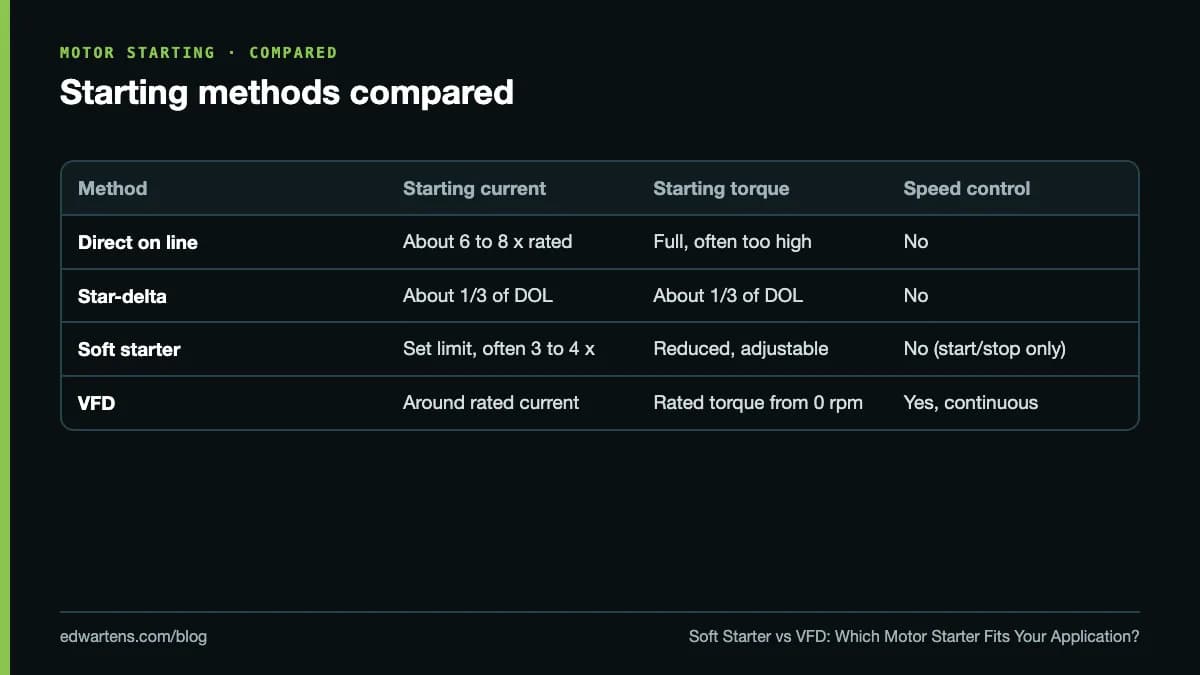
Direct on line (DOL). The motor sees full voltage at once. ABB's handbook gives a normal starting current of 6 to 8 times rated current, with values up to 14 times possible, and a brief magnetising peak that can be higher still. Starting torque is high, often more than the load needs.
Star-delta. Starting in star gives each winding 1/√3 of the line voltage, so line current and torque both fall to about one third of their DOL values. The catch is the changeover to delta, which can cause a current peak, sometimes higher than a DOL start on a pump. Our star-delta starter walkthrough explains the power and control circuits.
Soft starter. Starting current depends on the ramp and current-limit settings. ABB's handbook recommends current limits of around 3 to 5 times rated current depending on the application, and quotes roughly 3 to 4 times rated current for a typical compressor start.
VFD. Around rated current during acceleration, with full torque available from zero speed. This is why a VFD can start loads a soft starter struggles with, such as a loaded conveyor or a positive-displacement pump against pressure.
Soft starter vs VFD: the full comparison
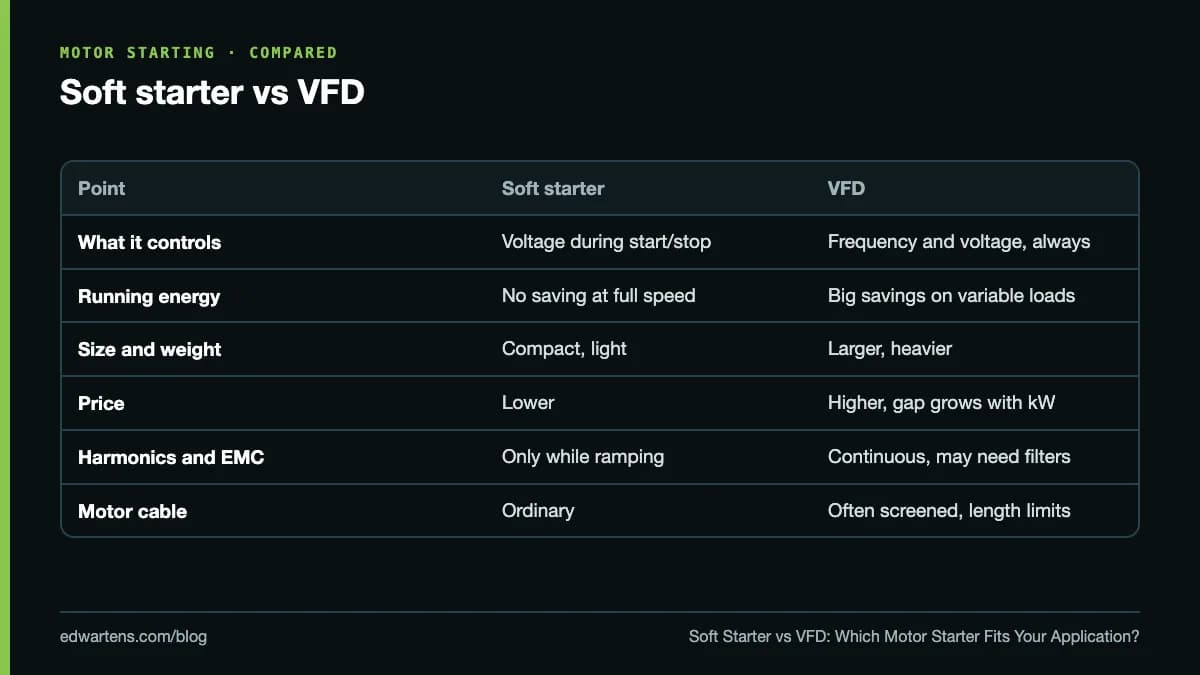
Cost and size. For the same kW rating, a soft starter is cheaper, smaller and lighter. ABB's handbook makes the point that using a drive only to start and stop a motor that never needs speed control is an unnecessarily expensive solution.
Harmonics and EMC. A soft starter distorts the current only while it is ramping. A standard 6-pulse VFD draws non-sinusoidal current whenever it runs, so large drive installations may need line reactors, filters or active front ends. In North America the reference is IEEE 519-2022, applied at the point of common coupling with the utility; in Europe and many other regions, drive EMC is covered by IEC 61800-3 and harmonic emissions from equipment by the IEC 61000-3 series.
Motor and cabling. A VFD's fast-switching output stresses motor insulation and can drive bearing currents, so long motor cables need screened cable and sometimes output filters. A soft starter's output is ordinary mains voltage once running.
Heat. Thyristors dissipate heat while current flows. That is why most soft starters now use a bypass: integrated contacts (or an external contactor) close once the motor is at speed, so the thyristors carry current only during the ramp.
Does a VFD really save energy? A worked pump example
Only on loads that do not need full output all the time, and most of all on centrifugal pumps and fans. Their affinity laws say flow is proportional to speed, head to speed squared, and power to speed cubed.
Take a 55 kW centrifugal pump that draws 50 kW at full speed, but whose flow is held at 80% by a part-closed valve for most of the year. Run it on a VFD at 80% speed instead:
| Step | Value |
|---|---|
| Speed ratio | 0.8 |
| Power ratio (0.8 cubed) | 0.512 |
| Ideal shaft power at 80% speed | 50 kW x 0.512 = about 25.6 kW |
| Saving per running hour, ideal | about 24 kW |
| Over 6,000 hours a year | about 144,000 kWh |
That is the theoretical upper bound. The VFD itself loses a few per cent, and in systems with a lot of static head (lifting water uphill or into a pressurised vessel) the savings are much smaller, because that head does not fall with speed. The US Department of Energy guide written with the Hydraulic Institute and Europump makes both points, and reports savings of between 30% and 50% on rotodynamic pump installations converted to speed control. Use the real pump and system curves for a business case, and price the energy in your local currency and tariff.
A soft starter saves none of this, because once started the pump runs at full speed exactly as it would on a DOL starter. Our free Motor and VFD Calculator and the free engineering calculators guide help with motor current and speed sums.
How many starts per hour can a soft starter do?
There is no single number. The limit is heat in the thyristors, so it depends on the starting current, the length of each start, the ambient temperature and the off time between starts. Manufacturers publish starting capacity curves for this. As one example, ABB's handbook advises selecting one size larger for a compressor in an example where more than 10 starts per hour are needed, and one size larger for heavy-duty starts such as large fans with big flywheels. A VFD handles frequent starts more easily because its starting current stays near rated.
Which should you choose?
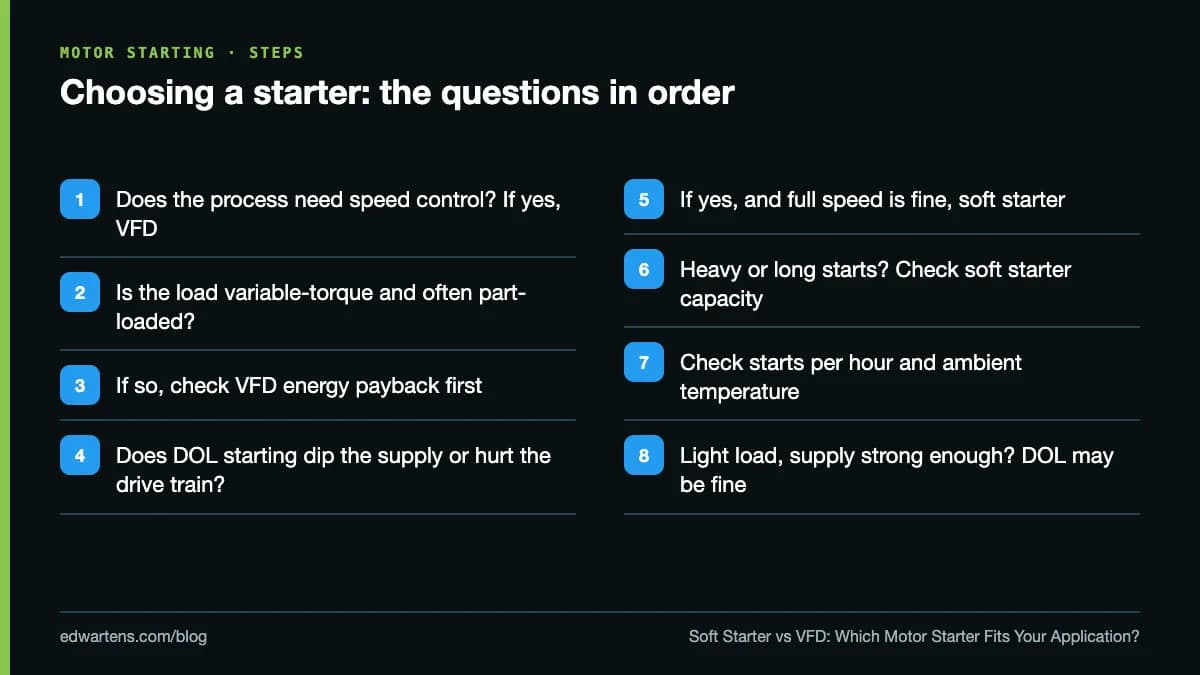
Some typical answers:
- Constant-speed pump, fan or compressor where DOL causes voltage dips or water hammer: soft starter.
- Pump or fan with variable demand, now throttled or cycled: VFD, and check the energy payback.
- Conveyor that needs a gentle start but one speed: soft starter; VFD if it needs speed changes or must start fully loaded.
- Mixer, extruder or anything needing torque at low speed: VFD.
- Small motor on a strong supply with a light load: DOL is often fine. Not every motor needs electronics.
Whichever you pick, follow the product standard and the local rules: IEC 60947-4-2 covers semiconductor motor starters in IEC regions, while in the US and Canada controllers are listed to UL and CSA standards, and the supply voltage changes from 230/400 V to 120/208 V or 480 V systems. If you are new to the hardware around both, our comparison of contactors and relays covers the switching side.
Learn motor control free
The free Industrial Motor Control course covers DOL, star-delta and soft starters with real wiring. Variable Frequency Drives: Wiring, Programming, PLC and Network Control takes you from parameters to PLC control, and our VFD start-up and parameter setup walkthrough shows a first commissioning. Vendor-specific routes cover Siemens SINAMICS and Allen-Bradley PowerFlex drives. Mounting a starter or drive outside a panel? Check its enclosure against our IP rating chart.
Checked 5 October 2026 against ABB's Softstarter Handbook, the US DOE variable speed pumping guide and IEEE 519-2022.
Take the free course


Questions
Is a soft starter cheaper than a VFD?
Yes, for the same motor rating a soft starter is normally cheaper, smaller and lighter than a VFD, and the gap widens as the motor gets bigger. If the application only needs a gentle start and stop and runs at full speed, a VFD is usually an unnecessarily expensive choice.
Can a VFD replace a soft starter?
Technically yes: a VFD can ramp a motor up and down at least as smoothly as a soft starter and with lower starting current. Whether it should depends on cost, panel space, harmonics and whether speed control or energy saving will ever be used. If not, the soft starter is the simpler fit.
Does a soft starter save energy?
Not in normal running. Once the motor is up to speed, a soft starter, usually with its bypass closed, runs the motor at full speed exactly like a direct-on-line starter. Energy savings come from reducing speed, which only a VFD can do.
Which is better for a pump, soft starter or VFD?
If the pump must run at a constant duty, a soft starter gives a smooth start and a controlled stop that reduces water hammer, at low cost. If the flow demand varies and is currently controlled by a throttling valve or recirculation, a VFD usually pays back through energy savings, because centrifugal pump power falls with roughly the cube of speed.
Do soft starters need a bypass contactor?
Not always, but most do use a bypass. The thyristors in a soft starter dissipate heat while current flows through them, so many modern soft starters have integrated bypass contacts that close once the motor is up to speed. Older or larger units may use an external bypass contactor for the same reason.
How many starts per hour can a soft starter handle?
It depends on the starting current, the length of each start, the ambient temperature and how long the starter rests between starts, so check the manufacturer's starting capacity data. ABB's soft starter handbook, for example, advises choosing one size larger in an example where more than 10 starts per hour are needed.
Sources
- ABB: Softstarter Handbook (1SFC132060M0201, PDF)
- US DOE, Hydraulic Institute and Europump: Variable Speed Pumping, A Guide to Successful Applications (executive summary, PDF)
- IEEE 519-2022: Standard for Harmonic Control in Electric Power Systems
- Wikipedia: Affinity laws for pumps and fans
Written by the EDWartens engineering team for general education. Product names are trademarks of their owners; mentioning them does not imply endorsement. Prices and terms of other providers were checked on the date shown and can change.
RS-485 Wiring Explained: Termination, Biasing and Daisy Chains (Video)

Start/Stop Seal-In Circuit in Ladder Logic, Explained Rung by Rung (Video)

2.3 Million Technician Openings: Deloitte-MI Study on AI and Skills

Modbus TCP Explained by Doing: Read a Register in 10 Minutes (Video)

TIA Portal V21: What's New, Who Should Upgrade and How to Learn It Free

Allen-Bradley PLC Training: A Studio 5000 Guide for Beginners