MOTOR CONTROL VIDEO
Star-Delta Starter Explained: Power Circuit, Control Circuit and Timer Setting (Video)
How a star-delta (wye-delta) starter works, with Jim Pytel's free lecture: the three contactors, the six motor leads, the timer and interlocks, the overload setting, and when to use a soft starter or VFD instead.
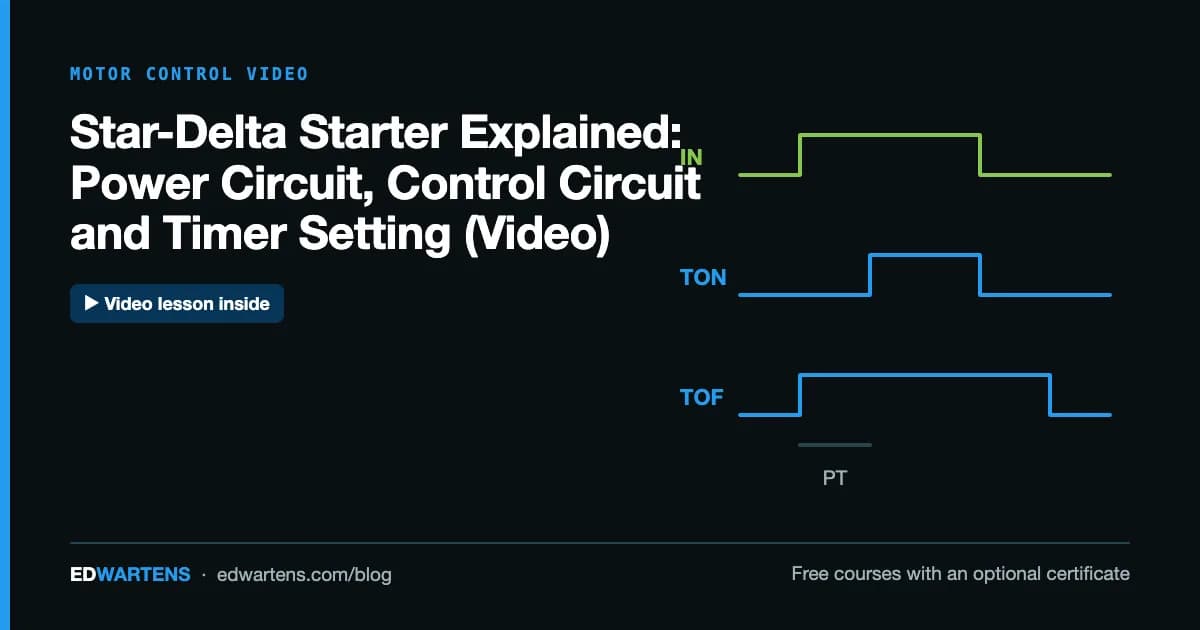
A star-delta (wye-delta) starter starts a three-phase motor with its windings connected in star, so each winding sees 1/√3, about 58%, of the line voltage. That cuts starting current and starting torque to about a third of their direct-on-line values. After a timed run-up it switches the windings to delta for full-voltage running. It needs three contactors, a timer, an overload relay and a motor with six accessible winding ends.
Checked 5 October 2026 against ABB and Siemens technical documentation.
In this lecture, Jim Pytel explains Y start-delta run reduced-voltage starters: why they limit inrush current and mechanical stress, why they only work on motors with both ends of every winding accessible (6-lead and 12-lead motors), and why the usual changeover is an open transition, in which the windings are briefly de-energised. It is one of the lessons in our free Industrial Motor Control course, in the module on reduced-voltage starting and soft starters. Pytel teaches with North American terms (wye, T1 to T6), so this walkthrough gives the IEC names (star, U1 to W2) alongside.
Watch it once, then use the notes below to draw and check your own starter.
What happens in a star-delta start
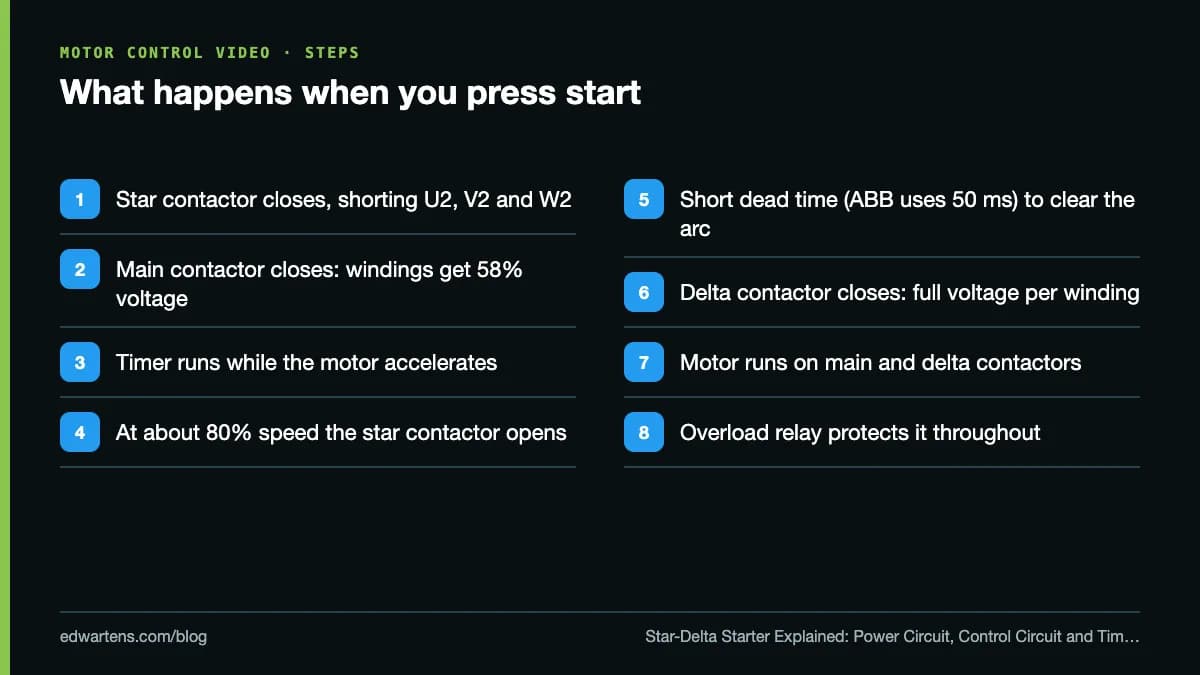
ABB's technical note describes the same three stages: star connection, star-to-delta switching, then delta. The gap between the star contactor opening and the delta contactor closing (ABB uses 50 ms) is there so the arc on the star contactor is out before the delta contactor makes; closing too early would short the supply.
Star and delta in numbers
| Star (start) | Delta (run) | |
|---|---|---|
| Voltage across each winding | Line voltage ÷ √3 (about 58%) | Full line voltage |
| Current from the supply | About 1/3 of DOL starting current | Normal |
| Torque | About 1/3 of DOL starting torque | Full |
| Contactors closed | Main and star | Main and delta |
The "one third" comes from two effects multiplying. Each winding gets 1/√3 of the voltage, so it draws 1/√3 of the current. In delta, line current is √3 times winding current; in star, they are the same. Put together, line current in star is one third of what the motor draws if started directly in delta, and torque, which follows the square of voltage, also falls to a third.
The power circuit: three contactors and six leads
A star-delta starter has a main (line) contactor, a star contactor and a delta contactor, plus an overload relay and a timer. ABB's solution guide lists exactly this set.
Using IEC terminal names, the most common arrangement is:
- The main contactor feeds L1, L2 and L3 to the winding starts U1, V1 and W1.
- The star contactor, when closed, shorts the winding ends U2, V2 and W2 together to form the star point.
- The delta contactor, when closed, connects each winding end to the next phase: W2 to L1, U2 to L2, V2 to L3 (that is, U1 to W2, V1 to U2, W1 to V2).
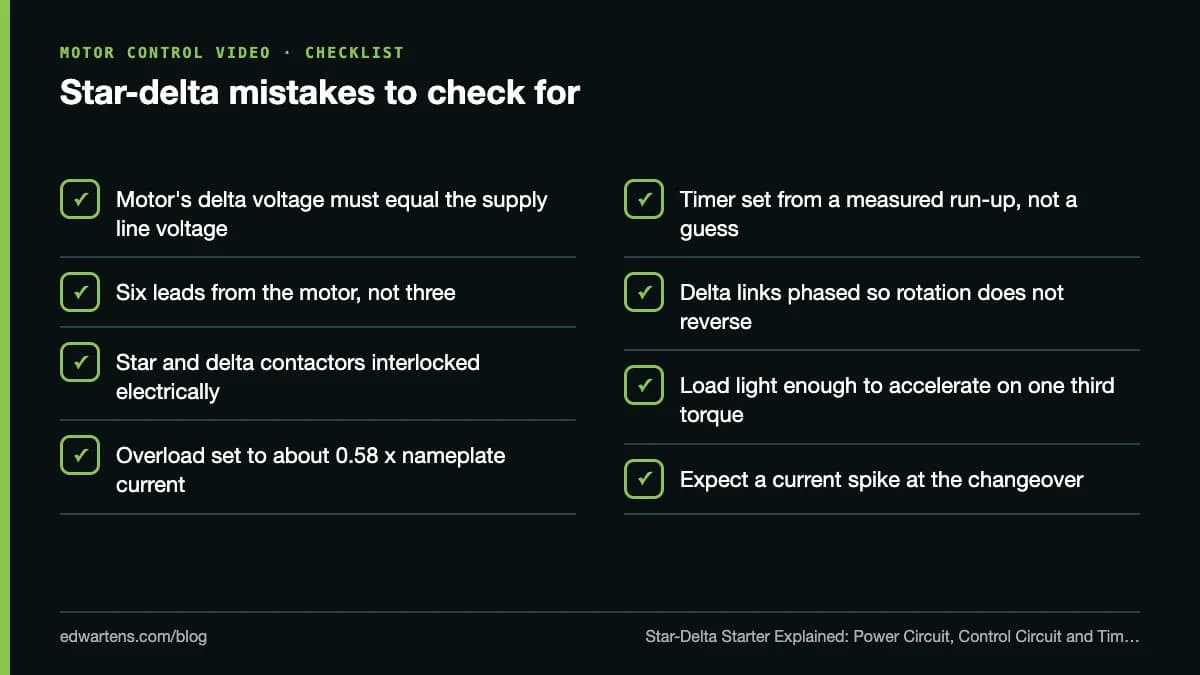
Get the delta links in the wrong order and the motor can reverse or draw heavy current at changeover, so check rotation in both star and delta during commissioning.
The motor must suit the supply
ABB is precise about this: the motor's voltage in delta must equal the supply voltage. A motor for a 400 V star-delta start must be rated 400 V in delta, which is written 400/690 V on the nameplate. A 230/400 V motor on a 400 V supply is meant to run in star permanently; connecting it in delta overvolts the windings.
The control circuit: timer and interlocks
The control circuit has three jobs:
- Sequence the contactors. Start energises the star and main contactors, and starts an on-delay timer. When the timer is done, its normally closed timed contact drops out the star contactor and its normally open timed contact brings in the delta contactor.
- Interlock star and delta. A normally closed auxiliary contact of each contactor goes in series with the other's coil, so star and delta can never be on together. Many manufacturers also offer a mechanical interlock between the two.
- Seal in and stop. A seal-in contact holds the starter on after the start button is released, and the stop button and overload contact break the whole circuit. If the seal-in is new to you, our start/stop ladder logic walkthrough covers it rung by rung.
Open and closed transition
In the usual open transition described above, the motor is briefly disconnected while it switches. The rotor is still spinning and magnetised, so the reconnection causes a current and torque spike. ABB notes that high transient currents are common during star-delta switching. Closed-transition designs keep the motor connected through the changeover, typically with an extra contactor and resistors, at extra cost. The course module covers both.
Setting the overload relay
In most star-delta starters the overload relay sits after the main contactor, in the motor phase circuit, so it measures winding current, not line current. Siemens' instructions for its star-delta starters say to set it to 0.58 times the rated motor current, and under no circumstances higher than the phase current. Setting it to the full nameplate current leaves the motor unprotected.
Setting the timer
Do not guess. Siemens' method is to start the motor and measure how long it takes to reach nearly rated speed, judged by the current settling and the motor hum reaching a steady pitch, then set the timer to that value. ABB gives a typical starting time of 6 to 10 seconds and says the changeover should happen at 80% of rated speed or more, or the delta current peak will be high. Switch over too late and the motor runs on its weak star torque for longer than it needs to.
When should you use star-delta, and when not?
ABB recommends star-delta when the load has low to moderate inertia, only a gradual start is needed, the utility will not accept direct-on-line inrush but current peaks are still acceptable, and a simple, cost-effective starter is wanted. Machine tools, centrifugal compressors and woodworking machines that start unloaded are its examples.
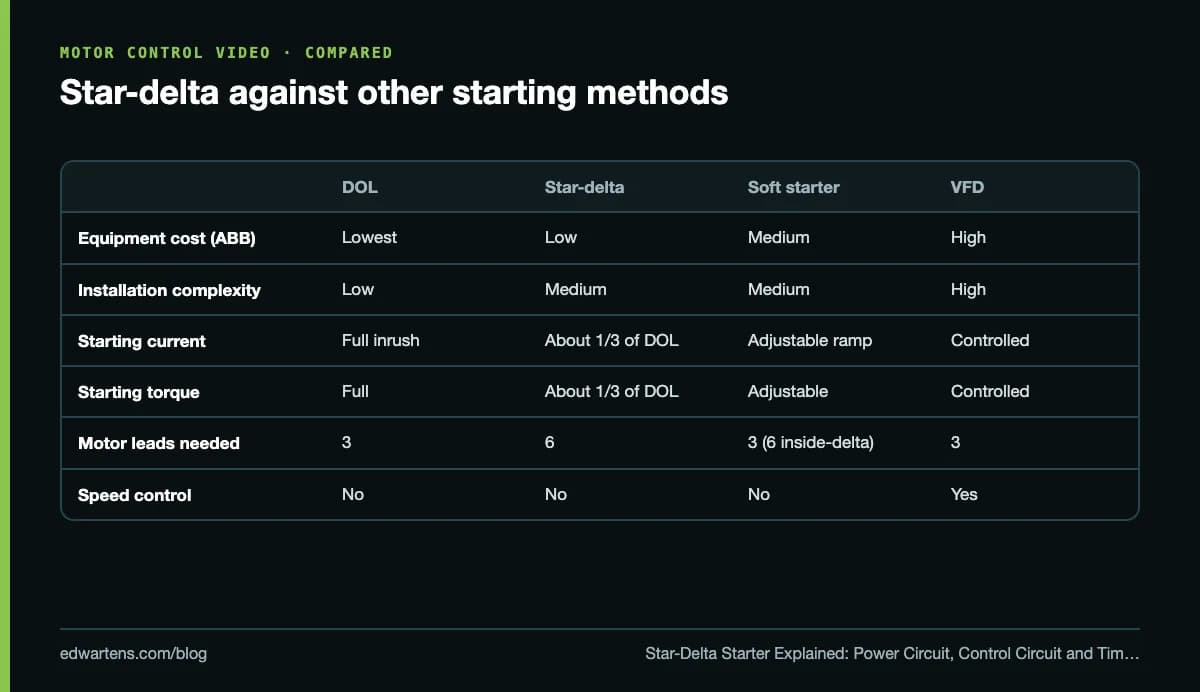
If the load is heavy at start, you need a smooth stop for pumps (to avoid water hammer), or you need speed control, a soft starter or a VFD is the better choice. Pytel's lecture on soft starters and RealPars' comparison of VFDs and soft starters sit in the same course module. To go further on drives, read our VFD training guide.
Common mistakes
Practise it
The course module ends with a practice task: draw a star-delta power circuit and control circuit with a 6-second on-delay transition and the star/delta interlock. Done means six motor leads correctly connected in both contactor states, and a ladder in which star and delta can never be on together. Work it on paper or in a free ladder simulator, then check it against the lecture.
Our free Motor and VFD Calculator helps with the numbers around the motor. Next, take Electrical Control Panel Design, Building and Testing to build starters into a real panel, and Variable Frequency Drives for the electronic alternative. If three-phase basics are shaky, Electrical Fundamentals for Technicians covers them. All are in the electrical courses and the electrical fundamentals path. The courses are free; an optional EDWartens Certificate of Completion, from US$2.99, is issued after the final assessment and verifiable at edwartens.com/verification. It is not a vendor certification and is not accredited.
Take the free course

Electrical · Beginner · Free
Industrial Motor Control

Electrical · Beginner · Free
Electrical Control Panel Design, Building and Testing

Drives · Beginner · Free
Variable Frequency Drives: Wiring, Programming, PLC and Network Control

Electrical · Beginner · Free
Electrical Fundamentals for Technicians: Volts to Multimeter to Drawings
Questions
Why is a star-delta starter used?
To reduce the starting current of a three-phase induction motor. In star, each winding sees 1/√3 (about 58%) of line voltage, so the starting current drawn from the supply falls to about a third of the direct-on-line value. It is used where the supply or the utility cannot accept full direct-on-line inrush and the load can start on reduced torque.
What is the disadvantage of a star-delta starter?
Starting torque also falls to about a third, so it only suits loads that start light, such as fans, centrifugal pumps and compressors started unloaded. The usual open transition also causes a current spike at changeover, and the motor needs six accessible leads, which means six cables from the starter.
What should the overload be set to on a star-delta starter?
When the overload relay sits in the motor phase circuit after the main contactor, as in most star-delta starters, it carries phase current rather than line current. Siemens' instructions for its star-delta starters say to set it to 0.58 times the rated motor current and never higher than the phase current.
How do you set the star-delta timer?
Measure it. Start the motor and time how long it takes to reach nearly rated speed, when the current settles and the motor hum steadies. Set the timer to that. ABB notes that the changeover should happen at 80% of rated speed or more to avoid a high current peak, and gives a typical start time of 6 to 10 seconds.
Can any three-phase motor be started in star-delta?
No. Both ends of each winding must be brought out (six leads), and the motor must be rated to run in delta at the supply's line voltage. On a 400 V supply that means a motor marked 400/690 V, not 230/400 V. A 230/400 V motor is meant to run in star on 400 V and would be overvolted in delta.
Sources
- Jim Pytel: Y Start-Delta Run Reduced Voltage Starters (Full Lecture)
- ABB: Star-delta starting of three-phase asynchronous motors (1SBC009500R1002)
- ABB: Solution guide, motor starting solutions (1SFC100125C0346)
- Siemens: DOL and automatic star-delta starter operating instructions
- IEC 60947-4-1:2023 Contactors and motor-starters
Written by the EDWartens engineering team for general education. Product names are trademarks of their owners; mentioning them does not imply endorsement. Prices and terms of other providers were checked on the date shown and can change.