FREE IIOT TRAINING
IIoT Training: How Plant Data Gets From a PLC to a Dashboard, and How to Learn It Free
The Industrial Internet of Things is plant data moved safely from controllers to the people and models that use it. The layers, the protocols and a free route.

IIoT training teaches you to move data from PLCs, drives and sensors to the dashboards, databases and models that use it, safely and without touching the control logic. The core skills are industrial protocols (Modbus, OPC UA, MQTT), an edge tool such as Node-RED or Python, time-series storage and OT security. All of them can be learned free on edwartens.com.
In this lesson by RealPars, the Industrial Internet of Things is introduced from the ground up. It sits in the free Industrial Communication course. Watch it for the overview, then read on for the layers, protocols and security choices behind a real IIoT system.
What IIoT is, and what it is not
The Industrial Internet of Things is a data layer. It sits beside the control system, not in place of it. The PLC or DCS still runs the machine; the IIoT layer reads what the controller already knows and makes it available to more people and more software.
That difference shapes every design decision. A dashboard that goes offline is an inconvenience. A controller that stops scanning because a gateway flooded it with requests is a production outage. Good IIoT engineers treat the control network with respect: they read, they rarely write, and they keep polling rates sensible.
Industry 4.0 is the wider idea of connected, data-driven manufacturing. IIoT is the plumbing much of it depends on. The Industry 4.0 guide covers the bigger picture.
The layers, from sensor to screen
Most IIoT systems can be drawn in five layers:
- Field and control. Sensors, drives and the PLC or DCS. This is levels 0 to 2 of the ISA-95 model.
- Edge. A gateway, an industrial PC or a Raspberry Pi that reads the controllers, converts protocols and buffers data if the network drops.
- Transport. Usually MQTT to a broker, sometimes OPC UA end to end.
- Storage. A historian or a time-series database such as InfluxDB, plus SQL for events and batches.
- Use. Dashboards, OEE reports, alerts and models such as anomaly detection.
A pattern you will hear about is the unified namespace: one broker where every system publishes its current state under a consistent topic tree, so consumers subscribe to one place instead of connecting to every machine. It is a design approach rather than a standard, and it works best when the topic naming is agreed before the first machine is connected.
The protocols that matter

Modbus is the oldest and simplest. A client asks a device for a block of numbered registers and gets numbers back. There are no names, no units and no security, so you need the device's register map and you must decode scaling and data types yourself, including two registers for a 32-bit float and the word order. It is still everywhere in meters, drives and packaged equipment. The Modbus tutorial goes into frames and function codes.
[OPC UA](https://opcfoundation.org/about/opc-technologies/opc-ua/), standardised as IEC 62541, gives you named, typed nodes with quality and timestamps, built-in security and subscriptions so the server sends changes instead of you polling. Most current PLCs and SCADA systems include an OPC UA server. The OPC UA guide covers the information model.
MQTT is a lightweight publish and subscribe protocol, an OASIS standard with version 3.1.1 also published as ISO/IEC 20922; the current MQTT 5.0 specification is free to read. Devices publish to topics on a broker; anyone authorised subscribes. The protocol does not define the payload, which is why conventions such as Sparkplug B, maintained at the Eclipse Foundation, exist to add structure, birth and death messages and state. Our MQTT Sparkplug B explainer shows how it works in practice.
Edge tools: Node-RED and Python
[Node-RED](https://nodered.org/) is a free, flow-based tool where you wire nodes together in a browser: read Modbus, reshape JSON, publish to MQTT, log to SQL, draw a dashboard. It is fast to learn and runs on a PC, a Raspberry Pi or some industrial gateways and PLCs. The free Node-RED for Industrial IoT course is a beginner course covering Modbus RTU and TCP, Siemens S7-1500 over OPC UA, MQTT, SQL logging and an OEE calculation. For a quick start, build a Node-RED PLC dashboard in one sitting.
Python takes over where decoding, cleaning and analysis matter. The free Industrial Data with Python course is intermediate. You run your own Modbus and OPC UA simulators, subscribe rather than poll, design MQTT topics with quality and timestamps, store in SQLite or InfluxDB with Grafana, then clean and grid live process data and detect anomaly episodes. The final project injects a fault into a simulator and measures how long the pipeline takes to notice it.
Security is part of the job
Connecting a plant is also exposing it. The baseline practices are well established:
- Segment the network into zones and control the conduits between them, as ISA/IEC 62443 describes.
- Keep the IIoT layer read-only unless a write is designed, reviewed and interlocked.
- Put a DMZ between the plant network and the enterprise or cloud.
- Use OPC UA security modes and TLS on MQTT, with real certificates and no default passwords.
- Log who connected, from where, and what they read.
The free OT and ICS Cybersecurity with ISA/IEC 62443 course is intermediate. If you have no security background, ICS Security Foundations is the beginner starting point. For every no-cost option, including CISA's courses, see free IEC 62443 training.
A free IIoT training route

- [Industrial Communication](/free/industrial-communication) first, if you already program one PLC: Ethernet and IP, RS-485 and Modbus frames, PROFINET, OPC UA, and industrial wireless.
- [Node-RED for Industrial IoT](/free/node-red-industrial-iot) to build flows and dashboards quickly.
- [Industrial Data with Python](/free/industrial-data-with-python) once you know basic Python; the Python for AI and Engineering Data course covers that from zero.
- [OT and ICS Cybersecurity with ISA/IEC 62443](/free/ot-ics-cybersecurity-iec-62443) so you can defend what you connected.
The first three plus security are grouped on the IIoT and OT security path, and every IIoT course is listed under free IIoT courses. If your goal is analytics and AI on top of the data, the Industrial AI engineer path continues from here, and data engineering for industrial AI explains how to get plant data ready for a model.
One project to prove it
The most convincing evidence of IIoT skill is a working pipeline you can demonstrate: a simulated or real device, a reader at the edge, MQTT with sensible topics, a database, a dashboard and one alert that fires when a value goes wrong. Document the topic tree, the polling rate and the security choices on one page. That page is what an interviewer will ask about.
Start the free IIoT courses
Create a free account and start with the course that matches where you are. Each course ends with one final assessment of 15 questions drawn from the whole course, a 60% pass mark and three attempts, then a 24-hour wait and a fresh paper.
Learning is free in full. The optional EDWartens Certificate of Completion is a small one-off fee, US$8.99 for a beginner course such as Node-RED and a little more for an intermediate course such as Industrial Data with Python. Anyone can check it at edwartens.com/verification. It is not a vendor certification and not an accredited qualification.
Take the free course
 Free
FreeIndustrial networks · Intermediate · Free
Industrial Communication: Serial, Fieldbus, Ethernet, Modbus, PROFINET and OPC UA
 Free
FreeIIoT · Beginner · Free
Node-RED for Industrial IoT
 Free
FreeAI and machine learning · Intermediate · Free
Industrial Data with Python
 Free
FreeCybersecurity · Intermediate · Free
OT and ICS Cybersecurity with ISA/IEC 62443
Questions
What is IIoT in simple words?
The Industrial Internet of Things is the practice of collecting data from machines, sensors and controllers and moving it to systems that store, show and analyse it, without disturbing the control that runs the plant.
Is IIoT the same as Industry 4.0?
Not quite. Industry 4.0 is the broader idea of connected, data-driven manufacturing; IIoT is the connectivity and data layer that much of it depends on.
Do I need hardware to learn IIoT?
No. Node-RED is free and runs on a PC, and the Python course uses simulated Modbus and OPC UA servers and a local MQTT broker. A Raspberry Pi and a USB to RS-485 adapter make some modules real but are optional.
Should an IIoT system write back to the PLC?
Rarely, and only by design. Most IIoT systems read data only; any write to a controller needs the same change control, interlocks and security review as any other change to the control system.
What does the IIoT certificate cost?
Learning is free. The optional EDWartens certificate is a small one-off fee, lowest for a beginner course such as Node-RED and a little more for an intermediate one.
Sources
- OPC Foundation: OPC Unified Architecture
- OASIS: MQTT Version 5.0 specification
- Eclipse Foundation: Sparkplug working group
- Node-RED: low-code programming for event-driven applications
- ISA: ISA/IEC 62443 series of standards
Written by the EDWartens engineering team for general education. Product names are trademarks of their owners; mentioning them does not imply endorsement. Prices and terms of other providers were checked on the date shown and can change.
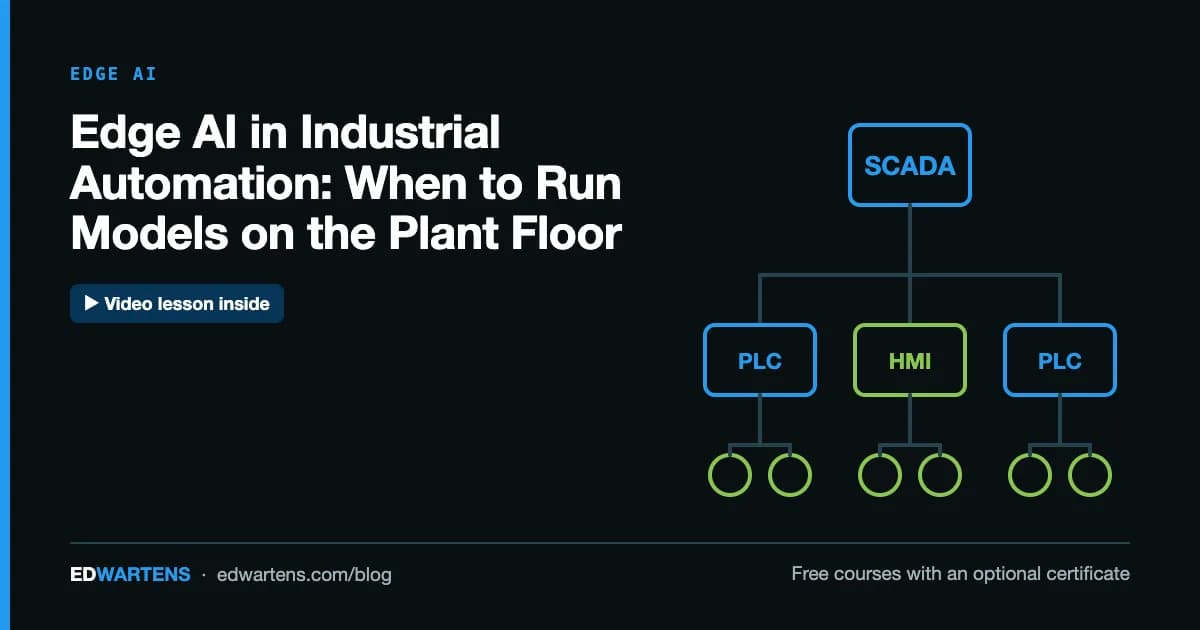
Edge AI in Industrial Automation: When to Run Models on the Plant Floor

Modbus TCP Explained by Doing: Read a Register in 10 Minutes (Video)
SCADA Training: A Complete Guide to Architecture, Protocols and Skills

Subnetting Explained for PLC and OT Networks, With a Free CCNA Video Lesson

Free Machine Learning Course for Mechanical and Electrical Engineers
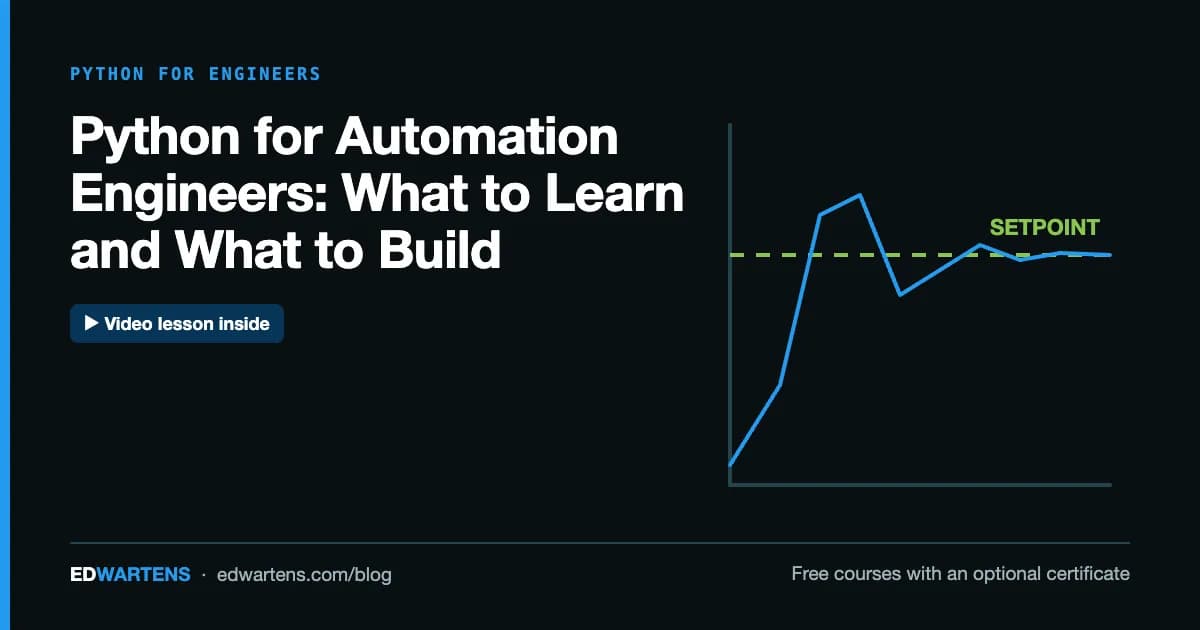
Python for Automation Engineers: What to Learn and What to Build