EDGE AI
Edge AI in Industrial Automation: When to Run Models on the Plant Floor
Why some industrial AI has to run beside the machine, how to decide edge or cloud, how the model talks to the PLC without taking control, and how to keep it running.
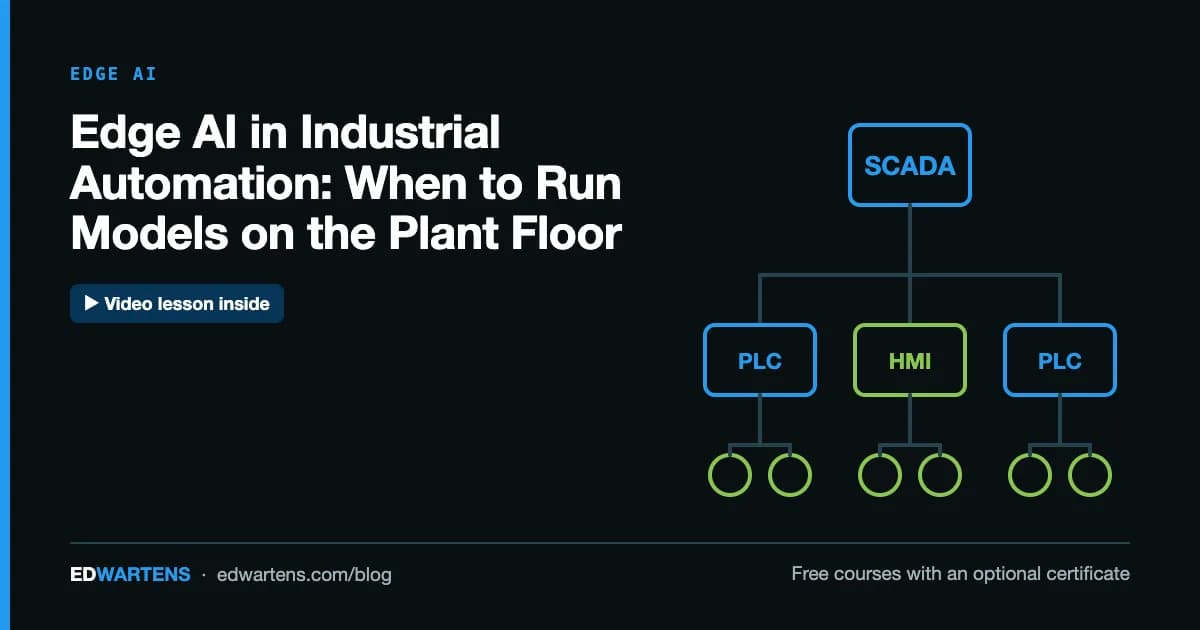
Edge AI in industrial automation means running a trained model on hardware at the plant, beside the machine, instead of in a remote data centre. You choose the edge when the answer is needed within a machine cycle, when the raw data is too large to send, or when the link or data policy cannot be relied on.
In this lesson by RealPars, edge computing is explained in the context of industrial systems. It sits in the "Edge or cloud" module of our free AI for Industrial Automation course, where the practice task is to decide edge or cloud for three use cases, with one sentence of reasoning each, and then specify the box.
Edge AI in industrial automation: what "the edge" means
"Edge" is not one place. From the machine outwards:
- Device level: a smart camera or sensor that runs inference itself.
- Controller level: an AI or neural-processing module in the PLC rack, which some vendors offer.
- Line level: an industrial PC or gateway in the panel or beside the line.
- Site level: a server in the plant's own data room.
In ISA-95 terms, edge computing sits between the control layer (levels 1 and 2) and the site's operations systems (level 3). The cloud, or a corporate data centre, sits above.
Why run inference at the edge
Time. A vision system on a conveyor moving at 1 m/s sees the part travel 10 cm in every 100 ms. A round trip to a remote server and back, with network jitter, makes it hard to guarantee the reject gate fires on the right part. A model beside the camera removes that uncertainty.
Data volume. A camera, or an accelerometer sampled thousands of times a second, produces far more data than it is sensible to stream. The edge device can reduce it to a result or a few condition indicators and send only those.
Connectivity. A production line cannot stop because an internet link went down. Edge inference keeps working without it.
Data policy. Some sites, particularly in pharmaceuticals, defence and utilities, do not allow process data to leave the plant.
What still belongs in the cloud
Training and retraining need more compute and pooled data, so they usually run centrally. So does comparing the same asset across sites, and long-term storage. A common pattern: train centrally, deploy to the edge, send summaries back, and retrain when the summaries show drift.

The PLC stays in charge
The most important design rule in industrial edge AI: the model advises, the PLC decides. Interlocks, permissives and safety functions stay in the PLC and in safety systems designed to IEC 61508, IEC 62061 or ISO 13849. A machine learning model is not a safety function.
In practice, the edge device writes a small set of tags the PLC reads:
- the result, such as "reject" or an anomaly score;
- a confidence value;
- a heartbeat that changes every cycle.
The PLC acts on the result only if the heartbeat is alive and the result makes sense in the current machine state. If the heartbeat stops, the PLC falls back to a defined safe behaviour, such as rejecting every part or running without the AI check and raising an alarm. That fallback is written and tested before go-live.
Hardware choices
Edge hardware ranges from fanless industrial PCs and GPU modules, such as NVIDIA's Jetson family, to smart cameras with onboard inference and AI modules that sit in a PLC rack. Choose by:
- Model size and speed: a small classifier runs on a CPU; real-time vision at high frame rates may need a GPU or neural accelerator.
- Environment: panel temperature, dust, vibration, DIN-rail mounting and 24 V DC supply.
- Lifecycle: how long the part will be sold and supported. Plants run for decades; consumer boards change every couple of years.
- Management: whether the vendor offers tools to deploy and update many devices.
Getting a model onto the device
- Train in Python with scikit-learn, TensorFlow or PyTorch.
- Export to a portable format such as ONNX, or the framework's own runtime format (LiteRT, formerly TensorFlow Lite).
- Optimise for the target: quantise to 8-bit integers where accuracy allows, and measure the accuracy you lose.
- Package the model and its pre-processing in a container, so what you tested is exactly what runs.
- Connect to the PLC through OPC UA, MQTT or Modbus TCP.
- Log inputs, outputs and timing so you can see drift and slowdowns.
The pre-processing step catches many teams out: if the edge device scales or filters the signal differently from the training notebook, the model sees data it was never trained on.
A worked example: a vision reject station
A camera above a conveyor photographs each part. An industrial PC beside it runs a small image classifier and writes three tags over OPC UA: "reject", a confidence value and a heartbeat. The PLC tracks each part from the camera to the reject gate using an encoder count, so the decision is applied to the right part however the conveyor speed varies. If confidence is low, the PLC rejects the part for manual inspection. If the heartbeat stops, the PLC raises an alarm and diverts every part until the vision system is back. Images of rejected parts are saved locally and sent to the central team each night, where they become training data for the next model version.
Running it for years
An edge model is software on the plant network, so it needs the same care as any other OT system. Put the edge box in a defined zone with controlled conduits, as ISA/IEC 62443 describes, and do not open inbound internet access to it; our OT cybersecurity primer explains zones and the Purdue model. Plan how updates are approved, deployed and rolled back. Review input drift on a schedule: a new supplier's material, a replaced camera or a re-tuned drive can all change what the model sees.

Related reading
If you want to build a first model, Predict Machine Failure From Sensor Data in Google Colab walks through one. Vision is the most common edge use case: computer vision for industrial inspection explains how it works and AI quality inspection in manufacturing covers when it pays. For keeping a deployed model healthy, see MLOps for engineers. For the wider picture of free AI learning, see Best Free AI Courses With Certificate for Engineers.
Learn edge AI free
AI for Industrial Automation covers where AI sits beside PLC and SCADA, OPC UA, MQTT and the unified namespace, edge against cloud, and safety, security and governance. Industrial Data with Python builds a real pipeline from OPC UA and MQTT to a model. Docker and Containers for Automation Engineers and MLOps Model Deployment and Monitoring cover packaging and running models. A free account saves your progress.
The courses are free in full. The optional EDWartens Certificate of Completion is a small one-off fee, US$8.99 for a beginner course. Anyone can check it at edwartens.com/verification. It is not a vendor certification or an accredited qualification.
Take the free course
 Free
FreeAI and machine learning · Intermediate · Free
AI for Industrial Automation
 Free
FreeAI and machine learning · Intermediate · Free
Industrial Data with Python
 Free
FreeSoftware and DevOps · Beginner · Free
Docker and Containers for Automation Engineers
 Free
FreeAI and machine learning · Intermediate · Free
MLOps Model Deployment and Monitoring
Questions
What is edge AI in manufacturing?
Edge AI means running a trained model on hardware at the plant, beside or inside the machine, instead of in a remote data centre. It is used when answers are needed within a machine cycle or when data cannot leave the site.
Does edge AI replace the PLC?
No. The PLC stays in charge of control, interlocks and safety. The model sends advice, such as a reject decision or an anomaly score, which the PLC checks before acting.
Is the model trained at the edge?
Usually not. Training needs more compute and more data, so it runs in a data centre or the cloud. The trained model is exported, often optimised, and deployed to the edge for inference.
What hardware runs edge AI?
Anything from an industrial PC or GPU module to a smart camera with onboard inference, or an AI module in a PLC rack from some vendors. The choice depends on model size, speed, environment and how long the part will be available.
How does the edge device talk to the PLC?
Most often through OPC UA, MQTT or Modbus TCP. The model writes its result to tags the PLC reads, alongside a heartbeat so the PLC knows the result is fresh.
Sources
- ONNX: Open Neural Network Exchange
- Google AI Edge: LiteRT migration (TensorFlow Lite is now LiteRT)
- NVIDIA: Jetson embedded computing
- ISA: ISA/IEC 62443 series of standards
Written by the EDWartens engineering team for general education. Product names are trademarks of their owners; mentioning them does not imply endorsement. Prices and terms of other providers were checked on the date shown and can change.

Data Engineering for Industrial AI: Getting Plant Data Ready for a Model
MQTT Sparkplug B Explained: Topics, Birth/Death and UNS (Video)

IIoT Training: How Plant Data Gets From a PLC to a Dashboard, and How to Learn It Free

OPC UA Explained: Address Space, Subscriptions and Security for Engineers

Node-RED PLC Dashboard: Read Live Data and Build an Operator Page (Video)

EU AI Act After the Digital Omnibus: New Deadlines for Industrial AI