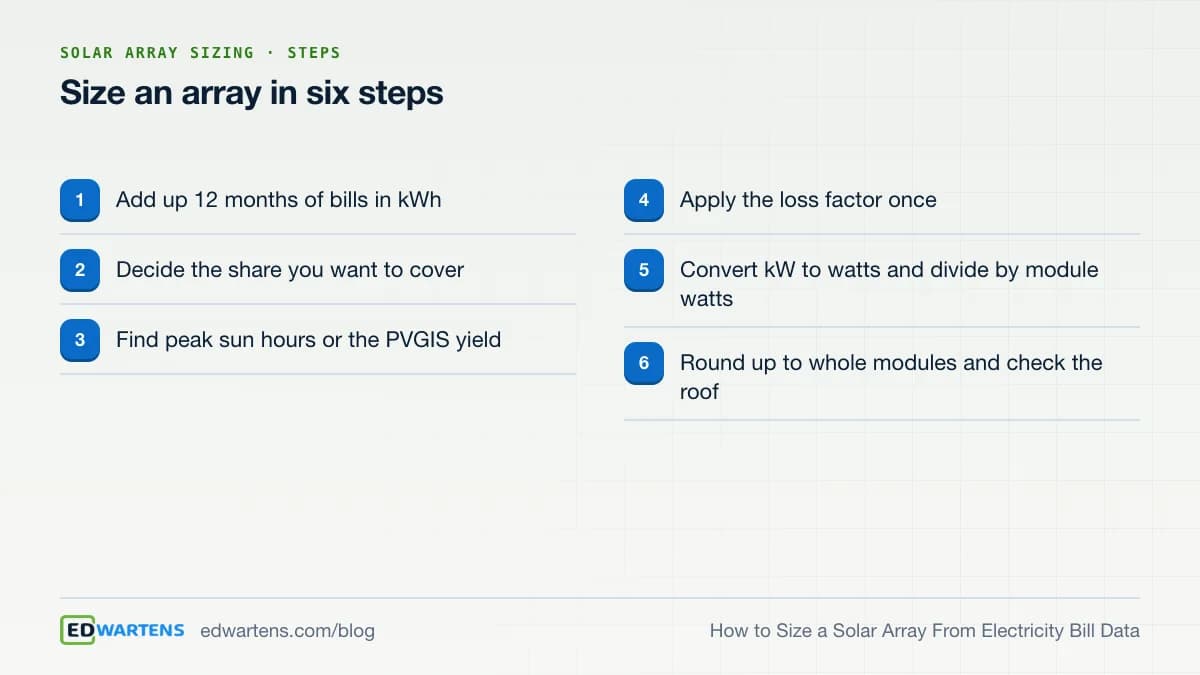
How to size a solar array from electricity bill data, in one line: divide the kWh you use in a year by the kWh that one kW of panels makes at your site, then divide the result by your module's watts and round up. There are two ways to get the "kWh per kW" figure, peak sun hours or the free PVGIS tool, and the sources we read write the loss factor three different ways. This guide shows both routes with the same example, explains why the factors differ, and warns about the one mistake that oversizes an array by about a quarter.
This is a learning guide, not an installer's quote or a design approval. Local codes and the installer's design decide what is built.
How to size a solar array from electricity bill: what you need first
Gather three things.
- Twelve months of bills in kWh. One month is not enough because use changes with the seasons. If your bills show cost only, ask the supplier for the kWh.
- The share you want to cover. Covering 100 per cent of use is a choice, not a rule. The University of Maryland Extension's method uses a solar offset, for example 50 per cent.
- The roof. Its area, tilt, direction and shading decide how many modules fit and how well they work.
Our worked example uses the numbers from the Penn State course: 6,500 kWh a year in State College, Pennsylvania, with 4.22 peak sun hours a day and 1,231 kWh a year per kW installed. They are the author's example values for a US site, not a figure for yours.
Route A: peak sun hours
A peak sun hour is one hour of sunshine at 1 kW per square metre. A site with 4.22 peak sun hours a day receives, in energy terms, 4.22 hours of that full sun every day. That is why one kW of panels makes about 4.22 kWh a day before losses.
The Penn State course (AE 868, grid-connected system sizing) gives the formula:
PV size in kW = annual kWh / (365 x peak sun hours), then multiply by 1.25 for losses
Worked example:
- 6,500 / (365 x 4.22) = 4.22 kW before losses.
- 4.22 x 1.25 = 5.27 kW after losses.
The 1.25 is there because losses "can reach up to 25 per cent", in the course's words. Heat, wiring, the inverter and dirt all take a share, so you need more panels than the sum suggests.
Route B: use the PVGIS yield
The European Commission's Joint Research Centre runs PVGIS, a free tool with no registration that covers any location worldwide. Its production version 5.3 uses data from 2005 to 2023, and a version 6 beta covers 2014 to 2025 (read 23 November 2026). It also has programming interfaces if you want to automate it.
You enter the location, the tilt, the direction and the system losses. The tool returns the energy one kW of panels makes in a year. In the Penn State example that is 1,231 kWh per kW.
Then the sum is short: 6,500 / 1,231 = 5.28 kW. That matches Route A's 5.27 kW, which is a useful cross-check. The video below shows how to read irradiance and temperature data in PVGIS.
The trap: counting losses twice
Look at the two routes again. Route A starts with sunshine and applies a loss factor. Route B starts with a yield that already includes losses. In the example, 4.22 hours x 0.8 x 365 days = 1,232 kWh per kW, which is the PVGIS figure within rounding. The 0.8 is hidden inside the 1,231.
So if you take the PVGIS yield and then also divide by 0.8, you count the losses twice. 6,500 / 1,231 / 0.8 = 6.60 kW, which is about 25 per cent bigger than the 5.28 kW the correct sum gives. PVGIS asks for a system-loss percentage, and whatever you enter is built into the yield it reports. Check the tool's own help for its default before relying on it.
The two routes side by side, for the same example:
| Item | Route A: peak sun hours | Route B: PVGIS yield |
|---|---|---|
| Starting data | 4.22 sun hours a day | 1,231 kWh per kW a year |
| Formula | 6,500 / (365 x 4.22) x 1.25 | 6,500 / 1,231 |
| Losses applied | By you, once, as 1.25 | Inside the yield, from the loss you entered |
| Result | 5.27 kW | 5.28 kW |
Why the loss factors differ
The sources write the same idea in three ways. Dividing by 0.8 is the same as multiplying by 1.25. The University of Maryland Extension (FS-2023-0655) divides by a derate factor with a default of 0.86. Aurora Solar's page gives an example derate of 0.80 and says residential systems fall between 0.75 and 0.86. Aurora sells design software, so its page is a vendor source, but its formula matches the others.
| Source | Written as | Your 6,500 kWh at 4.22 sun hours |
|---|---|---|
| Penn State | Multiply by 1.25 | 5.27 kW |
| Aurora Solar | Divide by 0.80 | 5.27 kW |
| Maryland Extension | Divide by 0.86 | 4.91 kW |
| PVGIS yield | 6,500 divided by 1,231 | 5.28 kW |
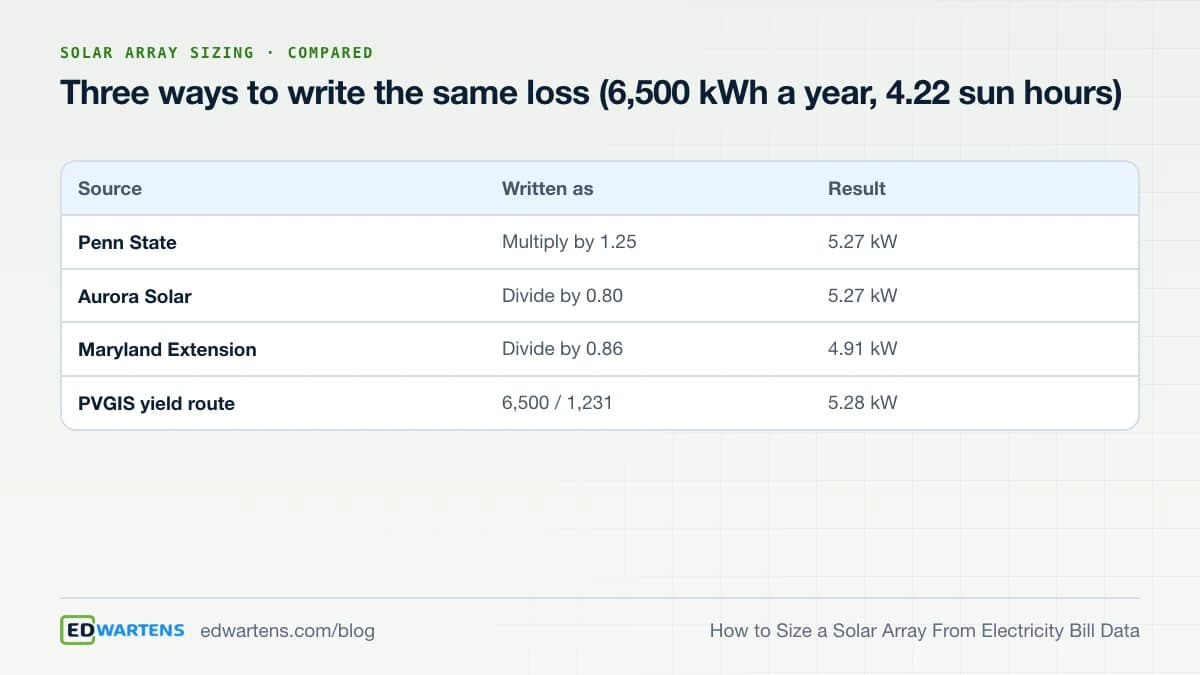
The first two are identical. Maryland's 0.86 assumes smaller losses, so it asks for fewer panels. Neither is wrong. Pick one, apply it once, and say which. If you are choosing for a real roof, ask the installer which loss figure the design uses and why.
Maryland's own worked case is different from ours. For 5,592 kWh a year at a 50 per cent offset, with 1,580 peak sun hours a year and a derate of 0.86, the sums are 5,592 / 1,580 = 3.54 kW, times 0.5 = 1.77 kW, divided by 0.86 = 2.06 kW. The page's intermediate units are mislabelled, so we corrected them here.
From kW to modules
Now turn kW into a number of modules. Take the array size in watts and divide by the module's rated watts, then round up.
For 5.28 kW and a 400 W module, which is an example size you should replace with your datasheet's figure: 5,280 / 400 = 13.2, so you need 14 modules. Those 14 modules are 5.6 kW. At the PVGIS yield of 1,231 kWh per kW, they make about 6,894 kWh a year, which is about 106 per cent of the 6,500 kWh you use. Rounding up means you slightly exceed the target, which is normal.
| Step | Sum | Result |
|---|---|---|
| Array size needed | 6,500 / 1,231 | 5.28 kW |
| Modules, rounded up | 5,280 W / 400 W = 13.2 | 14 modules |
| Installed size | 14 x 400 W | 5.6 kW |
| Expected yearly energy | 5.6 kW x 1,231 | about 6,894 kWh |
| Share of use | 6,894 / 6,500 | about 106 per cent |
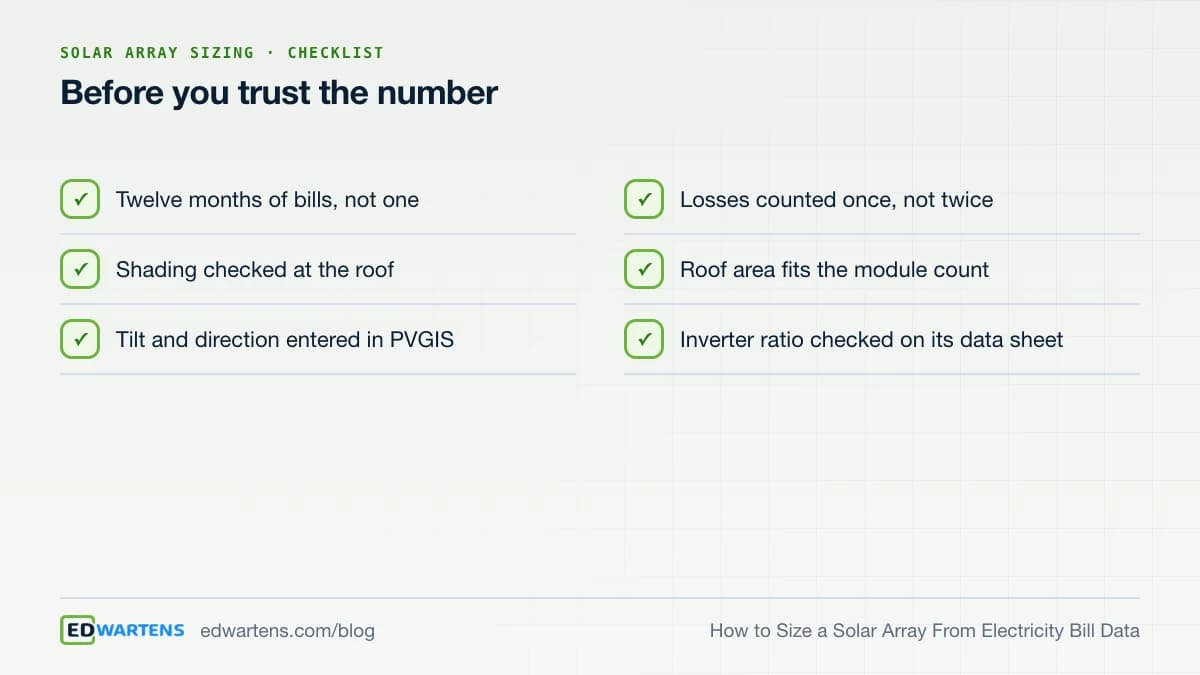
Three things can stop the sum.
- Roof area. Multiply the module count by the module area on its datasheet and compare it to the free roof, with space for access.
- The inverter. Its data sheet gives a maximum DC input and a voltage window, which set how many modules go in each string and in total.
- Shading and orientation. A chimney or tree can cost more than the loss factor. Enter the real tilt and direction in PVGIS.
Common mistakes
- Using one month of bills. Summer and winter use differ. Use twelve months.
- Ignoring shading. A tree or chimney can cost more than any loss factor.
- Mixing units. Keep kWh for energy and kW for power. A kW rating is not a yearly figure.
- Using a data sheet maximum. Use the module's rated watts at standard test conditions, as the data sheet states, and let the loss factor cover real conditions.
- Forgetting the roof. The sum can give a number the roof cannot hold.
Sanity checks and the battery question
Compare your answer with an installer's quote. If they differ by a lot, ask which sun-hour data, loss figure and module they used. A gap often comes from different assumptions, not an error.
A battery does not change the array size in this method. It changes when you use the energy. If you want to read more, the free Battery Energy Storage Systems course covers storage design, and our post on UL 9540, UL 9540A and NFPA 855 explains the safety documents for batteries.
Do it in the lab
Sizing is a skill you learn by doing it several times. The Solar and EV lab in EDWartens Lab lets you size a solar array and wire an EV charger. It is free with a free account, runs in the browser, and is for learning, not for designing a real installation.
The free Rooftop Solar PV Design and Installation course starts with PVGIS and peak sun hours and sizes an on-grid array from a year of bills. The PVsyst course goes further, to plant-scale design. The Solar PV and EV Charging Engineer job simulation sizes an array, tests it to IEC 62446 and fits EV chargers on a limited supply, as practice at a simulated company, not a job. The free Electrical and Solar Energy internship runs 4 weeks online: it is a training programme, not employment. More courses are in the solar and storage hub.
For what comes after design, read our solar PV commissioning checklist for IEC 62446-1, the solar and EV charger commissioning simulator post and renewable energy automation training. For quick sums, try the free engineering calculators.
Every course is free to learn in full. The optional certificate of completion for a beginner course is a one-off US$8.99, and anyone can check it on the verification page. It is an EDWartens certificate, not a vendor credential.
Practise with us
Internship
Electrical and Solar Energy
Free internship: 4 weeks, a free certificate and nothing to buy. The Engineer-verified internship adds an engineer's review and the graded certificate.
See the internshipLab
Electrical lab
Practise in your browser. Free, nothing to install.
Open the lab (opens in a new tab)Roles
Power and energy
Roles that ask for this skill, 87 open in this country now. Free to see and to apply. We are not a recruitment agency.
See rolesTake the free course
 Free
Renewable energy · Beginner · Free
Rooftop Solar PV Design and Installation
 Free
Renewable energy · Intermediate · Free
PVsyst Solar Power Plant Design
 Free
Renewable energy · Intermediate · Free
Battery Energy Storage Systems (BESS): Design, Controls and Safety
 Free
Electrical · Beginner · Free
Electrical Fundamentals for Technicians: Volts to Multimeter to Drawings
Questions
How many solar panels do I need for my house?
Divide your yearly kWh by the yearly kWh one kW of panels makes at your site, then divide kW by the module's watts. In our worked case, 6,500 kWh a year needs about 5.3 kW, which is 14 modules of 400 W. Your roof and climate will change it.
How do I calculate solar system size from my kWh bill?
Add 12 months of bills in kWh. Divide by 365 times your peak sun hours, then divide by the loss factor (about 0.8) or multiply by 1.25. Or divide your yearly kWh by the PVGIS yield per kW, which already includes the losses you entered.
What are peak sun hours and where do I find mine?
A peak sun hour is one hour of sunshine at 1 kW per square metre, so a day's total energy expressed in those hours. PVGIS, the European Commission's free tool, gives irradiance data for any location worldwide with no registration.
What is a derate factor or performance ratio, and what value should I use?
It is the share of the panels' rated output you actually get after heat, wiring, inverter and dirt losses. The sources we read use 0.86 (Maryland), 0.80 (Aurora) and 1 divided by 1.25 (Penn State). Pick one, apply it once, and say which.
How do I use PVGIS to estimate solar production?
Enter the location, the module tilt and direction, and the system losses, and read the yearly energy per kW installed. Because the tool applies your loss figure, do not divide by a derate factor again, or you size the array about 25 per cent too large.
Is a bigger solar array always better?
No. A bigger array costs more, needs more roof and may exceed the inverter or the connection limit, and unused energy may earn little. Size to the share of use you want, then check the roof, shading and the installer's design.
Sources
- Penn State AE 868: Grid-connected system sizing (read 23 November 2026)
- University of Maryland Extension: Working on Solar Design and System Sizing, FS-2023-0655 (read 23 November 2026)
- European Commission Joint Research Centre: PVGIS (read 23 November 2026)
- Aurora Solar: Sizing a PV System from an Electricity Bill (read 23 November 2026)
Written by the EDWartens engineering team for general education. Product names are trademarks of their owners; mentioning them does not imply endorsement. Prices and terms of other providers were checked on the date shown and can change.

Safe Isolation Procedure for Control Panels

Troubleshoot a Control Panel with a Multimeter

Arc Flash PPE Categories 1 to 4: Chart and Methods

NFPA 70E Training Requirements: Who, How Often, 2027

Free virtual internship with certificate for engineering students (2026)

Does a virtual internship count for college credit? (UGC, AICTE, HEC)