UL 9540 vs UL 9540A: UL 9540 is a product safety standard for an energy storage system, UL 9540A is a test method for thermal runaway and fire spread that is not a certification, and NFPA 855 is the code that governs how the system is installed. Mixing them up is the most common mistake in battery storage projects. This guide gives each one in a sentence, shows how they fit together, lists the documents to ask for, and tells you which edition dates to confirm locally.
This is an explainer for learning, not engineering or legal advice. The local authority having jurisdiction (AHJ), usually the fire marshal or building official, decides what applies to a project. UL Solutions sells testing, so its pages are a vendor's, though they quote the standards. We read all three sources on 23 November 2026. EDWartens is not affiliated with UL or NFPA.
UL 9540 vs UL 9540A vs NFPA 855 in one sentence each
| Document | One sentence | Kind |
|---|---|---|
| UL 9540 | The product safety standard for energy storage systems | Product standard |
| UL 9540A | The test method for thermal runaway and fire propagation | Test method |
| NFPA 855 | The standard for installing stationary energy storage | Installation code |
That table is from UL Solutions' own explainer. The three do different jobs. A product is evaluated against one, tested by another and sited under the third.
UL 9540: the product standard
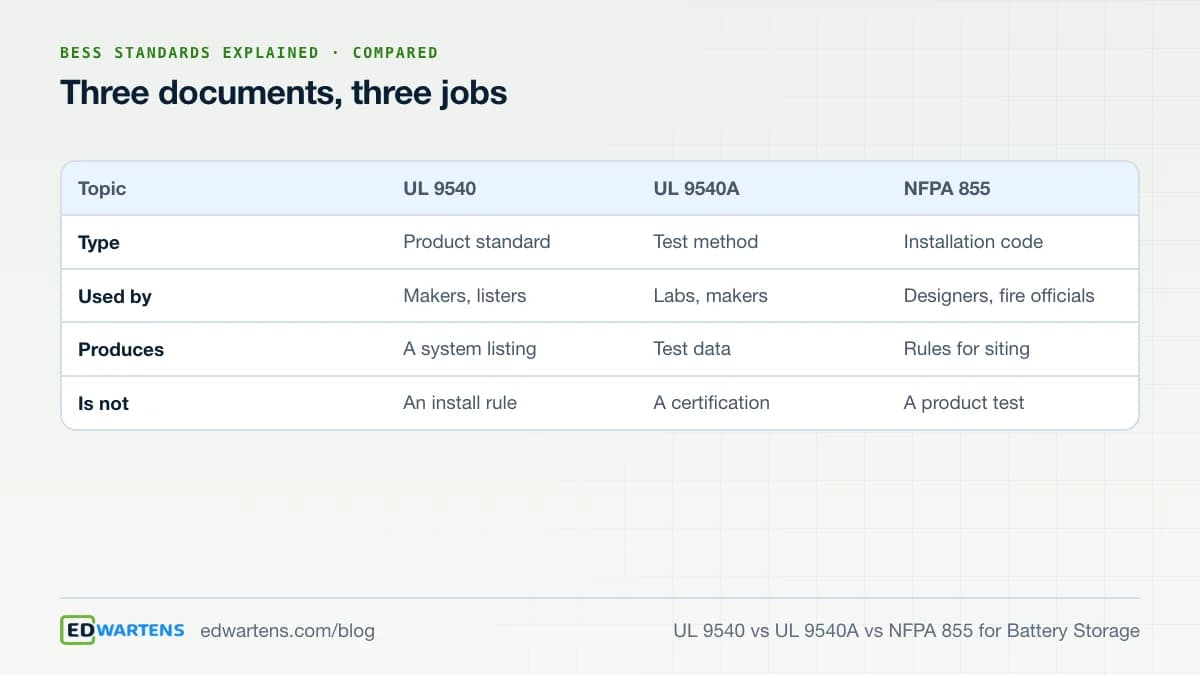
UL 9540 is the product safety standard for energy storage systems, according to UL. Think of it as the standard a whole system is evaluated against, so that a buyer or an inspector can ask for a listing instead of trusting a claim. We do not describe the clause contents here because we did not read the standard.
What it is not: an installation rule. A listed system can still be installed in a place or at a spacing that a code forbids.
UL 9540A: a test method, not a certification
UL 9540A tests how a battery behaves when it goes into thermal runaway, the self-heating failure in which a cell gets hotter and hotter, and how fire may spread. The Sunhub explainer says plainly that UL 9540A is a test method, not a product certification standard. Testing can happen at four levels: the cell, the module, the unit and the installation.
The output is data. Designers and fire officials use that data to judge spacing, barriers and fire protection. A report that says "tested to UL 9540A" is not the same as "listed to UL 9540", and it does not say the system is safe by itself. It says what happened in a particular test.
Edition dates are a trap. UL says an effective date of 1 January 2027 will be established for UL 9540A, Edition 6. The Sunhub page gives different dates for editions 5 and 6, which conflict with UL's wording, so we quote only UL and suggest you ask for the edition on every test report.
NFPA 855 and the fire code
NFPA 855 covers installation. It is the document a designer reads for where a system may go and what protection it needs. UL's explainer says the 2026 edition of NFPA 855 puts emphasis on large-scale fire testing, with a new Annex G.11. UL's FAQ adds that UL 9540A is the only fire and explosion testing method that will be referenced in the 2026 edition, and that the International Fire Code requires large-scale testing "in accordance with UL 9540A" in its 2024 edition.
We could not read NFPA's own page, which returned only a title. So we say nothing about NFPA 855 beyond the UL descriptions. Read the scope in the edition itself before you rely on it, and check which edition your authority has adopted. A code edition applies from the date a jurisdiction adopts it, not from the date NFPA publishes it.
Large-scale fire testing (LSFT) means testing a bigger arrangement, such as a whole unit, rather than one cell. It tells you about spread in a real layout, which cell tests cannot.
How the three fit together on a project
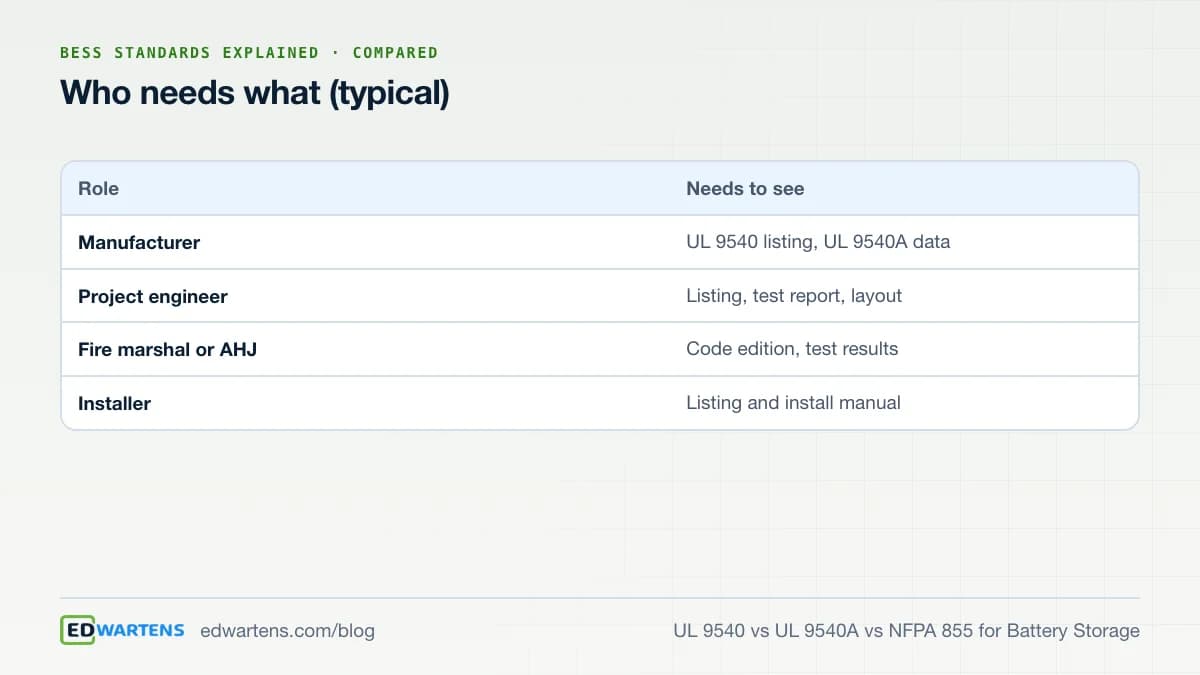
A BESS project moves through four hands.
- The manufacturer builds the system, gets it evaluated to UL 9540 and has test data from UL 9540A.
- The project engineer collects the listing and the test report and designs the layout.
- The authority checks the design against the adopted code, which may be NFPA 855 or the fire code, and decides if more test evidence is needed.
- The installer follows the listing's installation instructions and the approved design.
| Question | Look at |
|---|---|
| Is this product evaluated as a system? | The UL 9540 listing |
| How does it behave in a fire test? | The UL 9540A report and its edition |
| Where may it go and how far apart? | NFPA 855, the fire code and the authority's adopted edition |
| Is large-scale testing needed? | The code edition adopted locally |
What to look for in a UL 9540A report
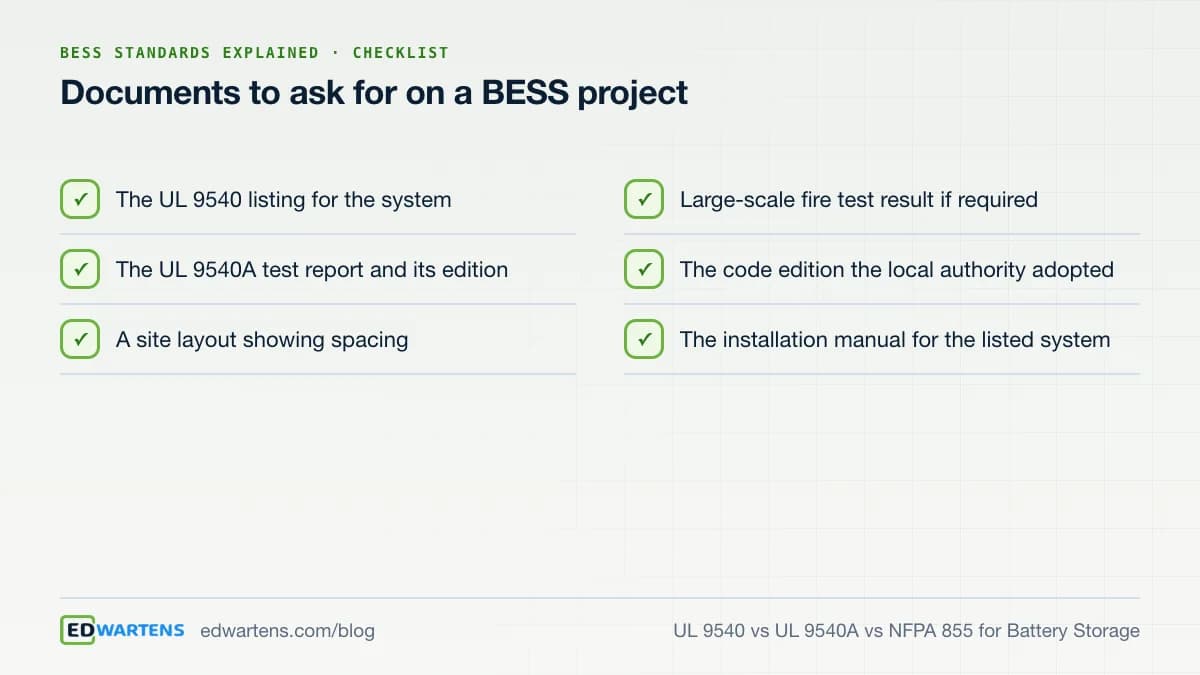
A test report is a document you can read, not a badge. When a project engineer receives one, a short list of questions turns it into evidence.
- Which edition was used? Editions change, and an authority may ask for a particular one.
- Which level was tested? Cell, module, unit and installation tests answer different questions. A cell test says little about how fire moves between racks.
- What exactly was tested? The report should name the product, its configuration and the test set-up. If your project uses a different layout, the report may not cover it.
- What did the test observe? Look for the description of what happened, such as whether fire spread to neighbouring units, rather than a one-line summary.
- Who ran it? A report from a recognised test laboratory is easier for an authority to accept, and it is the authority's call.
If any answer is missing, ask the manufacturer before the design is frozen.
Reading a data sheet: what the words really claim
Product literature uses these terms loosely. The table translates a few phrases. It is our reading, so confirm the facts with the documents themselves.
| Phrase in a brochure | What it may mean | What to ask for |
|---|---|---|
| "Listed to UL 9540" | The system was evaluated as a product | The listing document and its scope |
| "Tested to UL 9540A" | Fire test data exists for some level | The report, the level tested and the edition |
| "Complies with NFPA 855" | A claim about installation, not a product | The site design and the adopted code edition |
| "Large-scale fire tested" | A bigger test than a single cell | The test report and what was burned |
The most common slip is to read "tested to UL 9540A" as "certified". It is not. UL 9540A produces data, not a listing. A second slip is to treat a manufacturer's claim about NFPA 855 as if it settled siting. The authority decides, using the code edition it adopted.
Edition dates and the authority having jurisdiction
Three dates matter, and all three are local or specific.
- The UL 9540A edition on the report. Confirm which edition was used.
- The NFPA 855 edition adopted. Jurisdictions adopt editions on their own schedule.
- The fire code edition adopted. UL's FAQ refers to the 2024 International Fire Code.
If the project is on the border between two editions, ask the authority early. A delay that costs a week is better than a redesign that costs a month.
Learn BESS design and safety free
The free Battery Energy Storage Systems course has a module on fire safety with UL 9540A and NFPA 855, and covers design and controls. It is free to learn in full with a free account. Useful companions are Rooftop Solar PV Design and Installation, Electrical Safety: Arc Flash, NFPA 70E and LOTO and NEC 2026 for Engineers and Electricians. The solar and storage hub lists more.
For practice, the Solar and EV lab in EDWartens Lab lets you size a solar array and wire an EV charger, free with a free account. The Solar PV and EV Charging Engineer job simulation is a working day at a simulated company, not employment. The free Commissioning internship runs 4 weeks online as training with no stipend. For what follows design, read the solar PV commissioning checklist, the solar and EV charger commissioning simulator post, FAT versus SAT and renewable energy automation training. Safety reading includes arc flash PPE categories, protection relay testing and transformer testing types. To size the array that feeds a battery, see how to size a solar array from your electricity bill.
The optional certificate of completion for an intermediate course is a one-off US$10.99. Anyone can check it on the verification page. It is an EDWartens certificate. It is not a UL or NFPA credential.
Practise with us
Internship
Electrical and Solar Energy
Free internship: 4 weeks, a free certificate and nothing to buy. The Engineer-verified internship adds an engineer's review and the graded certificate.
See the internshipLab
Electrical lab
Practise in your browser. Free, nothing to install.
Open the lab (opens in a new tab)Roles
Power and energy
Roles that ask for this skill, 87 open in this country now. Free to see and to apply. We are not a recruitment agency.
See rolesTake the free course
 Free
Renewable energy · Intermediate · Free
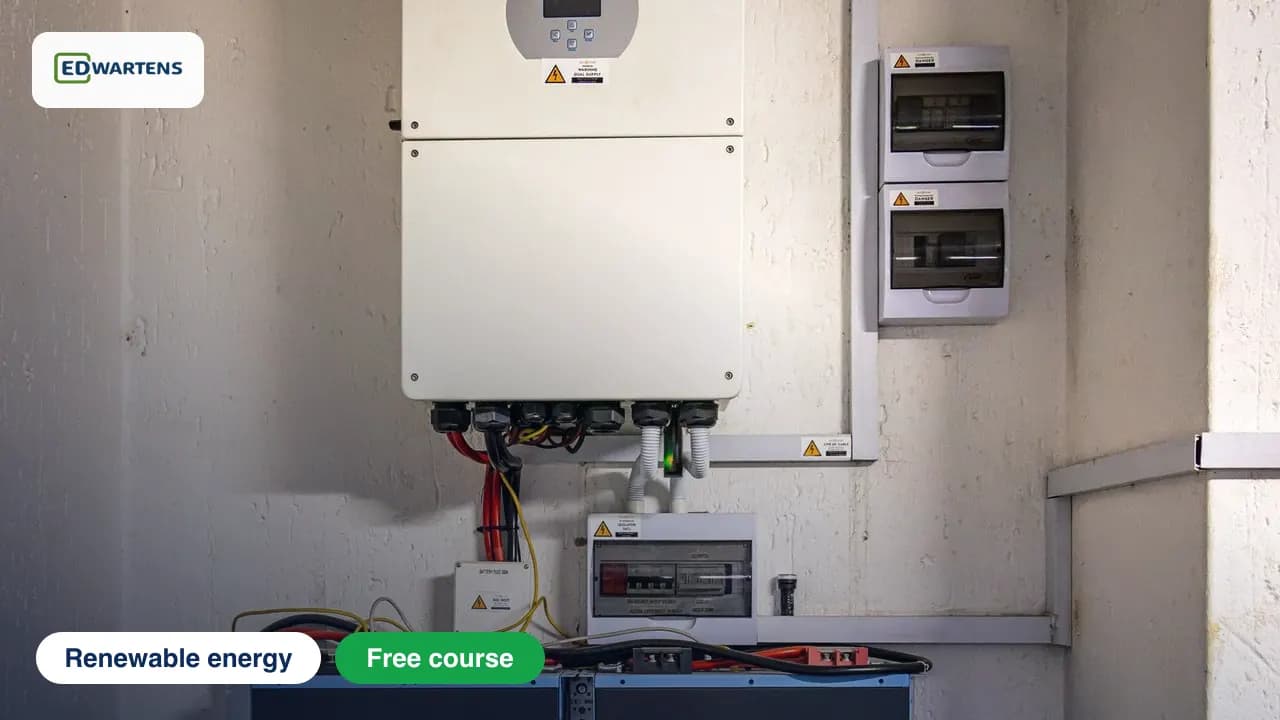
Battery Energy Storage Systems (BESS): Design, Controls and Safety
 Free
Renewable energy · Beginner · Free
Rooftop Solar PV Design and Installation
 Free
Electrical · Beginner · Free
Electrical Safety: Arc Flash, NFPA 70E and LOTO
 Free
Electrical · Intermediate · Free
NEC 2026 for Engineers and Electricians
Questions
What is the difference between UL 9540 and UL 9540A?
UL 9540 is a product safety standard for energy storage systems. UL 9540A is a test method for thermal runaway and fire propagation, run at cell, module, unit and installation level. One evaluates a product, the other produces fire test data.
Is UL 9540A a certification?
No. Sunhub's explainer says UL 9540A is a test method, not a product certification standard, and UL Solutions describes it as the test method for thermal runaway and propagation. It produces data that others use. A product listing comes from UL 9540.
What does NFPA 855 require for battery storage?
UL Solutions describes NFPA 855 as the installation standard for stationary energy storage. We have not read the NFPA text itself, so read the edition your authority adopted for the actual rules on spacing, size limits and fire protection.
What changed in the 2026 edition of NFPA 855?
UL Solutions says the 2026 edition emphasises large-scale fire testing, with a new Annex G.11, and that UL 9540A is the only fire and explosion test method it references. Confirm the details in the published NFPA text and your local adoption.
Do I need UL 9540A test data to install a BESS?
Sometimes. It depends on the code edition your authority has adopted and the size and location of the system. UL says the 2024 International Fire Code requires large-scale testing in accordance with UL 9540A. Ask the authority having jurisdiction.
What is large-scale fire testing (LSFT) for BESS?
It is testing that burns a unit or an installation-scale arrangement to see how fire spreads, rather than testing a single cell. UL 9540A is the method the codes cited by UL reference for it, and the 2026 NFPA 855 edition places emphasis on it.
Sources
- UL Solutions: Understanding UL 9540A and NFPA 855 (read 23 November 2026)
- UL Solutions: Installation codes and requirements for energy storage systems (ESS) FAQs (read 23 November 2026)
- Sunhub blog: UL 9540 vs UL 9540A, 11 November 2026, a retailer's explainer (read 23 November 2026)
Written by the EDWartens engineering team for general education. Product names are trademarks of their owners; mentioning them does not imply endorsement. Prices and terms of other providers were checked on the date shown and can change.

Safe Isolation Procedure for Control Panels

Troubleshoot a Control Panel with a Multimeter

ATEX vs IECEx vs CompEx: What Each One Means

NFPA 70E Training Requirements: Who, How Often, 2027
MCC Safe Isolation Simulator: Practise in a Free 3D Switchroom
Electrical Engineering Work Experience Without an Internship