
ISO 9001:2026 changes are an evolution of the 2015 edition, not an overhaul. DNV says ISO published the new edition on 16 September 2026, the first update since 2015, and that organisations certified to ISO 9001:2015 have three years to transition. BSI lists the changes: a clearer split between risks and opportunities, new requirements on culture and ethical behaviour, more emphasis on planned change, a new Annex A, and updated alignment with the harmonised structure. This guide separates what is confirmed from what you must check with your certification body, and ends with a ten-point gap analysis.
EDWartens is not affiliated with ISO, BSI, DNV or LRQA, does not certify companies and does not run accredited auditor courses. The standard itself is paywalled and we have not reproduced it. Everything below comes from the three public pages listed at the end, read on 23 November 2026.
What is confirmed on 23 November 2026
| Fact | Source |
|---|---|
| ISO published ISO 9001:2026 on 16 September 2026, the first update since 2015 | DNV (21 September 2026) |
| BSI published its adoption, BS EN ISO 9001:2026, on 16 September 2026 | BSI |
| Organisations certified to ISO 9001:2015 must transition within 3 years | DNV |
| The changes are evolutionary rather than revolutionary | DNV |
| The changes are a natural evolution, not a complete overhaul | BSI |
| The Draft International Standard was published on 27 August 2025 | LRQA |
We could not open ISO's own news release, which refused automated access. Before you write a date into an audit document, read the official wording on iso.org for yourself.
ISO 9001:2026 changes, in plain English
BSI's article names these changes. We have added what each means for a quality engineer, in our own words.
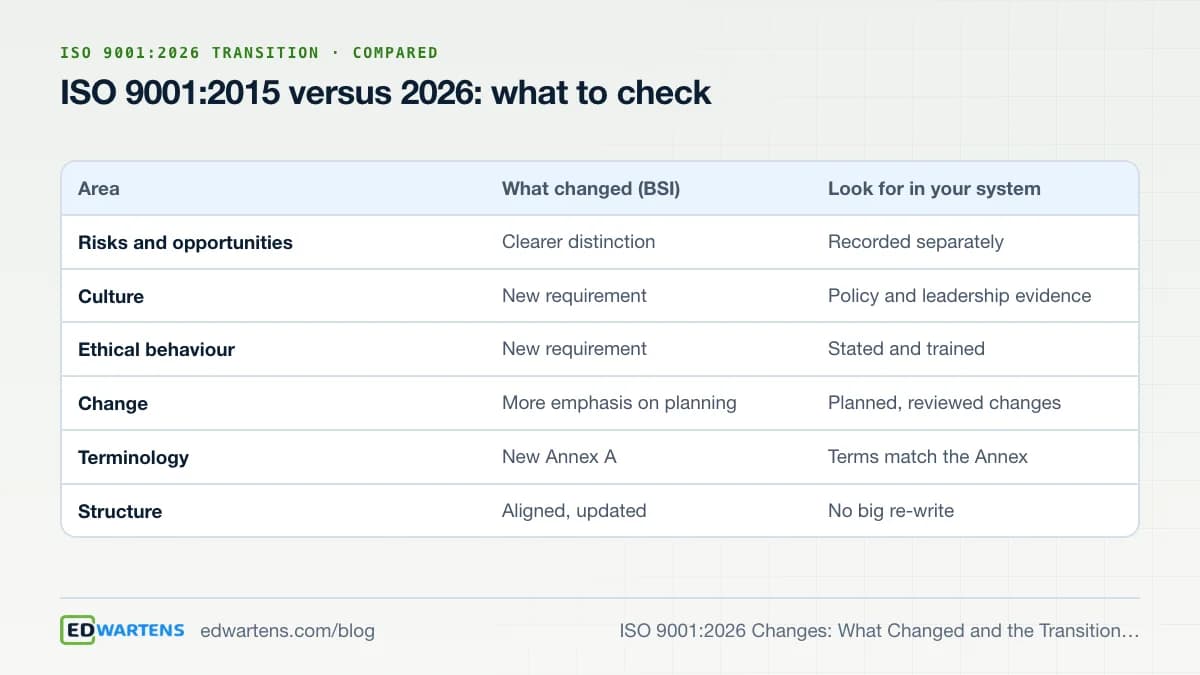
| Area | What BSI says changed | What it means in practice |
|---|---|---|
| Risks and opportunities | A clearer distinction between the two | Record a risk (something that could go wrong) separately from an opportunity (something you could gain) |
| Culture | New requirements on organisational culture | Leaders should be able to show how they build a quality culture |
| Ethical behaviour | New requirements on ethical behaviour | The system should state expected behaviour, for example about honest records |
| Change | More emphasis on planned change | Changes to the system should be planned, reviewed and recorded |
| Terminology | A new Annex A clarifying terminology and intent | Check that the words you use match the standard's |
| Structure | Updated alignment with the harmonised structure of ISO 14001, 45001 and 27001 | Combined management systems should line up more easily |
DNV frames the same update around evolving business practices, organisational resilience, digitalisation and stakeholder expectations. Those are themes, not clauses. For the clause-level wording you need the standard.
What did not change
DNV says the standard keeps its familiar structure. BSI calls the revision a natural evolution. In practice that means a system built for the 2015 edition is a good base. You are not starting again.
The core ideas of a quality management system stay the same: understand the context of the organisation, lead from the top, plan, support, operate, evaluate performance and improve. Our free course teaches the seven quality management principles and the clauses in plain words, and the Quality Management hub links the related courses.
The transition: three years, and who sets the date
DNV says certified organisations have three years to transition. It adds that the period was set at international level, by the bodies that oversee certification. The page gives no calendar date. LRQA says organisations typically get a three-year transition.
Three consequences follow.
- Your certification body sets your practical deadline. Ask them the date it will stop issuing and auditing to the 2015 edition, and when transition audits are available.
- Do not wait for the last year. Audit slots can be scarce near a deadline, and gaps take time to fix. That is our judgement, not a quote from the sources.
- A three-year period implies that 2015 certificates stay usable while you move. The sources do not spell this out, so ask your certification body how long yours remains valid.
If you are a student or a quality engineer outside a certified company, the transition matters for the questions interviewers ask. Learning the new edition now saves you learning the old one and then re-learning it.
Questions to ask your certification body
Your certification body, not a blog, sets the rules for your certificate. Put these to them in writing.
- On what date will you stop auditing to the 2015 edition?
- When do you offer transition audits, and how long do they take?
- Do I need a separate audit, or can the transition happen at a surveillance visit?
- What evidence will the auditor expect for culture, ethics and planned change?
- Will a gap analysis done by us in advance be accepted as input?
- Is there a cost difference between transitioning early and late?
Their answers turn this guide into a plan with dates. Keep the replies with your records.
A ten-point gap analysis you can do in an afternoon
A gap analysis compares what your system does today with what the new edition expects. You do not need the full text to start; use BSI's list of changes and the questions below, then confirm each with the standard.
| Check | Question to ask | Evidence to find |
|---|---|---|
| 1 | Does the quality policy mention ethics and culture? | The policy document |
| 2 | Are risks and opportunities recorded separately? | The risk register |
| 3 | Does the change process cover planning and review? | A recent change record |
| 4 | Can leadership show sign-off? | Management review minutes |
| 5 | Do your terms match the new Annex A? | Procedures and glossary |
| 6 | Is the internal audit plan updated? | The audit schedule |
| 7 | Are auditors trained on the new edition? | Training records |
| 8 | Do supplier requirements still fit? | Purchasing procedure |
| 9 | Is documented information still controlled? | The document register |
| 10 | Do management review inputs include the new topics? | The review agenda |
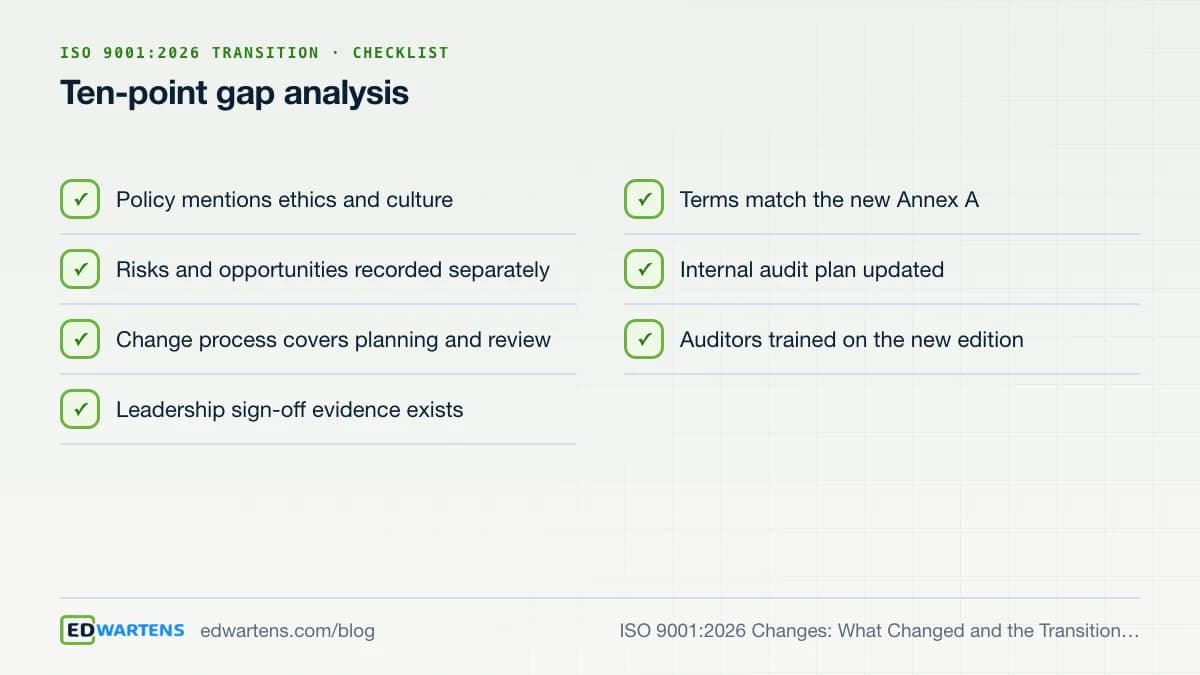
Score each as met, partly met or not met. The partly met items are your plan. Write one action, one owner and one date for each, and you have a transition plan.
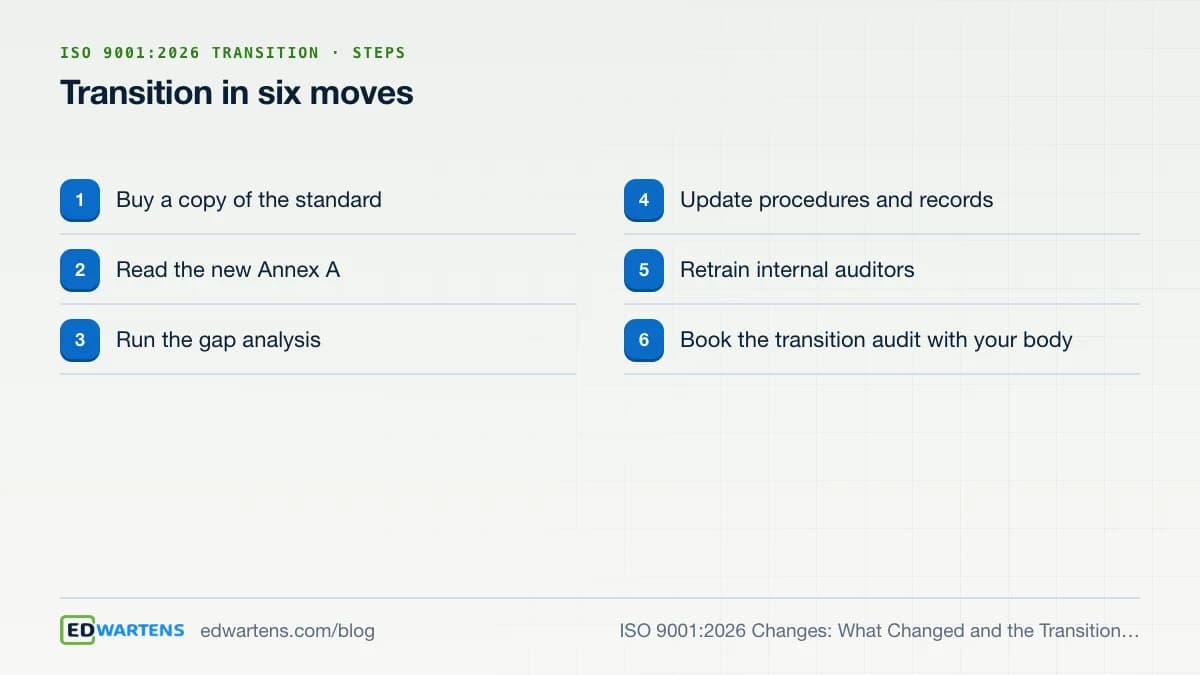
Two mistakes to avoid. First, do not rewrite the whole manual because the edition number changed. The sources describe an evolution, and a system that worked for the 2015 edition mostly still works. Second, do not treat the gap analysis as paperwork. Each action should have an owner and a date, and someone should check it was done.
What it means on the shop floor
If you work on a line or in the lab rather than in the quality office, three changes touch you most.
- Change control. Planned change means a trial, a check and a record before a new method goes live. Our 8D report example shows how a problem becomes a recorded fix.
- Risk thinking. A risk is written down with the action, and so is an opportunity. The same thinking sits behind the failure mode tools in PPAP levels explained.
- Honest records. Ethical behaviour includes recording what happened, not what was hoped. Measurement tools such as process capability, Cp and Cpk only help if the data is true.
If your plant also uses ISO 14001, read what an environmental management system is, because the shared structure makes a joint system easier. Automotive suppliers should also read the IATF 16949 internal audit process.
Learn it free
The free ISO 9001:2026 Quality Management and Internal Auditing course explains what a QMS is, states what changed in ISO 9001:2026 and plans a transition gap analysis. It is free to learn in full with a free account. A copy of the standard helps but is not required, because the notes explain each clause's intent. Related courses are IATF 16949 internal auditor, SPC and MSA and Lean, OEE and TPM. If you work with production data, see how a dashboard gets OEE right in Power BI OEE dashboard.
To practise the job, the Quality Engineer job simulation has you run an 8D, a PFMEA, SPC and a customer complaint with 24-hour containment at a simulated company. It is practice, not employment. The free QA/QC internship runs for 4 weeks online; it is training, not employment, and pays no stipend. For the programme in detail see QA/QC internship for freshers.
The optional certificate of completion for the course is a one-off US$8.99. Anyone can check it on the verification page. It is an EDWartens certificate. It is not an ISO, BSI or auditor credential.
Practise with us
Internships
Project work you can show
Free internships, 4 weeks each, with a free certificate. The Engineer-verified internship is optional.
See all internshipsRoles
Quality and projects
Roles that ask for this skill, 52 open in this country now. Free to see and to apply. We are not a recruitment agency.
See rolesTake the free course
 Free
Quality management · Beginner · Free
ISO 9001:2026 Quality Management and Internal Auditing
 Free
Quality management · Beginner · Free
IATF 16949 Automotive QMS and Internal Auditing
 Free
Quality management · Beginner · Free
SPC and MSA: Control Charts, Capability and Gauge R&R
 Free
Manufacturing excellence · Beginner · Free
Lean Manufacturing, OEE and TPM
Questions
When was ISO 9001:2026 published?
DNV says ISO published ISO 9001:2026 on 16 September 2026, the first update since 2015, and BSI marked it the same day. We could not read ISO's own news page, so confirm the wording there before you quote a date in an audit document.
What are the main changes in ISO 9001:2026?
BSI lists a clearer distinction between risks and opportunities, new requirements on organisational culture and ethical behaviour, more emphasis on planned change, a new Annex A on terminology, and updated alignment with the harmonised structure used by ISO 14001, 45001 and 27001.
How long do I have to transition from ISO 9001:2015?
DNV says organisations certified to ISO 9001:2015 have three years to move. The page gives no calendar date, so ask your certification body for the exact date it will stop auditing against the 2015 edition.
Is ISO 9001:2026 a major revision?
Both DNV and BSI describe it as an evolution. DNV calls the changes evolutionary rather than revolutionary, and BSI calls it a natural evolution, not a complete overhaul. Expect targeted updates, not a new system, but read the full text.
Is ISO 9001:2015 still valid?
Organisations certified to the 2015 edition have a three-year period to move, according to DNV. The sources do not state how long each 2015 certificate stays valid, so ask your certification body for the date and plan the move rather than wait.
What is Annex A in ISO 9001:2026?
BSI describes a new Annex A that clarifies terminology and intent. The standard itself is paywalled, and we have not reproduced it. Read the Annex in your own copy, then check that your procedures use its terms.
Sources
- DNV: The new edition of the quality management system standard ISO 9001 is released, 21 September 2026 (read 23 November 2026)
- BSI: BS EN ISO 9001:2026 is here, 16 September 2026 (read 23 November 2026)
- LRQA: ISO 9001 revision now published (read 23 November 2026)
Written by the EDWartens engineering team for general education. Product names are trademarks of their owners; mentioning them does not imply endorsement. Prices and terms of other providers were checked on the date shown and can change.

QA vs QC in Construction: Who Checks What on Site

What Is MES? Manufacturing Execution Systems and ISA-95 for Automation Engineers

AI Data Center Rack Power: kW, Amps and Cooling

How to Size a Solar Array From Electricity Bill Data
UL 9540 vs UL 9540A vs NFPA 855 for Battery Storage

ETABS to SAFE: Export a Floor and Check the Foundation