
In construction, quality assurance is the system of plans and procedures that prevents defects, and quality control is the checking of the work that finds them. QA writes the rules before the work starts. QC inspects and tests the work as it happens. A civil site needs both, and the clearest way to see the difference is to follow one concrete pour and one compacted layer of soil from plan to result.
Facts about the ACI and ASTM pages were read on 1 November 2026. Test methods are named by number only, because editions change, and acceptance limits always come from the project specification.
Two jobs that are often confused
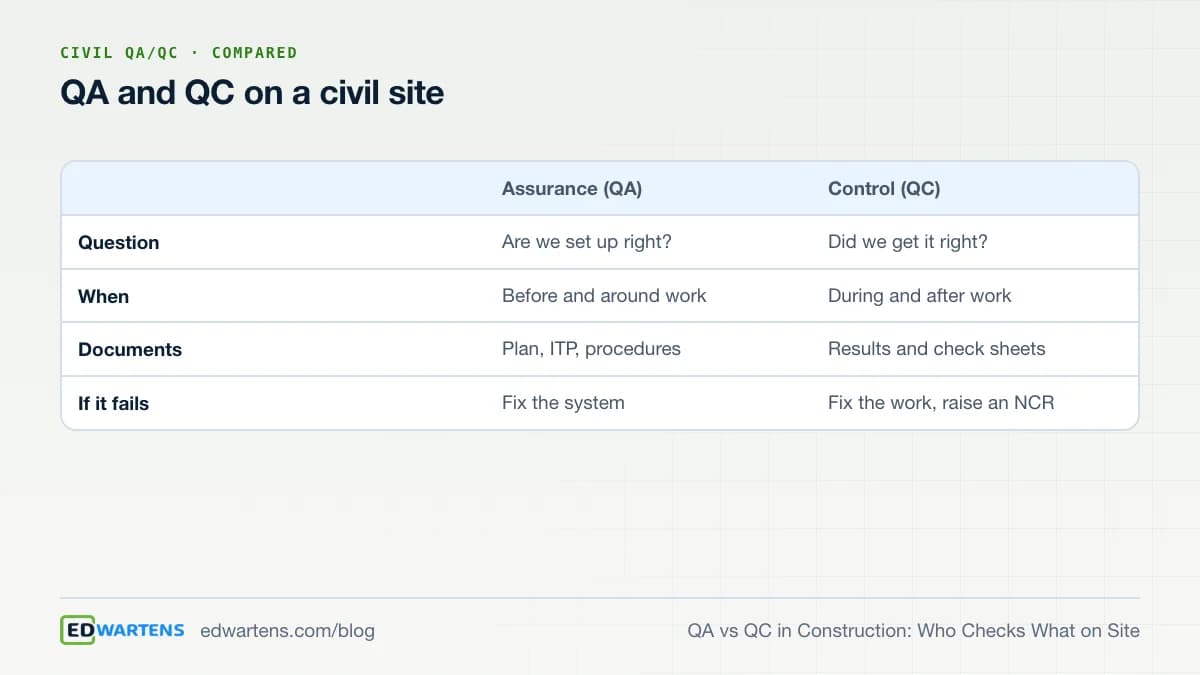
Quality assurance and quality control sound alike, and job titles blur them. The honest split is by timing. QA happens before and around the work: the project quality plan, the inspection and test plans, the method statements, the approval of materials and the control of documents. QC happens during and after: the slump test, the cube or cylinder sample, the inspection of reinforcement, the field density test.
A third piece closes the loop. When a check fails, a non-conformance report records what went wrong, why, and what will stop it happening again. That report is QA learning from QC.
| Quality assurance | Quality control | |
|---|---|---|
| Question it answers | Are we set up to get it right? | Did we get it right this time? |
| When | Before and around the work | During and after the work |
| Typical documents | Quality plan, ITP, method statement, procedures | Test results, inspection records, check sheets |
| Typical people | Quality manager, document controller | Site quality engineer, technician, inspector |
| If it fails | Fix the system | Fix the work and raise an NCR |
The inspection and test plan is where they meet
An inspection and test plan, or ITP, lists each activity, the check to be made, the method or standard, the acceptance rule and the record. It also marks the type of check. A hold point means work stops until a named person signs the check. A witness point means the inspector may attend, and work may continue if they do not. A review point means a document is reviewed.
The ITP is a QA document, because someone writes it before the work. Yet every line in it is a QC check. That is why site teams talk about QA/QC as one job.
A worked example: one compacted layer
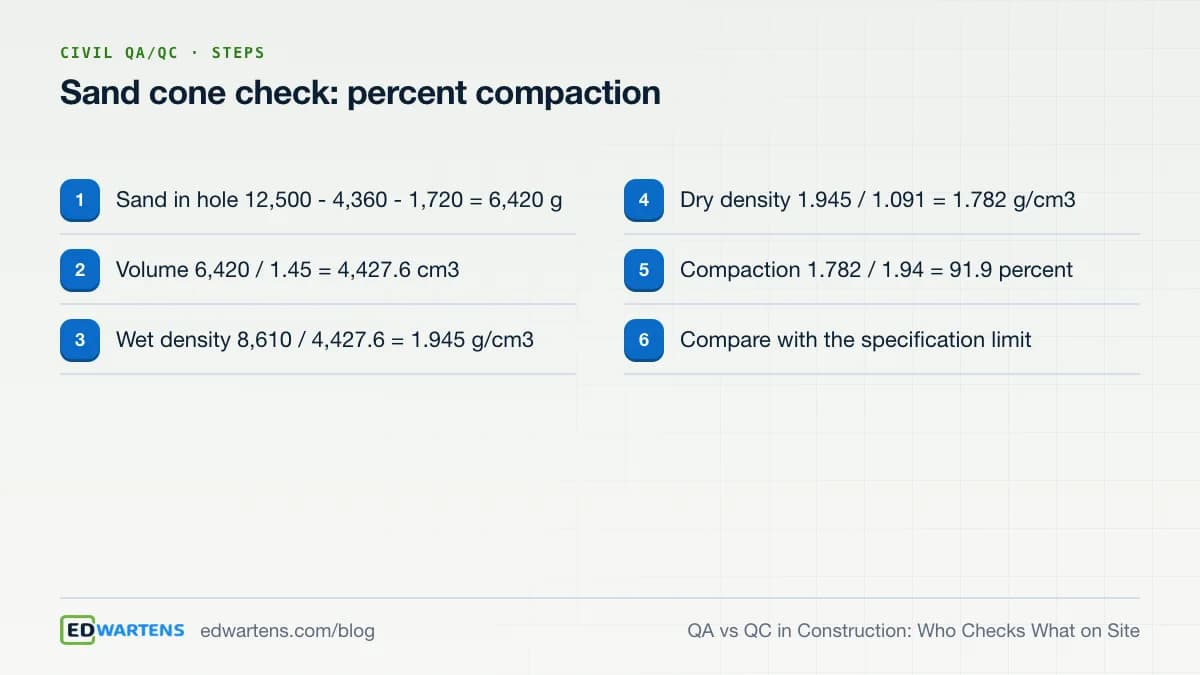
Here is a worked example of a QC result that decides whether the next layer can be placed. A sand cone test measures the in-place density of a compacted soil layer. The sand-cone method is described on the ASTM D1556 page. The inputs below are example values, and every step was computed in a script.
The jar of calibrated sand weighs 12,500 g before the test and 4,360 g after. The cone holds 1,720 g of sand. The sand's calibrated density is 1.45 g/cm3. The soil dug from the hole weighs 8,610 g wet, and its moisture content is 9.1 percent. The laboratory maximum dry density for this soil is 1.94 g/cm3.
- Sand in the hole is 12,500 - 4,360 - 1,720 = 6,420 g.
- The hole volume is 6,420 / 1.45 = 4,427.6 cm3.
- The wet density is 8,610 / 4,427.6 = 1.945 g/cm3.
- The dry density is 1.945 / (1 + 0.091) = 1.782 g/cm3.
- Percent compaction is 1.782 / 1.94 = 91.9 percent.
Now compare with the specification. If it requires 95 percent, the target dry density is 0.95 x 1.94 = 1.843 g/cm3, and this layer falls short by 0.061 g/cm3. The QC engineer does not place the next layer. The contractor recompacts, and the test is repeated. If the specification asks for a different percentage, the answer changes, so read it first.
| Step | Result | Unit |
|---|---|---|
| Sand in hole | 6,420 | g |
| Hole volume | 4,427.6 | cm3 |
| Wet density | 1.945 | g/cm3 |
| Dry density | 1.782 | g/cm3 |
| Compaction | 91.9 | percent |
Concrete: the same split in action
For a concrete pour, QA produces the method statement, the approved mix and the ITP with its hold point before concreting. QC checks the delivery ticket, tests slump and temperature, and makes the cylinders or cubes. ACI describes its Concrete Field Testing Technician, Grade I programme as covering basic field tests on fresh concrete. These include sampling, temperature, slump, density, air content, and making and curing specimens.
The ASTM C39 page notes that compressive strength depends on how the specimens are prepared and cured. That is why QC cares about the way a cylinder is made and stored, and why QA writes a procedure for it.
What an ITP looks like in practice
A short extract shows how one document joins the two jobs. The rows below are examples for a concrete slab. Real ITPs cite the project's own specification and standards, so treat the wording as a pattern, not a template to copy.
| Activity | Check | Point type | Record |
|---|---|---|---|
| Reinforcement before the pour | Bar size, spacing and cover against the drawing | Hold | Signed inspection request |
| Concrete delivery | Ticket matches the approved mix, time of batching | Witness | Delivery ticket log |
| Fresh concrete | Slump and temperature at the point of discharge | Witness | Test sheet |
| Specimens | Cylinders or cubes made, cured and labelled | Review | Specimen register |
| Strength result | Result compared with the specification rule | Review | Laboratory report |
Notice that the first row stops work until it is signed. That is the hold point doing its job. The other rows allow work to continue while a record is built.
Common failures and the system fix
QC finds the same few failures again and again. A slump that is out of tolerance often traces to water added on site. A low cylinder result may come from poor curing of the sample rather than poor concrete. A failed compaction test often follows a layer that was too thick or too wet.
QA turns each finding into a prevention. Water added on site leads to a rule that only the batching plant adjusts the mix. Poor sample curing leads to a procedure and a labelled curing tank. A thick layer leads to a maximum layer thickness in the method statement. Each fix lives in a document, so the next team inherits it.
Who does what on a project
On the contractor's side, a quality manager owns the system and site quality engineers carry out checks. On the consultant or client side, an inspector or resident engineer reviews and witnesses. Third-party laboratories often run the tests. The contractor still owns the quality of its work.
Titles vary by company, so read what a role does rather than what it is called. The same person may be called a QA/QC engineer, a quality engineer or a site inspector.
Records are the product
An inspector cannot see yesterday's pour, so the record is the only proof that a check took place. A good record names the activity, the location, the date, the method, the result, the limit and the person who signed. Photographs help, but they do not replace the written result.
Keep records in one place and give each a number. When a consultant asks for the cylinder results for a level, you should find them in a minute. That speed is a quality measure in itself.
Learn the site workflow free
The free Civil QA/QC Engineer: Concrete, Steel and Earthworks course follows one hospital project from the quality plan to handover. It has twelve study modules and a final assessment, with about 8.4 hours of video. Practise the sand cone arithmetic and the concrete result check in a spreadsheet as you go.
The civil quality course is a free course with a verifiable certificate of completion, and anyone can check a certificate on our verification page. It is not a testing technician certification, it gives no professional licence, and EDWartens is not affiliated with ASTM or ACI.
Keep a portfolio of records
Hiring teams like to see how you record work. Draft a one-page ITP for a slab pour, a sample non-conformance report and a results sheet for the layer above. Use a fictional project so you share nothing confidential. Our guide to building an engineering portfolio from course projects shows how to present them, and our post on electrical QA/QC engineers shows the same split on the electrical side.
Practise with us
Internships
Project work you can show
Free internships, 4 weeks each, with a free certificate. Premium is optional.
See all internshipsRoles
Quality and projects
Roles that ask for this skill, 43 open in this country now. Free to see and to apply. We are not a recruitment agency.
See rolesTake the free course



Questions
What is the difference between QA and QC in construction?
QA is the system of plans and procedures that prevents defects. QC is the inspection and testing that finds them. QA works before and around the work, and QC works during and after it.
Is an ITP a QA or a QC document?
Both. It is written beforehand as part of the quality system, so it is a QA document. Each line in it is a QC check, with a hold, witness or review point.
How do I calculate percent compaction from a sand cone test?
Find the hole volume from the sand used and the sand's calibrated density. Divide the wet soil mass by that volume, then convert to dry density using moisture. Divide by the laboratory maximum dry density. In the example above it is 91.9 percent.
Who sets the acceptance limit for a test result?
The project specification. Standards describe how to run a test, but the contract documents say what result passes. Always read the specification before judging a result.
What happens when a QC check fails?
Work stops or is corrected, and a non-conformance report records the cause and the corrective action. The check is repeated, and the report is closed when the engineer accepts the result.
Is there a free course on construction quality control?
Yes. EDWartens Civil QA/QC Engineer is a free course with a verifiable certificate of completion. It teaches the workflow and the arithmetic, and it is not a technician certification.
Sources
- ASTM International: D1556 sand-cone density of soil in place (read 1 November 2026)
- ASTM International: C39 compressive strength of cylindrical concrete specimens (read 1 November 2026)
- ACI: Concrete Field Testing Technician, Grade I (read 1 November 2026)
Written by the EDWartens engineering team for general education. Product names are trademarks of their owners; mentioning them does not imply endorsement. Prices and terms of other providers were checked on the date shown and can change.

ETABS to SAFE: Export a Floor and Check the Foundation

IATF 16949 Internal Audit Process: Step by Step

PPAP Levels Explained: What Is a Level 1 PPAP?

How Long Does It Take to Become a Construction Estimator?

How Long Does It Take to Learn STAAD.Pro? A Plan

What Is an Environmental Management System (EMS)?