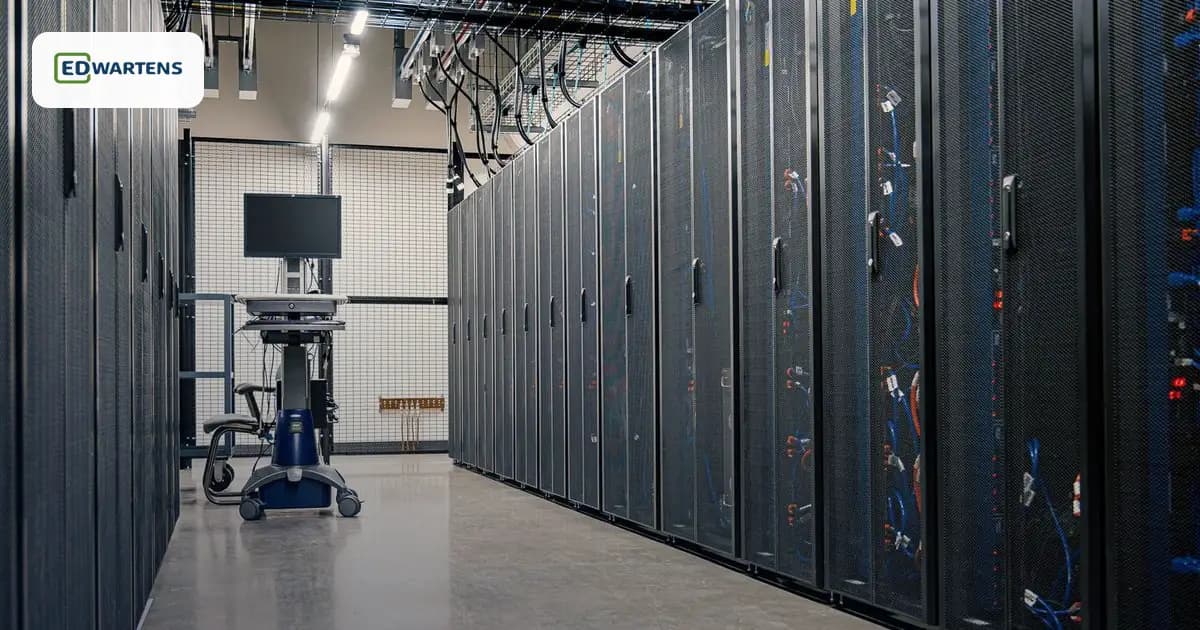
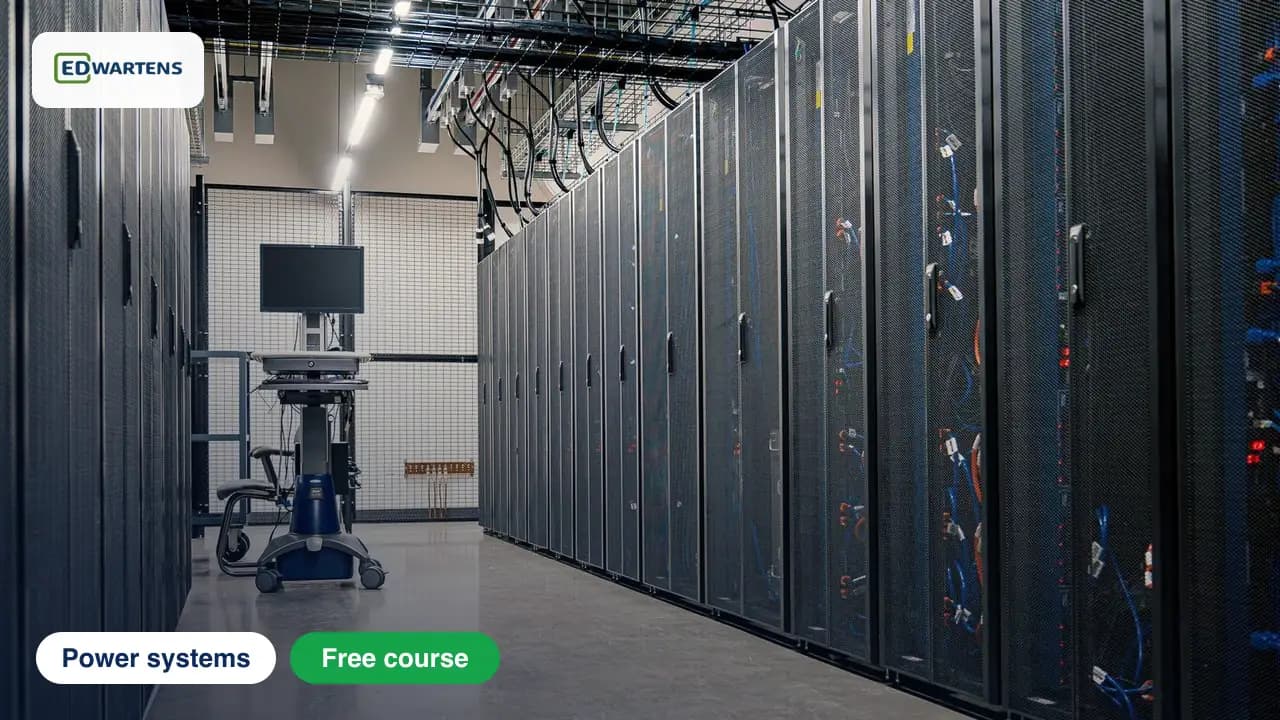
AI data center rack power ranges from about 20 kW to more than 100 kW per rack, compared with about 11 kW for the typical rack in 2026. A 100 kW rack on a 415 V three-phase supply draws about 139 A, and it must be cooled by roughly 143 litres of water a minute. That one sum explains why AI halls use liquid cooling and heavy busways. This guide shows the arithmetic step by step, dates every outside figure, and ends with a free lab where you can size a hall.
The spelling "data center" is what people type, so it is in the title. In the rest of the guide we use the British "data centre".
AI data center rack power in 2026: the numbers
Four trade and consultancy sources, all read on 23 November 2026, give different pictures of rack power: two pages from Data Center Knowledge, a Chatsworth Products article and a Roland Berger report. They are not in conflict. They measure different things.
| Figure | Value | Source and what it measures |
|---|---|---|
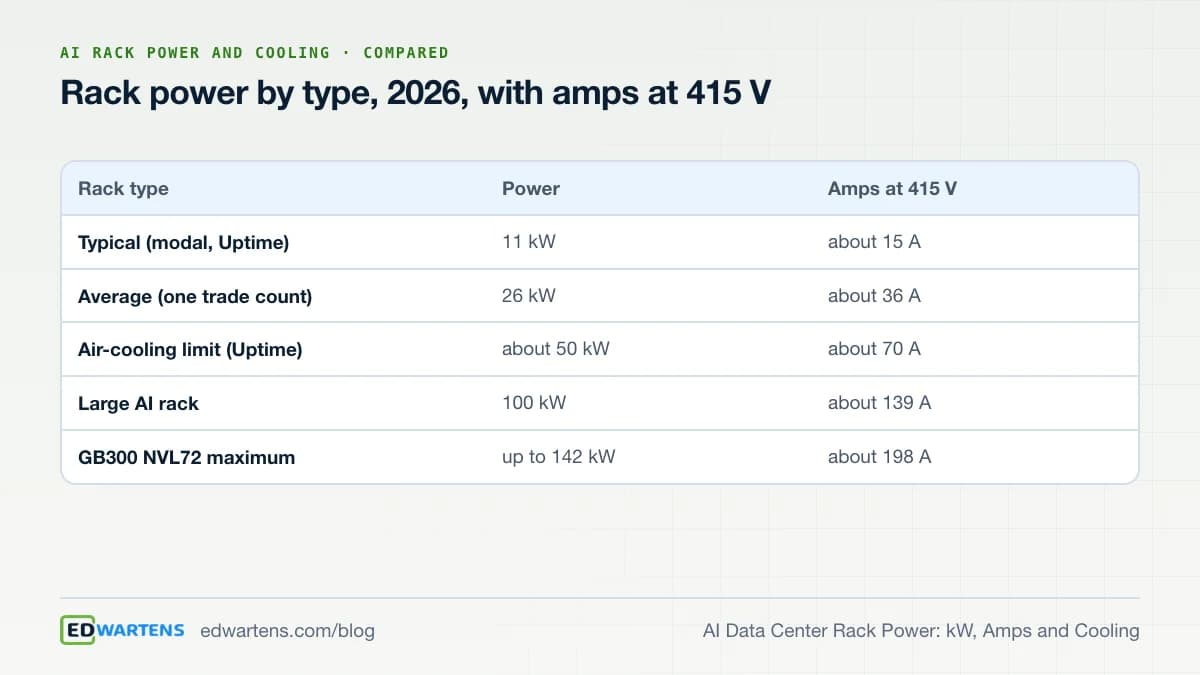
| Typical (modal) rack | 11 kW in 2026, 9 kW in 2025 | Uptime Institute's 16th annual survey, reported by Data Center Knowledge: the most common rack |
| Average rack load | 6.1 kW in 2016, 12 kW in 2024, 26 kW in 2026 | Data Center Knowledge: the mean across racks |
| AI rack | 20 kW to more than 100 kW | Chatsworth Products (a rack and power vendor) |
| Nvidia GB300 NVL72 | up to 142 kW per rack | Its reference architecture, as reported by Data Center Knowledge |
| Traditional design range | 10 to 40 kW per rack | Roland Berger, 31 March 2026 |
The modal rack is the most common one. The average is pulled up by a smaller number of very heavy racks. So 11 kW and 26 kW can both be true in the same year. When you read a number, ask whether it is a typical, an average or a maximum.
From kW to amps
Every rack feed is a current problem. For a three-phase supply the line current is:
current in amps = power in watts / (1.732 x line voltage x power factor)
We assume a power factor of 1 to keep the sums short. A real load has a power factor a little below 1, which raises the current, so treat these as lower bounds.
| Rack power | Amps at 415 V | Amps at 208 V |
|---|---|---|
| 11 kW | 15.3 A | 30.5 A |
| 20 kW | 27.8 A | 55.5 A |
| 50 kW | 69.6 A | 138.8 A |
| 100 kW | 139.1 A | 277.6 A |
| 142 kW | 197.6 A | 394.2 A |
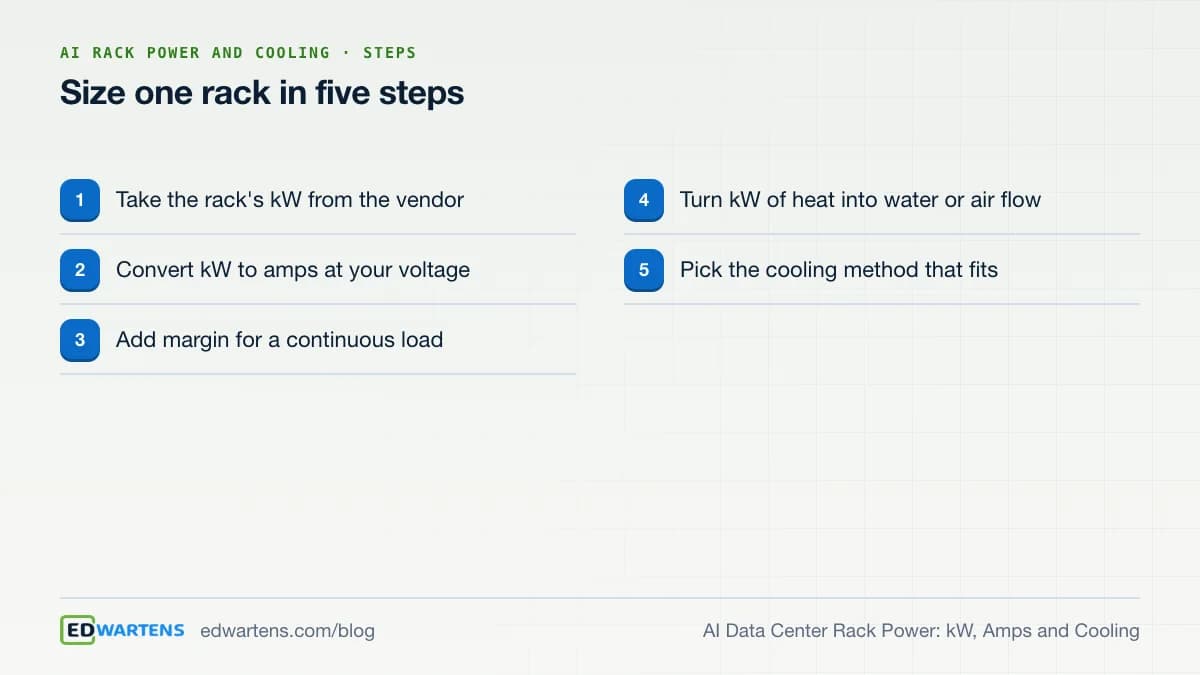
The worked case is the 100 kW rack. At 415 V, 100,000 / (1.732 x 415) = 139 A. At 208 V it is 100,000 / (1.732 x 208) = 278 A, twice as much. Double the current means thicker cable, bigger breakers and more heat in the copper. That is the reason high-power halls prefer the higher voltage where the local supply allows it.
From amps to a breaker and a busway
A breaker rated at the rack's current is not enough. Many electrical codes treat a load that runs for hours as a continuous load and allow only a share of the rating, often 80 per cent. The rule and its exact wording depend on the code and edition, so check the one you work to.
Chatsworth's table is consistent with this. A 100 A rack power distribution unit (PDU) gives about 28.8 kW at 208 V and about 57.5 kW at 415 V. The sums behind those numbers are:
- At 415 V: 80 A x 1.732 x 415 = 57.5 kW.
- At 208 V: 80 A x 1.732 x 208 = 28.8 kW.
So the "100 A" circuit carries 80 A continuously. A 100 kW rack therefore needs more than one such circuit, or a bigger one. With 415 V and a 200 A circuit, 160 A x 1.732 x 415 = 115 kW, so one circuit could serve it.
The busway that feeds the row, the tap-off box, the cable and the breaker are separate parts. Each must be rated for the current. A busway rating that is fine for a 20 kW rack row can be far too small for a row of 100 kW racks, so check the whole path, not just the breaker.
From kW to cooling
Almost every watt of electrical power ends up as heat in the rack. So 100 kW of IT load is about 100 kW of heat to remove.
Tonnes of refrigeration. One tonne of refrigeration (TR) is 3.517 kW of cooling. So 100 kW is 100 / 3.517 = 28.4 TR.
Water. Heat removed = mass flow x specific heat x temperature rise. For water, specific heat is 4.186 kJ per kg per K. With a 10 K rise, the flow is 100 / (4.186 x 10) = 2.39 kg/s. At about 1 kg per litre, that is 143 litres a minute.
Air. For air, use a specific heat of 1.005 kJ per kg per K and a density of about 1.2 kg/m3. With a 15 K rise, the mass flow is 100 / (1.005 x 15) = 6.63 kg/s, which is 5.53 m3/s. In the units used on many fan data sheets, that is about 11,700 cubic feet a minute for one rack.
The comparison tells the story. For the same 100 kW, the air flow is about 2,300 times the volume of the water flow (5.53 m3/s against 0.00239 m3/s).
| Medium | Flow for 100 kW | Assumption |
|---|---|---|
| Water | about 143 L/min | 10 K temperature rise |
| Air | about 5.5 m3/s (about 11,700 CFM) | 15 K temperature rise |
Pipes carry heat in a small space. Air cannot, because it holds so little heat per cubic metre. This is the basic reason liquid cooling takes over as racks get hotter.
Why air runs out, and why sources disagree
Uptime Institute is quoted by Data Center Knowledge as saying air cooling becomes impractical above roughly 50 kW per rack, and that direct-to-chip liquid cooling handles 100 to 150 kW per rack. Roland Berger puts the point where air cooling is inadequate beyond roughly 200 kW. Those are very different numbers, and neither page explains the gap.
Our reading, which is ours and not a quote, is that the figures describe different designs. How hot the supply air is, whether hot and cold aisles are contained, and whether rear-door heat exchangers are used all move the limit a long way. So the honest answer is that there is no single limit. Ask what each source assumes before you compare them.
The cooling methods fit like this:
- Air cooling: fans and cold aisles, fine for the typical 11 kW rack.
- Direct-to-chip liquid: cold plates on the processors, with water or a coolant loop to a coolant distribution unit. Handles the high rack powers above.
- Immersion: servers sit in a dielectric fluid. Less common, and a different maintenance model.
Power is now the limit
Roland Berger's 31 March 2026 piece argues that power, not graphics processors, is the limit for AI data centres, and says global data centre capacity is heading to 165 GW by 2030. You do not need to accept every forecast to see the engineering consequence. Every rack that moves from 11 kW to 100 kW multiplies the current in the feeds, the heat in the loop and the work for the people who test it.
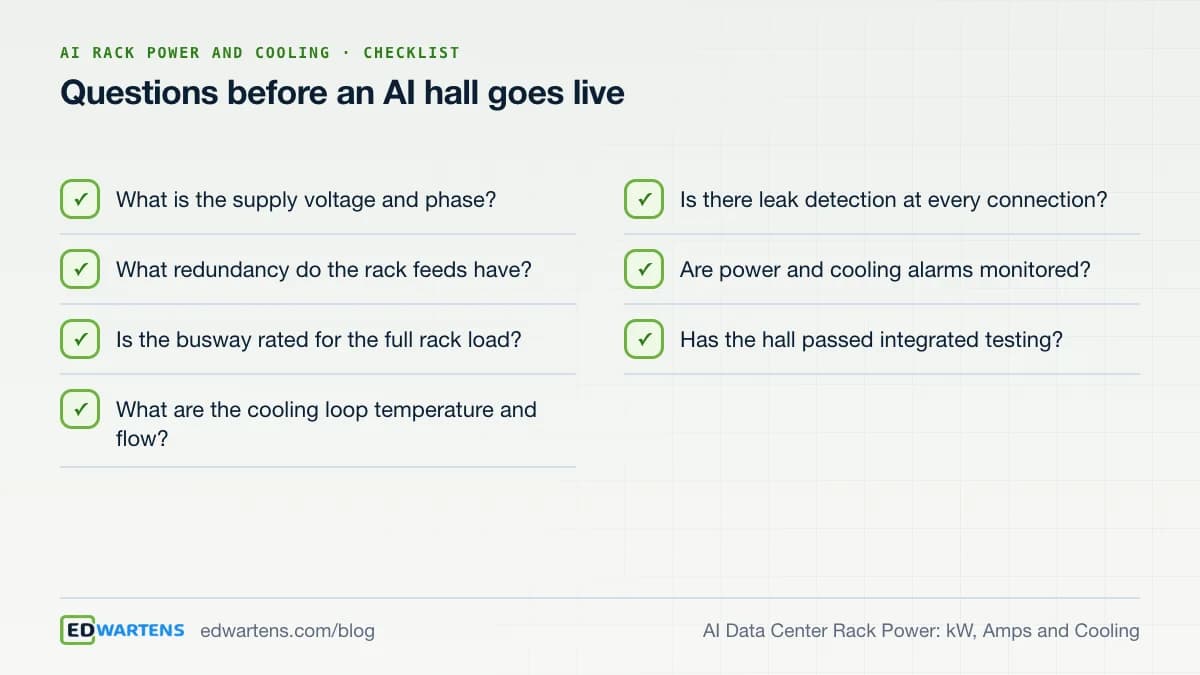
Before an AI hall goes live, the electrical and mechanical systems are tested together, level by level. Our guides on data centre commissioning levels and a method of procedure example show what that work looks like. For the wider picture of who is needed, see the manufacturing skills gap in 2026.
Try it: size a hall in a free lab
The sums above are easy to follow and easy to get wrong when you do them ten times. The AI Data Centre lab in EDWartens Lab lets you walk an AI data hall and size its power and cooling. It is free with a free EDWartens account, runs in the browser, and is for learning. It is not a design tool and does not replace a vendor's reference design or a designer's calculations. The 3D Lab shows every lab, and the free online engineering labs tour walks through them.
For the theory, start with Data Centre Electrical and Critical Power, which traces power from the utility to the rack and sizes UPS and cable current. Then take Data Centre Cooling, BMS and DCIM, and the commissioning course. All three are in the data centre course hub. To see the role in action, the Data Centre Critical Facilities Engineer job simulation gives you a working day with method statements, change control and a UPS event at a simulated company. It is practice, not employment. The free Commissioning internship runs 4 weeks online with checks before power and FAT and SAT practice, as a training programme with no stipend. Cooling and BMS systems also carry cyber risk, so see our OT security career guide.
Every course is free to learn in full. The optional certificate of completion for an intermediate course is a one-off US$10.99, and anyone can check it on the verification page. It is an EDWartens certificate, not a vendor credential.
If you are checking vendor figures, remember that Chatsworth, like other power and rack vendors, sells equipment, and the Nvidia figure is a reference-architecture maximum, not a typical draw. Keep every number tied to its source and its date, and you will not be caught out when next year's numbers change.
Practise with us
Internship
Electrical and Solar Energy
Free internship: 4 weeks, a free certificate and nothing to buy. The Engineer-verified internship adds an engineer's review and the graded certificate.
See the internshipLab
Electrical lab
Practise in your browser. Free, nothing to install.
Open the lab (opens in a new tab)Roles
Power and energy
Roles that ask for this skill, 87 open in this country now. Free to see and to apply. We are not a recruitment agency.
See rolesTake the free course


Questions
How many kW does an AI server rack use?
Chatsworth Products says AI racks commonly draw 20 kW to more than 100 kW. Nvidia's GB300 NVL72 reference design needs up to 142 kW per rack, reported by Data Center Knowledge in 2026. A typical rack is far lower, about 11 kW.
How many amps does a 100 kW rack draw at 415 V and at 208 V?
At unity power factor and three-phase supply, 100 kW draws about 139 A at 415 V and about 278 A at 208 V. The formula is kW times 1000, divided by 1.732 times the line voltage. A lower power factor raises the current.
Why is liquid cooling needed for AI racks?
Water carries far more heat per litre than air carries per cubic metre. A 100 kW rack needs about 143 litres of water a minute at a 10 K rise, but about 5.5 cubic metres of air a second at a 15 K rise, which is hard to move through one rack.
What is the maximum rack density you can air cool?
There is no single limit. Uptime Institute is quoted as saying air cooling is impractical above roughly 50 kW per rack, while Roland Berger puts inadequacy beyond roughly 200 kW. The answer depends on containment, temperatures and design.
How do you size the breaker and busway for a GPU rack?
Convert the rack's kW to amps at your voltage, then choose a rating so the continuous load stays within the limit your code allows, often 80 per cent of the rating. Check the busway tap, cable and breaker each against that current.
What jobs exist inside an AI data centre for electrical and mechanical engineers?
Typical work areas are medium and low voltage distribution, UPS and generators, chilled water and liquid cooling loops, building management and monitoring systems, and commissioning. EDWartens does not promise any job; its courses and labs let you practise first.
Sources
- Data Center Knowledge: AI Rack Density's Real Limits, 2026 (read 23 November 2026)
- Roland Berger: Power, not GPUs, is the limiting factor for AI data centers, 31 March 2026 (read 23 November 2026)
- Chatsworth Products: How much power does an AI rack use, 26 June 2026 (read 23 November 2026)
- Data Center Knowledge: Rack Power Is Rising Fast (read 23 November 2026)
Written by the EDWartens engineering team for general education. Product names are trademarks of their owners; mentioning them does not imply endorsement. Prices and terms of other providers were checked on the date shown and can change.

ISO 9001:2026 Changes: What Changed and the Transition Plan

Power BI OEE Dashboard: A Build That Gets the Maths Right

How to Size a Solar Array From Electricity Bill Data
UL 9540 vs UL 9540A vs NFPA 855 for Battery Storage

QA vs QC in Construction: Who Checks What on Site

ETABS to SAFE: Export a Floor and Check the Foundation